

Can You Re-Enroll as a Health Insurance Dependent After Your Income Drops? Eligibility Requirements and How to Apply
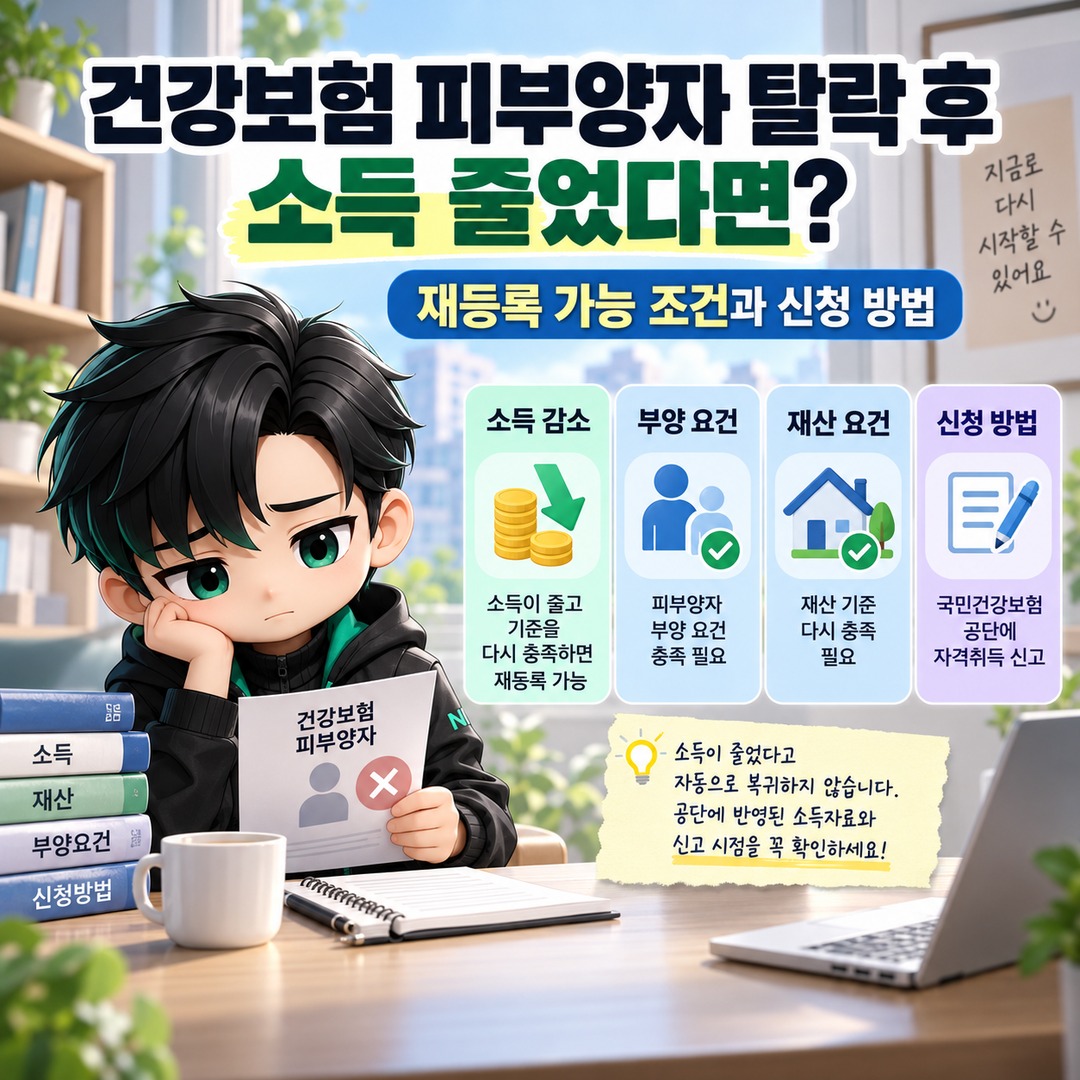
Even if you lost your status as a health insurance dependent in 2026, you may be able to re-enroll if your income has decreased and you once again meet the dependency and property requirements. However, a reduction in income does not automatically restore your eligibility. You must check the income records reflected by the National Health Insurance Service (NHIS) and the timing of your eligibility registration.
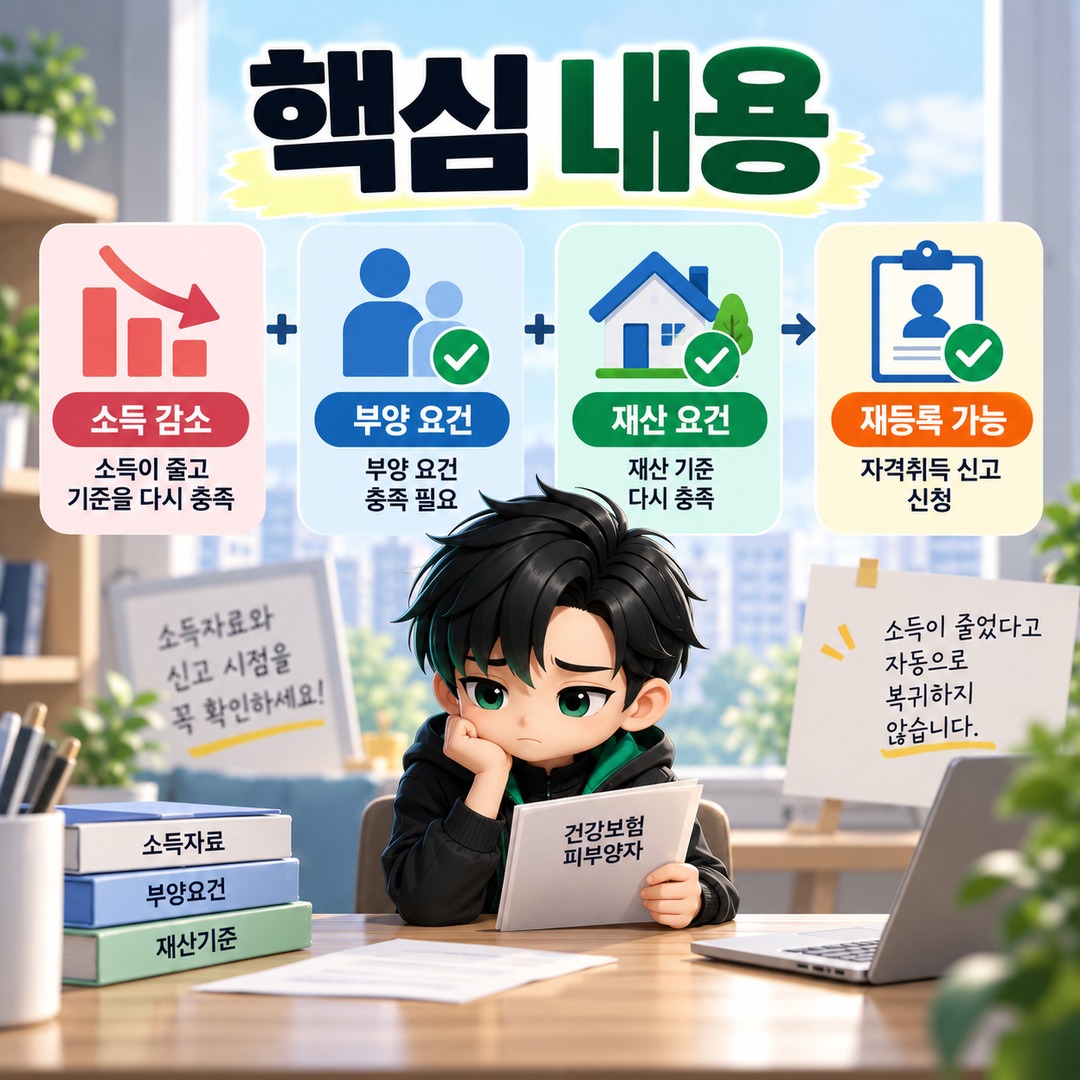
In particular, people who have retired or closed their businesses should be aware that they may still be classified as self-employed health insurance subscribers because of their previous income, even if they currently have no income.
*Information verified as of: 2026-10-16*
1. Can You Re-Enroll After Losing Dependent Status if Your Income Has Decreased?
Yes. Losing dependent status under the national health insurance system does not mean you are permanently barred from regaining it.
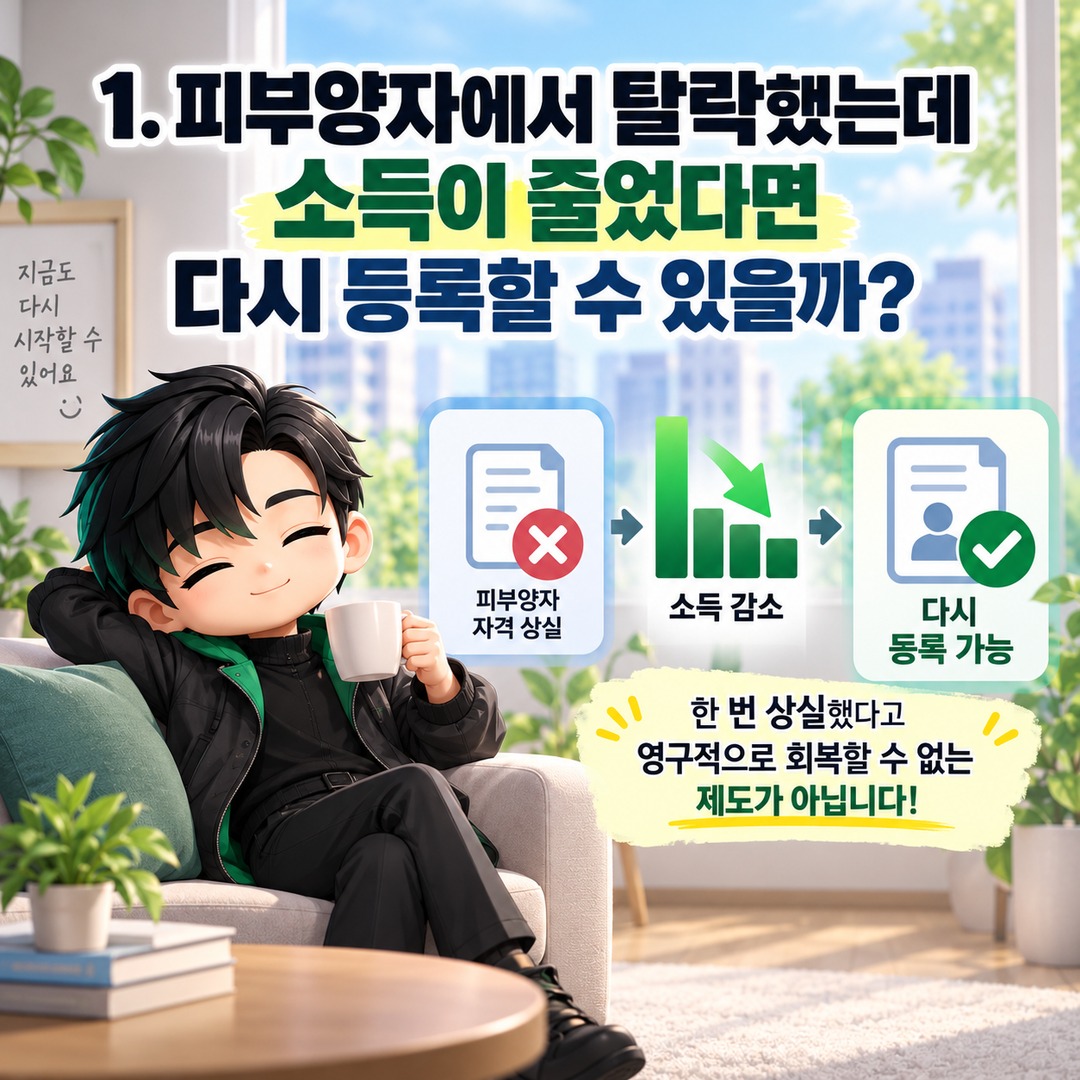
Under Article 2 of the Enforcement Rule of the National Health Insurance Act, a person must satisfy the dependency relationship, income, and property requirements to qualify as a dependent of an employee-insured subscriber.
Therefore, even if you previously lost eligibility because your income exceeded the threshold, you can apply to regain dependent status if your income subsequently decreases and you meet the requirements.
However, the following situations must be distinguished.
| Current situation | What to check |
|---|---|
| Employment income has stopped after retirement or leaving a job | Whether the employment termination and updated income records have been reflected |
| Business income has stopped after business closure | Proof of business closure and whether an income adjustment is possible |
| Interest or dividend income has decreased | Whether finalized income records from the National Tax Service have been reflected |
| Public pension payments have decreased | Pension income recorded by the NHIS and the total amount of other income |
The important point is that eligibility is not determined solely by the money currently entering your bank account.
You need to check which income period the NHIS is using to determine when you may actually qualify for re-enrollment.
2. Will You Immediately Qualify as a Dependent if Your Annual Income Falls Below KRW 20,000,000?
Having annual income of KRW 20,000,000 or less does not, by itself, guarantee re-enrollment as a dependent.

This is because you must also satisfy other requirements, including the property tax assessment base and restrictions on business income.
The general income and property eligibility criteria are as follows.
| Category | Requirements for recognition as a dependent |
|---|---|
| Total annual income | Generally KRW 20,000,000 or less |
| Property tax assessment base of KRW 540,000,000 or less | Meets the basic property requirement |
| Property tax assessment base exceeding KRW 540,000,000 and up to KRW 900,000,000 | Annual income of KRW 10,000,000 or less |
| Property tax assessment base exceeding KRW 900,000,000 | Generally difficult to qualify |
Separate restrictions apply to business income, and eligibility may vary depending on whether the person has a registered business and the type of income involved. Additional property, age, and other requirements apply to siblings seeking dependent status.
An Example of Someone Who Could Lose Eligibility Despite Having Income of KRW 18,000,000
The following is a hypothetical example to help explain the criteria.
Person A has annual income of KRW 18,000,000 and a property tax assessment base of KRW 400,000,000.
Person B also has annual income of KRW 18,000,000, but their property tax assessment base is KRW 600,000,000.
Person A may meet the basic income and property requirements. However, because Person B's property tax assessment base exceeds KRW 540,000,000, the annual income requirement of KRW 10,000,000 or less applies.
This means that even with the same income of KRW 18,000,000, eligibility can differ depending on property holdings.
Of course, both individuals must also satisfy the remaining requirements, including their dependency relationship and business income conditions, to actually qualify as dependents.
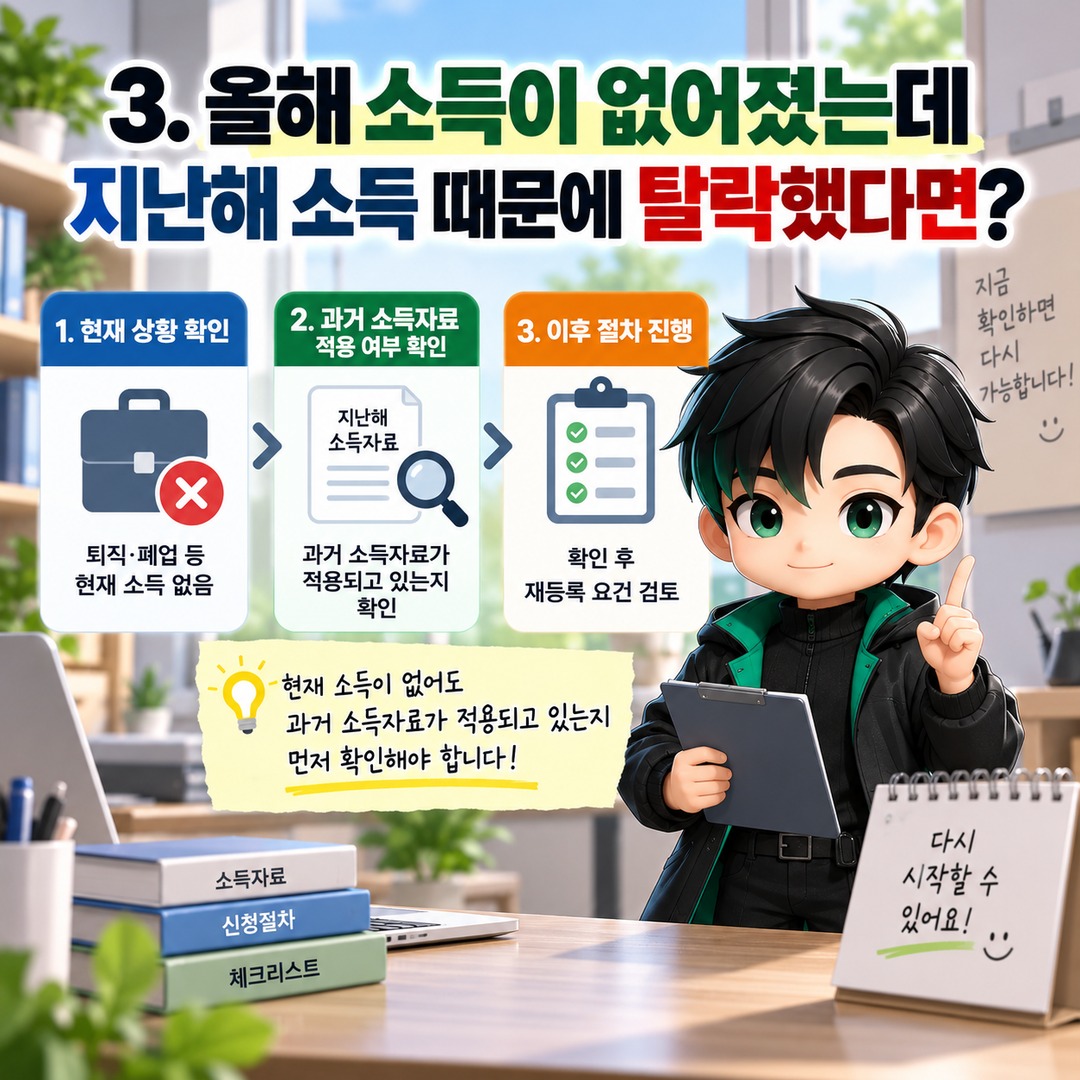
3. What if You Have No Income This Year but Lost Eligibility Because of Last Year's Income?
If your income has stopped because you retired, left your job, or closed your business, the first step is to check whether previous income records are still being applied.
Income records verified by the National Tax Service and other relevant agencies are used in health insurance eligibility assessments. As a result, the date your income actually stopped may differ from the date that change is reflected in NHIS records.
For example, suppose someone earned business income in 2025 but closed their business in June 2026.
Even if that person no longer has business income in the second half of 2026, their previous income records may still remain in the system.
In this situation, there are three things to check.
1. The income attribution year currently being applied by the NHIS
2. Documents proving business closure or termination of employment
3. Whether an income adjustment or an application to regain dependent status is possible
If business or employment income has decreased or stopped, you can check whether an adjustment is possible by submitting supporting documents.
However, you should not assume that the same adjustment procedure applies simply because interest or dividend income has decreased. The accepted evidence and methods for reflecting income changes differ by income type.
In addition, receiving an adjustment to your regional health insurance premiums and regaining dependent status are two separate determinations.
4. Where Can You Apply to Re-Enroll as a Dependent?
Re-enrollment as a dependent involves confirming your relationship with an employee-insured subscriber, verifying that you meet the income and property requirements, and submitting a dependent eligibility acquisition report to the NHIS.
Generally, the report can be submitted through the employer of the employee-insured subscriber, or the employee-insured subscriber or dependent can submit it directly to the NHIS.
Steps to Check Before Applying
Step One: Check Your Current Health Insurance Status
Visit the NHIS website to check information related to your eligibility.
National Health Insurance Service Website
Customer service: 1577-1000
Step Two: Identify Why You Lost Dependent Status
Determine whether you lost eligibility because your income exceeded the threshold, your property exceeded the permitted limit, or there was an issue with your dependency relationship.
Step Three: Prepare Evidence of Reduced Income
Depending on your circumstances, you may need relevant documents such as a certificate of employment termination or proof of business closure.
Step Four: Submit a Dependent Eligibility Acquisition Report
Submit the report through the employee-insured subscriber's workplace or directly to the NHIS.
Step Five: Confirm the Eligibility Start Date and Insurance Premiums
Check the recognized eligibility start date in your application results and ask whether any adjustment to previously assessed regional health insurance premiums is necessary.
5. Will You Receive a Refund of Regional Health Insurance Premiums Already Paid After Re-Enrolling?
Being re-enrolled as a dependent does not mean that all regional health insurance premiums you previously paid will automatically be refunded.
The key question is whether the dependent eligibility start date recognized by the NHIS overlaps with the period for which you were charged regional health insurance premiums.
For example, even if you paid regional premiums in September and October, if your dependent eligibility is recognized only from November, premiums for the earlier period will not automatically be canceled.
Conversely, if your eligibility start date is recognized retroactively and overlaps with a period for which premiums were already assessed, you can check whether a premium adjustment or settlement is available.
Why the 90-Day Reporting Period Matters for Dependent Registration
Article 2 of the Enforcement Rule of the National Health Insurance Act provides that, in principle, if a dependent eligibility acquisition report is submitted within 90 days of the employee-insured subscriber's eligibility acquisition date or eligibility change date, the relevant acquisition or change date is recognized as the dependent's eligibility start date.
If the report is submitted after 90 days, the eligibility start date is generally the date the report is submitted.
However, exceptions apply when reporting is delayed for unavoidable reasons beyond the person's control, such as illness or an accident.
This provision concerns the timing of reports associated with an employee-insured subscriber's acquisition or change of eligibility. It does not mean that everyone whose income has decreased is automatically entitled to retroactive dependent registration for 90 days.
Therefore, when determining whether previously paid premiums may be refunded, you should first confirm the eligibility start date actually recognized by the NHIS.
6. 3 Common Points of Confusion Before Re-Enrolling as a Dependent
Q. If My National Pension Payments Decrease, Will My Dependent Status Be Restored Immediately?
No.
If your public pension income has decreased, you must check whether your combined pension income and other income satisfy the dependent eligibility requirements.
The date your actual pension payments decrease may also differ from the date the updated income information is reflected in the records recognized by the NHIS.
Q. If My Spouse Is an Employee-Insured Subscriber, Can I Register Immediately Once I Have No Income?
Having a spouse who is an employee-insured subscriber does not automatically qualify you for dependent status.
You must meet the income and property requirements. For married individuals, the income requirements applicable to both spouses must also be checked under the relevant regulations.
Q. What Should I Do if My Application for Dependent Re-Enrollment Is Rejected?
First, identify the specific reason for rejection.
Check whether your income records were incorrectly reflected or whether there are issues involving business income or property requirements. You can then prepare supporting documents and ask the NHIS whether a reassessment or correction is possible.
Simply stating that your income has decreased does not automatically cancel a previous decision to terminate your dependent status.
7. What Matters Most Now Is When You Can Regain Eligibility, Not Just Your Income Amount
There are three important considerations for anyone seeking to restore their dependent status.
First, check whether the income records currently being applied accurately reflect your actual circumstances.
Second, even if your income has decreased, verify that you meet the other requirements, including property and dependency relationship criteria.
Third, confirm the date from which your dependent eligibility can be recognized.
In particular, if you are already paying regional health insurance premiums, it is advisable to check whether an income adjustment is possible, the effective date of your restored dependent status, and whether previously assessed premiums can be adjusted as separate matters.
As of October 2026, if your income has decreased but the change has not yet been reflected in NHIS records, you should first ask whether there is a way to provide evidence that your income has actually stopped.
Official Reference Materials
Korean Law Information Center — Dependent Income and Property Requirements, Attached Table 1-2
National Health Insurance Service