

USD/KRW Exchange Rate Returns to the KRW 1,300 Range After 11 Months, KOSPI Plunges 5.8% and Triggers 25th Sell-Side Sidecar
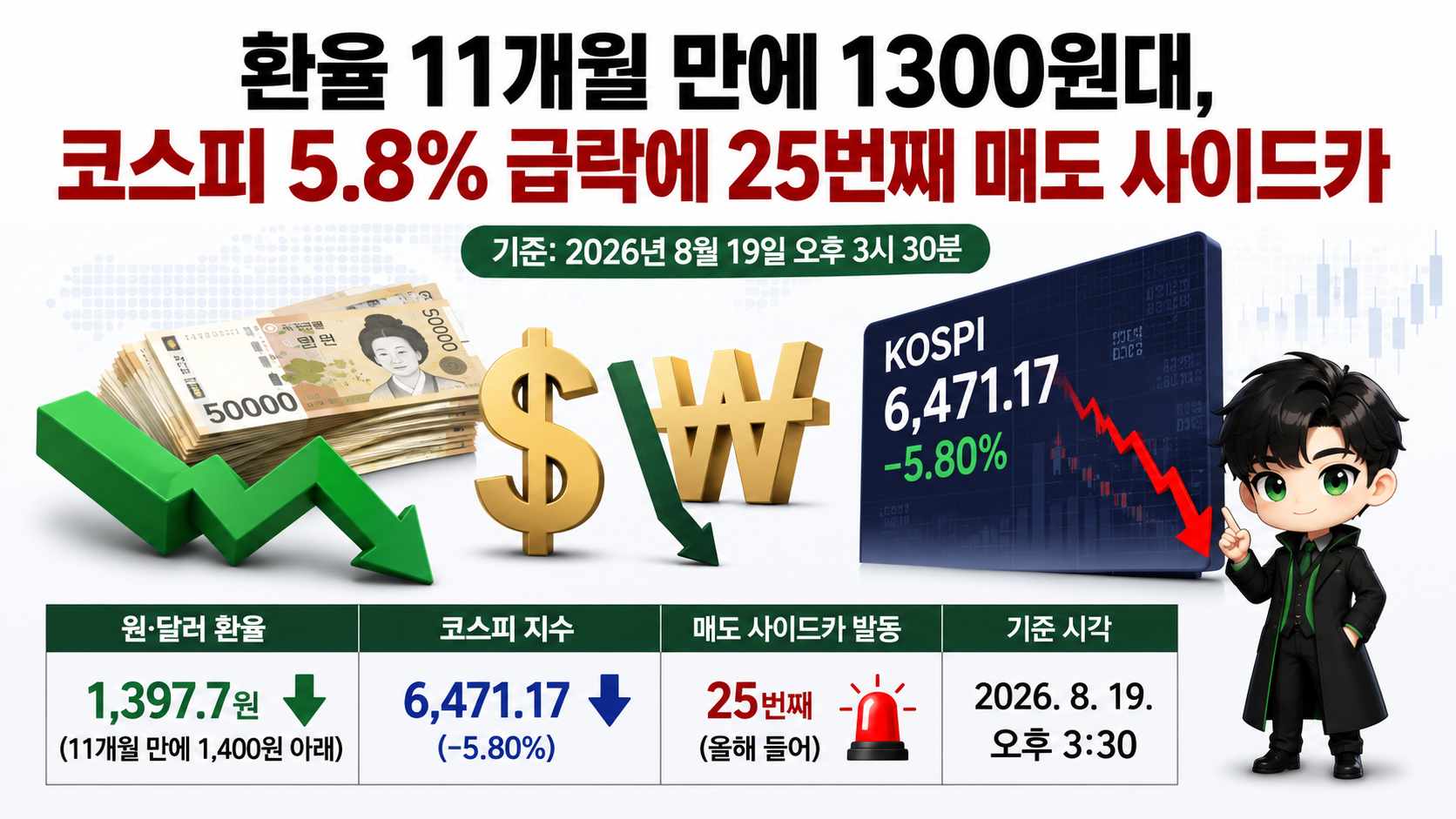
The USD/KRW exchange rate fell to KRW 1,397.7 as of 3:30 p.m. on 2026-08-19, dropping below KRW 1,400 for the first time in approximately 11 months on a regular-session closing basis. On the same day, the KOSPI closed at 6,471.17, plunging 5.80%, while the year's 25th KOSPI sell-side sidecar was triggered early in the session.
What stood out was that the exchange rate and stock prices did not move in the same direction. South Korean stocks suffered a sharp decline, but the USD/KRW exchange rate actually fell into the KRW 1,300 range. When assessing the market on August 19, rather than treating the exchange rate's entry into the KRW 1,300 range and the KOSPI's plunge as a single phenomenon, it is important to examine the price movements and supply-and-demand dynamics behind each separately.
The information was verified as of 00:42 KST on 2026-08-20.
How Far Did the USD/KRW Exchange Rate Fall?
In Seoul's foreign exchange market on August 19, the USD/KRW exchange rate stood at KRW 1,397.7 as of 3:30 p.m., down KRW 14.1 from the previous trading day's regular-session close. This marked the first regular-session close below KRW 1,400 in approximately 11 months, since 2025-09-29 KRW 1,398.7.
The exchange rate had already broken below KRW 1,400 earlier during intraday trading. On 19, it opened at KRW 1,413.3 before falling to KRW 1,399.0 at approximately 12:2 p.m. The last time it traded below KRW 1,400 on an intraday basis was approximately 10 and a half months earlier, in 2025-10-02.
This explains why reports published on the same day used both 'approximately 10 months' and '11 months.' They do not describe different events. The distinction comes from whether the reference point is the intraday break below KRW 1,400 or the regular-session closing rate recorded at 3:30 p.m. Based on the regular-session close, the move represents a return to the KRW 1,300 range after approximately 11 months.
A simple comparison between the opening rate of KRW 1,413.3 on 19 and the KRW 1,397.7 rate recorded at 3:30 p.m. shows an intraday decline of KRW 15.6. Author's calculation: KRW 1,413.3 - KRW 1,397.7 = KRW 15.6. However, the official change from the previous trading day is measured against the previous regular-session closing rate rather than the opening rate, so the correct day-over-day decline is KRW 14.1.
Why Did the KOSPI Fall Sharply Even as the Exchange Rate Declined?
On August 19, the factors driving the exchange rate and the stock market were not entirely the same. Slowing U.S. economic indicators, easing concerns about further monetary tightening, and dollar selling by exporters were cited as factors pushing the USD/KRW exchange rate lower. Meanwhile, South Korean stocks were heavily affected by rising long-term government bond yields in major economies and declines in U.S. technology and semiconductor shares.
The KOSPI ended the session at 6,471.17, down 398.66 points, or 5.80%, from the previous day. Its intraday low reached 6,400.81, while the KOSDAQ also fell 1.17% to close at 824.46.
Major South Korean semiconductor stocks suffered particularly steep losses early in the session. As of 9:15 a.m., Samsung Electronics and SK Hynix had posted declines in the 7% and 9% ranges, respectively. At the same time, the KOSPI had fallen to 6,429.25, down 6.41% from the previous trading day.
By the close, Samsung Electronics was down approximately 7.8%, while SK Hynix had fallen about 9.8%. Foreign and institutional investors recorded combined net selling of approximately 4 trillion 8 hundred billion won in KOSPI shares, while retail investors recorded net purchases of approximately 4 trillion 6 hundred billion won.
In other words, it is difficult to interpret a single day's market movements through the assumption that a falling USD/KRW exchange rate must mean foreign capital is flowing into South Korean stocks and pushing the KOSPI higher. Actual trading on August 19 showed that a decline in the exchange rate and a sharp selloff in domestic equities could occur simultaneously.
When Was the 25th Sell-Side Sidecar Triggered?
The KOSPI sell-side sidecar was activated at 9:6 a.m. on August 19. The effectiveness of program-trading sell orders was suspended for 5 minutes. It was the 25th sell-side sidecar triggered in the KOSPI market that year. Including 23 buy-side sidecar activations, the securities market had recorded a total of 48 sidecar activations so far in 2026.
At the time of activation, the Mini KOSPI 200 futures index had fallen from its reference price of 1,078.26 to 1,013.26, representing a decline of 65.00 points, or 6.02%. Program trading recorded net selling of KRW 350,500,000,000 at the time the sidecar was triggered.
A sidecar is not automatically activated simply because the KOSPI index falls 5%. In the securities market, a sell-side sidecar is triggered when the price of the designated futures contract based on the KOSPI 200 declines by at least 5% from the previous day and remains at that level for 1 minutes.
Understanding this condition is essential to accurately interpreting statements such as 'the sidecar was triggered because the KOSPI fell more than 5%.' The direct trigger is the movement in KOSPI 200 futures prices, not the spot KOSPI index itself.
Does a Sell-Side Sidecar Halt All Stock Trading?
No. Activating a sidecar does not mean that trading in every stock, including Samsung Electronics and SK Hynix, is suspended for 5 minutes. The measure implemented on August 19 suspended the effectiveness of program-trading sell orders for 5 minutes.
A sidecar is designed to mitigate situations in which sharp fluctuations in the futures market rapidly spread to the spot market through program trading. It should therefore be distinguished from measures that suspend all stock trading by ordinary investors.
In the August 19 case, the sidecar was activated at 9:6 a.m., but the market itself was not closed. The KOSPI continued to fluctuate afterward, falling as low as 6,400.81 intraday before closing at 6,471.17.
Equating 'sidecar activation' with 'a complete halt to stock market trading' can lead to a serious misunderstanding of actual market conditions.
Entering the KRW 1,300 Exchange Rate Range Does Not Automatically Signal a Trend Reversal
The fact that the exchange rate reached KRW 1,397.7 at 3:30 p.m. on August 19 is separate from any prediction that it will continue to decline. What can be confirmed from that day's trading is that the regular-session closing rate fell below KRW 1,400 for the first time in approximately 11 months.
On June, the USD/KRW exchange rate had also exceeded KRW 1,560 during overnight trading. A simple comparison between the KRW 1,561.5 overnight rate on June 6 reported by Kukmin Ilbo and the KRW 1,397.7 rate recorded at 3:30 p.m. on August 19 produces a difference of KRW 163.8.
According to the author's calculation, KRW 1,561.5 - KRW 1,397.7 = KRW 163.8, representing a decline of approximately 10.5% from the starting value. The calculation is `163.8 ÷ 1,561.5 × 100 ≈ 10.49%`. However, because the two prices come from different trading times and sessions, this is not an official return over the period or a closing-price-based percentage change. It is simply a comparison intended to illustrate the scale of recent exchange rate fluctuations.
When using exchange rates for actual currency exchanges or investment decisions, the market reference rate of KRW 1,397.7 is also different from the cash exchange and remittance rates that banks apply to individual customers. Anyone exchanging currency should separately check each financial institution's spread and preferential exchange rate discounts.
Which Figures Should Investors Watch First in the August 20 Market?
In the next trading session, it would be better to examine separately whether the USD/KRW exchange rate continues trading below KRW 1,400 and where the KOSPI establishes its price level following the previous day's sharp decline. The movements of these two markets on August 19 alone cannot establish their future direction.
For the exchange rate, the key reference is KRW 1,397.7, recorded at 3:30 p.m. on August 19. For the stock market, investors should distinguish between the KOSPI closing level of 6,471.17 and its intraday low of 6,400.81, as well as the futures-market movements that directly triggered the sidecar.
Particularly on days like this, when the exchange rate falls while stock prices plunge, it is difficult to assess the market using a single rule such as 'a stronger won means stronger stocks.' Examining the exchange rate, long-term interest rates, foreign and institutional investor flows, KOSPI 200 futures, and movements in influential index constituents such as Samsung Electronics and SK Hynix separately provides a more accurate understanding of the day's price changes.
The key confirmed figures from the August 19 market are clear: USD/KRW exchange rate KRW 1,397.7, KOSPI 6,471.17, KOSPI decline 5.80%, sell-side sidecar activation at 9:6 a.m., and the year's 25th sell-side sidecar.
※ This article is provided for informational purposes to help readers understand market trends and does not constitute an investment recommendation for any particular stock or asset. All final investment decisions and related responsibilities rest with the individual investor.