

Trump Delays 50% Additional Tariffs on Canada by 3 Days, Pushing Implementation to August 22
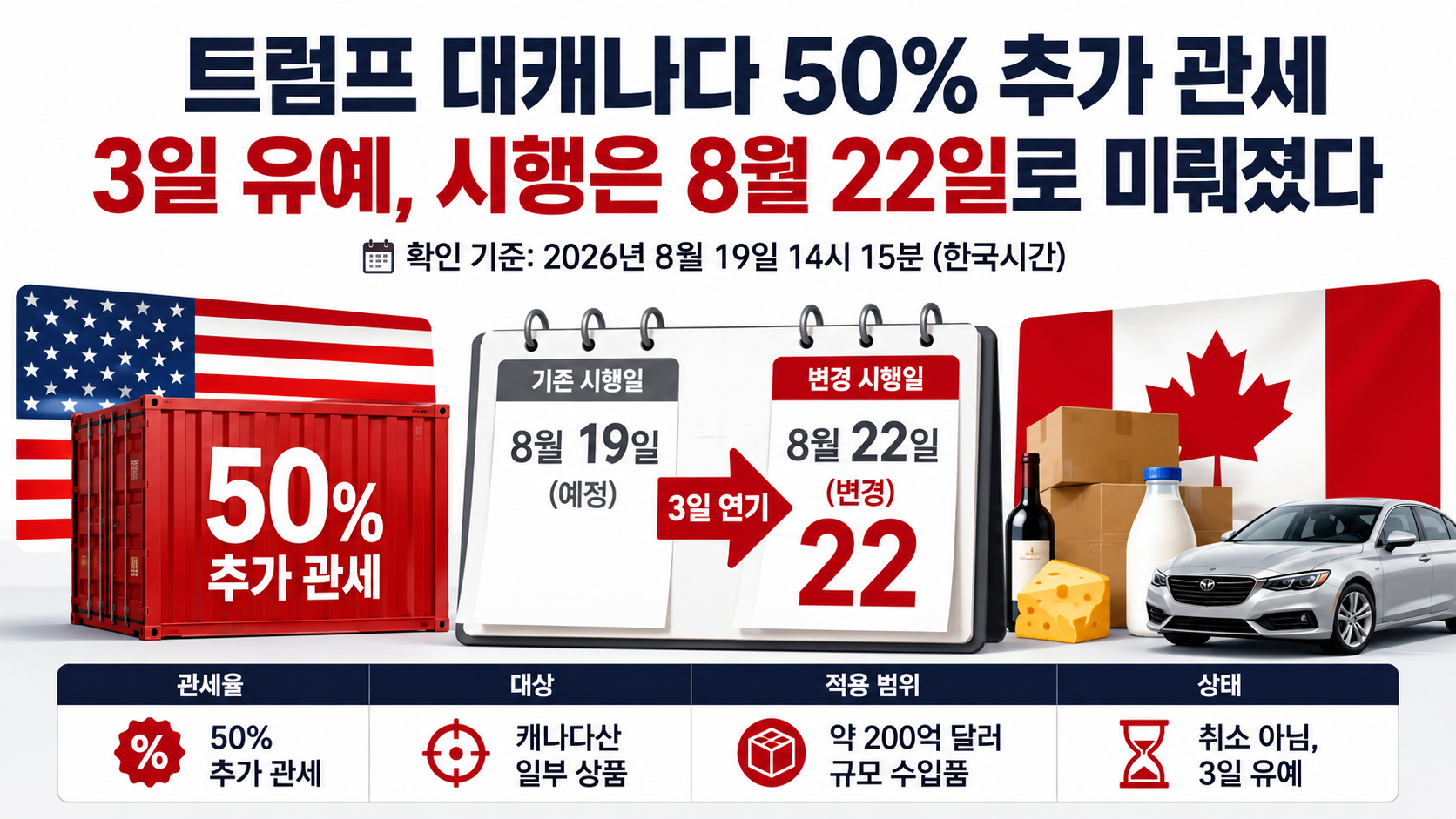
U.S. President Donald Trump has postponed the implementation of the previously announced 50% additional tariffs on certain Canadian goods by 3 days, moving the effective date from 2026-08-19 to August 22. However, the tariffs have not been withdrawn, nor has a final trade agreement been completed. The United States delayed implementation citing progress in negotiations, while Canada also acknowledged progress but said further talks were necessary.
The information is verified as of 2026-08-19 at 14:15 Korea Standard Time.
The 50% Tariffs Have Not Been Eliminated; Their Implementation Has Been Postponed by 3 Days
The most important distinction in this development is that a postponement is not the same as a withdrawal. The presidential proclamation released by the White House on August 18 changed the effective time of the existing 3 tariff proclamations from August 19 at 0:1 a.m. U.S. Eastern Time to August 22 at 0:1 a.m. It contains no provision abolishing the tariffs themselves.
The current situation can therefore be summarized as follows.
The original implementation time was 2026-08-19 at 0:1 a.m. U.S. Eastern Time. The revised implementation time is August 22 at 0:1 a.m. The difference is exactly 72 hours.
Author's calculation: Converting U.S. Eastern Time on August, using EDT (UTC-4), to Korea Standard Time, KST (UTC+9), produces a time difference of 13 hours. Accordingly, the original scheduled implementation time was August 20 at 1:1 a.m. Korea Standard Time, while the revised time is August 23 at 1:1 a.m.
This time difference also explains why Korean news coverage may refer to both 'implementation on 19' and 'implementation on 20.' The calendar dates differ between the United States and South Korea.
Why Was the Implementation Delayed by Exactly 3 Days?
The direct reason stated in the White House proclamation is the status of negotiations between the United States and Canada. Senior U.S. administration officials reported to the president that Canada had indicated its willingness to address measures that the United States had challenged. Trump stated that, considering the state of negotiations, suspending the additional tariffs for 3 days would serve the public interest.
This should not be interpreted as meaning that a complete agreement has already been finalized.
Trump announced that the two countries had reached an agreement subject to finalizing the documentation. However, Canadian Prime Minister Mark Carney acknowledged substantial progress while emphasizing that important work still remained to be done. At the time, the Canadian government had not confirmed all the details of the agreement disclosed by the United States.
In other words, based on currently verified information, the 3-day period is better understood as a brief negotiating window for both sides to finalize documents and resolve outstanding issues, rather than an already established long-term suspension.
Do the 50% Tariffs Apply to All Canadian Goods?
No. The postponed measure does not impose a blanket 50% tariff on every product imported from Canada. Instead, it imposes additional tariffs on specific Canadian products identified in the 3 proclamations signed by Trump on July 20. The areas of concern raised by the United States involve trade measures related to alcoholic beverages, dairy products, and automobiles.
According to a White House fact sheet released on July, the affected products include various goods such as wine, hockey sticks, and cement. The measure was designed so that qualifying products could be subject to these additional tariffs even if they satisfy the rules-of-origin requirements of the United States-Mexico-Canada Agreement (USMCA). Conversely, the White House stated that these additional tariffs under Section 338 would not apply to energy, potash fertilizer, products subject to tariffs under Section 232 of the Trade Expansion Act, certain seafood products, and critical minerals, among other exclusions.
The reported value of affected imports is approximately USD 20,000,000,000. Both AP and Reuters reported that the postponed 50% tariffs concern approximately USD 20,000,000,000 worth of Canadian imports.
There is therefore a substantial difference between understanding the measure as '50% on everything from Canada' and understanding it as 'additional tariffs applying to specific goods representing approximately USD 20,000,000,000 in imports.'
Why Are They Being Described as 'Retaliatory Tariffs'?
The legal basis for the 50% measure is Section 338 of the Tariff Act of 1930. This provision allows the U.S. president to impose additional tariffs to offset burdens when another country is deemed to discriminate against American goods. The White House issued three proclamations on July 20, separately challenging Canada's restrictions on the sale of U.S. alcoholic beverages, administration of dairy tariff-rate quotas, and automobile-related regulations.
For this reason, Korean news reports may use the term 'retaliatory tariffs' to describe the United States responding to Canadian measures.
However, the official White House documents currently describe the measures as additional duties on Canada. Tariffs imposed by Canada on U.S. goods should not be confused with the 50% additional tariffs imposed by the United States under this measure.
Another distinction is necessary. The United States already applies separate tariff frameworks to Canadian steel, aluminum, and other products. The 3-day postponement applies specifically to the 3 additional tariff proclamations announced on July 20 under Section 338. It does not mean that all previously existing U.S. tariffs on Canada, imposed under other legal authorities, have also been suspended for 3 days.
Have the United States and Canada Already Finalized a Trade Agreement?
Based on currently available information, it is too early to conclude that a final agreement has been completed. There is also a noticeable difference in how the two governments have characterized the situation.
The U.S. proclamation states that Canada expressed its willingness to resolve American concerns involving alcoholic beverages, dairy products, and automobiles. Trump also announced that the two countries had reached an agreement, subject to finalizing the documentation.
By contrast, Prime Minister Carney described the negotiations as having made substantial progress while stressing that additional work was required. As of the Reuters report, the Canadian government had not confirmed the specific terms of the agreement described by U.S. officials.
The most accurate description of the current situation is therefore that 'negotiations progressed shortly before the tariffs were scheduled to take effect, resulting in a 3-day postponement.'
Unresolved questions remain, making it premature to say that 'the 50% tariffs have been canceled' or that 'a new trade agreement between the United States and Canada has been finalized.'
What Should Be Monitored Before August 22?
The most important deadline is August 22 at 0:1 a.m. U.S. Eastern Time, which corresponds to August 23 at 1:1 a.m. Korea Standard Time. Under the current White House proclamation, this is when the 50% additional tariffs are newly scheduled to take effect.
There are three main developments to monitor before that deadline.
First, whether the United States and Canada actually finalize the agreement documents. Second, whether the United States issues a separate official measure to further postpone, modify, or withdraw the 50% tariffs depending on the final outcome. Third, whether specific measures concerning alcoholic beverages, dairy products, and automobiles are disclosed in official documents as part of the negotiations.
At this stage, no official documents have been identified confirming any one of these three outcomes. Accordingly, any new presidential proclamation or announcement by either government before August 22 will serve as the next key reference point for this issue.
More important than the figure '50%' in this news is the fact that the status is 'postponed by 3 days,' not 'canceled.' The legal framework for the additional tariffs decided on July 20 remains in place, and only the implementation date has moved to August 22. Until the final outcome of negotiations becomes clear, it is essential to maintain this distinction.
※ This article is provided for informational purposes to help readers understand market developments and does not constitute investment advice or a recommendation to buy or sell any particular security or asset. All final investment decisions and responsibility rest with the individual investor.