

What Are KOSPI and KOSDAQ? Why These Two South Korean Stock Markets Have Different Index Levels and Company Compositions
이 포스팅은 쿠팡 파트너스 활동의 일환으로, 이에 따른 일정액의 수수료를 제공받습니다.

When following stock market news, you will notice that KOSPI and KOSDAQ move at different index levels every day. They are not stock exchanges in different countries but two segments of South Korea's domestic stock market operated by the Korea Exchange. KOSPI refers to both the main securities market and its benchmark index, while KOSDAQ refers to the market established to help small and medium-sized enterprises, startups, and technology companies raise capital, as well as its index.

2026-10-06, the Korea Exchange reported 831 listed companies on KOSPI and 1,821 on KOSDAQ. Although KOSDAQ has more listed companies, the market capitalization figures shown on the same screen reveal a substantial difference: KRW 5,723,000,000,000,000 for KOSPI and KRW 518,000,000,000,000 for KOSDAQ.
KOSPI Is Both a Market Name and an Index Name
KOSPI stands for Korea Composite Stock Price Index. The Korea Exchange describes KOSPI as the composite stock price index of the main securities market, which is also commonly called the KOSPI Market.
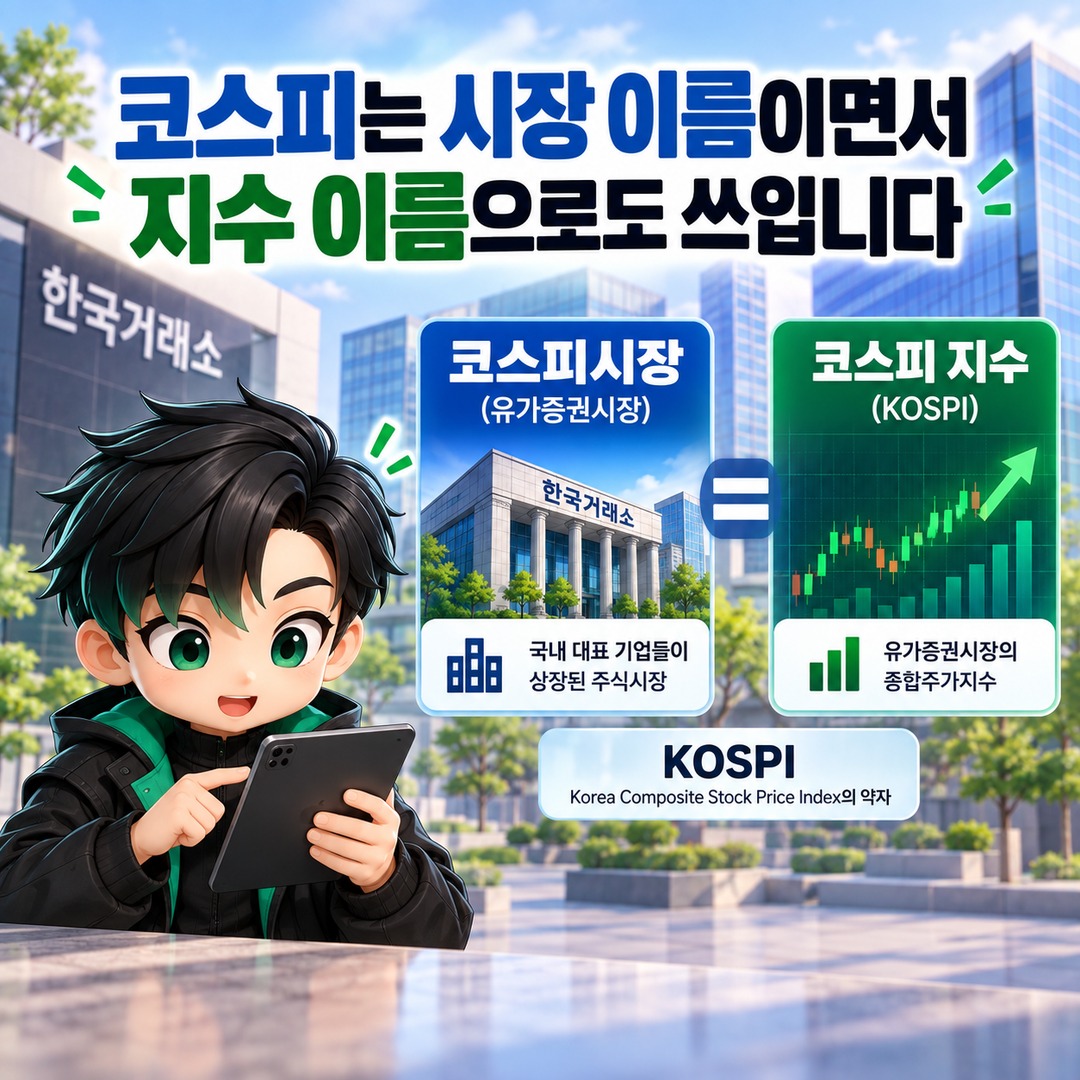
Therefore, when you encounter the term KOSPI in the news, it is important to distinguish its meaning from the context.
In the phrase “listed on KOSPI,” it generally refers to the market. In the phrase “KOSPI rose,” it refers to the index that reflects the overall direction of the market.
The KOSPI index is calculated using a market-capitalization-based methodology, with a base value of 100 established as of 1980-01-04.
What Kind of Market Is KOSDAQ?
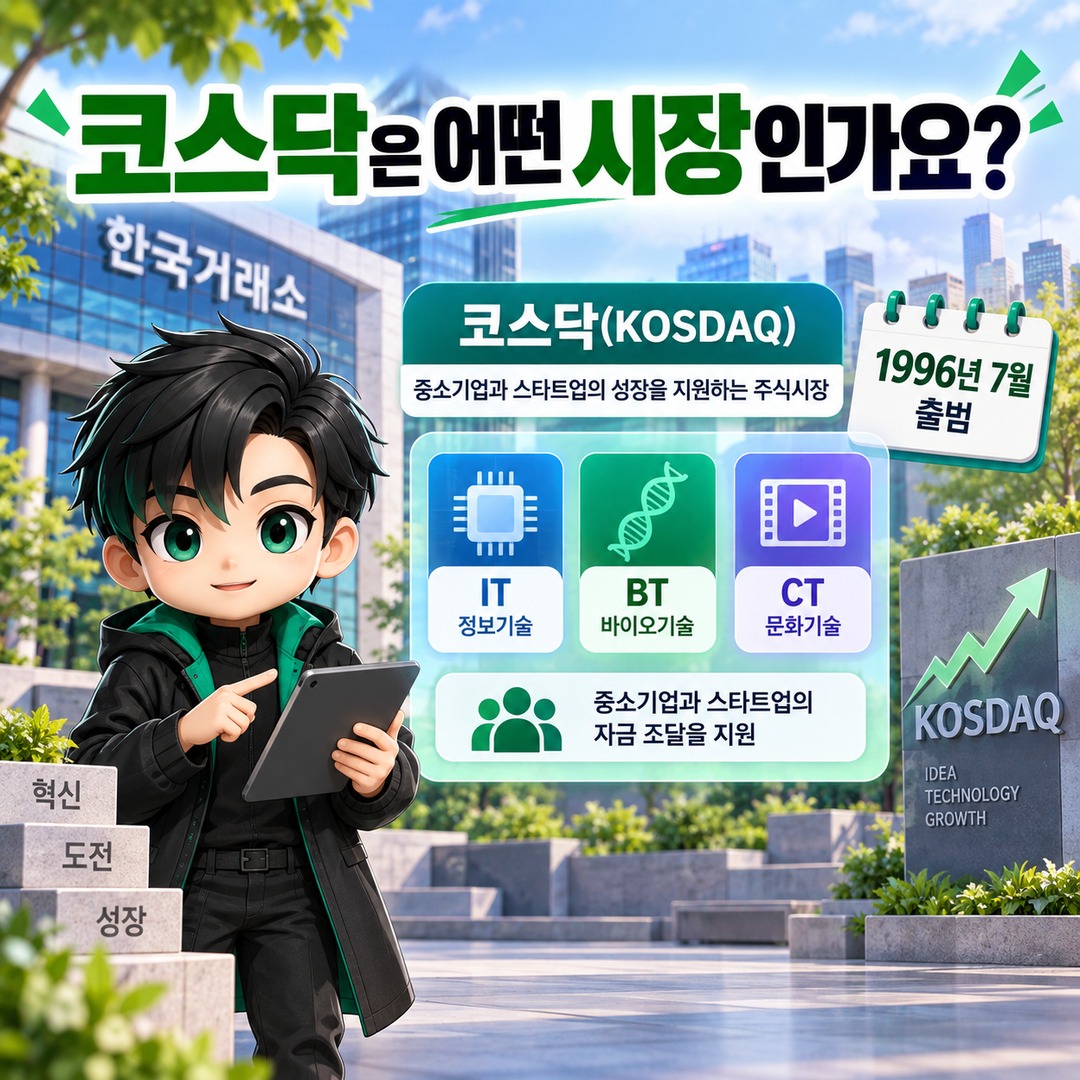
KOSDAQ was launched July 1996. According to the Korea Exchange, the KOSDAQ Market was established to support capital raising by small and medium-sized enterprises and startups, including businesses in IT, BT (biotechnology), and CT (cultural technology).
Today, KOSDAQ includes listed companies from various growth industries, including entertainment, software, and gaming, in addition to IT and biotechnology.
Rather than simply categorizing KOSPI as the “market for good companies” and KOSDAQ as the “market for small companies,” it is more accurate to understand that the two markets have different origins and compositions of listed companies.

What Are the Biggest Differences Between KOSPI and KOSDAQ?
For beginners, the easiest way to distinguish the two markets is to compare both the number of listed companies and their overall market sizes.
According to the Korea Exchange figures displayed 2026-10-06, KOSPI has 831 listed companies, while KOSDAQ has 1,821. KOSDAQ has approximately 2.19 times as many listed companies as KOSPI.
Conversely, KOSPI's market capitalization is KRW 5,723,000,000,000,000, compared with KRW 518,000,000,000,000 for KOSDAQ. Calculating from the same figures, KOSPI's market capitalization is approximately 11.0 times that of KOSDAQ.
In other words, understanding that KOSDAQ has significantly more listed companies, while KOSPI is substantially larger in terms of the combined market value of its companies helps explain the differences between the two markets.
| Category | KOSPI | KOSDAQ |
|---|---|---|
| Market | Main Securities Market | KOSDAQ Market |
| Number of listed companies | 831 | 1,821 |
| Market capitalization | KRW 5,723,000,000,000,000 | KRW 518,000,000,000,000 |
| Market characteristics | South Korea's main stock market | Established to help growth-oriented and technology companies raise capital |
| Benchmark index | KOSPI | KOSDAQ |
The numbers of listed companies and market capitalization figures are based on Korea Exchange data displayed 2026-10-06. Market figures change continuously over time.
Why You Should Not Directly Compare KOSPI 6,000 with KOSDAQ 900
You should not judge which market is larger or has risen more simply by comparing the numerical levels of the KOSPI and KOSDAQ indices.
An index expresses the overall movement of a market as a numerical value according to a specific calculation methodology. Therefore, the fact that KOSPI has a higher numerical index level than KOSDAQ does not mean that KOSPI-listed stocks are more expensive or that their investment performance is better.
If you want to compare market sizes, it is more appropriate to examine statistics measured on the same basis, such as market capitalization, rather than the index levels themselves.
Are KOSPI Stocks Safe and KOSDAQ Stocks Risky?
You cannot determine the investment risk of an individual stock based solely on the market where it is listed.
KOSPI and KOSDAQ are useful for distinguishing where companies are traded and understanding overall market movements, but the actual investment targets are individual companies. Even companies listed on the same market differ in their business structures, financial conditions, earnings, and valuations.
Therefore, when evaluating a stock, you should first identify whether it is listed on KOSPI or KOSDAQ and then separately review the company's disclosures, financial information, and other relevant details. Being listed on either KOSPI or KOSDAQ does not itself guarantee investment returns or protection of your principal.
The Easiest Way to Understand KOSPI and KOSDAQ in the News
When a news report says “KOSPI rises,” it does not mean that one particular company listed on the KOSPI Market has gained in value. It means that the KOSPI index has risen.
Similarly, “KOSDAQ rises” means that the benchmark index of the KOSDAQ Market has increased.
When examining an individual stock, you need to go one step further.
Check KOSPI or KOSDAQ → Examine the Individual Company → Review Disclosures and Financial Information
Following this sequence can help you avoid confusing overall market movements with the condition of an individual company when making investment judgments.
The Difference in One Sentence
KOSPI refers to South Korea's main securities market and its composite stock price index, while KOSDAQ refers to the market launched in 1996 to help small and medium-sized enterprises, venture businesses, and technology companies raise capital, as well as its index.
Understanding that the market with more listed companies is not necessarily the market with the larger total market capitalization makes the distinction between the two much clearer.
※ This article is provided for informational purposes to help readers understand market movements and does not constitute an investment recommendation for any particular stock or asset. You are responsible for your final investment decisions and their outcomes.
Related Articles
What Does One Share of SPCX Contain?
Can You Use September 23 Stock Sale Proceeds to Buy Shares Again on 28 Before Settlement on 29?
Why September 23 Stock Sale Proceeds Are Settled on 29 After the Chuseok Holiday
이 포스팅은 쿠팡 파트너스 활동의 일환으로, 이에 따른 일정액의 수수료를 제공받습니다.