

KOSPI Trading Value Falls to a Year-to-Date Low of KRW 26,300,000,000,000.0: Why Is Money Leaving Despite Rising Volatility?
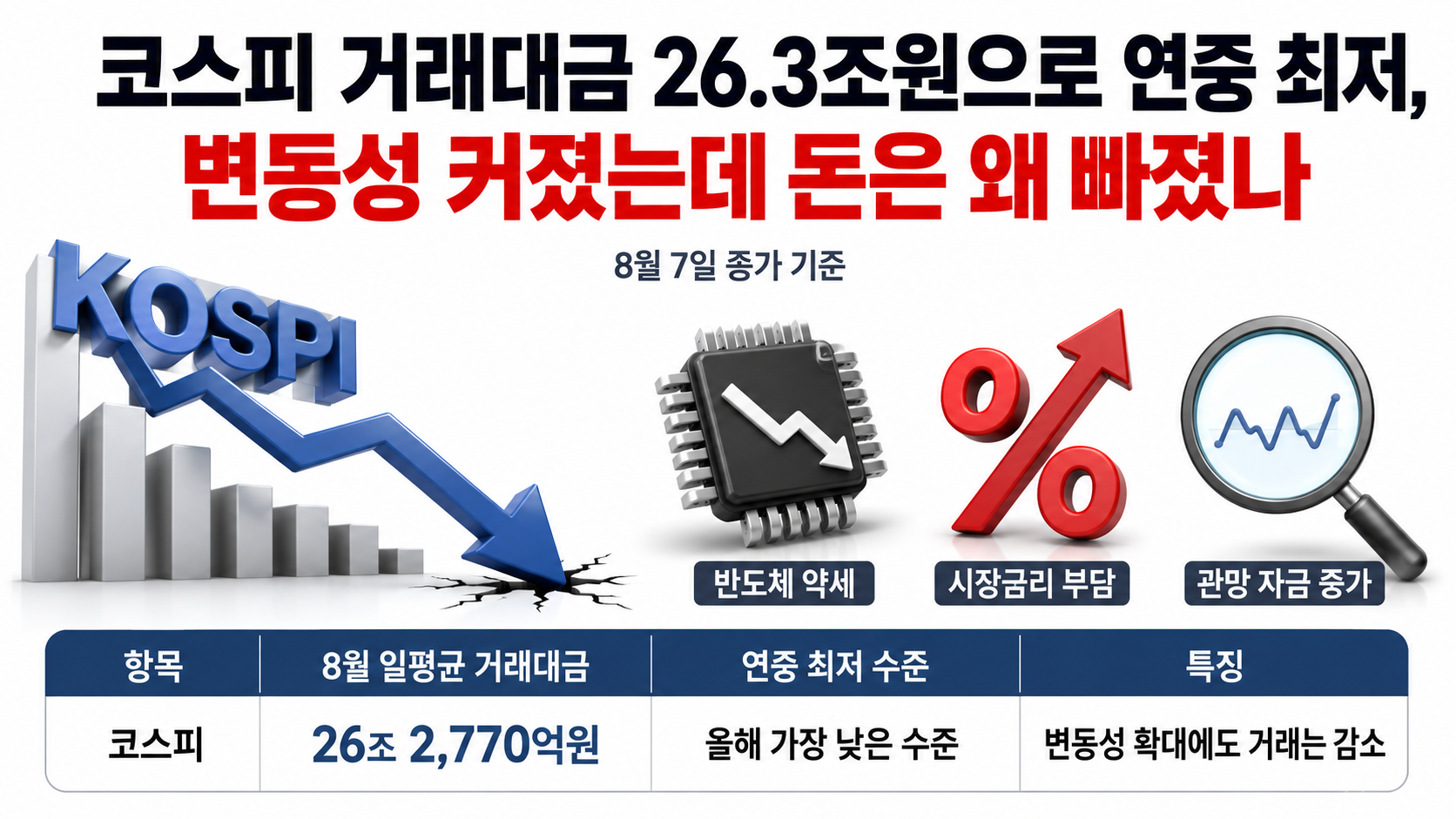
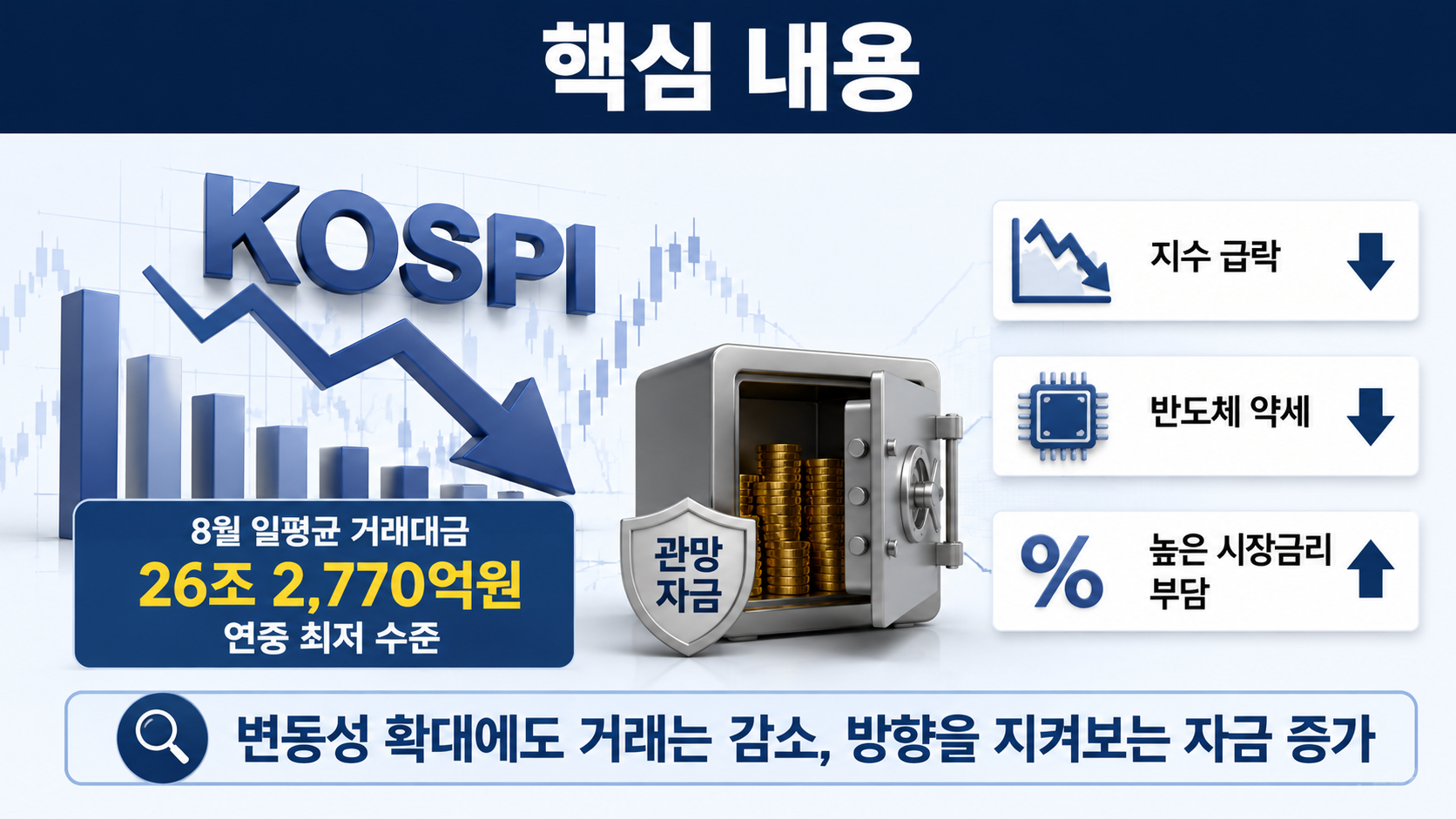
In August 2026, the KOSPI's average daily trading value fell to 26 trillion KRW 277,000,000,000, its lowest level of the year. Normally, sharp stock price movements might be expected to generate more trading, but this time was different. With a steep index decline, weakness in semiconductor stocks, and the burden of high market interest rates occurring simultaneously, more investors appear to be waiting for a clearer market direction rather than actively buying and selling.
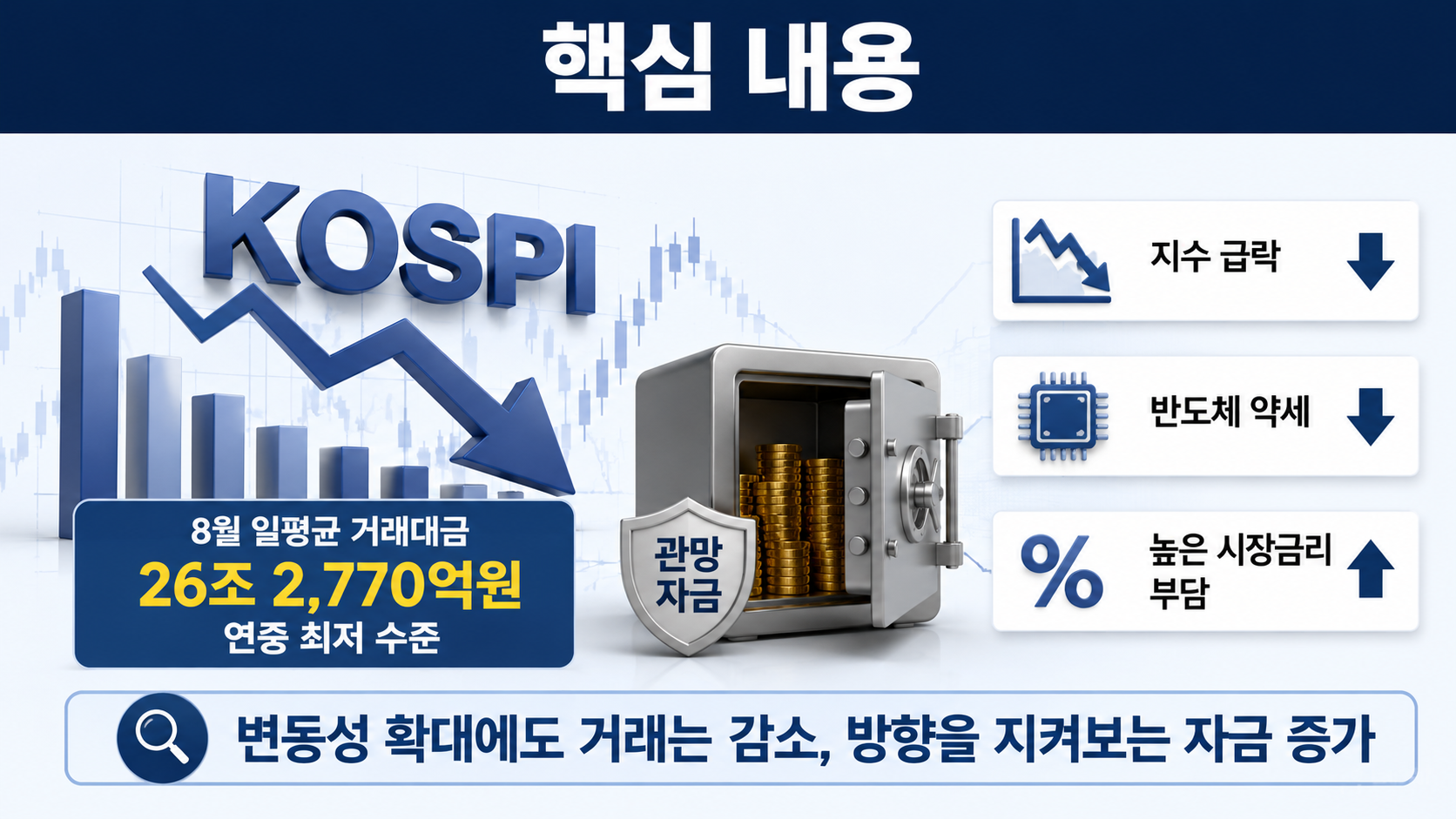
As of the August 7 closing price, the KOSPI stands at 6,258.77. Financial market figures may change on subsequent trading days, so the current numbers alone cannot establish whether the index will rise or fall further.
How Much Has KOSPI Trading Value Actually Declined?
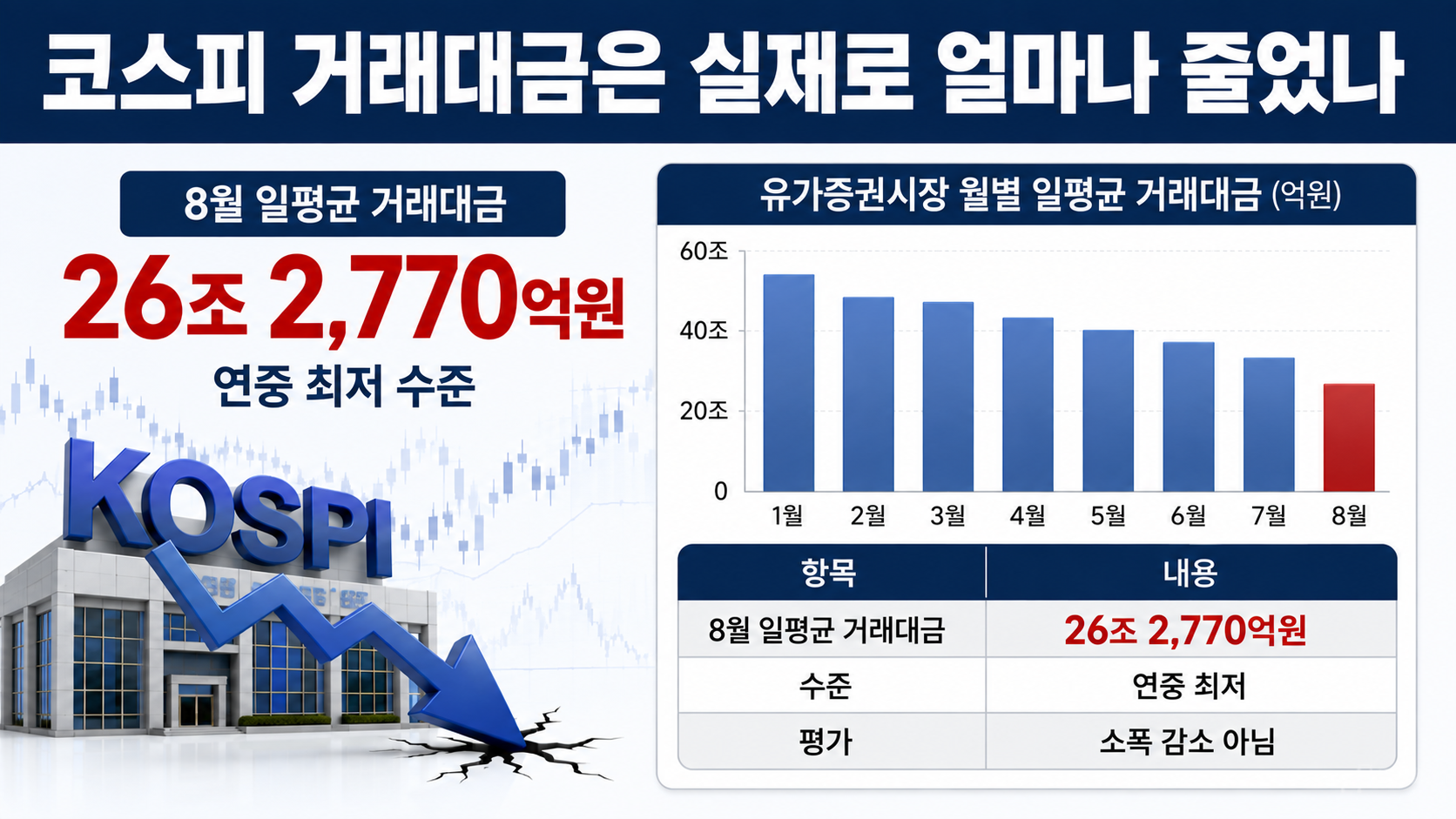
In August, the average daily trading value on the KOSPI market was 26 trillion KRW 277,000,000,000. Looking at this year's monthly figures, the decline is difficult to describe as merely a slight decrease.
In January, the figure was 27 trillion KRW 56,000,000,000, followed by February KRW 32,234,000,000,000, March KRW 30,143,000,000,000, and April KRW 29,551,000,000,000. During May and June, when the index was rising rapidly, trading value increased to KRW 50,215,000,000,000 and KRW 50,347,000,000,000, respectively.
However, it fell to 36 trillion KRW 875,000,000,000 in July and declined further to KRW 26,277,000,000,000 in August.
According to the author's calculation comparing July and August,
trading value fell from KRW 36,875,000,000,000 to KRW 26,277,000,000,000, a decrease of approximately KRW 10,598,000,000,000, representing a decline of about 28.7%.
Compared with KRW 50,347,000,000,000 in June, the decrease was approximately KRW 24,070,000,000,000, equivalent to about 47.8%. In other words, the average daily trading value effectively shrank by nearly half in just two months.
An interesting point is that trading value in August was even lower than in January. Compared with January KRW 27,056,000,000,000, it was approximately 2.9% lower. This shows how trading activity, which had expanded significantly during the stock market rally in the first half of the year, has rapidly retreated during the recent correction.
Why Has Trading Value Declined Despite High Volatility?
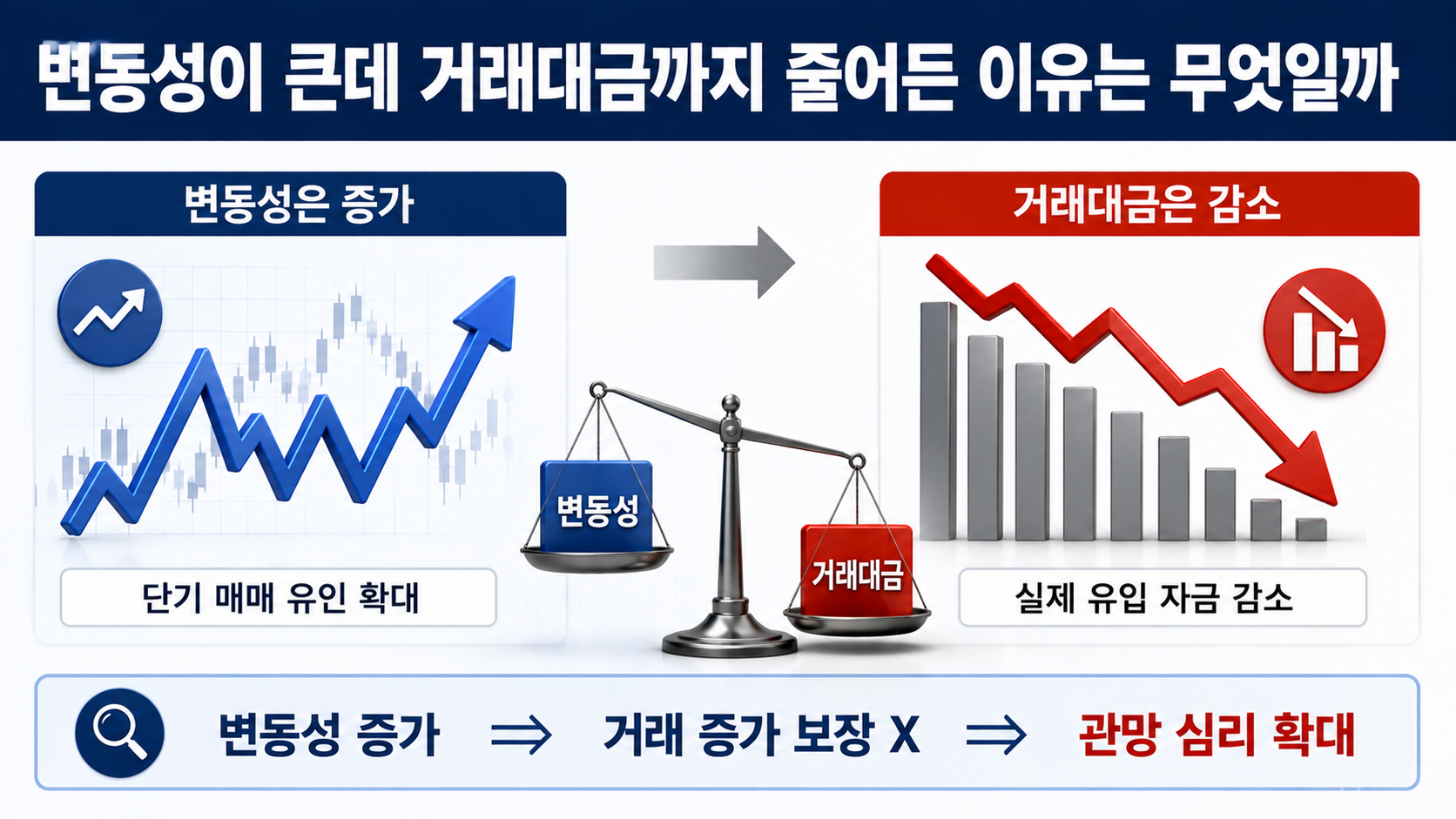
When stock price volatility increases, short-term trading can become more active, pushing trading value higher. However, volatility itself does not guarantee an increase in trading activity.
When investors view price fluctuations as opportunities, buying and selling become more active. Conversely, when they are highly concerned about further declines, more investors may choose to hold cash and wait until the market's direction becomes clearer.
During the first trading week of August, the KOSPI fell by more than 5%, and sidecar mechanisms temporarily restricting program trading were triggered twice. A defining feature of this market environment is that trading value and volume fell to their lowest levels of the year even as prices fluctuated sharply.
Average daily trading volume also dropped to approximately 3 hundred million 166 ten thousand 7 thousand shares, the lowest level of the year. This means that not only did trading value decline, but the actual number of shares bought and sold also decreased.
Therefore, the current situation cannot easily be explained simply by a greater proportion of trading in lower-priced stocks reducing the total trading value. It is necessary to examine whether overall market participation has weakened as well.
Why Does Weakness in Samsung Electronics and SK Hynix Matter?
On the KOSPI, movements in large-market-cap stocks such as Samsung Electronics and SK Hynix have a substantial impact not only on the index but also on overall investor sentiment.
In August, Samsung Electronics declined 12.00%, while SK Hynix fell 17.23%. When leading semiconductor stocks that previously drove the market rally weaken simultaneously, investors may become more inclined to assess the situation rather than aggressively increase their exposure to other stocks.
Concerns that the semiconductor industry may have already passed its peak, along with assessments of whether corporate earnings can remain sustainable, are also factors influencing trading participation.
However, declines in leading stocks alone cannot fully explain the decrease in total KOSPI trading value. Multiple factors are operating simultaneously, including external interest rates, foreign investor flows, and changes in leveraged product trading.
Why Are Market Interest Rates Important for a Recovery in KOSPI Trading?
In the stock market, higher interest rates create additional burdens for both companies and investors.
Companies face higher financing costs when raising funds through corporate bonds or loans, while investors demand higher expected returns to justify holding risky assets such as stocks. Even when a company generates the same earnings, its stock may be valued more conservatively in a high-interest-rate environment.
Artificial intelligence and semiconductors, two central drivers of the recent stock market, are industries that require substantial capital investment. As global AI investment increasingly involves corporate bond issuance and borrowing, the stability of market interest rates becomes an important factor in assessing whether investment can continue.
Conversely, if international oil prices rise, inflationary pressures intensify again, and US market interest rates remain elevated, these developments could weigh on stock markets.
Therefore, when assessing whether KOSPI trading value is recovering, it is important to examine US Treasury yields, inflation trends, and international oil prices alongside movements in the index itself.
Does Lower Trading Value Mean the KOSPI Must Fall Further?
Not necessarily. A decline in trading value does not, by itself, determine whether the market will rise or fall.
Trading value is better understood as an indicator of the intensity of market participation. Reduced trading may suggest that both buyers and sellers are postponing active pricing decisions, but the market's subsequent direction will depend on where new capital enters.
For example, if stock prices rebound temporarily while trading remains subdued, investors should further assess whether the rebound has sufficient strength. Conversely, if trading value increases, foreign investors return to net buying, and earnings forecasts for major companies improve, there may be grounds to interpret the situation as a different market trend.
It is advisable to avoid concluding that the market has 'bottomed out' or that 'another sharp decline is inevitable' based on trading value alone.
Which Indicators Should Investors Monitor Next?
The first is foreign investor flows. A sustained return to net buying by foreign investors, who hold significant positions in major Korean stocks, could provide an important indication of a recovery in trading activity.
The second is earnings forecasts for major companies, including Samsung Electronics and SK Hynix. More important than a simple rebound in stock prices is whether future earnings estimates remain stable or improve.
The third is market interest rates. Stabilization in long-term US interest rates and easing inflationary pressures could also influence valuations of Korean growth stocks and semiconductor companies.
The fourth is a simultaneous recovery in trading value and trading volume. Rather than focusing on a one-day surge in trading when the index rises, it is more meaningful to determine whether market-wide trading activity recovers over a sustained period.
Shareholder return policies are another factor worth monitoring. If companies implement more substantial shareholder returns through dividends or share buybacks, investors may adjust how they assess corporate value.
What Does This Year-to-Date Low in Trading Value Tell Us?
The defining characteristic of the KOSPI in August is not simply 'weak trading activity,' but the simultaneous occurrence of increased volatility and reduced market participation.
Average daily KOSPI trading value, which exceeded KRW 50,000,000,000,000 in June, declined to the KRW 26,000,000,000,000 range in August. According to the author's calculation, it decreased by approximately 47.8% over two months. During the same period, trading volume also fell to its lowest level of the year, while leading semiconductor stocks underwent a correction.
The current figures can be interpreted as a signal that investors are more inclined to wait for confirmation of the market's direction than to treat price fluctuations as active buying opportunities. However, declining trading activity alone cannot determine the future direction of the index.
Going forward, it will be important to monitor, in sequence, whether foreign capital returns, whether earnings expectations for semiconductor companies remain intact, whether market interest rates stabilize, and whether trading value and volume recover together.
Stock market analysis is an interpretation based on publicly available historical and current data and does not guarantee future returns or the direction of an index. Investment decisions should take into account each individual's investment horizon and tolerance for losses.
The key figures used in this article were cross-checked against 2026-08-09 reporting based on Korea Exchange data. The figures confirmed include average daily trading value of KRW 26,277,000,000,000 in August, trading volume of 3 hundred million 166 ten thousand 7 thousand shares, trading value of KRW 36,875,000,000,000 in July, and KRW 50,347,000,000,000 in June.
※ This article is provided for informational purposes to help readers understand market trends and does not constitute an investment recommendation for any particular stock or asset. Final investment decisions and responsibility rest with the individual investor.