

KOSPI Has Surpassed 7000, but Why Is Holding Above It a Different Challenge? How 18.9 Trillion in Retail Investor Holdings Between 7000 and 7500 Could Be a Key Factor
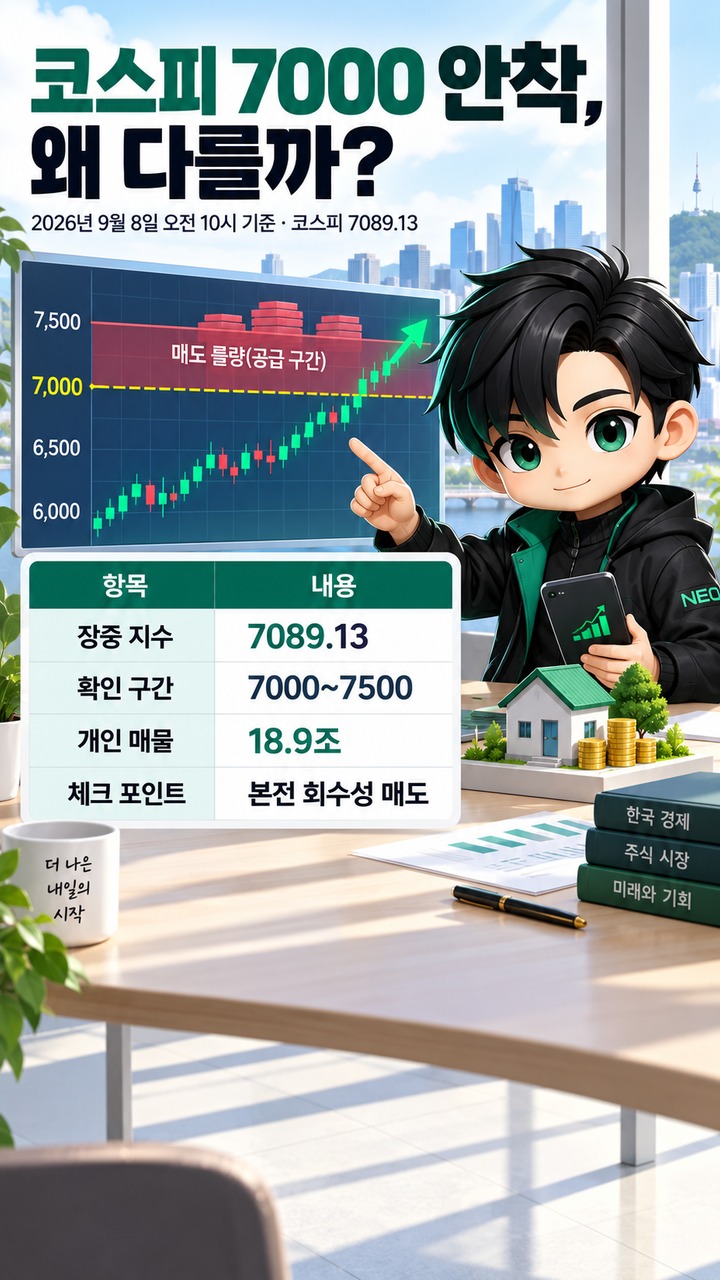
The KOSPI climbed back above 7000 during intraday trading on 2026-09-08, but briefly breaking through 7000 is different from establishing a sustained position above it. Shares previously purchased by retail investors at index levels above 7000 could come onto the market, making it important to watch whether selling to recover initial investments increases as the index rises.
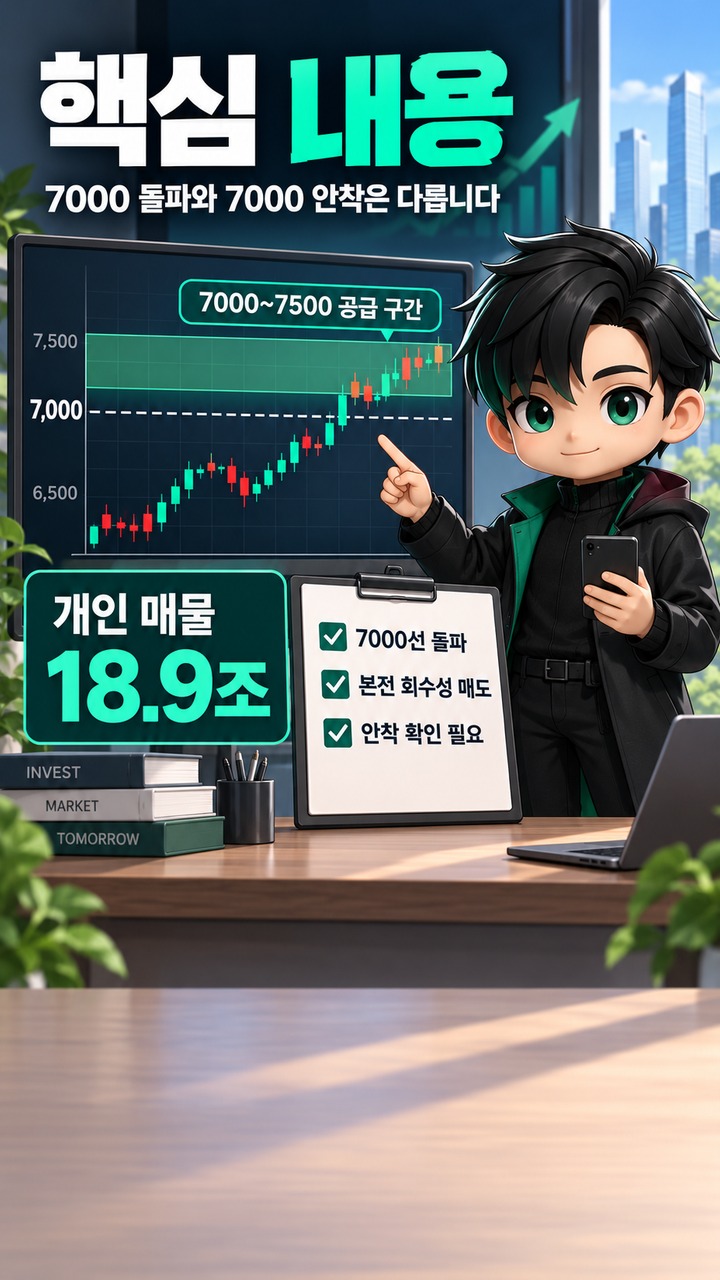
As of 10 a.m. on 8, the KOSPI stood at 7089.13, up 1.34% from the previous trading session. Having closed the previous day at 6995.39, just 4.61 points short of 7000, the index crossed that threshold early in the session.
The more important question now is not simply whether the KOSPI has surpassed 7000, but who can absorb the selling pressure that emerges above 7000.
What Makes KOSPI 7000 Important Is the Supply of Shares, Not the Number Itself
KOSPI 7000 is not an institutionally defined threshold. Market structures do not suddenly change between 6999 and 7001.
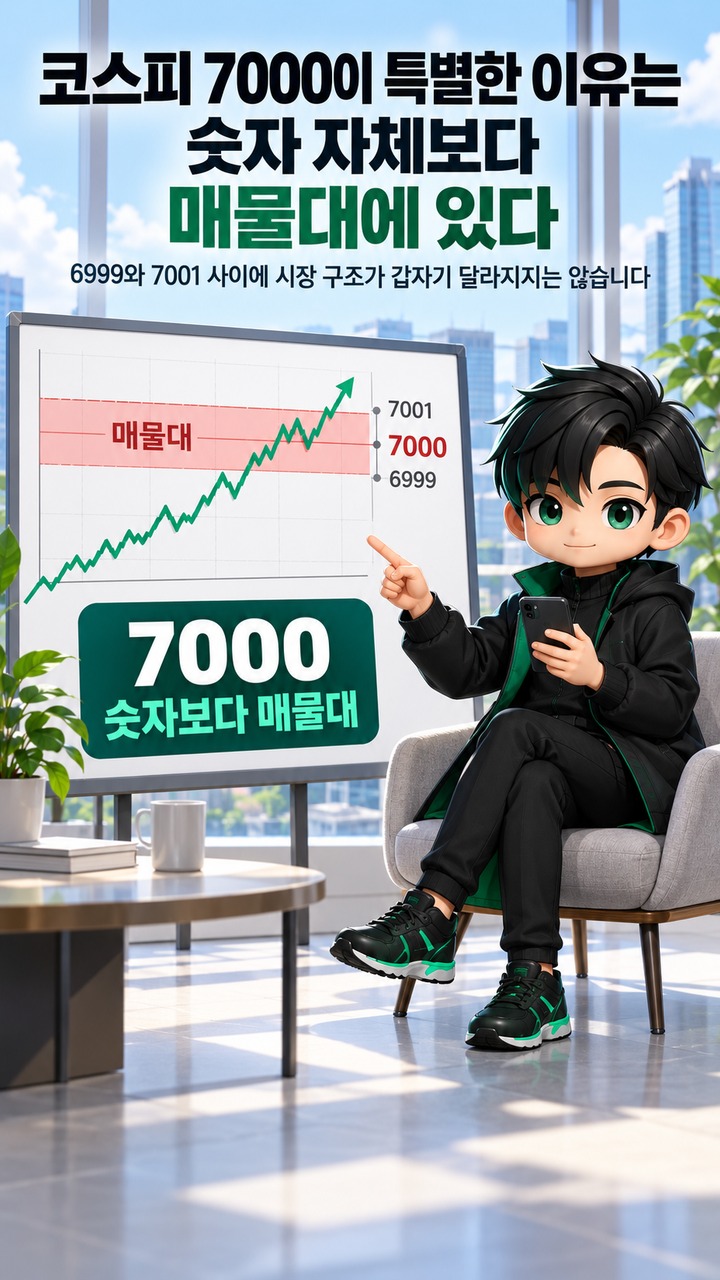
For investors, however, the level carries a different significance. Investors who bought stocks when the KOSPI was trading higher and subsequently suffered losses have been waiting for the index to recover to 7000.
According to recent reports citing an analysis by Kiwoom Securities, cumulative net purchases by retail investors at KOSPI levels above 7000 are estimated at approximately KRW 87,000,000,000,000. Of that amount, approximately KRW 18,900,000,000,000 is concentrated in the 7000–7500 range alone.
In simple terms, as the index climbs above 7000, some investors who previously bought at higher prices may increasingly decide:
"My losses have narrowed, so it's time to sell."
"I'm almost back to breaking even, so I'll cash out."
This makes 7000 both a psychologically significant round number and a price level where actual selling pressure may emerge.
Why Estimates of '84 Trillion, 87 Trillion, and 90 Trillion in Potential Selling Pressure' Differ
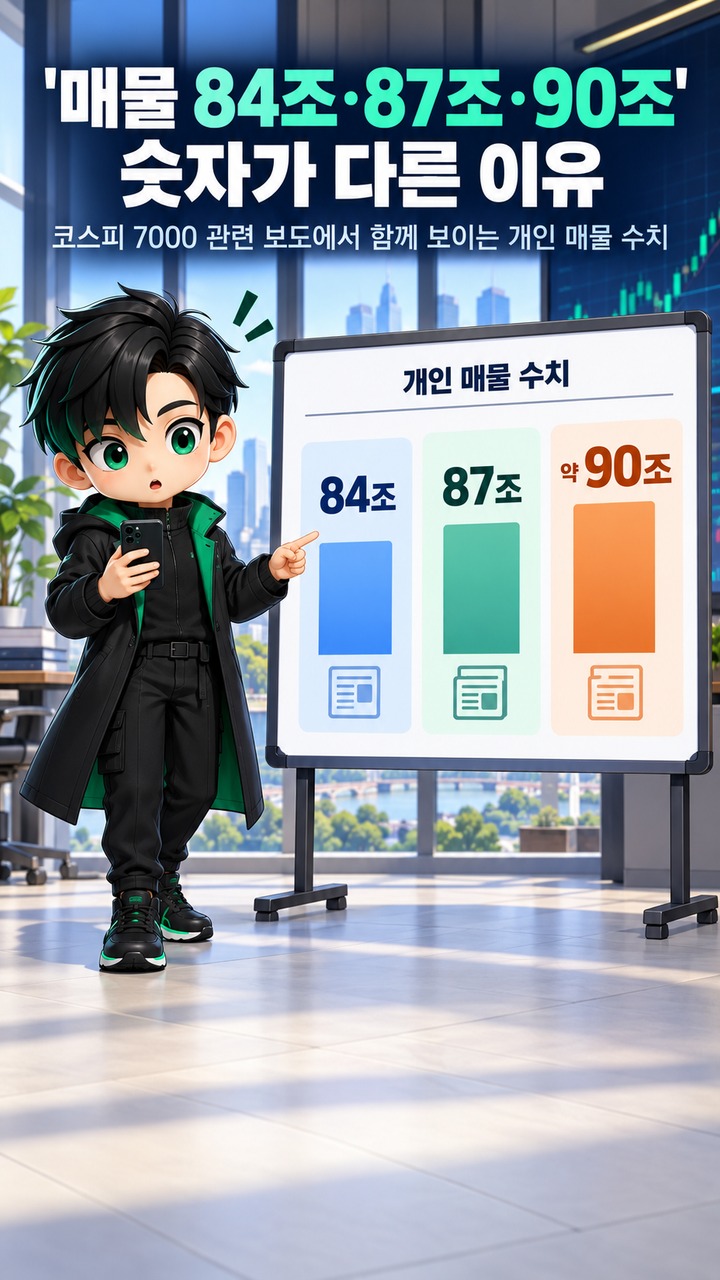
Reports discussing KOSPI 7000 sometimes describe retail investor holdings as KRW 84,000,000,000,000, KRW 87,000,000,000,000, or approximately KRW 90,000,000,000,000.
These figures do not necessarily describe entirely different phenomena. They differ because the index ranges covered and the reporting methods are different.
Some recent reports put retail investors' net purchases in the 7000–8000 range at approximately KRW 49,000,000,000,000, while other estimates combine several index ranges above 7000 to arrive at approximately KRW 87,000,000,000,000. The expression '90 trillion selling barrier' is a rounded description of that KRW 87,000,000,000,000 estimate.
The differences become clearer when the figures are broken down by index range.
| KOSPI Range | Estimated Retail Investor Net Purchases |
|---|---|
| 7000–7500 | KRW 18,900,000,000,000.0 |
| 7500–8000 | KRW 30,200,000,000,000.0 |
| 8000–8500 | KRW 28,300,000,000,000.0 |
| 8500–9000 | KRW 6,200,000,000,000.0 |
| 9000–9500 | KRW 3,400,000,000,000.0 |
Simply adding the figures above gives KRW 87,000,000,000,000.
18.9 + 30.2 + 28.3 + 6.2 + 3.4 = KRW 87,000,000,000,000.0. *(Author's calculation)*
Therefore, a statement that 'selling pressure at the 7000 level amounts to KRW 90,000,000,000,000' should not be interpreted as meaning that sell orders worth KRW 90,000,000,000,000 are currently waiting immediately above 7000.
Rather, it is an estimate of potential selling pressure based on cumulative net purchases by retail investors when the index previously traded within those ranges.
Why the KOSPI Can Rise Even When Retail Investors Sell
Retail investors selling stocks does not necessarily cause the KOSPI to decline. If buying by foreign and institutional investors and other market participants is stronger than the selling by retail investors, the index can continue rising.
In fact, when the KOSPI surged 4.61% on September 7 and closed at 6995.39, foreign and institutional investors each recorded net purchases exceeding KRW 2,500,000,000,000. Their combined net purchases surpassed KRW 5,000,000,000,000.
The KOSPI also moved above 7000 early in the session on 8.
However, investor flows continued changing throughout the morning. At 9:33 a.m., institutions recorded net purchases of KRW 181,700,000,000, while retail and foreign investors posted net sales of KRW 283,300,000,000 and KRW 43,900,000,000, respectively. Later, as of 10 a.m., foreign investors had returned to net buying of KRW 51,700,000,000, while institutions recorded net purchases of KRW 267,700,000,000.
This illustrates why it is difficult to determine the market's direction from a single intraday investor-flow figure: buying and selling volumes change continuously.
At the 7000 level, what matters more than figures from a particular moment is whether foreign and institutional investors can consistently absorb retail selling over multiple trading sessions.
How Can Investors Distinguish Between a 'Breakout' Above 7000 and Sustained Trading Above It?
'Sustained trading above a level' is not an official classification established by the Korea Exchange. It is an expression used in stock market reporting and analysis when an index or price does more than briefly cross a particular threshold and instead maintains that level with relative stability.
Therefore, the fact that the KOSPI briefly reached 7100 in the morning is not enough to confirm that it has firmly established itself above 7000.
Three indicators are particularly useful.
First, the closing level.
Check whether the KOSPI rises above 7000 during the session but falls back below it under afternoon selling pressure, or whether it also closes above 7000.
Second, foreign and institutional investor flows.
When retail selling increases, it is important to see whether foreign and institutional investors continue absorbing those shares over several trading sessions.
Third, whether gains spread beyond semiconductor stocks.
A market in which only heavyweight stocks such as Samsung Electronics and SK Hynix push the index higher has a different breadth of gains from one in which multiple industries rise together.
In fact, on July 22, Samsung Electronics and SK Hynix together accounted for 51.66% of the KOSPI's total market capitalization during intraday trading. This indicates how significantly movements in those two stocks can influence the overall index.
Why the 7500 Range Becomes More Important After the KOSPI Surpasses 7000
After a breakout above 7000, the process of absorbing potential selling pressure between 7000 and 7500 matters more immediately than the next round-number milestone.
According to Kiwoom Securities' analysis, estimated retail investor net purchases in this range amount to KRW 18,900,000,000,000. In the 7500–8000 range, the figure increases further to KRW 30,200,000,000,000.
This does not mean that every share previously purchased will be sold simultaneously as the index rises. However, selling pressure may increase as the index approaches the levels at which investors originally bought their shares.
Conversely, if foreign and institutional investment flows can sufficiently absorb this supply and corporate earnings expectations improve, the existence of potential selling pressure alone does not necessarily prevent further index gains.
Ultimately, overhead supply is not an absolute ceiling on market gains. It is better understood as a supply-and-demand factor indicating how much additional buying capital may be needed.
What to Check When Monitoring the KOSPI Now
As of the morning of 2026-09-08, the KOSPI had recovered above 7000. However, the trading session was not yet over, so intraday figures could differ from the closing figures.
When the index moves above 7000 immediately after a sharp rally, as it has now, it is useful to examine the following developments rather than focusing only on the index level.
Closing above 7000 → Consecutive sessions of foreign and institutional net buying → Absorption of retail investor selling → Broadening gains into industries beyond semiconductors
Checking whether all four developments occur together provides a more detailed picture of market conditions than simply reading a headline saying that the KOSPI 'touched 7000.'
In particular, the estimated KRW 87,000,000,000,000 in retail investor net purchases above 7000 does not represent the value of actual sell orders placed that day. It represents potential selling pressure calculated from historical transactions. Distinguishing between these concepts is essential to avoid overstating the significance of the figure.
Stock prices and market indices can fluctuate significantly in response to interest rates, exchange rates, international oil prices, corporate earnings expectations, overseas stock markets, and other factors. Rather than using a breakout above a particular index level as the sole basis for buying or selling, investors should also consider their investment horizons and ability to tolerate losses.
※ This article is provided for informational purposes to help readers understand market trends and does not constitute an investment recommendation for any particular stock or asset. Investors are responsible for their own final decisions and investment outcomes.