

KOSPI Rises 3.76%: Reasons Behind the 6598.26 Close and Indicators to Watch in the Next Session
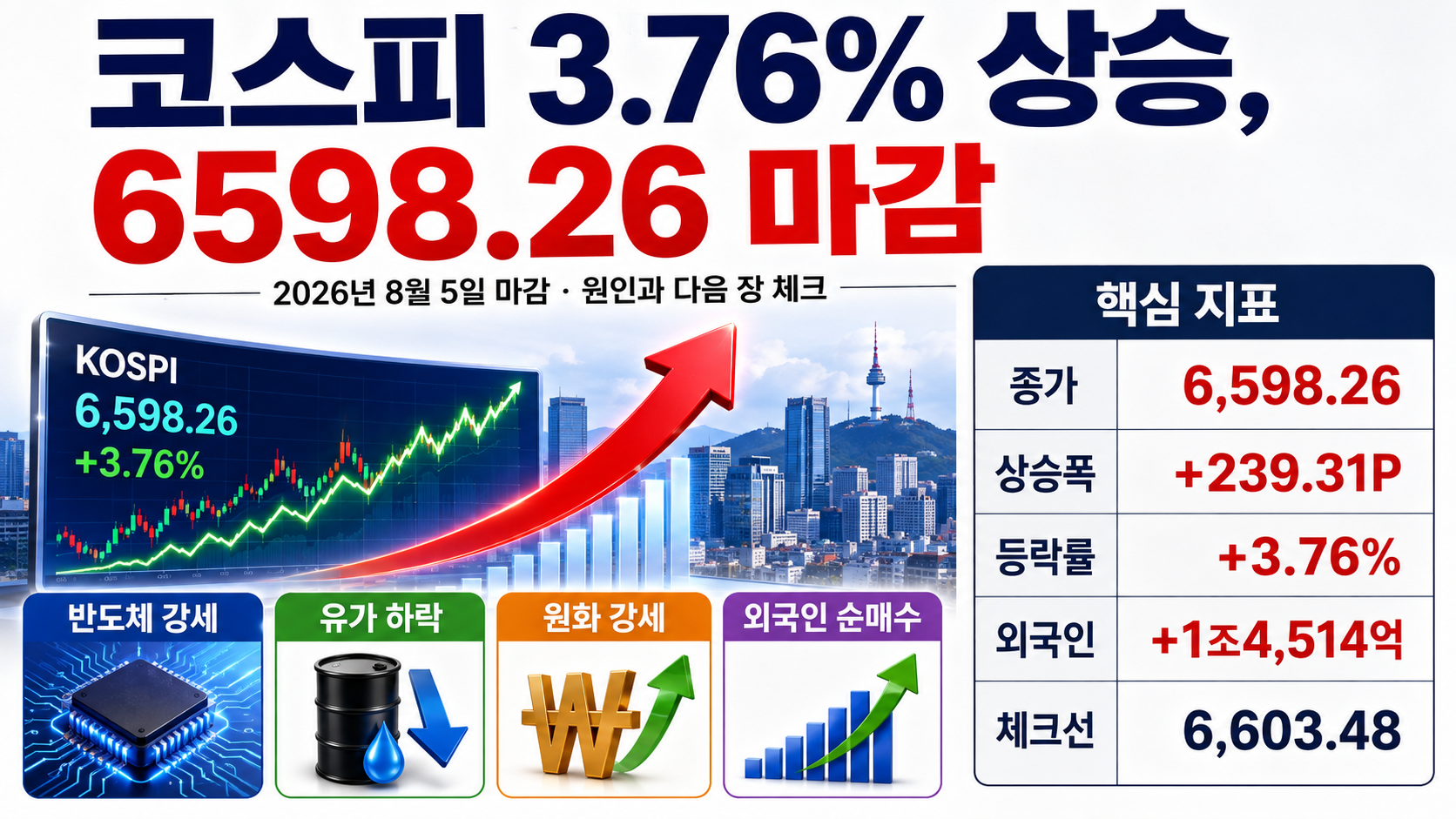
2026-08-05 The KOSPI closed at 6,598.26, up 239.31 points, or 3.76%. Strength in U.S. semiconductor stocks, falling international oil prices, a stronger Korean won, and KRW 1,451,400,000,000 in net foreign buying all contributed to the gain. However, the index closed just 2.81 points above its July 31 closing level, making it too early to conclude that a new upward trend has been established.
On August 5, the KOSPI Closed 1.74 Points Away from the 6600 Level
The KOSPI opened at 6,603.48 and climbed as high as 6,674.66 during the session, but closed at 6,598.26. According to the author's calculations, the index remained 1.74 points, or approximately 0.03% of its closing level, below the 6,600 mark.
| Category | August 5 Figure |
|---|---|
| KOSPI closing level | 6,598.26 |
| Change from previous session | +239.31 points |
| Percentage change | +3.76% |
| Opening level | 6,603.48 |
| Intraday high | 6,674.66 |
| KOSDAQ closing level | 799.59 |
| KOSDAQ percentage change | +2.42% |
The closing level was 76.40 points below the intraday high. According to the author's calculations, the index finished 1.14% below its peak, suggesting that profit-taking and cautious selling emerged after the sharp rise early in the session.
Four Factors Combined to Drive the KOSPI's 3.76% Gain
The most direct drivers were gains in U.S. semiconductor stocks and an inflow of foreign investment. Falling international oil prices, lower U.S. Treasury yields, and a decline in the won-dollar exchange rate also reduced the perceived risks associated with Korean equities.
Strength in U.S. Semiconductor Stocks Lifted Korean Large-Cap Shares
In the previous U.S. trading session, stocks related to artificial intelligence and memory semiconductors rose sharply. Micron gained 7.62%, SanDisk advanced 10.84%, and the Nasdaq Composite Index climbed 2.59%.
Positive sentiment toward semiconductor investments in the U.S. carried over into the Korean market. On August 5, Samsung Electronics rose 2.50% and SK Hynix gained 5.77%. These two heavily weighted stocks helped lift the KOSPI.
Falling International Oil Prices Reduced Pressure on the Korean Market
Expectations of easing tensions in the Middle East increased after U.S. government officials mentioned the possibility of an agreement with Iran concerning the reopening of the Strait of Hormuz. West Texas Intermediate crude oil prices fell to around USD 75 per barrel.
Because South Korea relies heavily on energy imports, rising international oil prices put pressure on corporate costs, consumer prices, and exchange rates. Conversely, falling oil prices can partially ease the pressures affecting domestic risk assets.
Foreign Investors Recorded KRW 1,451,400,000,000 in Net Purchases
On August 5, foreign investors recorded net purchases of 1 trillion KRW 451,400,000,000 in the KOSPI market. Individual investors recorded net sales of KRW 1,185,400,000,000, while institutional investors recorded net sales of KRW 280,200,000,000.
In the previous session, individual investors had driven the index's rebound while foreign and institutional investors were net sellers. On August 5, however, foreign investors shifted to net buying for the first time in 3 trading days. The expansion of foreign buying beyond electrical and electronic equipment into transportation equipment, pharmaceuticals, and financial stocks also contributed to the broader market advance.
The Won-Dollar Exchange Rate Also Fell to KRW 1,424.5
The won-dollar exchange rate closed at KRW 1,424.5, down KRW 8.0 from the previous trading session. A decline in the exchange rate means that the Korean won strengthened against the U.S. dollar.
When weakness in the won subsides, foreign investors may have less incentive to sell Korean equities because of concerns about foreign-exchange losses. However, a single day's decline in the exchange rate is not enough to establish that foreign capital will continue flowing into Korea over the medium to long term.
Why the 3.76% Gain Does Not Yet Confirm a New Upward Trend
Although the advance on August 5 was strong, recent closing levels suggest that the move was primarily a recovery from a sharp decline. The KOSPI fell from 6,595.45 on July 31 to 6,257.45 on August 3 before recovering to 6,598.26 over the following two days.
| Date | KOSPI Closing Level | Daily Percentage Change |
|---|---|---|
| July 31 | 6,595.45 | +17.91% |
| August 3 | 6,257.45 | -5.12% |
| August 4 | 6,358.95 | +1.62% |
| August 5 | 6,598.26 | +3.76% |
Comparing the closing levels on August 3 and August 5, the index gained 340.81 points, or 5.45%, over two days. This is not the 5.38% obtained by simply adding 1.62% and 3.76%. Instead, it is the result of a compounded calculation based on the changing closing level each day.
However, the August 5 closing level was only 2.81 points, or 0.04%, above the July 31 closing level. According to the author's calculations, after accounting for both the recent sharp decline and subsequent rebound, the index had essentially returned to where it stood three days earlier.
Therefore, the 3.76% advance can be viewed as a strong rebound signal, but the period is too short to serve as evidence that the index has entered a new upward phase. Further confirmation is needed to determine whether foreign investor flows, semiconductor earnings expectations, international oil prices, and exchange rates continue moving in supportive directions.
A Buy-Side Sidecar Trigger Does Not Halt All Stock Trading
A buy-side sidecar is a market stabilization mechanism that temporarily suspends the effectiveness of program buy orders for 5 minutes when index futures rise sharply. It is triggered when KOSPI 200 futures prices remain at least 5% above their reference price for 1 minutes.
At approximately 9:24 a.m. on August 5, a buy-side sidecar was triggered after the KOSPI 200 futures index rose by more than 5%. This does not mean that all individual stock orders placed directly by ordinary investors are suspended.
A sidecar is not a mechanism designed to reverse the market's direction, whether upward or downward. It temporarily slows trading activity when program orders threaten to amplify price fluctuations excessively. The activation of a sidecar should not itself be interpreted as a buy signal.
What Should Investors Check Before the Market Opens on August 6?
The direction of the next trading session cannot be determined solely from the August 5 closing level. Investors should review overseas markets, commodities, and exchange rates before the opening bell, then monitor foreign investor flows and major semiconductor stocks during the session.
The first factor is the closing performance of the U.S. Nasdaq Index and memory semiconductor stocks such as Micron. If U.S. semiconductor stocks fail to maintain their gains, Korean semiconductor stocks may also give back their early advances.
The second factor is international oil prices and subsequent developments concerning the Strait of Hormuz. If oil prices surge again, concerns about Korean companies' costs, inflation, and exchange rates could intensify once more.
The third factor is the won-dollar exchange rate. Using the August 5 closing level of KRW 1,424.5 as a reference, investors should check whether the exchange rate continues to decline or begins rising again.
The fourth factor is whether foreign investors continue making net purchases in the cash equity market. More important than the fact that foreign investors bought more than KRW 1,000,000,000,000 in a single day is whether they continue buying in the next session, whether funds remain concentrated in Samsung Electronics and SK Hynix, and whether buying spreads to other industries.
Finally, investors should watch whether the KOSPI can hold above the 6,600 level through the close rather than merely crossing it during the session. 6,600 is a psychologically significant number, but it is not inherently a support or resistance level that guarantees further gains.
Investment Strategies Should Differ According to Existing Holdings
Investors who already own stocks may be better served by first checking whether their assets are excessively concentrated in particular semiconductor companies rather than rushing to increase their exposure after a single day's 3.76% gain. The performance of individual holdings can differ from the overall index's movement.
Those considering new positions may reduce volatility risk by evaluating prices in stages rather than chasing stocks immediately after a sharp opening surge. Before buying, investors should determine the amount of loss they can tolerate and their intended investment horizon.
Investors using margin trading or leveraged products should not assume that volatility has subsided. Although the KOSPI 200 Volatility Index fell 4.27% on August 5, it still closed at 78.55. Prices can fluctuate sharply during the session even on days when the index rises, so investors should also check collateral ratios and forced-liquidation conditions.
Frequently Asked Questions
Does the KOSPI's 3.76% Gain Mean It Is Likely to Rise Again the Next Day?
A gain in the next trading session cannot be guaranteed. The likelihood of a sustained rebound increases if U.S. semiconductor stocks, international oil prices, exchange rates, and foreign investor flows all continue moving in supportive directions.
Is KRW 1,451,400,000,000 in Net Foreign Buying a Signal of a Trend Reversal?
One day of net buying is not enough. A stronger basis for interpreting the move as a medium-term trend change would emerge if foreign purchases continued over several trading sessions and corporate earnings expectations improved at the same time.
Is It Safe to Buy Once the KOSPI Breaks Above 6600?
A break above 6,600 alone should not determine whether to buy. Investors should distinguish between an intraday breakout and a sustained close above the level, while also considering exchange rates, foreign investor flows, the earnings performance of their holdings, and whether stock valuations have become excessive.
This article explains publicly available market information and does not recommend buying or selling any particular stock or financial product. Investing in stocks involves the risk of losing principal, and past returns or a single day's index gain do not guarantee future profits.
※ This article is provided for reference purposes to help readers understand market trends and does not constitute investment advice regarding any particular stock or asset. Final investment decisions and responsibility rest with the individual investor.