

Youth Future Savings Account: Can SME Employees Select 'General Income Earner'? For Round 2, You Must Select 'SME Employee'

If you work for a small or medium-sized enterprise (SME), you must select 'SME Employee' rather than 'General Income Earner' when applying for the Youth Future Savings Account in round 2 of 2026. This is because applicants are now required to select their own application category starting with round 2.

It is easy to assume, 'I am a salaried employee, so shouldn't I be classified as a general income earner?' However, the categories shown on the Youth Future Savings Account application screen are not simply classifications of income types. The key point is that employees seeking assessment for the preferential SME category must select 'SME Employee' from the application stage.
Round 2 of the Youth Future Savings Account Requires Applicants to Choose from 3 Categories
For round 2 applications, which opened on 2026-10-07, applicants must select their own category through the mobile app of a participating financial institution.
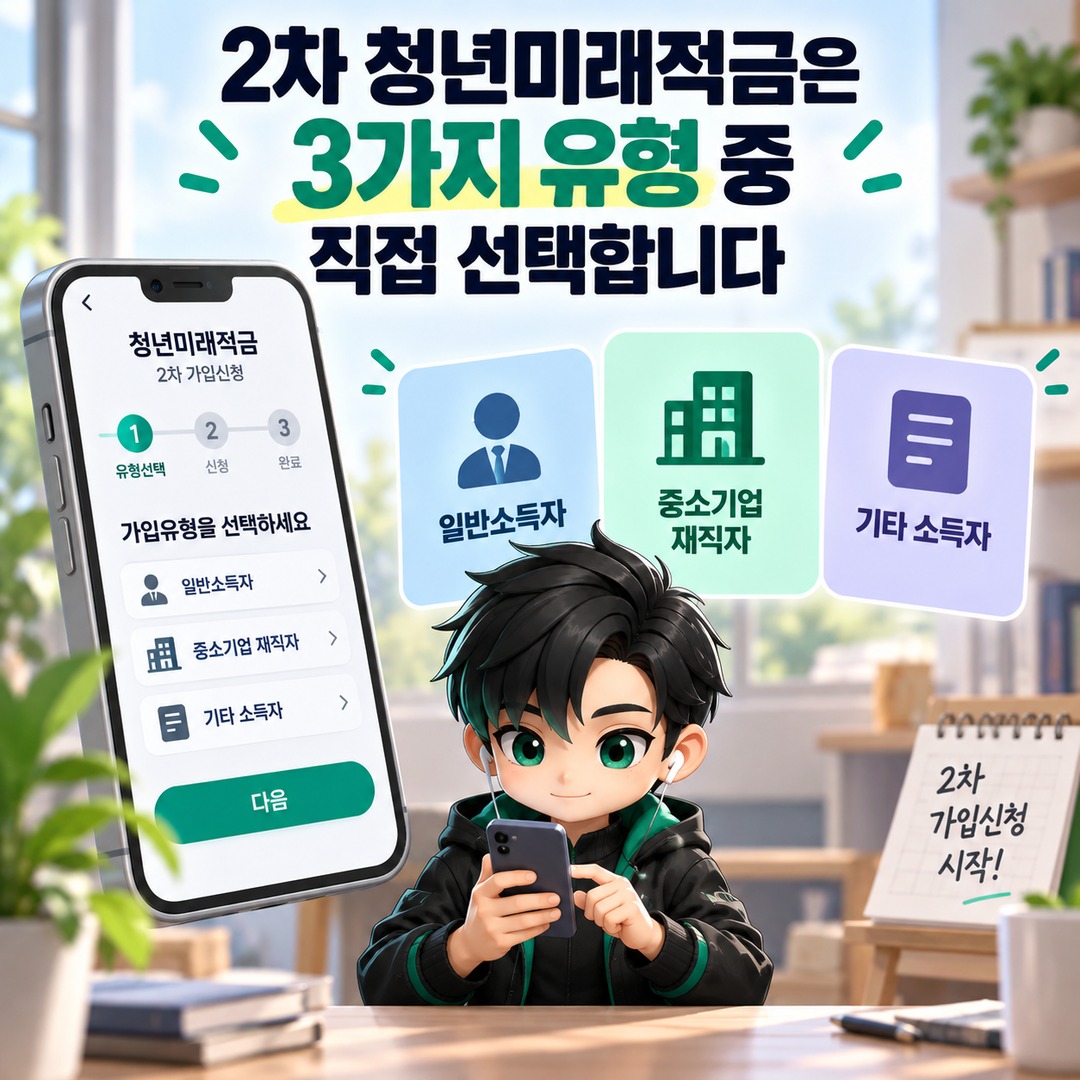
| Current situation | Category to select |
|---|---|
| General income earner who does not qualify as an SME employee or small business owner | General Income Earner |
| SME employee | SME Employee |
| Self-employed business owner seeking assessment under the small business owner category | Small Business Owner |
In its guidance for round 2, the Financial Services Commission explicitly stated that SME employees must select 'SME Employee' at the application stage. After submission, the screening process examines individual and household income and whether the applicant's employer qualifies as an eligible SME.
Therefore, employees working for SMEs should not assume that applying as general income earners will automatically result in an assessment under the preferential SME category.
Why Are 'General Income Earner' and 'SME Employee' Separate Categories?
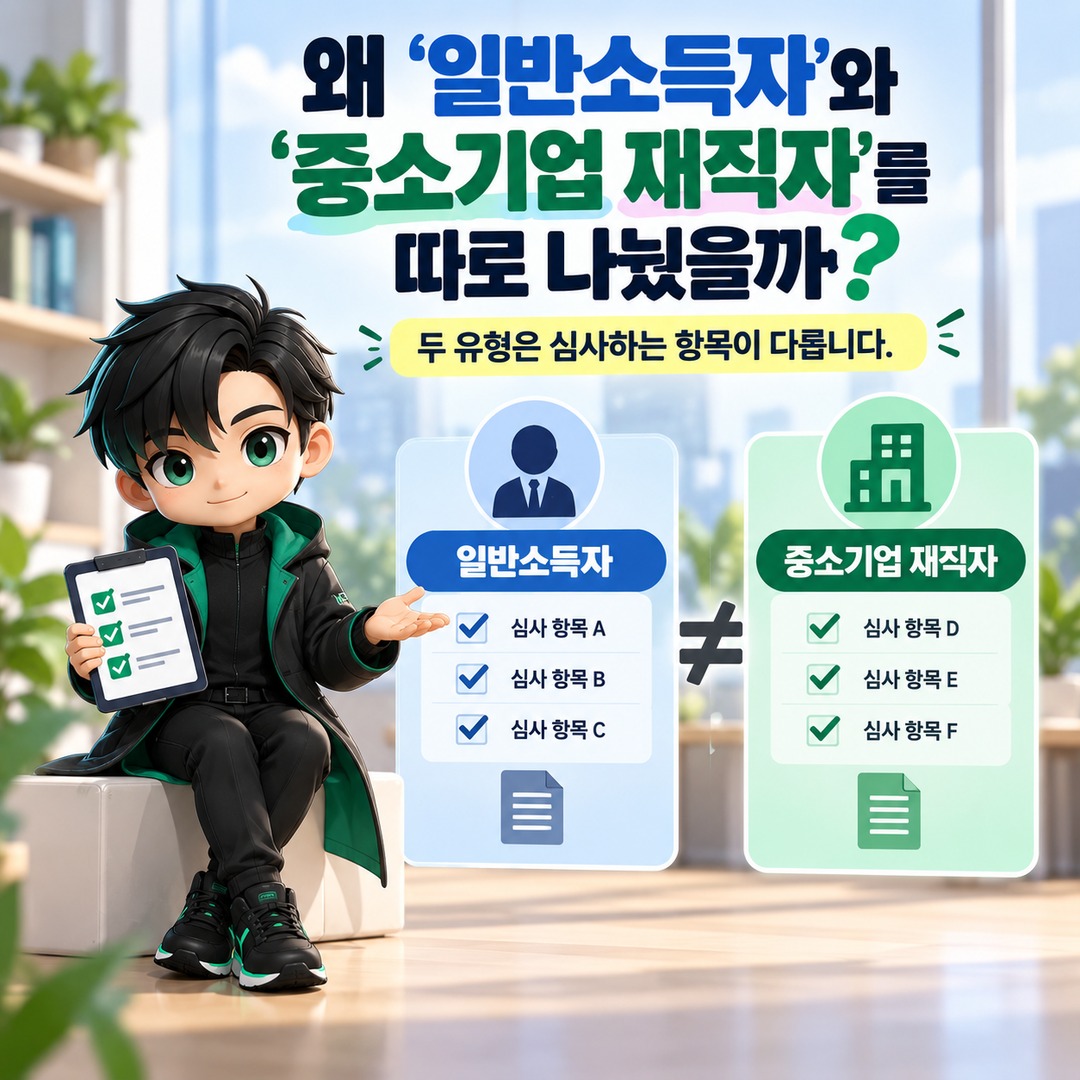
The two categories have different screening criteria.
For general income earners, eligibility is primarily assessed based on individual income, household income, and other basic enrollment requirements. SME employees undergo additional checks to determine whether their employer is an eligible SME and whether they meet the SME employment requirements.
For SME employees who also satisfy the preferential category's income requirements, the current government contribution matching rate is 12%. The standard category's rate is 6%.
For example, assuming a monthly deposit of KRW 500,000, a simplified calculation shows the following differences in government contributions.
Standard category, 6%: Up to KRW 30,000 per month
Preferential category, 12%: Up to KRW 60,000 per month
Monthly difference: Up to KRW 30,000
Simple cumulative difference over 36 months: Up to KRW 1,080,000
These figures are the author's calculations based on depositing KRW 500,000 every month for all 36 months and applying the current matching rates of 6% and 12%. Actual payments may vary depending on the amount deposited, the final eligibility assessment, and other factors.
In addition, the proposed increase in preferential-category contributions for 2027 is subject to the government budget proposal and National Assembly deliberations. It should therefore be distinguished from the 12% rate confirmed as of 2026-10-07.

What If You Are Unsure Whether Your Company Qualifies as an SME?
Rather than judging solely by the company's name or number of employees, it is safer to verify its official SME status.
The SMEs recognized under the Youth Future Savings Account program are determined using criteria established under the Framework Act on Small and Medium Enterprises and related standards. Private schools and kindergartens, research institutes affiliated with government agencies, and public institutions are not automatically classified as SMEs simply because they are small.
During the round 2 screening process, SME status is verified through electronic data sharing among relevant agencies. However, if electronic verification is difficult, applicants may be required to submit an SME Confirmation Certificate.
The certificate must be obtained by the employer, not the employee. The Financial Services Commission has advised that issuance may take approximately a week or longer.
If your company's size makes its classification uncertain or its SME status cannot be immediately verified, you should also prepare for the possibility of an additional document request after applying.
Selecting 'SME Employee' Does Not Automatically Qualify Everyone for the Preferential 12% Rate
Selecting 'SME Employee' and ultimately receiving preferential-category approval are separate steps.
Even if you currently work for an SME, you must satisfy the preferential category's individual and household income requirements. The current main income criteria for the preferential SME employee category are gross employment income of KRW 36,000,000 or less, or comprehensive income of KRW 26,000,000 or less. Household income requirements also apply.
Separate criteria apply to newly hired SME employees.
In other words, selecting 'SME Employee' on the application screen does not guarantee preferential-category approval. It is more accurate to understand this as the step in which you request an eligibility assessment as an SME employee.
If Your Selected Category Differs from the Screening Result, You Can File an Objection in Early November
A new procedure has been introduced for round 2, allowing applicants to review their preliminary screening results in advance.
The tentative schedule currently announced by the Financial Services Commission is as follows.
| Stage | Schedule |
|---|---|
| Application | October 7–16 |
| Enrollment and income screening | October 19–November 13 |
| Preliminary screening results announced | October 30–November 2 (tentative) |
| Objection period | November 2–5 (tentative) |
| Account opening | November 16–27 |
Applicants can compare the category they selected with their preliminary screening results. If they disagree with the outcome, they will have an opportunity to provide supporting explanations or evidence. However, the internal screening schedule may change depending on the number of applicants and the progress of the review process.
Therefore, rather than simply waiting for the final outcome after applying, it is important to check whether the category you selected matches the actual determination shown in your preliminary screening results.
What Happens If You Leave Your SME Job After Enrolling Under the Preferential Category?
Receiving preferential-category approval at enrollment does not mean that the 12% benefit is unconditionally guaranteed throughout the entire 3-year period.
Participants enrolled under the preferential SME category must be employed by an SME for a total of at least 29 months between enrollment and one month before maturity. Transfers between SMEs are permitted up to 2 times during the enrollment period.
If the employment requirements are not met, the account may be converted to the standard category at maturity, and certain benefits, including government contributions, may be adjusted.
This is why it is important to consider not only the category selected when applying but also the total qualifying employment period through maturity.
If You Are Applying on October 7, Check the Last Digit of Your Birth Year
The application period for round 2 of the Youth Future Savings Account runs from 2026-10-07 through 16, but an odd-even birth-year system applies during the first two days.
On October 7, applicants whose birth years end in an odd digit may apply. On October 8, applicants whose birth years end in an even digit may apply. From October 12 through 16, applications are accepted regardless of birth year.
The Youth Future Savings Account is not a first-come, first-served product, so there is no need to rush to submit an application as early as possible on your eligible day. As long as you apply properly within the application period, your application will be reviewed regardless of submission order.
The key point for round 2 of 2026 is straightforward. If you work for an SME, do not select 'General Income Earner' simply because you are a salaried employee. Select 'SME Employee' on the application screen and make sure to check your preliminary screening results.
Detailed official criteria can be found at and .