

Youth Future Savings Account 2 Application Round: Am I Eligible Based on My Income and Age? 2025 Income and Date-of-Birth Requirements
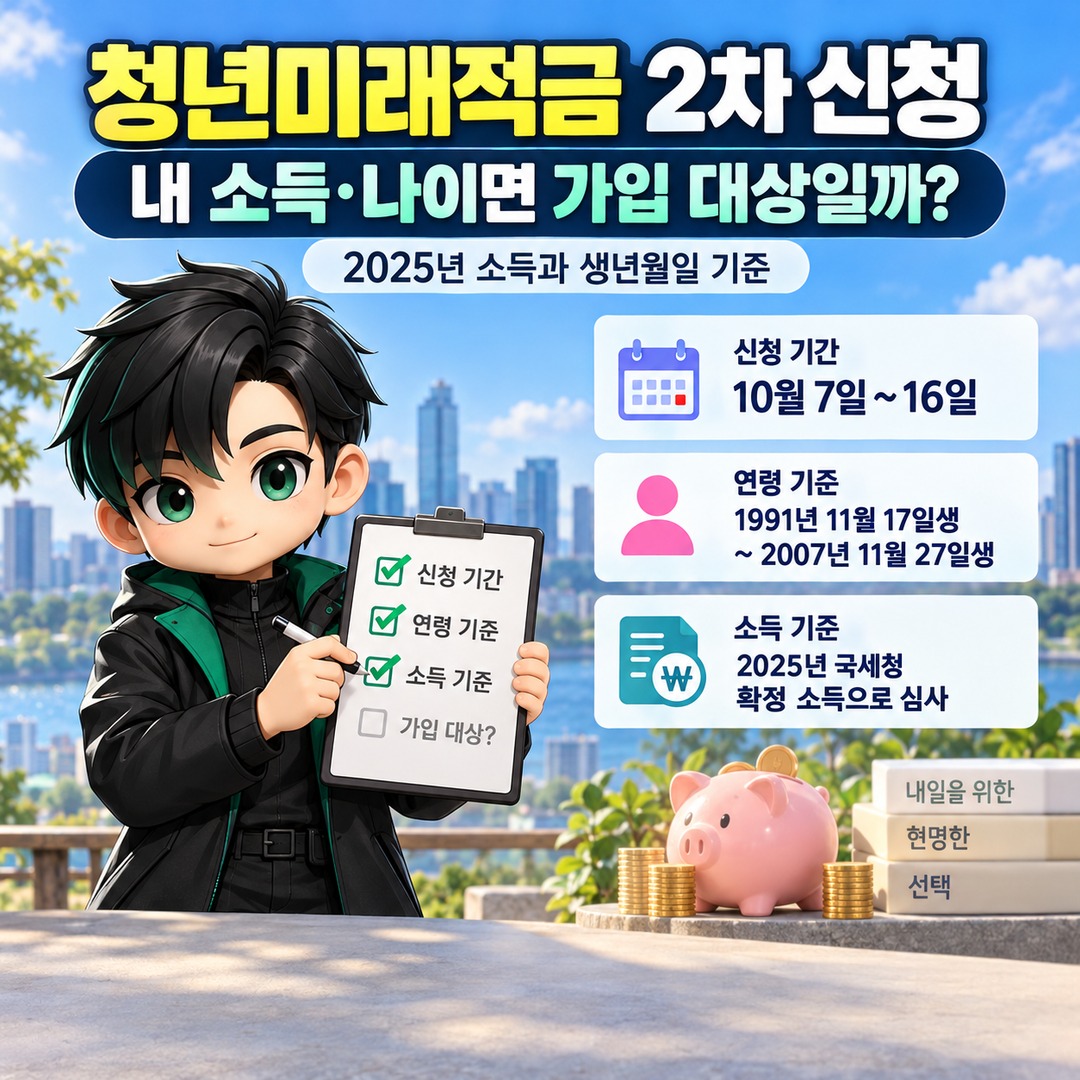
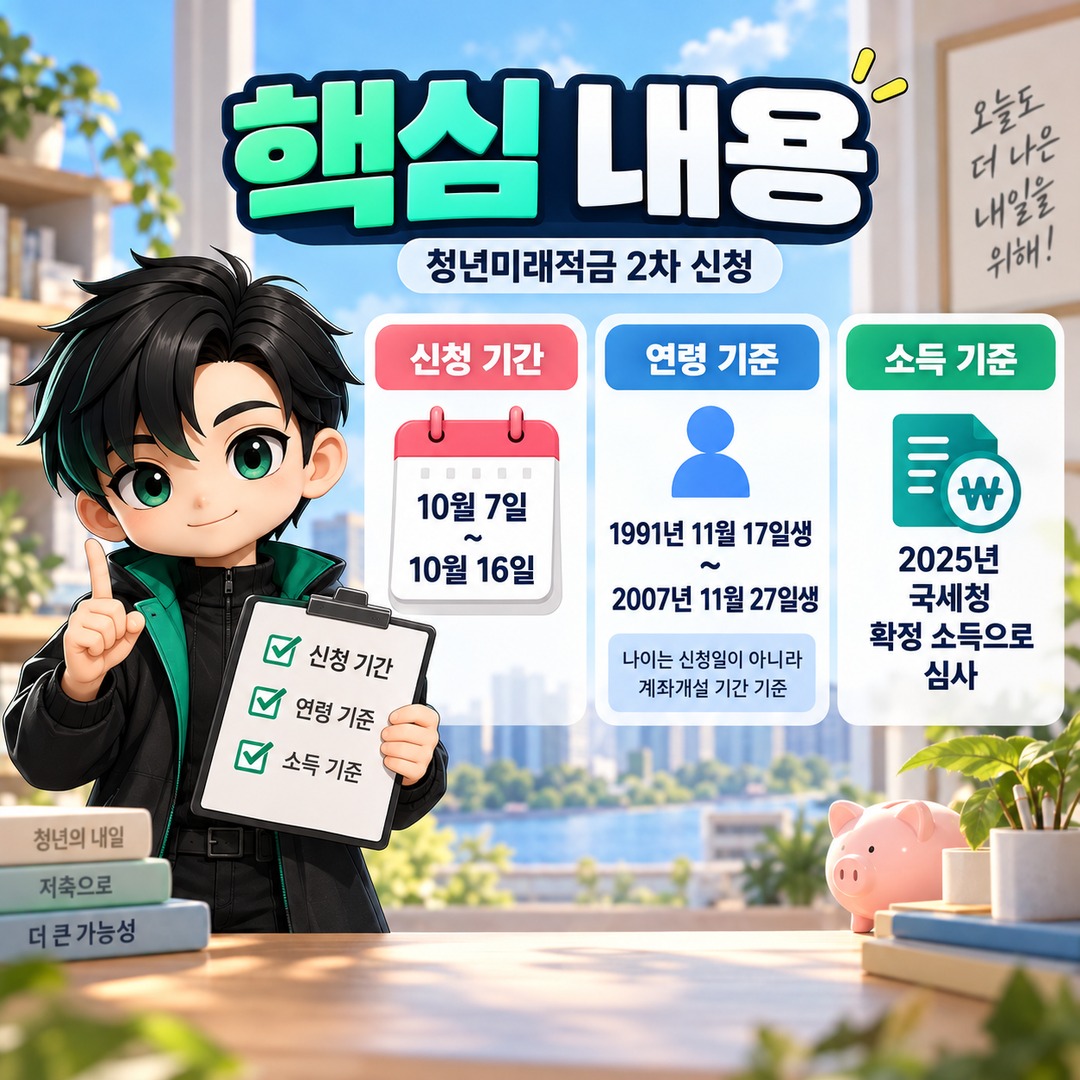
As of 2026-09-28, applications for the 2 round of the Youth Future Savings Account are open from October 7 through 16. Age eligibility is determined based on the account-opening period rather than the application date, with the standard eligible birth-date range extending from 1991-11-17 to 2007-11-27. Income eligibility is assessed using 2025 income finalized by the National Tax Service.
Therefore, you should not determine your eligibility based solely on your salary this year or your current age. In particular, it is important to distinguish between eligibility to open an account and eligibility to receive government contributions. Even if your gross annual salary exceeds KRW 60,000,000, you may still qualify to open an account under certain conditions if it does not exceed KRW 75,000,000, although you may not receive government contributions.
Checking Your Date of Birth Is the Fastest Way to Confirm Age Eligibility for the 2 Round
The standard eligibility age for the Youth Future Savings Account is 19 to 34 years old.

For the 2 recruitment round, eligibility is based on whether applicants fall within the 19-to-34 age range during the actual account-opening period, 2026-11-16 to 27. This means the eligible range of birth dates has been specifically defined.
If you were born between 1991-11-17 and 2007-11-27, you meet the standard age requirement.
However, the calculation may differ if you have completed military service. Up to 6 years of military service can be excluded when calculating your age. For example, even if you are currently 35 years old, completing 2 years of military service means your age for eligibility screening would be calculated as 33, after deducting those 2 years.
Conversely, you should not assume that you qualify simply because you are 34 years old when applying. Since the eligible birth-date range for this recruitment round is determined using applicants' ages at the time of account opening, checking whether your date of birth falls within the specified range is the more accurate approach.
Income Eligibility Is Based on 2025 Income, Not Your Expected 2026 Salary

Income screening for the 2 recruitment round uses 2025 income finalized by the National Tax Service.
For applicants assessed under the general income criteria, the basic upper limits are gross annual salary of KRW 75,000,000 or less, or comprehensive income of KRW 63,000,000 or less. Applicants must also meet the household income requirements.
The criteria for account eligibility and government contribution eligibility are not identical.
Applicants with a gross annual salary of KRW 60,000,000 or less may qualify for the standard category and receive government contributions equivalent to 6% of their deposits if they meet requirements such as household income not exceeding 200% of the median household income.
If your gross annual salary is above KRW 60,000,000 but no higher than KRW 75,000,000, you may still open a Youth Future Savings Account if you meet the eligibility requirements, including household income not exceeding 200% of the median household income. However, this income bracket qualifies only for tax-exempt interest income, without government contributions.
Under the comprehensive income criteria, the corresponding thresholds are KRW 48,000,000 and KRW 63,000,000, respectively.
In other words, earning more than KRW 60,000,000 annually does not automatically make you ineligible. KRW 60,000,000 is the threshold that determines eligibility for standard-category government contributions, while the upper income limit for general applicants is a gross annual salary of KRW 75,000,000.
You Must Also Meet the Household Income Requirements
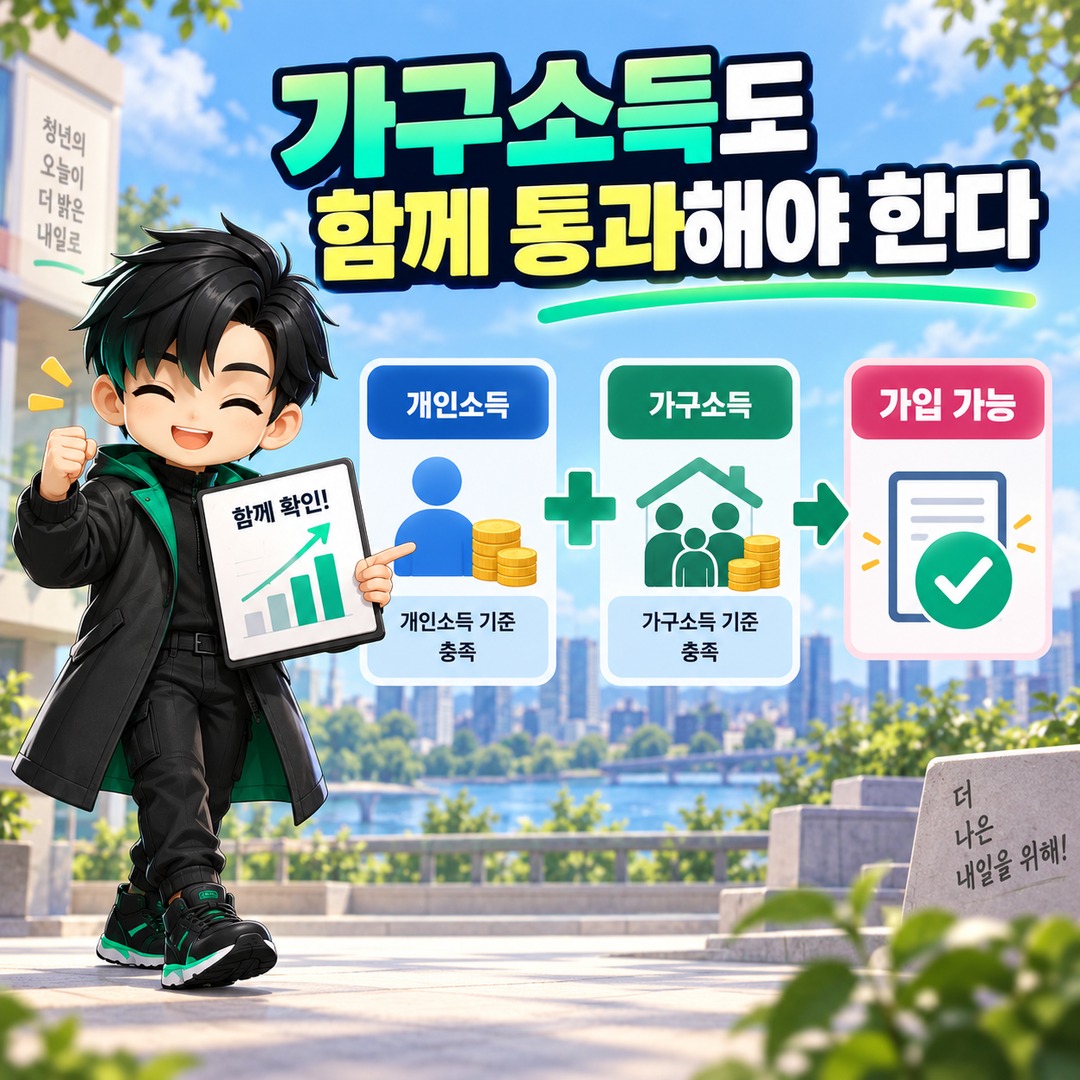
Meeting the individual income requirement alone does not guarantee eligibility.
The general eligibility criteria also require household income not exceeding 200% of the median household income. Therefore, even if your gross annual salary is KRW 75,000,000 or less, your eligibility may depend on the outcome of the household income assessment.
A separate standard applies to dual-income 2-person households. If a household consists of the young applicant and their spouse as listed on the resident registration certificate, and both individuals have income amounts verifiable by the National Tax Service, the household income threshold for general eligibility is 250% of the median household income.
The household income requirement is also relaxed for dual-income 2-person households applying under the preferential category.
Employees of Small and Medium-Sized Enterprises Should Check Whether They Qualify for the Preferential Category
Not everyone employed by a small or medium-sized enterprise automatically qualifies for the same preferential benefits.
Existing employees of small and medium-sized enterprises may qualify for the preferential category if they meet requirements including gross annual salary of KRW 36,000,000 or less, or comprehensive income of KRW 26,000,000 or less, and household income not exceeding 150% of the median household income. The current government contribution matching rate for the preferential category is 12% of the deposited amount.
Different criteria apply to newly hired employees of small and medium-sized enterprises. For the October 2026 application round, eligible newly hired employees include those who first obtained employment between 1 and December in 2025 and are currently employed by a small or medium-sized enterprise.
Applicants do not choose between the standard and preferential categories themselves when applying. Their category is determined after an assessment of their income and qualifications related to small and medium-sized enterprise employment.
Small Business Owners Must Also Meet Annual Revenue Requirements
Small business owners may qualify for the standard category if they meet requirements including annual revenue of KRW 300,000,000 or less and household income not exceeding 200% of the median household income.
The thresholds are lower for small business owners seeking preferential-category eligibility. They must meet requirements including annual revenue of KRW 100,000,000 or less and household income not exceeding 150% of the median household income.
If an applicant operates multiple business establishments, annual revenue is calculated by combining revenue from all establishments rather than assessing each one separately.
Even small business owners whose annual revenue exceeds KRW 300,000,000 may qualify under the general income criteria if their comprehensive income is KRW 63,000,000 or less. To apply as a small business owner, the applicant must be actively operating a business on the application date.
Applicants with no income, those unable to provide proof of income, and small business owners with no revenue reported to the National Tax Service for 2025 are not eligible under the criteria for this round.
How to Quickly Assess Your Eligibility Using Realistic Examples
For an employee born in 1995 with 2025 gross annual salary of KRW 45,000,000, both the age and individual income requirements fall within the standard eligibility range. Final eligibility will be determined after the applicant passes the remaining assessments, including household income screening.
For an employee born in 1993 with 2025 gross annual salary of KRW 65,000,000, exceeding the KRW 60,000,000 salary threshold does not automatically disqualify them. If their gross annual salary is KRW 75,000,000 or less and they meet the household income and other requirements, they may open an account. However, they will not qualify for government contributions and can receive only the tax-exemption benefit.
For someone born in 1990 who completed 2 years of military service, eligibility should not be determined solely by birth year. Since up to 6 years of military service can be excluded from the age calculation, a separate age assessment is required.
The common factor in all three examples is that age, 2025 individual income or business revenue, and household income must be considered together.
2 Applications Begin on October 7, With Odd-Even Birth-Year Rules for the First Two Days
The application period for the 2 round is 2026-10-07 through 16.
On October 7, applicants whose birth years end in an odd digit may apply. On October 8, applications are open to those whose birth years end in an even digit. From October 12 through 16, applications are accepted regardless of birth year.
After applications are submitted, screening of income and preferential-category qualifications is scheduled from October 19 through November 13.
Applicants who pass the screening can open their accounts and begin making deposits between November 16 and 27 through participating financial institutions. However, internal screening schedules may change slightly depending on the number of applicants and the progress of the review process.
Existing Youth Leap Account Holders Do Not Need to Give Up Their Accounts Immediately
The Youth Future Savings Account and the Youth Leap Account cannot be held simultaneously. However, the 2 recruitment round provides an additional opportunity for existing Youth Leap Account holders to switch to the new program.
The order of the process matters.
First, submit an application for the Youth Future Savings Account, complete the screening process, and receive confirmation that you are eligible. Then open the Youth Future Savings Account. Afterward, apply for a special early termination of your Youth Leap Account specifically for the purpose of joining the Youth Future Savings Account.
This differs from voluntarily closing your existing Youth Leap Account before opening the Youth Future Savings Account, so it is important to follow the detailed instructions provided for the transition.
Distinguish the 2027 Expansion Proposal From the Current 2 Recruitment Criteria
A government budget proposal submitted to the National Assembly includes plans to expand eligibility and increase the government contribution rate for the preferential category in 2027.
However, the proposed 2027 expansion must not be applied in advance to the October 2026 2 application round.
The planned expansion of eligibility in 2027 is subject to National Assembly approval and the necessary regulatory and administrative changes. It is intended to apply beginning with the 2027 recruitment rounds. Therefore, applicants for the current 2 round must determine their eligibility using the existing confirmed requirements, including age 19 to 34, 2025 income, and household income.
The steps to take now are straightforward. First, check your date of birth and military service period. Next, verify your 2025 income finalized by the National Tax Service. Finally, assess whether you meet the household income requirements. Since applications begin on October 7, the key is to prepare using the 2025 income figures used in screening rather than your current salary.
Related Articles
5 Indicators to Use Alongside RSI: Why Moving Averages and Trading Volume Matter