

Fixed, Hybrid, and Variable Mortgage Rates: Why DSR Loan Limits Differ Even When Interest Rates Are the Same
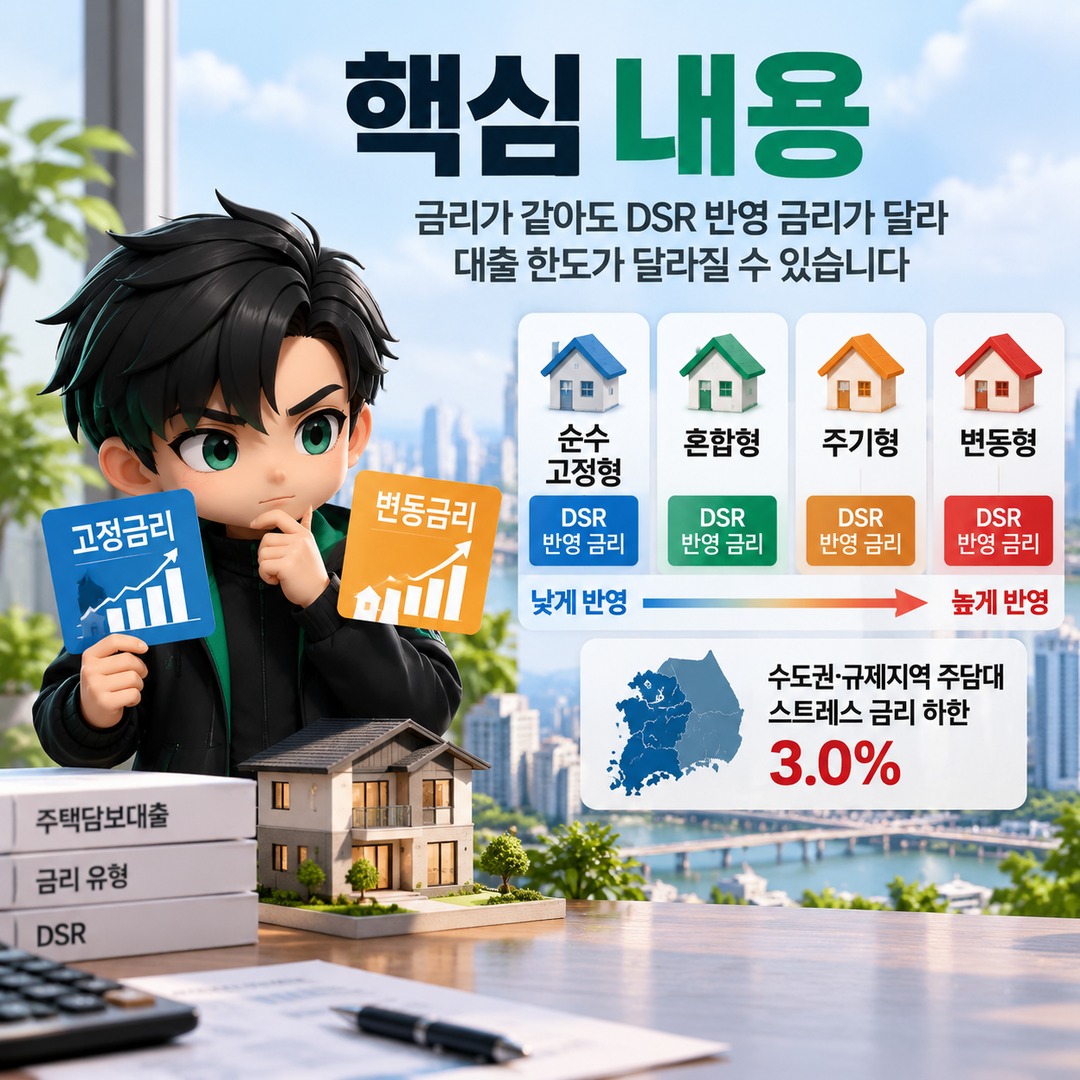
As of September 2026, mortgage loan limits can differ even when the contracted interest rate is the same because the interest rate used in the stress DSR calculation varies depending on whether the mortgage has a variable, hybrid, periodic-reset, or fully fixed rate. In particular, mortgages in the Seoul metropolitan area and regulated areas are subject to a minimum stress interest rate of 3.0%, so the type of interest rate can have a significant impact on borrowing limits.
Why Do Mortgage Loan Limits Differ When Interest Rates Are Identical?
The key is that the interest rate you actually pay may differ from the rate used to assess your debt service ratio (DSR).
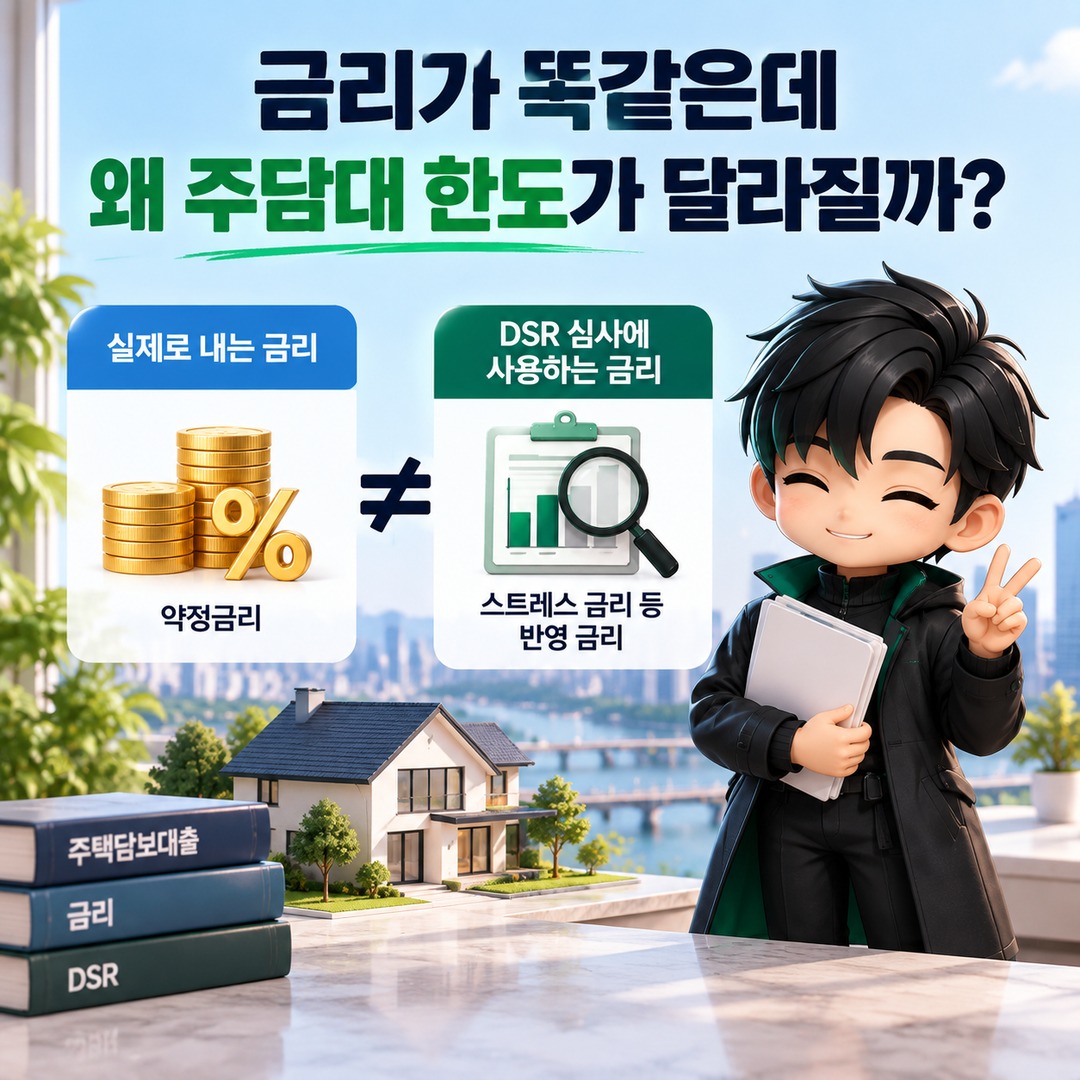
Stress DSR is a system that adds a hypothetical interest rate during loan assessment to account for the possibility that future interest rate increases could raise principal and interest repayment burdens. This additional rate is not charged on the actual loan. Instead, it is used solely to calculate borrowing limits.
In the second half of 2026, mortgages in the Seoul metropolitan area and regulated areas are subject to a stress interest rate of at least 3.0%. Meanwhile, mortgages outside these areas are subject to separate, relaxed standards until 2026-12-31.
Therefore, even with the same annual income and contracted interest rate, borrowers must consider not only the property's location but also how the loan product's interest rate may change in the future.
How Do Variable, Hybrid, and Periodic-Reset Rates Differ?
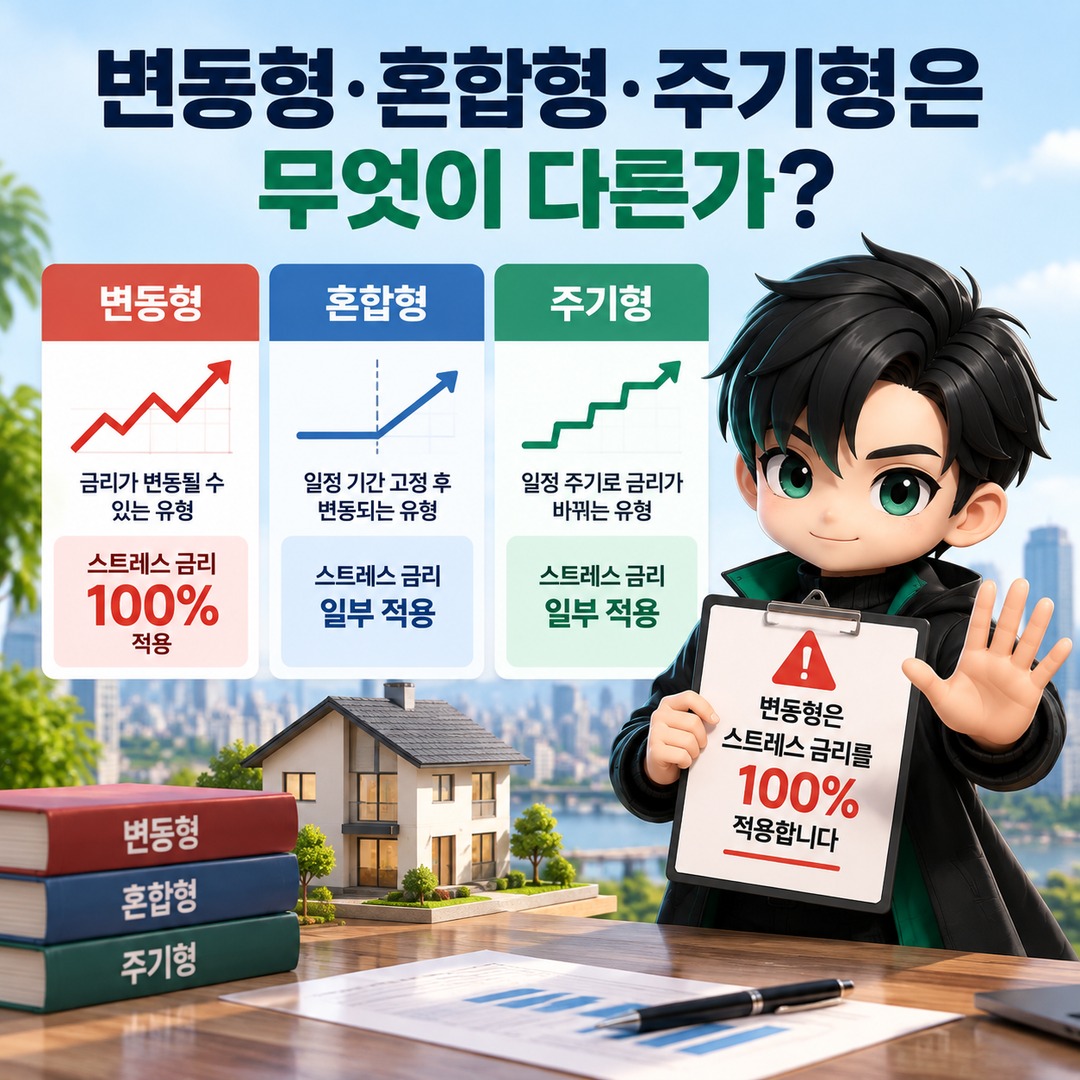
Variable-rate mortgages are most directly exposed to interest rate fluctuations, so the stress interest rate is applied at 100%.
A hybrid-rate mortgage has a fixed interest rate for a specified period before switching to a variable rate. A periodic-reset mortgage has an interest rate that is recalculated at specified intervals and remains unchanged until the next reset date.
Under the Financial Services Commission's 3-stage stress DSR rules, the longer the fixed-rate period or interest rate reset interval, the lower the percentage of the stress interest rate that applies. Products with interest rates fixed for a sufficiently long period, such as fully fixed-rate mortgages, may be exempt from the stress interest rate.
For example, a mortgage with a maturity of 30 years produces the following differences.
| Interest Rate Type | Stress Interest Rate Applied |
|---|---|
| Variable rate | 100% |
| 5-year hybrid rate | 80% |
| 5-year periodic-reset rate | 40% |
| Rate fixed for at least 21 years | 0% |
The percentages above are based on the 3-stage rules. Until the end of 2026, mortgages in non-regulated areas outside the Seoul metropolitan area are subject to relaxed standards for both the base stress interest rate and the percentages applied to hybrid and periodic-reset mortgages.
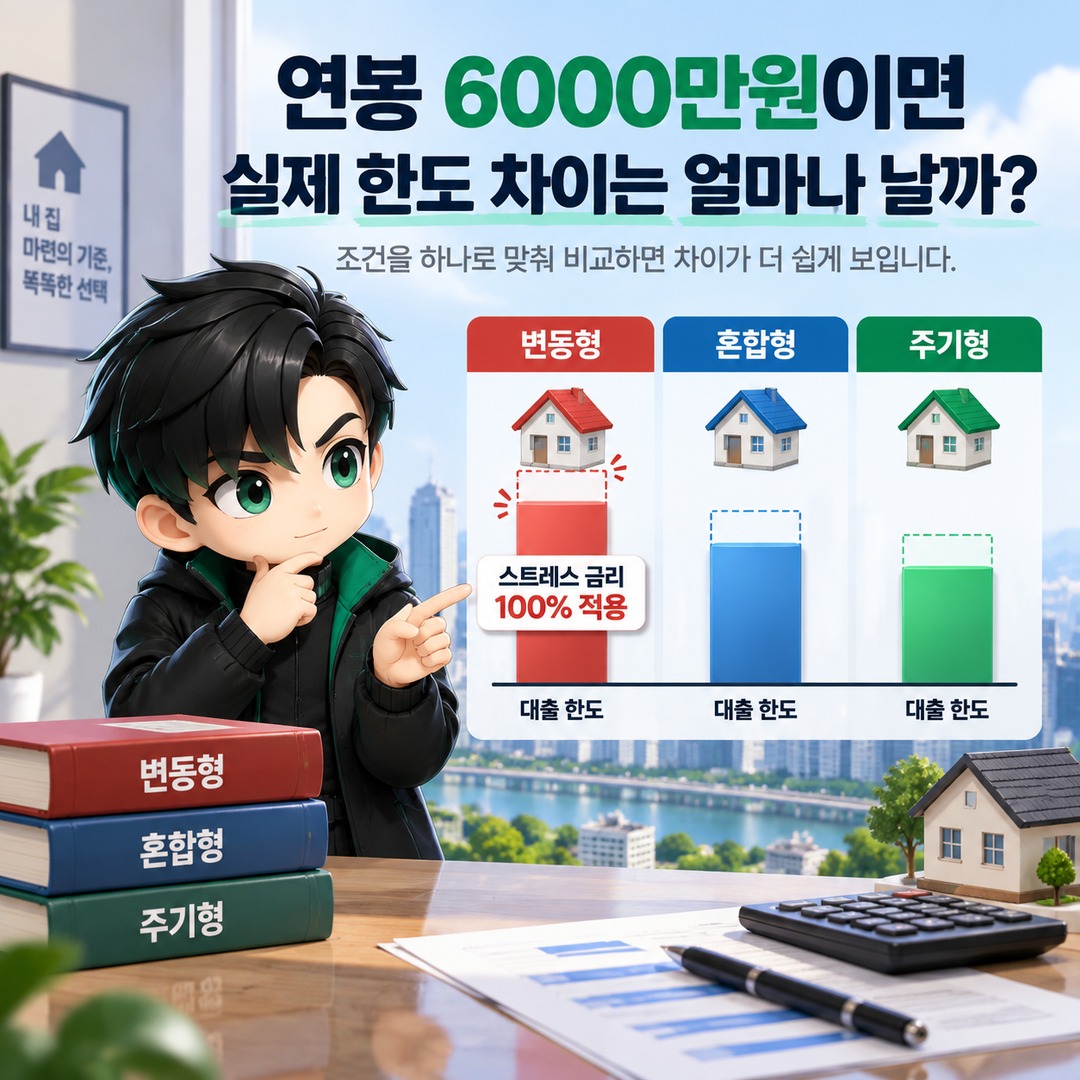
How Much Can Actual Loan Limits Differ With an Annual Salary of KRW 60,000,000?
The differences become easier to understand when the comparison uses identical conditions.
Assume an annual income of KRW 60,000,000, a bank DSR limit of 40%, no existing loans, equal principal-and-interest repayments over 30 years, a contracted annual interest rate of 4.0%, and a mortgage in the Seoul metropolitan area or a regulated area.
With a DSR of 40%, the annual principal and interest repayment capacity is KRW 24,000,000, or approximately KRW 2,000,000 per month.
Using the stress interest rate of 3.0% applicable to the Seoul metropolitan area and regulated areas, the estimated loan limits can be calculated backward from the assessment rates for each interest rate type as follows.
| Type | Interest Rate Used for DSR Calculation | Estimated DSR-Based Loan Limit |
|---|---|---|
| Variable rate | 7.0% | Approximately KRW 300,600,000 |
| 5-year hybrid rate | 6.4% | Approximately KRW 319,700,000 |
| 5-year periodic-reset rate | 5.2% | Approximately KRW 364,200,000 |
| Assumed fully fixed rate | 4.0% | Approximately KRW 418,900,000 |
Author's calculation: Annual income of KRW 60,000,000 × DSR 40% = an annual principal and interest repayment limit of KRW 24,000,000. The loan principal was then calculated backward using each assessment interest rate and equal principal-and-interest repayments over 30 years. This is a simplified comparison applying the Financial Services Commission's stress interest rate methodology for different interest rate types.
Even with the same assumed annual interest rate of 4.0%, the difference in DSR-based borrowing limits between variable-rate and fully fixed-rate mortgages is approximately KRW 118,300,000.
However, there is no guarantee that variable-rate and fixed-rate mortgage products will offer identical contracted interest rates in the actual market. Therefore, the calculations above should be viewed as an illustrative example that isolates the effect of the interest rate type itself on DSR borrowing limits.
Does Choosing a Fixed Rate Always Mean You Can Borrow More?
Not necessarily. An advantage under the stress DSR rules does not automatically translate into an equivalent increase in the final mortgage loan limit.
Actual mortgage lending is subject to other requirements in addition to DSR, including loan-to-value ratios (LTV), property-price-based lending caps, homeownership status, existing debt, and individual financial institutions' lending criteria.
In particular, maximum mortgage limits for home purchases in the Seoul metropolitan area and regulated areas vary according to property prices. Since 2025-10-16, the applicable limits have been KRW 600,000,000 for properties with a market value of KRW 1,500,000,000 or less, KRW 400,000,000 for properties valued above KRW 1,500,000,000 and up to KRW 2,500,000,000, and KRW 200,000,000 for properties valued above KRW 2,500,000,000.
For example, even if a DSR calculation indicates that a loan of KRW 700,000,000 is possible, borrowers should not assume they can actually borrow KRW 700,000,000 if the separate lending cap applicable to the property is KRW 400,000,000.
Not Every Hybrid-Rate Mortgage Uses 80%
This is one of the easiest details to overlook.
You should not automatically apply 80% of the stress interest rate simply because a product is labeled a hybrid-rate mortgage. The applicable percentage depends on how much of the total loan term is covered by the fixed-rate period.
Under the 3-stage rules for a 30-year mortgage, hybrid-rate products apply 80% when the interest rate is fixed for 5–9 years, 60% for 9–15 years, and 40% for 15–21 years. No stress interest rate applies when the rate is fixed for at least 21 years.
The applicable percentage for periodic-reset mortgages also varies according to the interest rate reset interval.
Therefore, when comparing mortgage products at a bank, borrowers should go beyond simply asking whether the rate is fixed or variable. They should confirm how many years the rate remains fixed, whether the product subsequently switches to a variable rate, and how frequently the interest rate is recalculated.
Follow This Order When Comparing Mortgage Loan Limits
First, check the contracted interest rate that will actually apply. Next, determine whether the mortgage is variable-rate, hybrid-rate, periodic-reset, or fully fixed-rate.
For hybrid-rate or periodic-reset products, confirm the fixed-rate period or interest rate reset interval to identify the correct percentage of the stress interest rate that applies.
Then determine whether the property is located in the Seoul metropolitan area, a regulated area, or a non-regulated area outside the Seoul metropolitan area. Compare DSR, including existing loans, alongside LTV and property-price-based lending caps.
Ultimately, a single table showing how much someone can borrow based on annual salary is not enough to determine an actual mortgage loan limit. In 2026, a realistic borrowing estimate requires considering not only income and existing debt but also the property's location and the mortgage's interest rate type.
Individual loan approval amounts and applicable interest rates may vary depending on the financial institution, income verification method, existing debt, and product conditions. Borrowers should therefore reconfirm the applicable terms with their financial institution at the time of application before taking out a loan.
※ This article is provided for informational purposes to help readers understand market conditions and does not constitute an investment recommendation for any particular security or asset. All final decisions and investment responsibilities rest with the individual.