

iPhone 18 Pro Component Costs Could Jump 38%, but Why Won't Its Retail Price Rise 40%?
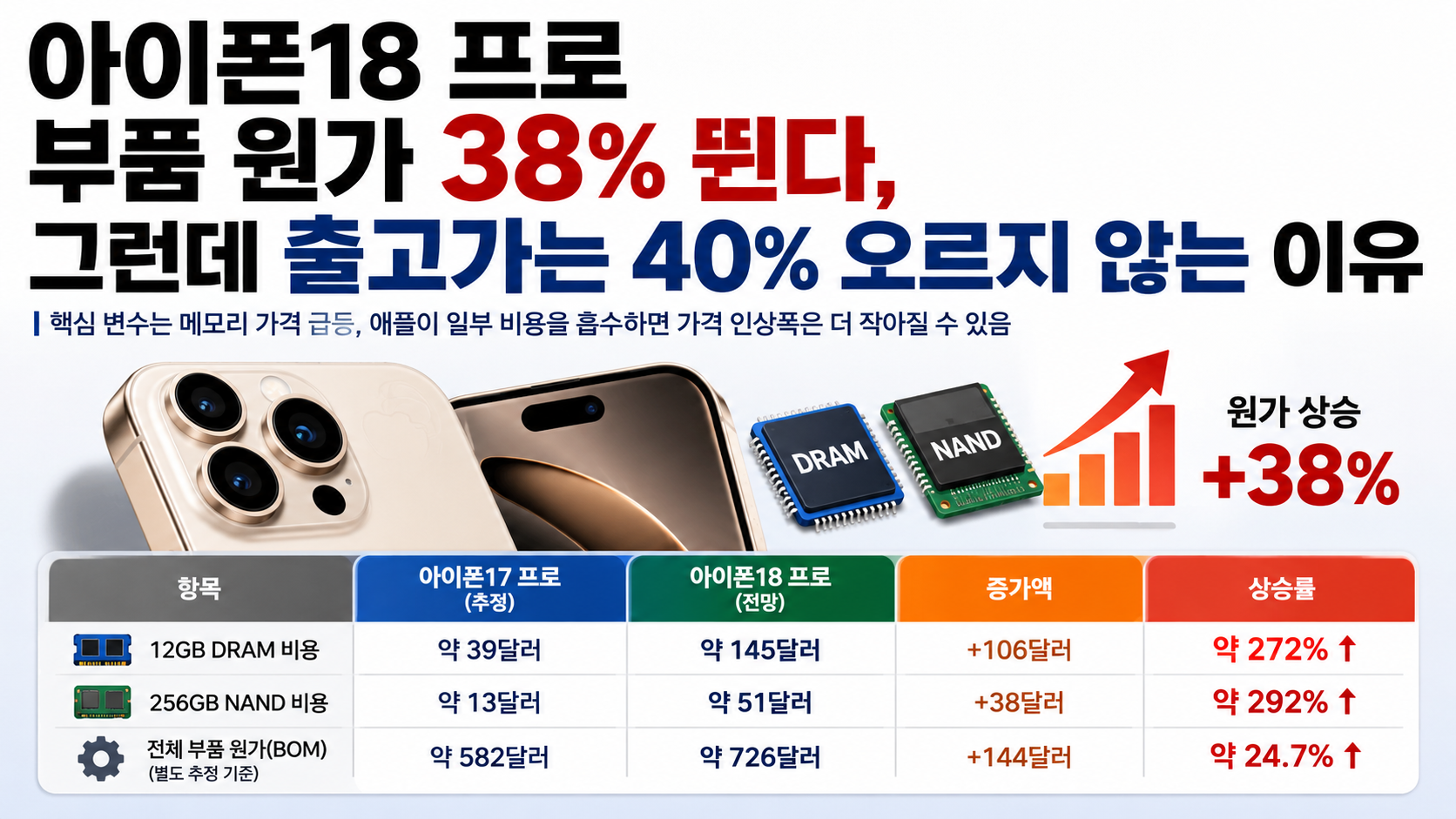
A forecast suggests that component costs for the iPhone 18 Pro 256GB model could increase by approximately 38% compared with its predecessor. Although this is often summarized as a '40% increase in costs,' it does not mean iPhone prices will rise by the same 40%. The biggest variable is the sharp increase in memory prices, and if Apple absorbs some of the additional costs, the increase in consumer prices could be smaller than the rise in component costs.

As of 2026-08-12, the final launch price of the iPhone 18 Pro has not been confirmed. Therefore, the two figures that need to be distinguished are the increase in component costs and the actual increase in retail prices.
What Exactly Does a 40% Increase in iPhone 18 Pro Component Costs Mean?
To describe the current forecast accurately, component costs for the iPhone 18 Pro 256GB could increase by approximately 38% year over year. When rounded, that is close to 40%.
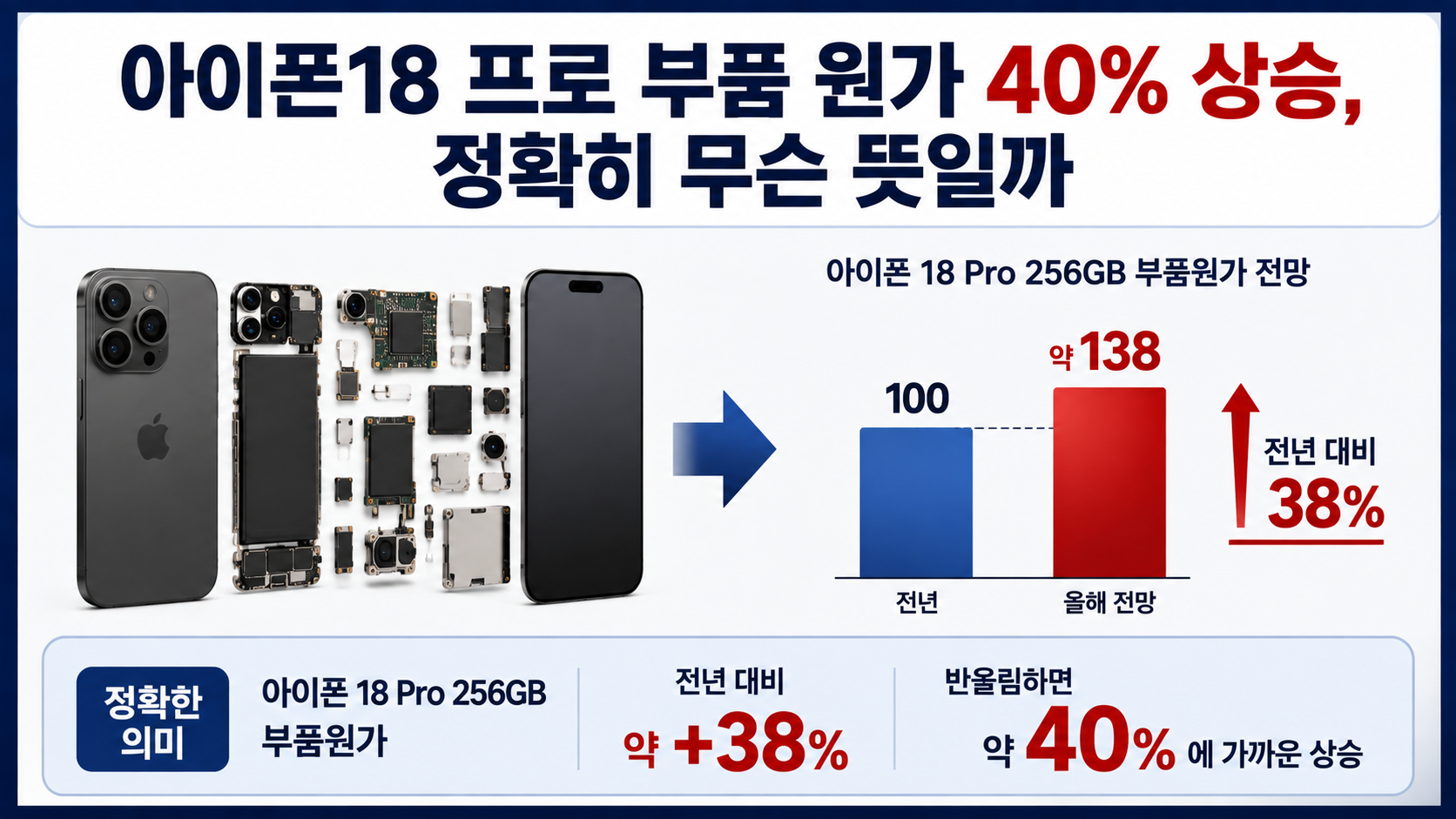
The component costs discussed here refer to the Bill of Materials (BOM), essentially the combined physical costs of the major components used in a smartphone. This is different from the price consumers pay in stores.
In addition to components, smartphone retail prices reflect various expenses, including research and development, software, manufacturing and assembly, logistics, marketing, distribution, warranty services, and corporate profits.
Therefore, a 38% increase in component costs does not automatically require a 38% increase in the selling price.
Instead, the important question in this forecast is how much of the additional cost Apple will pass on to consumers and how much it will absorb through lower profit margins.
Memory Is the Biggest Driver of Rising Component Costs

DRAM and NAND flash prices are at the center of the projected increase in iPhone 18 Pro component costs.
DRAM is the memory used by applications and operating systems while performing tasks, while NAND is used in storage devices that hold photos, videos, applications, and other data. As investment in AI data centers expands rapidly, changes in memory supply and pricing are also affecting consumer electronics.
The cost of 12GB of DRAM in the iPhone 17 Pro was estimated at approximately USD 39, but another analysis suggested that the same 12GB configuration in the iPhone 18 Pro could cost approximately USD 145.
A simple calculation puts the difference at USD 106.
Author's calculation
USD 145 - USD 39 = USD 106 increase
USD 106 ÷ USD 39 × 100 = approximately 271.8%
In other words, based on these estimates, the cost of 12GB of DRAM alone would increase by approximately 272%.
A scenario has also been presented in which the cost of 256GB of NAND storage rises from approximately USD 13 to approximately USD 51.
Author's calculation
USD 51 - USD 13 = USD 38 increase
USD 38 ÷ USD 13 × 100 = approximately 292.3%
Combining just these two components, DRAM and NAND, the cost rises from USD 52 to USD 196.
The increase amounts to USD 144.
This makes it difficult to interpret the current cost issue simply as a case of new features making the phone more expensive. A substantial part of the increase comes from major price changes in memory and storage components that were already necessary in previous models.
How High Could Total Component Costs Rise?
An earlier, separate cost estimate calculated the component cost of the base iPhone 17 Pro at approximately USD 582 and the projected cost of the upcoming iPhone 18 Pro at approximately USD 726.
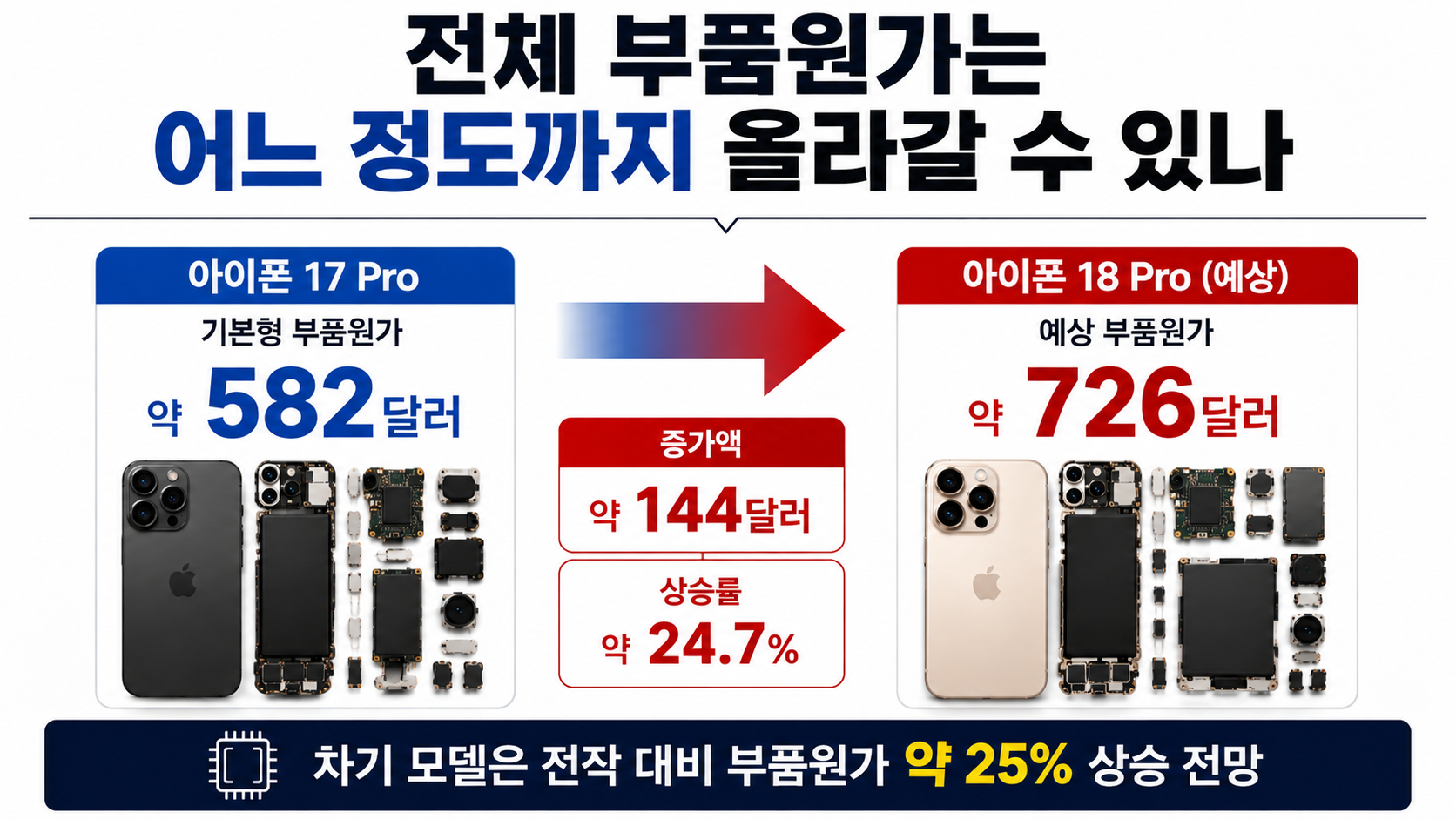
Comparing the two figures on the same basis gives an increase of USD 144.
Author's calculation
USD 726 - USD 582 = USD 144
USD 144 ÷ USD 582 × 100 = approximately 24.7%
In other words, that earlier calculation indicated an increase of approximately 25%.
By contrast, a subsequent forecast presented a higher estimate, suggesting that component costs for the iPhone 18 Pro 256GB could increase by approximately 38% year over year.
It is essential to distinguish between these different figures.
Component prices are not fixed, and memory contract prices and supply conditions continue to change. Overall BOM estimates can also vary depending on which components and time periods are used in the calculations.
Therefore, rather than concluding that 'the confirmed manufacturing cost of the iPhone 18 Pro has increased by exactly 38%,' it is more accurate to understand that the latest forecast reflecting current supply-chain costs has risen to approximately 38%.
Will the iPhone 18 Pro Price Also Rise 40%?
The information currently available does not provide sufficient grounds to conclude that the retail price of the iPhone 18 Pro will increase by 40%.
Instead, the most important scenario is that Apple may absorb some of the additional component costs through lower profit margins rather than passing the entire increase on to consumers.
For example, suppose a product sells for USD 1,000. Even if its component costs rise from USD 500 to USD 690, an increase of 38%, the company does not necessarily have to raise the selling price to USD 1,380.
It could adjust the selling price to USD 1,200 or maintain much of the existing price while accepting a decline in its profit margin.
The iPhone 18 Pro faces the same trade-off.
From Apple's perspective, a substantial price increase would make it easier to protect profitability per device, but it could put pressure on sales volumes. Conversely, keeping price increases as small as possible could help preserve sales volumes but reduce hardware margins.
Ultimately, consumers should look beyond the single figure of '38% in component costs' and focus on what percentage of the additional costs Apple actually incorporates into its retail prices.
Why iPhone 18 Pro Price Forecasts Keep Changing
Price expectations for the iPhone 18 Pro have changed considerably this year. Early forecasts suggested that Apple would try to maintain its starting price through supply-chain negotiations and cost absorption. However, as memory costs increased, some analysts began discussing the possibility of price increases in the 100~USD 300 range.
Three variables are changing simultaneously.
The first is DRAM and NAND pricing. Memory now accounts for a larger share of the cost of each iPhone than before.
The second is the A20 Pro. The iPhone 18 Pro is rumored to feature a next-generation chip manufactured using a 2-nanometer process, making semiconductor costs another pricing variable.
The third is Apple's pricing strategy. Supply-chain costs alone cannot determine whether Apple will pass the entire increase in component prices on to consumers or absorb some of it.
In particular, the final pricing decision may depend on whether Apple benefits more from raising prices substantially and potentially reducing sales volumes, or from limiting price increases while accepting lower margins.
Why the 256GB Base Storage Capacity Also Matters
The iPhone 18 Pro may start with 256GB of storage. This possibility needs to be considered alongside the current increase in memory prices.
When storage component prices have risen significantly, increasing the base storage capacity places an additional cost burden on the entry-level model.
Conversely, reducing storage capacity would make it easier to control the starting price, but it could make the Pro model less attractive to prospective buyers.
If 256GB remains the base capacity as currently forecast, Apple would need to rely on other cost reductions or margin adjustments rather than lowering the starting price by reducing storage capacity.
However, as of 2026-08-12, the final specifications and country-specific prices of the iPhone 18 Pro have not yet been officially announced. Storage capacity and pricing will need to be verified against Apple's actual announcement.
Should You Buy the iPhone 17 Pro Now or Wait for the 18 Pro?
If price is your main priority, it would be better to compare the actual selling price of the existing model with the new model's price once the iPhone 18 Pro is announced. Unconfirmed pricing forecasts alone are not sufficient reason to rush into purchasing the iPhone 17 Pro.
On the other hand, if hardware changes such as a new chip and camera are more important to you, there is good reason to wait for the official announcement before making a comparison.
In particular, the iPhone 18 Pro is rumored to feature the A20 Pro based on a 2nm manufacturing process, along with new camera hardware. Buyers should confirm whether these changes actually appear in the final product and evaluate them alongside the price difference.
For example, even if the new model costs USD 100 more, waiting could be a reasonable choice if it offers substantial improvements in features you need. Conversely, if the price increase is large but the practical improvements are limited, the discounted price of the previous generation may become more important.
Ultimately, it is still too early to conclude that consumers should 'definitely buy the 17 Pro' or 'wait for the 18 Pro.'
The Key Numbers to Watch for the iPhone 18 Pro
When evaluating the price of the iPhone 18 Pro, the first figure to check should be its officially announced starting price rather than the projected 38% increase in component costs.
Next, buyers should compare whether the 256GB base storage capacity is retained, the price difference between the Pro and Pro Max, prices for higher storage configurations, and country-specific pricing.
For buyers in South Korea in particular, predicting local prices based solely on the US launch price has limitations. Korean prices may also reflect exchange rates and Apple's country-specific pricing policies.
The information confirmed so far can be summarized in one sentence.
The component costs of the iPhone 18 Pro could rise by nearly 40%, but that figure does not mean consumer prices will increase by 40%.
Instead, the key question for the upcoming iPhone 18 Pro is how Apple will distribute the burden of sharply rising memory costs between higher retail prices and lower profit margins.
Once official prices are announced, rather than simply asking whether the price has increased, comparing how many dollars and what percentage the price has risen relative to the iPhone 17 Pro, and which specification changes are included in that difference, will be more useful for making a purchasing decision.