

When Will the 23 Million Homes in the Seoul Metropolitan Area Be Ready for Occupancy? 37 Months Refers to the Time Until Construction Begins, Not Move-In
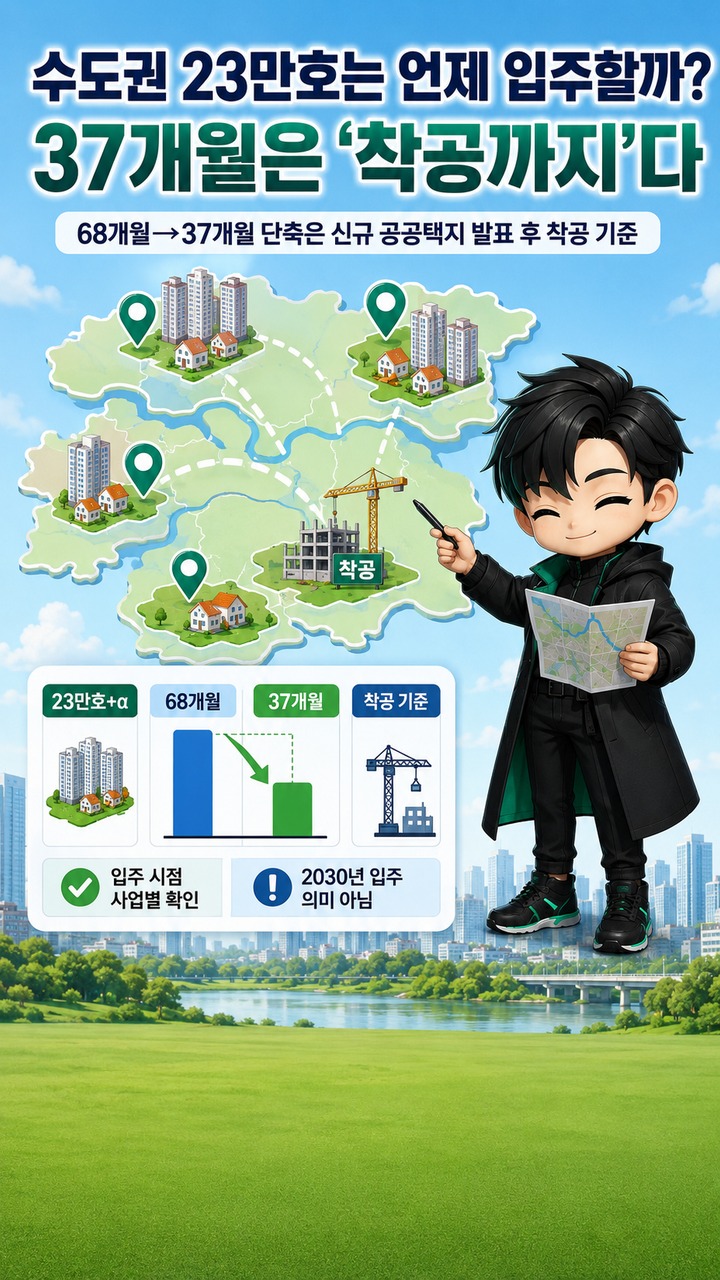
The 23 million homes+α planned for the Seoul metropolitan area are not necessarily scheduled for occupancy by 2030. The government's proposed reduction from 68 months to 37 months refers to the period between the announcement of a new public housing site and the start of construction, and the sales and occupancy schedules for individual developments will only become clear once their respective project timelines are finalized.
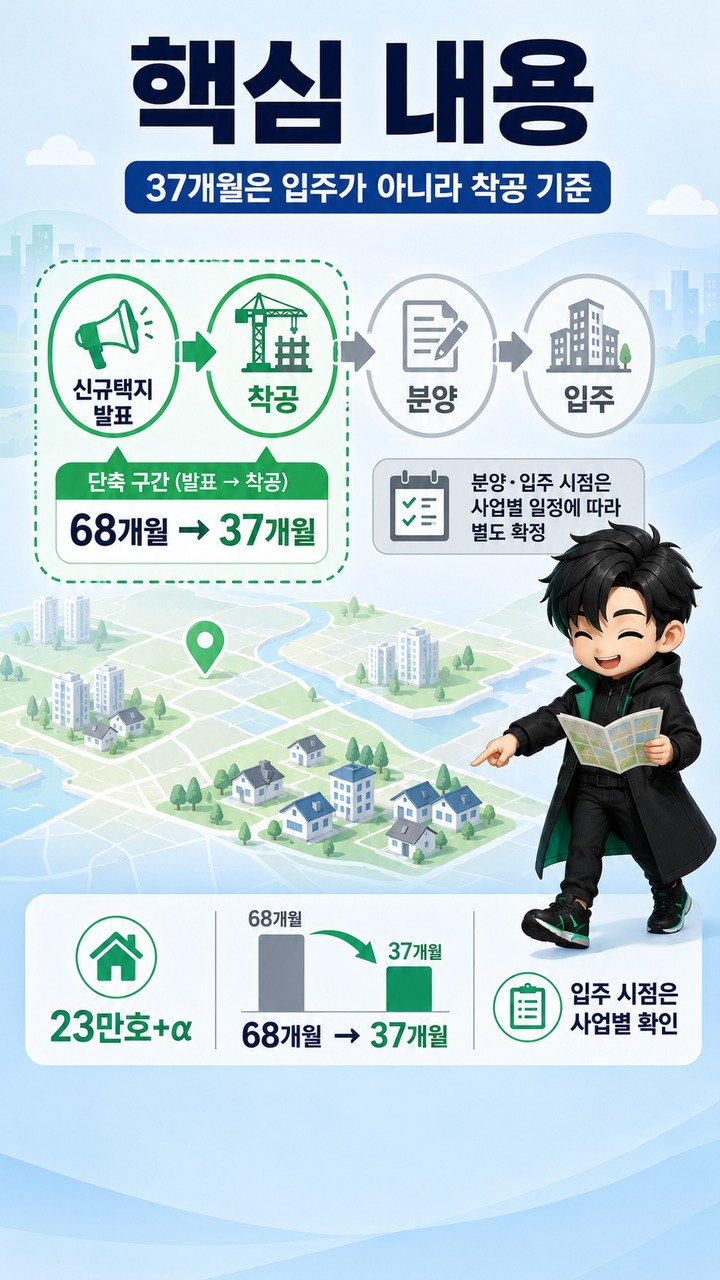
For people without homes and those waiting to apply for housing, it is therefore important to distinguish between new housing sites, existing sites where construction will begin earlier than planned, and housing units with actual sales schedules rather than focusing solely on the overall figure of 23 million homes.
23 Million Homes+α Does Not Mean Homes Ready for Occupancy in 2030
In its housing supply acceleration plan announced on 2026-08-13, the government said it would pursue an additional 23 million homes+α in the Seoul metropolitan area, including 10 million homes on newly designated housing sites.
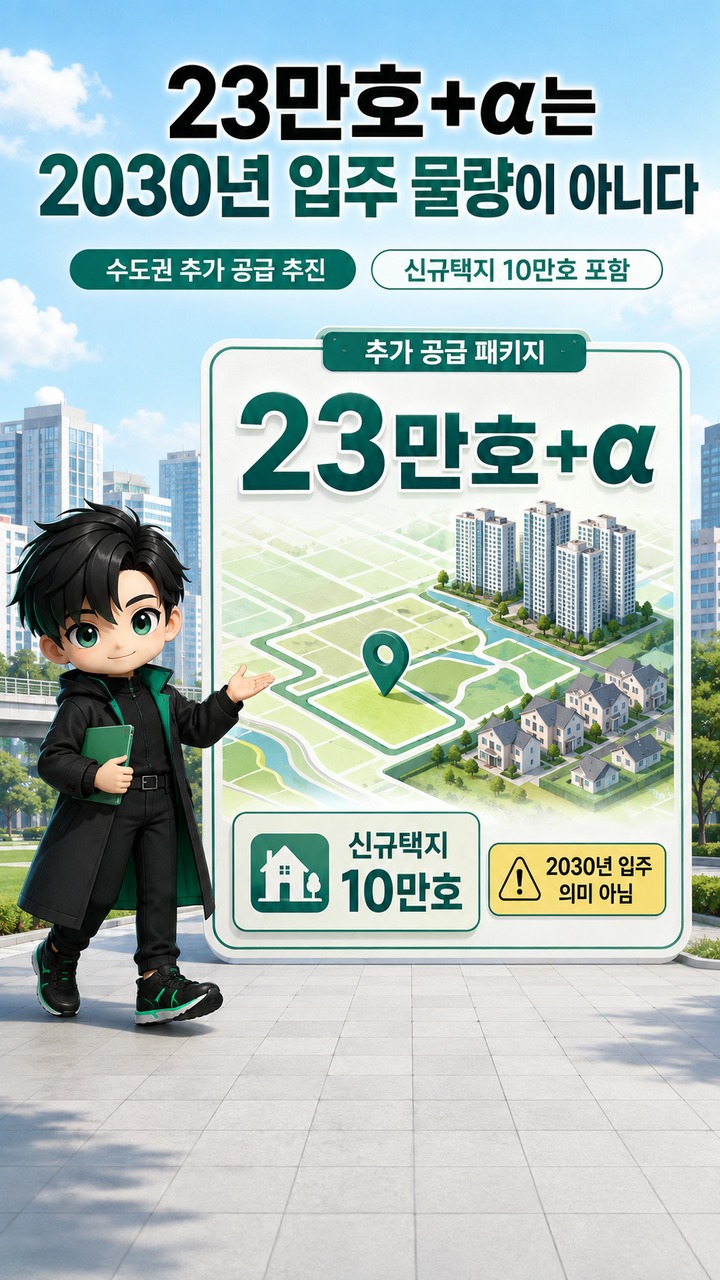
However, the government's underlying target is to begin construction on 135 million homes in the Seoul metropolitan area between 2026 and 2030. Many provisions of the 8 and 13 measures are likewise designed to bring forward construction start dates rather than occupancy dates.
Three stages need to be distinguished.
| Stage | Meaning |
|---|---|
| Supply plan | The stage at which authorities determine how many homes will be supplied and where |
| Construction start | The stage at which actual residential construction work begins |
| Occupancy | The stage at which construction has been completed and residents can move in |
In other words, a commitment to begin construction by 2030 is entirely different from a commitment to make homes available for occupancy by 2030.
This distinction explains why questions about when the 23 million homes will actually become available have repeatedly surfaced following the government's announcement. Recent reports have also continued to emphasize that the 23 million homes+α are not units available for immediate occupancy and that a substantial time lag remains before the housing supply materializes.
What Exactly Does the 37-Month Timeline Cover?
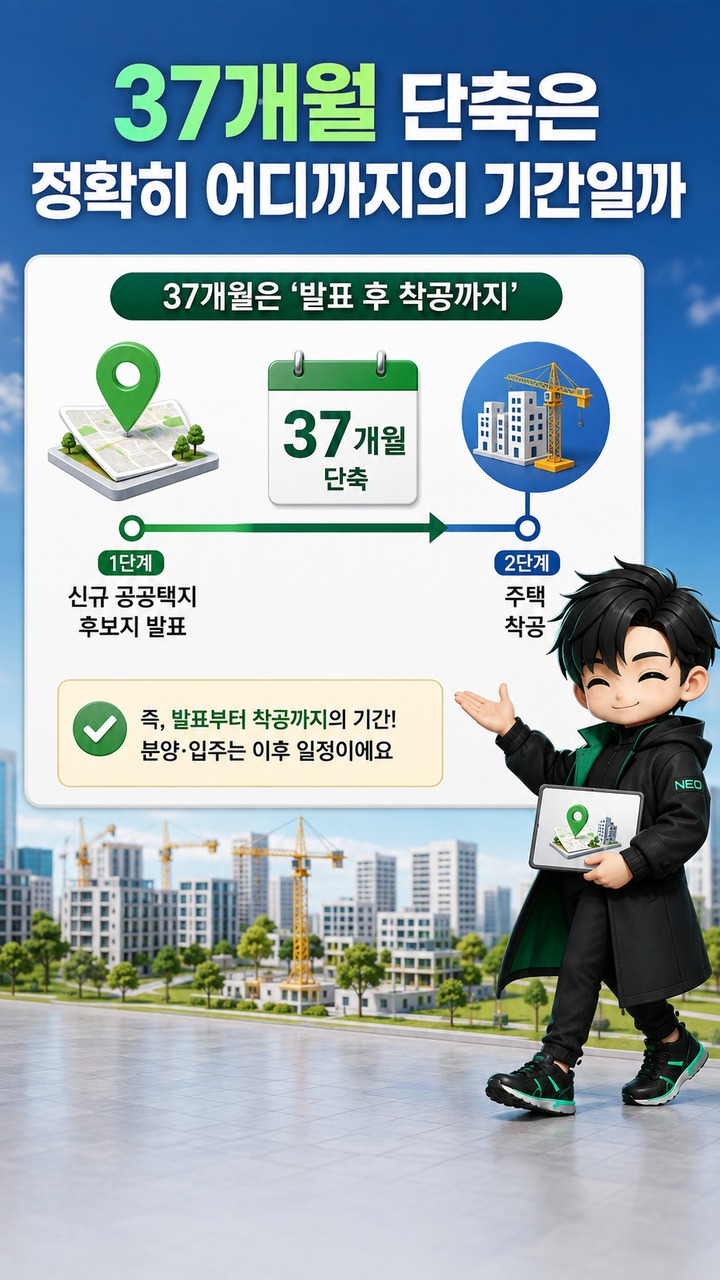
37 months refers to the period from the announcement of a candidate site for new public housing development until residential construction begins.
Under the previous 3-generation new-town development model, it took an average of approximately 68 months from the announcement of a candidate site to the start of construction. The government plans to shorten this period to 37 months by carrying out certain procedures, including permitting and land compensation, simultaneously. This would reduce the timeline by as much as 31 months, or approximately 2 years and 7 months.
The calculation is straightforward:
68 months - 37 months = 31 months saved
However, homes will not be ready for occupancy immediately after 37 months. That point marks the targeted start of construction, not the date when buildings will be completed.
After construction begins, the actual apartment buildings must still be built, supporting infrastructure must be developed, and construction must be completed and approved. Because development sizes and project conditions differ, it is difficult to calculate a single precise occupancy year for all developments based solely on the announced 37-month target.
Even the First 2 Million 7200 Homes Were Announced With Construction Targets, Not Occupancy Dates
Among the 10 million homes+α planned for new public housing districts, the first locations disclosed on 2026-08-13 comprise three areas totaling approximately 2 million 7200 homes.
These are approximately 1,000 homes at Yeomchang Park in Gangseo-gu, Seoul; approximately 2 million 1,700 homes in the Wabu-eup area of Namyangju, Gyeonggi Province; and approximately 4,500 homes in the Jangji-dong area of Gwangju, Gyeonggi Province.
The schedules currently available are closer to construction start targets than confirmed occupancy dates.
The Yeomchang Park project in Gangseo-gu, Seoul, aims to begin construction in 2029 by integrating major administrative procedures. The Wabu area of Namyangju has set a target of starting construction in the first half of 2030, following district designation and land compensation procedures.
However, as of 2026-08-31, it would be difficult to conclude that final occupancy dates have been confirmed for these areas.
New housing sites are particularly susceptible to changes during the development process, including public inspection and consultation, district designation, district planning, land compensation, and infrastructure planning. Land compensation and residents' opinions have also been cited as potential factors affecting the future schedule of the Yeomchang Park project.
The 23 Million Homes Figure Must Also Be Distinguished From the Actual Additional Construction Starts
It would also be inaccurate to interpret the entire 23 million homes+α figure as apartments that will all be newly built by 2030.
Based on the government's explanations and reports published immediately after the announcement, the number of additional homes expected to begin construction between 2026 and 2030, compared with previous plans, is currently estimated at approximately 12 million homes+α. Among the 10 million homes+α planned for new housing sites, the portion whose specific contribution to construction starts has not yet been determined will be reassessed during the future district designation process.
In addition, the government aims to bring forward construction on approximately 8 million 9000 homes in existing 3-generation new towns and major public housing sites by 1 to 2 years. The Ministry of Land, Infrastructure and Transport has explained that it intends to accelerate construction starts on 8 million 9000 public housing units by 2030.
The figures are therefore best understood as follows.
**23 million homes+α = Overall additional housing supply effect
12 million homes+α = Currently announced estimate of additional construction starts by 2030 compared with previous plans
8 million 9000 homes = Major volume of housing on existing public housing sites and elsewhere for which construction start dates will be brought forward**
Because these figures use different reference points, adding them together or comparing them as though they represent a single volume of homes ready for occupancy can easily lead to misunderstandings about when housing will actually become available.
What Should Prospective Housing Applicants Check?
For prospective owner-occupiers, the most important figure is ultimately not 23 million homes, but when the homes they are eligible to apply for will actually be advertised for applications.
The government has announced plans to expand public housing sales on public development sites in the Seoul metropolitan area to approximately 1 million 8000 homes in the second half of 2026 and approximately 2 million 7000 homes in 2027. This public housing sales plan is separate from the occupancy schedule for the entire 23 million homes planned on new housing sites.
For those preparing to apply for housing, it is therefore more practical to check the following sequence rather than focusing only on the announced supply figures.
Candidate site announcement → District designation → District planning and compensation → Construction start → Housing application notice and sales → Construction completion and occupancy
In particular, the announcement of a new housing development site does not, by itself, establish when applications will open, what the sale prices will be, or which types of housing will be offered.
For Yeomchang Park, the overall supply scale of approximately 1,000 homes and the 2029 construction start target have been disclosed. However, further project plans must be reviewed to determine the specific composition of rental and for-sale housing.
Housing Market Assessments Must Also Distinguish Between Construction Starts and Occupancy
Housing supply announcements can create expectations of future supply in the property market, but the stage at which new housing directly affects rental availability and the supply of homes people can actually live in comes much later.
For anyone currently deciding whether to buy a home or extend a jeonse lease, it would be difficult to conclude that a short-term housing shortage will immediately be resolved simply because construction is targeted to begin around 2030. Experts have also generally viewed the direction of accelerating housing supply positively while emphasizing that effective implementation, leading to actual construction starts and occupancy, will be crucial.
Conversely, if construction starts are accelerated as planned and subsequent sales and completion proceed without significant disruption, the measures could influence medium- to long-term housing supply expectations.
When assessing the property market, it is therefore necessary to examine announced supply volumes → actual construction starts → homes offered for sale → completed homes and occupancy volumes separately.
As of 2026-08-31, one conclusion can be stated with the greatest confidence.
The 23 million homes+α planned for the Seoul metropolitan area do not represent 23 million homes that will be ready for occupancy by 2030. Likewise, 37 months is not the period until occupancy, but the targeted period from the announcement of a new public housing site to the start of construction. Actual occupancy dates will need to be confirmed as district designation, compensation, construction, and housing sales schedules for individual projects become more concrete.
※ Housing supply schedules and market impacts may change depending on future permits, compensation procedures, and project conditions. Decisions to buy or sell property should take into account individual financial circumstances as well as actual occupancy and housing sales volumes.
※ This article is provided for reference to help readers understand market trends and does not constitute an investment recommendation for any particular security or asset. Final decisions and responsibility for investments rest with the individual.