

Can Small Business Owners Use the Business Stability Voucher for Telecom Bills? 2026 Final Eligible Expenses Cover 9 Categories
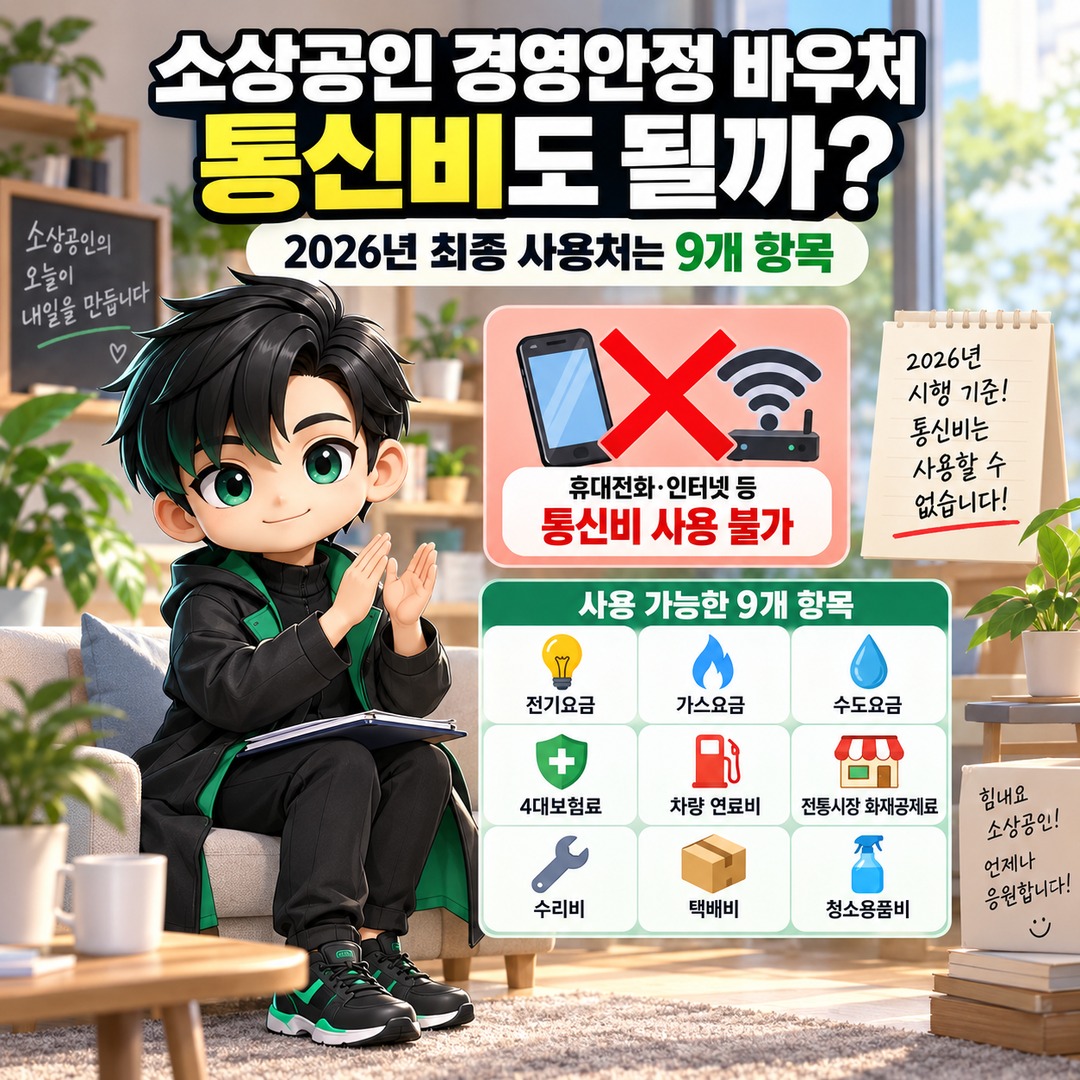
The 2026 small business Business Stability Voucher KRW 250,000 cannot be used for telecommunications expenses such as mobile phone or internet bills. Under the final implementation rules, eligible expenses include electricity, gas and water bills, 4 major social insurance premiums, vehicle fuel costs, and traditional market fire mutual aid contributions, totaling 9 categories.
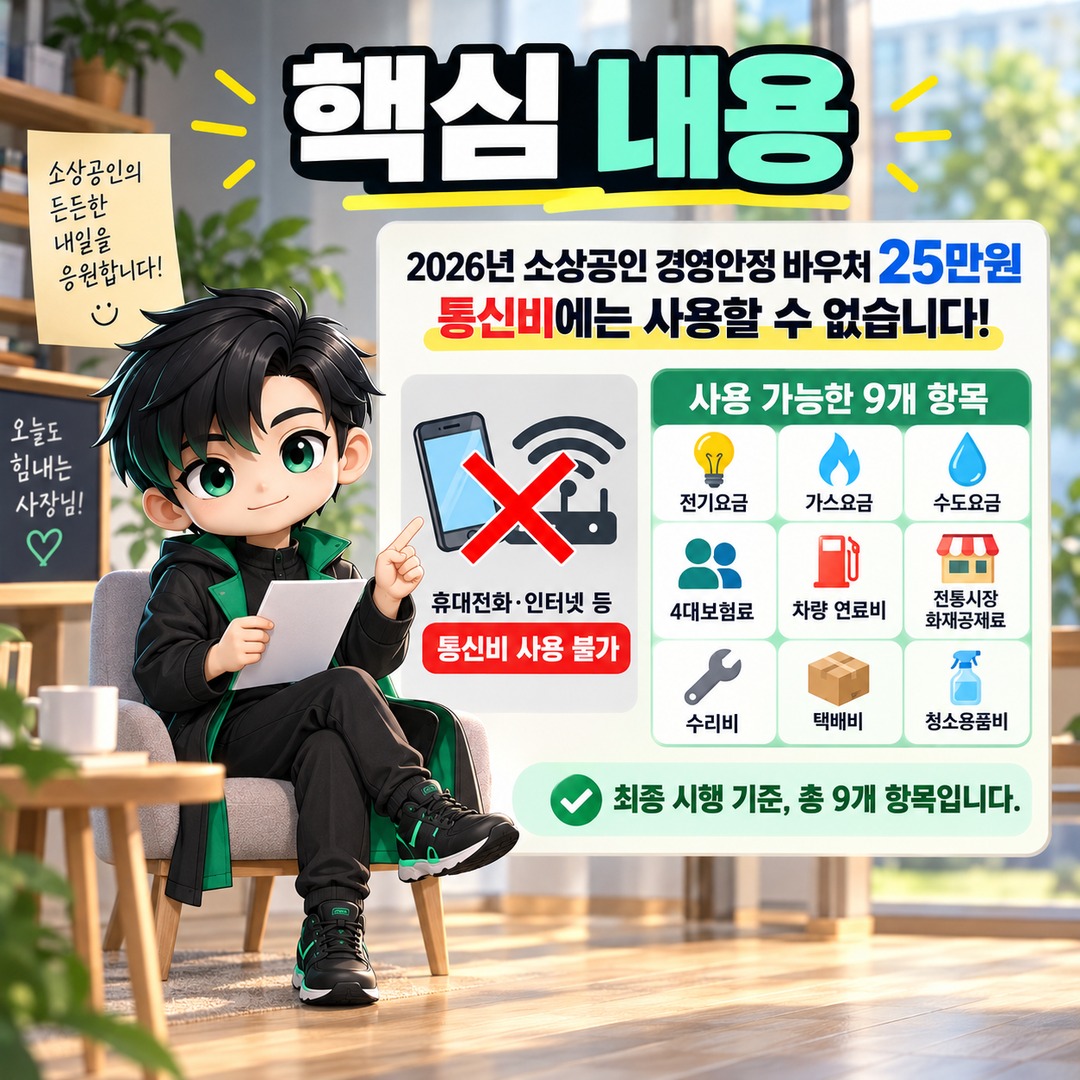
Some guidance documents and materials from earlier programs include telecommunications expenses, which may cause confusion. However, as of 2026-10-05, eligibility for actual voucher use should be determined by checking the final rules in the Ministry of SMEs and Startups' implementation notice and the official Business Stability Voucher guidance.
Why Do Some Sources Say Telecommunications Expenses Are Eligible?
The main reason for the confusion is that the details announced during the program planning stage differed from the final implementation rules.
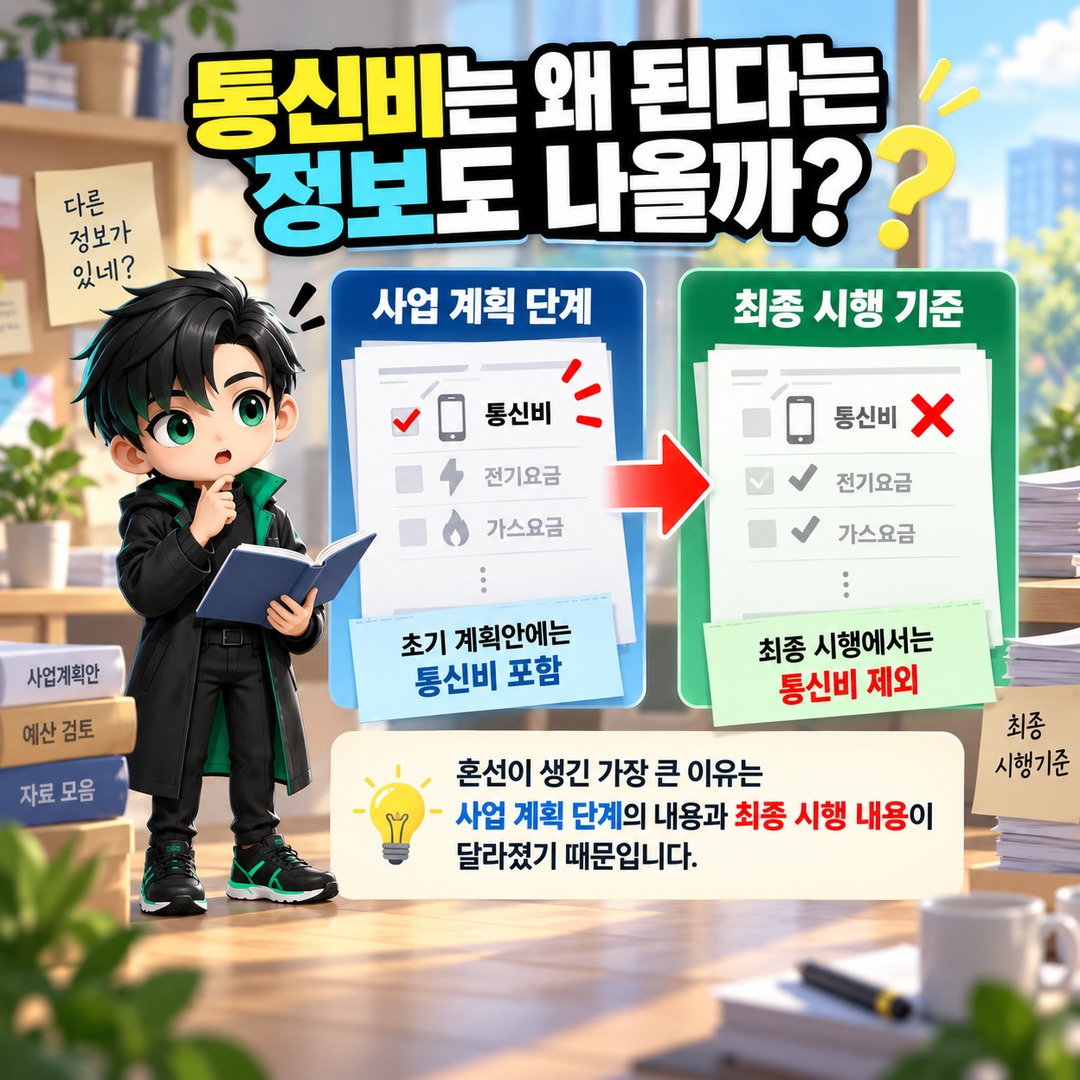
Some materials released during preparations for the 2026 program mentioned telecommunications expenses and vehicle fuel costs as eligible expenses, alongside electricity, gas and water bills and 4 major social insurance premiums. Some local government guidance materials still contain wording that includes telecommunications expenses.
However, telecommunications expenses were not included in the eligible categories finalized in the Ministry of SMEs and Startups' 2026 Business Stability Voucher implementation notice. The Business Stability Voucher guidance provided by the government civil service information call center 110 also explicitly states 'telecommunications expenses excluded.'
Therefore, small business owners should not assume that paying mobile phone bills or business internet charges by card will automatically deduct the amount from their Business Stability Voucher balance.
The 9 Categories Eligible for the 2026 Voucher KRW 250,000
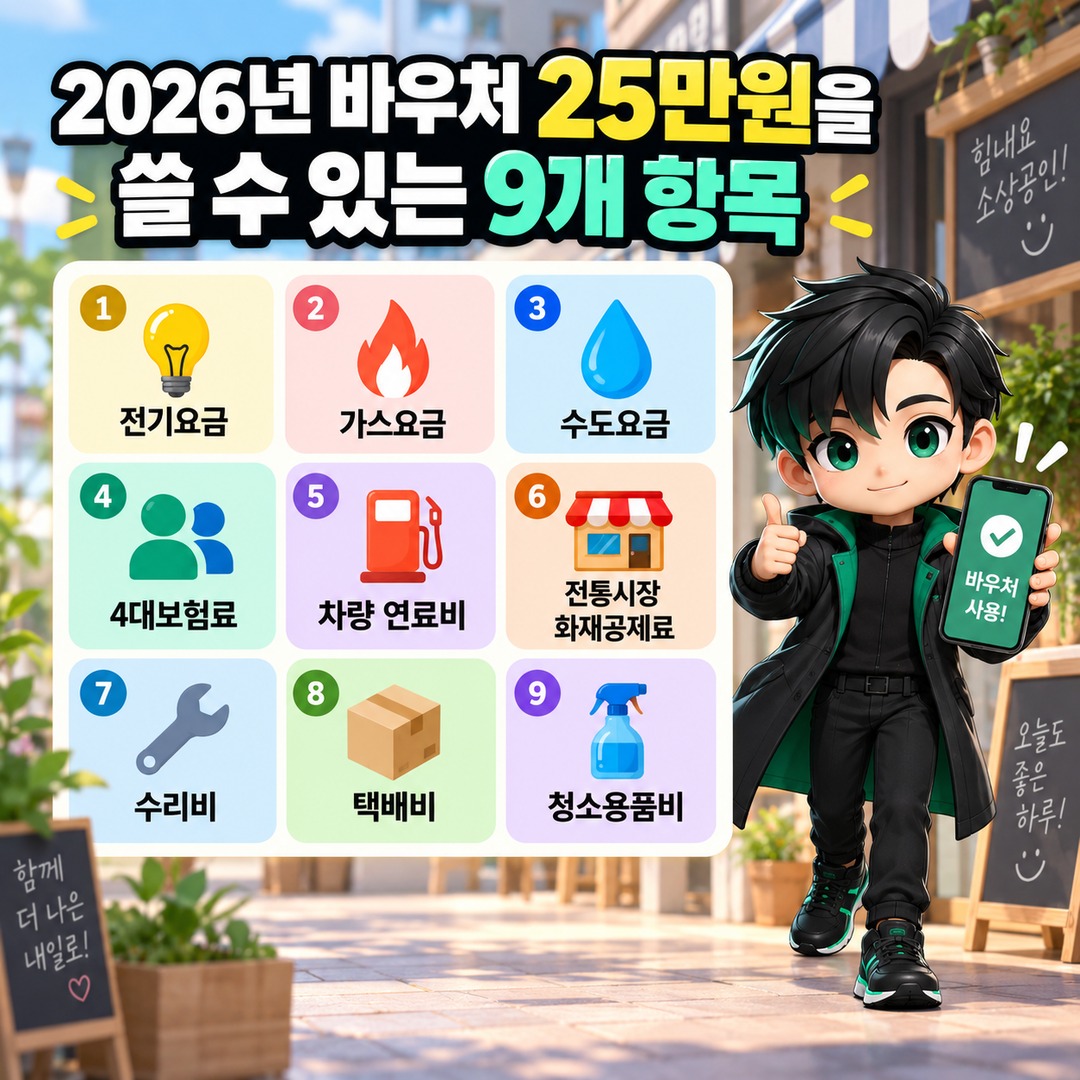
The final 2026 eligibility rules can be broken down into the following categories.
| Category | Eligible Expenses |
|---|---|
| Utility bills | Electricity, gas and water bills |
| 4 major social insurance programs | National Pension, National Health Insurance, Employment Insurance and Industrial Accident Compensation Insurance |
| Vehicles | Vehicle fuel costs |
| Mutual aid | Traditional market fire mutual aid contributions |
In other words, 3 utility bill categories + 4 insurance premium categories + vehicle fuel costs + traditional market fire mutual aid contributions = 9 eligible categories in total.
Gas bills include not only city gas but also LPG. The official notice states that vehicle fuel expenses are eligible for vehicles used in business operations, regardless of fuel type, including gasoline, diesel, gas and electricity.
The 4 major social insurance category covers not only premiums paid by employers but also the business owner's own 4 major social insurance premiums.
Traditional market fire mutual aid does not refer to just any fire insurance policy. Only the traditional market fire mutual aid program operated by the Korea SMEs and Startups Agency for Market and Small Business (SEMAS) is eligible.
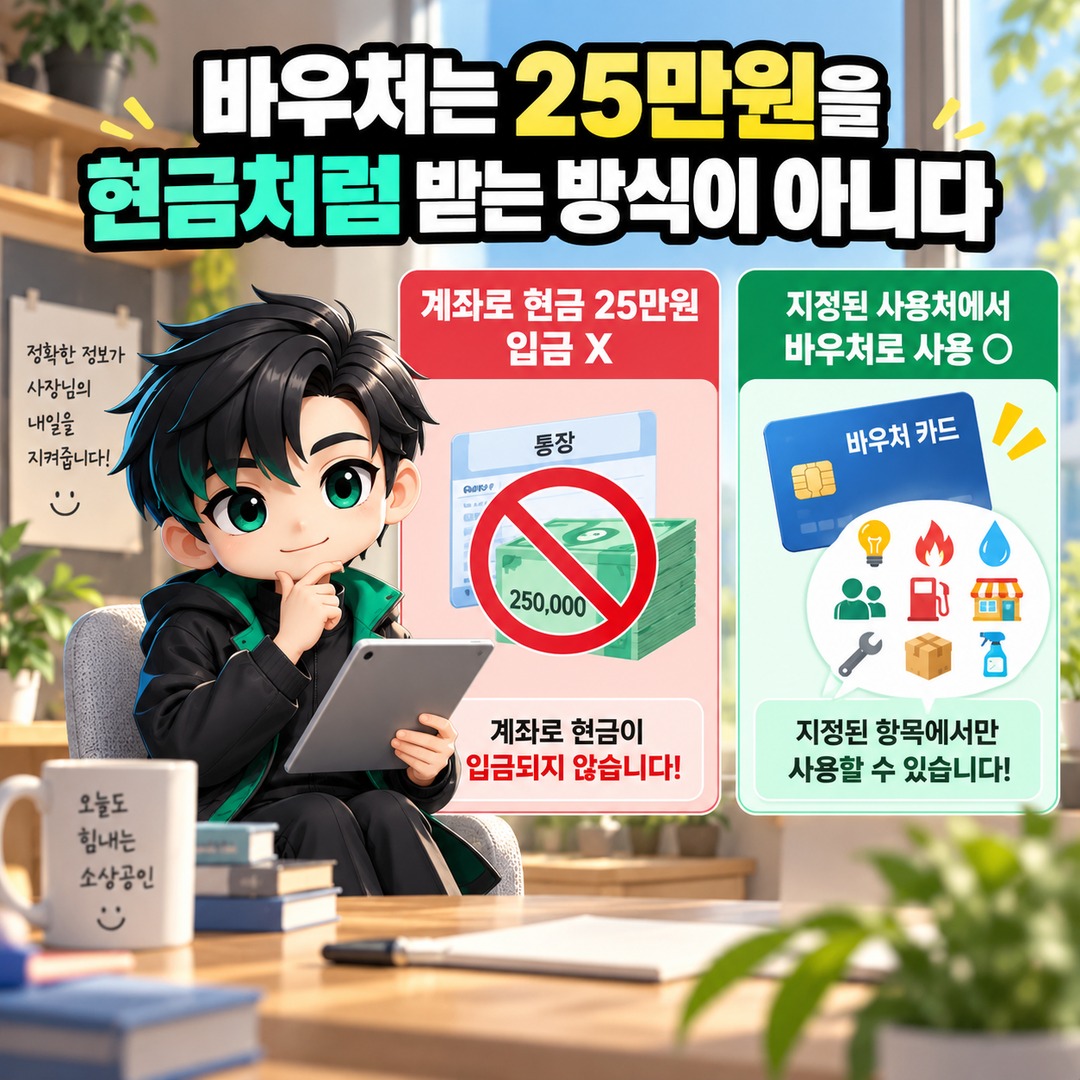
The Voucher KRW 250,000 Is Not Provided as Cash
The Business Stability Voucher is not a cash subsidy that deposits KRW 250,000 into a bank account for unrestricted use.
After an applicant is selected as an eligible recipient, an eligible card from the card issuer chosen during the application process is registered. When the recipient pays with that card at an approved merchant or for an eligible expense, the voucher balance is automatically deducted first.
For example, if the voucher balance is KRW 250,000 and an eligible electricity bill of KRW 100,000 is successfully paid by card, KRW 100,000 is deducted from the voucher balance. The remaining voucher balance is then KRW 150,000.
Conversely, payments made at restaurants or for ordinary shopping, which are not designated eligible expenses, are processed as regular card transactions rather than voucher payments.
If eligible expenses exceed KRW 250,000, the recipient must pay the excess amount.
Why an Eligible Expense Might Not Trigger a Voucher Deduction
Simply paying for an expense that falls within an eligible category does not guarantee that every transaction will automatically be covered by the voucher.
The payment method and merchant category information must allow the card issuer to recognize the transaction as eligible for the voucher. Because certain cards or payment methods may not be supported by individual card issuers, applicants should also review the instructions provided by their selected card issuer.
The following situations deserve particular attention.
Utility Bills and 4 Major Social Insurance Premiums
Payments must be made through a valid card payment method supported by the card issuer. Some card issuers state that voucher deductions do not apply when utility bills are paid through payment terminals at banks or similar locations.
Gas Stations
Vehicle fuel expenses are eligible, but whether the voucher is deducted may depend on how the card transaction is authorized. For example, some card issuers recommend selecting a specific payment amount at self-service gas stations rather than choosing the 'fill up' option.
Installment Payments and Reward Points
Depending on the card issuer, transactions involving installment payments or reward points may be excluded from voucher coverage.
Card Status
If a card transaction cannot be authorized normally because the card has been lost, suspended, or affected by overdue payments, the voucher cannot be used either.
Therefore, if an eligible expense has been paid but the voucher balance has not decreased, it is advisable to check the card authorization record and voucher transaction history first.
Where Can You Check Your Balance and Actual Voucher Usage?
The official Small Business Business Stability Voucher website provides an 'Application Results and Balance Inquiry' feature.
Immediately after applying, the first step is to confirm whether the applicant has been selected as an eligible recipient. Once voucher use has begun, checking the transaction history and remaining balance is the most reliable approach.
Card issuers may also provide features for checking Business Stability Voucher transactions or balances. It is therefore useful to review the guidance from the card issuer selected during the application process.
If an eligible expense was successfully paid but the voucher was not applied, it is safer to contact the card issuer or the dedicated Business Stability Voucher customer service center to verify the transaction rather than attempting another payment without confirmation.
The dedicated Business Stability Voucher customer service number is 1533-0600, while the Small Enterprise and Market Service (SEMAS) integrated call center can be reached at 1533-0100.
When Must the Remaining Voucher KRW 250,000 Be Used?
The deadline for using the 2026 Business Stability Voucher is 2026-12-31.
Unused voucher balances are not cash-equivalent points that recipients can keep indefinitely after the expiration date. Card issuer guidance also states that vouchers not used within the designated period will expire or be returned to the national treasury.
The application period and voucher usage period must also be distinguished.
Applications for 2026 opened on February 9, and card issuer guidance indicates an application deadline of December 18 at 6 p.m. However, applications may close early if the available budget is exhausted.
By contrast, the deadline for using vouchers that have already been issued is December 31.
Therefore, small business owners applying in October should not assume that receiving KRW 250,000 means they can use it throughout 1. Instead, they should first calculate how much they expect to spend on eligible utility bills, insurance premiums and fuel costs before the end of this year.
What Applicants in October Should Check, Step by Step
First, visit the official Business Stability Voucher website to check the application results and confirm whether the card has been registered.
Next, verify that the intended expense falls into one of the approved categories: electricity, gas or water bills; National Pension, National Health Insurance, Employment Insurance or Industrial Accident Compensation Insurance premiums; vehicle fuel costs; or traditional market fire mutual aid contributions.
After making a payment, do not stop at checking the card authorization. It is also advisable to confirm that the transaction appears in the voucher usage history and that the remaining voucher balance has actually decreased.
In particular, remembering that telecommunications expenses were excluded from the final 2026 eligible expense categories can help prevent confusion caused by older materials or certain guidance documents.
The information is based on the rules in effect as of 2026-10-05. If the program changes in the future, the latest guidance from the Ministry of SMEs and Startups and the Small Enterprise and Market Service (SEMAS) takes precedence.