

Semiconductor-Led KOSPI Earnings Growth: First-Half Operating Profit Reaches 388 Trillion Won…Will the Momentum Continue in the Second Half?
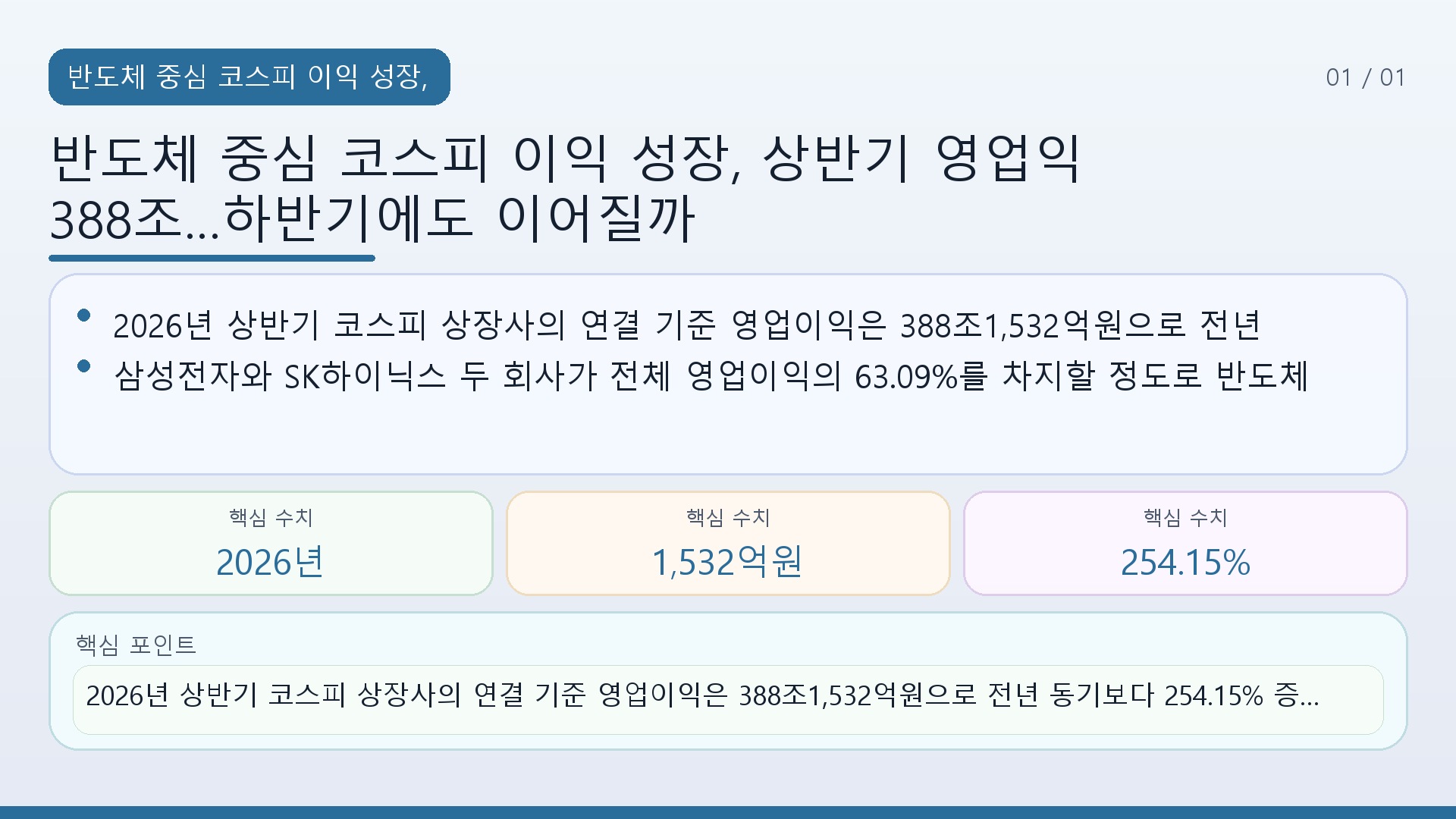
In the first half of 2026, the consolidated operating profit of KOSPI-listed companies reached KRW 388,153,200,000,000, an increase of 254.15% year over year. Semiconductors accounted for a substantial share, with Samsung Electronics and SK Hynix contributing 63.09% of total operating profit. However, operating profit at companies excluding these two also increased 75.61% year over year.
The prevailing outlook is that semiconductors will remain the main driver of KOSPI earnings in the second half. However, an important distinction is that continued corporate earnings growth does not necessarily mean stock prices will continue rising at the same pace. Investors need to monitor whether the pace of upward revisions to semiconductor earnings forecasts is slowing and whether earnings improvements are genuinely spreading to non-semiconductor industries.
Information verified as of 2026-08-19 Korea Standard Time.
How Much Did KOSPI Earnings Actually Improve in the First Half?
According to the consolidated financial results of December fiscal-year companies listed on the Korea Exchange's main market in the first half of 2026, revenue totaled KRW 2,000,126,100,000,000, operating profit reached KRW 388,153,200,000,000, and net profit amounted to KRW 386,674,000,000,000.
Compared with the same period a year earlier, revenue increased 28.84%, operating profit rose 254.15%, and net profit grew 333.30%. The operating profit margin improved to 19.41%, while the net profit margin rose to 19.33%.
An operating profit growth rate of 254.15% means that, if the corresponding period last year is set at 100, this year's figure reached approximately 354.15. Based on the author's calculation, that is roughly 3.54 times the previous level.
The results were also strong when examining 2 quarter separately. Consolidated revenue reached KRW 1,075,282,700,000,000, up 16.27% from 1 quarter. Operating profit came to KRW 231,993,000,000,000, an increase of 48.56%, while net profit reached KRW 245,396,100,000,000, up 73.70%.
In other words, the strong first-half figures were not simply the result of one exceptionally good quarter at the beginning of the year.
How Much Did Samsung Electronics and SK Hynix Contribute?
Samsung Electronics and SK Hynix played an exceptionally large role in first-half KOSPI earnings growth. Their combined consolidated operating profit reached KRW 244,880,000,000,000, accounting for 63.09% of total operating profit among the KOSPI companies included in the analysis.
Their combined revenue totaled KRW 432,270,000,000,000, representing 21.86% of overall revenue, while their combined net profit reached KRW 253,120,000,000,000, accounting for 65.46% of total net profit.
These figures reveal two important points.
First, it is difficult to explain KOSPI earnings growth in the first half of 2026 without discussing semiconductors. Although the two companies represented approximately 22% of revenue, their share of operating profit exceeded 63%.
Second, this does not mean that earnings at all other companies stagnated. Among listed companies excluding Samsung Electronics and SK Hynix, consolidated revenue increased 15.01%, operating profit rose 75.61%, and net profit grew 119.68% year over year.
Therefore, interpreting the first-half results as simply a case of 'only Samsung Electronics and SK Hynix performing well' would not accurately reflect the reported figures.
Why Semiconductor-Led Earnings Growth Is Expected to Continue in the Second Half
Semiconductors remain central to the second-half outlook. Yuanta Securities' market outlook for the second half of 2026 identified the continuation of the AI capital expenditure cycle, favorable semiconductor industry conditions, strong exports, and robust earnings as major factors supporting the Korean stock market.
Shinhan's second-half outlook for the domestic equity market also explained that, when evaluating semiconductors, investors should examine HBM prices, server DRAM, SSD demand, and changes in future earnings forecasts, rather than focusing solely on export growth rates.
In particular, the direction of earnings forecast revisions for 2028 was identified as an important variable, alongside forecasts for 2026 and 2027. The view is that semiconductors and AI infrastructure could remain the central pillars of the Korean stock market as long as current semiconductor earnings expectations hold up.
Similar assessments emerged following the release of first-half earnings on August 19. Securities industry analysts suggested that second-half semiconductor earnings could exceed first-half levels, citing trends in memory semiconductor selling prices and shipment volumes.
However, not every forecast implies that the pace of earnings growth will accelerate further in the second half.
Earnings May Improve Even as the Pace of Upward Forecast Revisions Slows
This is one of the most important distinctions when assessing the KOSPI in the second half. A forecast for rising earnings is not the same as a forecast for continuously accelerating upward revisions to earnings estimates.
According to securities industry analysis released on August, the projected earnings-per-share (EPS) growth rate for the KOSPI IT sector in 2026 rose from 476.3% at the end of June to 527.6% at the end of July. However, the analysis found that the magnitude of upward revisions had narrowed after entering August.
Forward 12-month EPS also increased 33.5% over the most recent 3 months, but analysts noted that the pace of forecast revisions had slowed compared with the first half.
Yuanta Securities likewise maintained its strategy of increasing semiconductor exposure in the second half while emphasizing the need to monitor whether earnings growth begins to slow after August.
This distinction matters because stock prices reflect not only companies' current earnings but also expectations for their future performance.
A company whose operating profit rises from 100 to 150 and then to 180 is still growing. However, the amount of additional growth declines from 50 to 30. Even when absolute corporate earnings continue to increase, stock prices may react differently if the market's expected growth rate declines.
Therefore, a positive second-half earnings outlook alone is not enough to determine the direction of the KOSPI or semiconductor stock prices with certainty.
Why Earnings at Non-Semiconductor Companies Also Matter
Another notable aspect of the first-half results was the performance of non-semiconductor companies.
By industry, consolidated operating profit in the electrical and electronics sector increased 674.92% year over year. Operating profit also rose in 14 industries, including general services at 237.04%, chemicals at 203.76%, and medical and precision equipment at 138.03%.
Conversely, operating profit declined in entertainment and culture by 33.55%, transportation and warehousing by 17.71%, telecommunications by 10.01%, electricity and gas by 6.98%, and transportation equipment and components by 6.17%. The real estate sector shifted into a loss.
In other words, a sharp increase in overall KOSPI earnings did not mean that every industry experienced the same earnings trend.
With some analyses also pointing to upward revisions in earnings forecasts for industries outside semiconductors, a more accurate approach in the second half is to examine which industries are actually seeing increases in expected earnings, rather than looking only at total KOSPI operating profit.
In particular, investors need to distinguish between companies whose annual earnings forecasts have also been raised following their first-half results and companies that reported strong quarterly earnings primarily because of one-off factors.
Which KOSPI Figures Should Investors Monitor Going Forward?
First-half earnings are already reported results. What matters more to the market now is whether earnings forecasts for the second half and beyond translate into actual financial performance.
The first factor to monitor is the earnings growth trajectory of Samsung Electronics and SK Hynix. Because these two companies accounted for 63.09% of total KOSPI operating profit in the first half, changes in their earnings forecasts are bound to have a substantial influence on the overall KOSPI earnings outlook.
The second factor is the pace of upward revisions to semiconductor earnings forecasts. Investors should distinguish between the current level of earnings and whether future EPS estimates continue rising or the pace of those revisions is slowing.
The third factor is whether earnings improvements are spreading beyond semiconductors. Operating profit among listed companies excluding Samsung Electronics and SK Hynix increased 75.61% in the first half, making it important to determine whether more industries sustain this improvement in the second half.
The fourth factor is whether quarterly earnings align with full-year forecasts. Even if 2-quarter results exceed expectations, their significance changes if earnings forecasts for 3 quarter and the full year are revised downward.
KOSPI earnings in the first half of 2026 were undeniably strong. Samsung Electronics and SK Hynix accounted for 63.09% of consolidated operating profit totaling KRW 388,153,200,000,000, but operating profit at companies excluding these two also increased 75.61%.
The prevailing second-half outlook among securities firms continues to favor sustained semiconductor-led earnings growth. However, the next question investors should examine is not simply whether semiconductor earnings are strong, but how quickly semiconductor earnings forecasts are changing and whether earnings improvements are spreading to non-semiconductor industries.
Distinguishing between the absolute level of earnings, which has already risen substantially, and expectations for further earnings increases is essential to understanding the KOSPI in the second half.
※ This article is provided for informational purposes to help readers understand market trends and does not constitute an investment recommendation for any specific stock or asset. Final investment decisions and responsibility for those decisions rest with the individual investor.