

Democratic Party Chungcheong Primary Results: Kim Min-seok 45.05%, Chung Cheong-rae 44.61%, a 303-Vote Margin
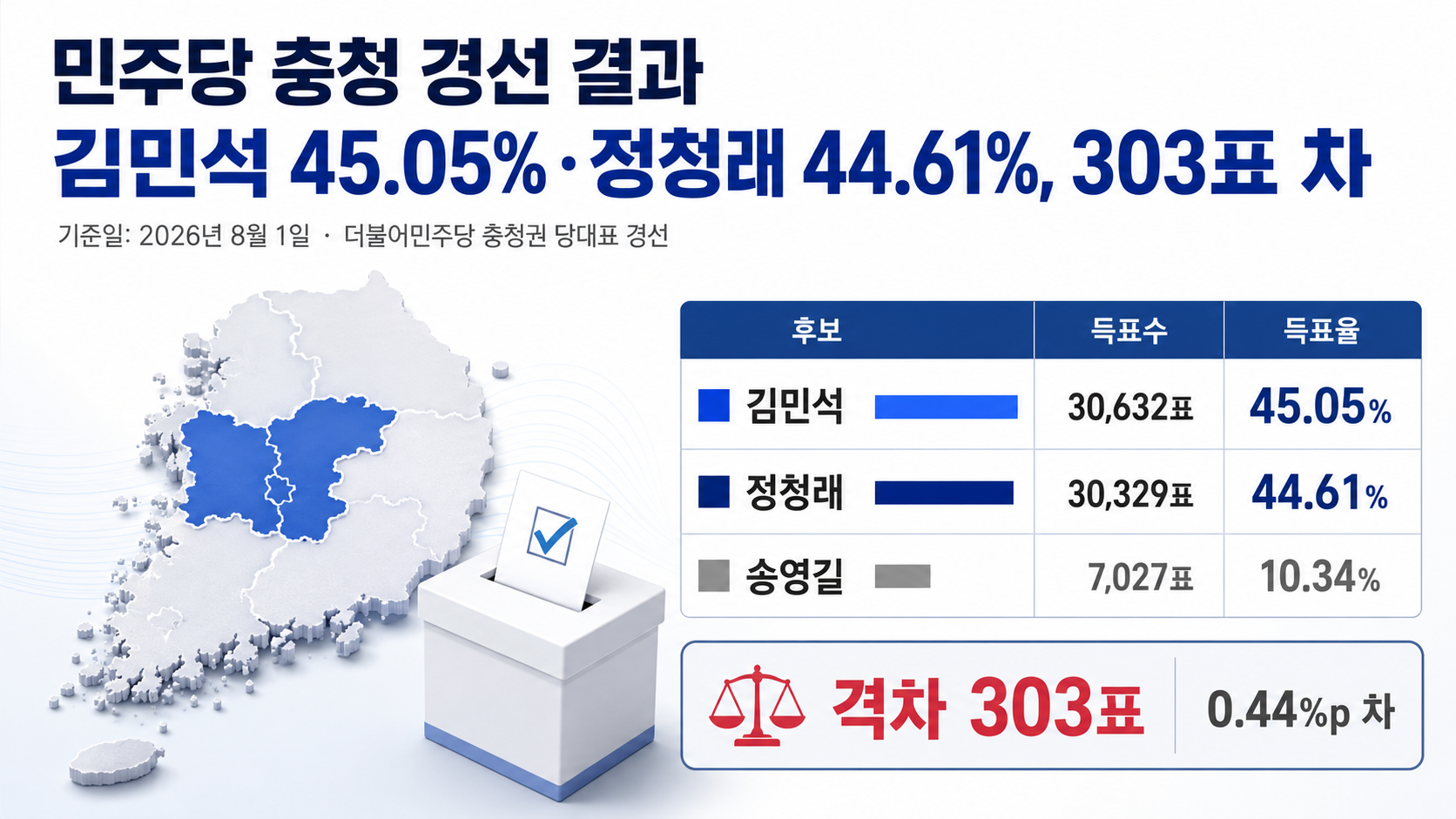
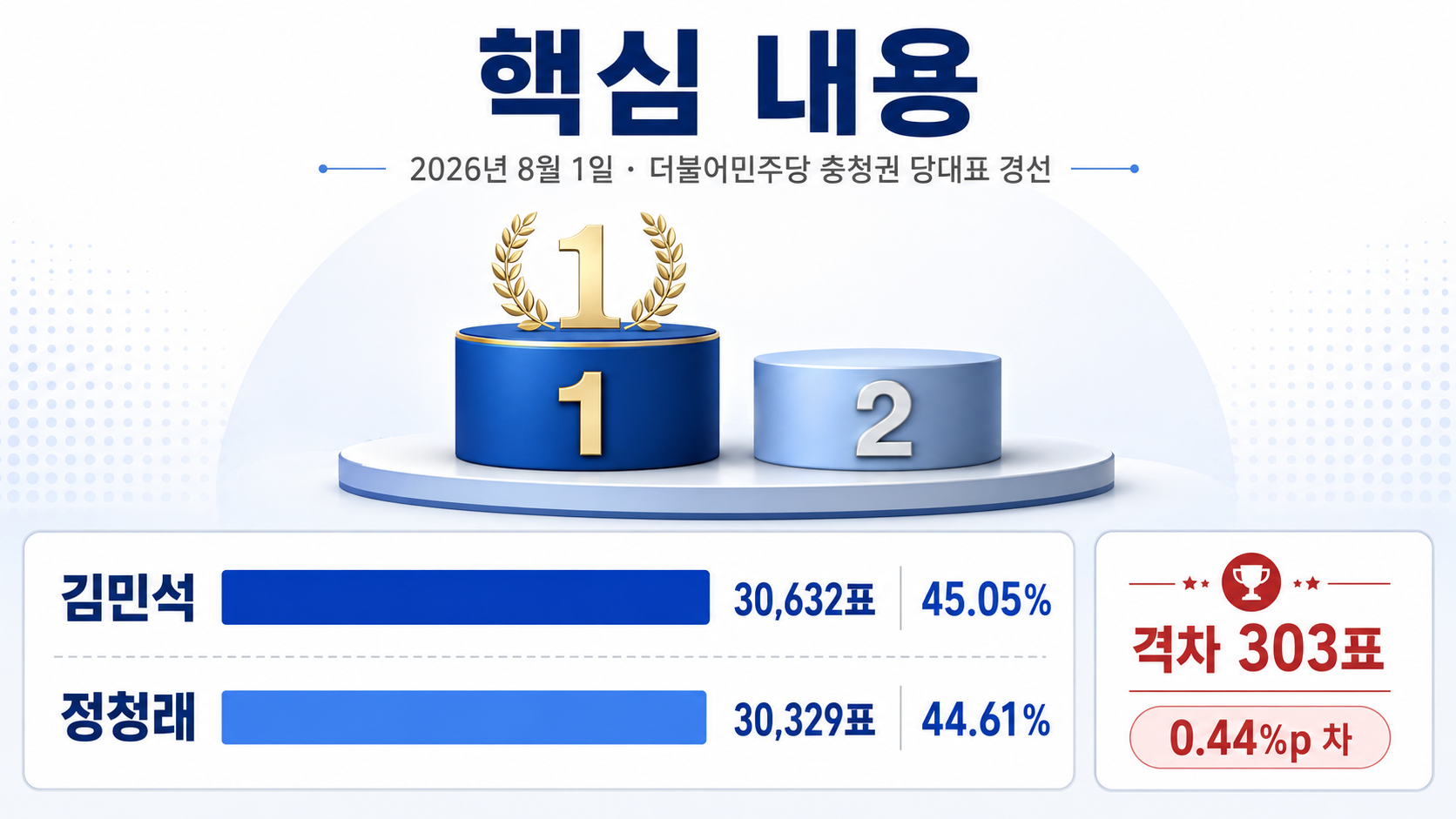
In the Democratic Party of Korea's Chungcheong regional leadership primary held on 2026-08-01, candidate Kim Min-seok finished in 1 place with 3 ten-thousand 632 votes. Candidate Chung Cheong-rae placed 2 with 3 ten-thousand 329 votes. The difference between the two candidates was 303 votes, or approximately 0.44% percentage points.
Candidate Song Young-gil received 7,027 votes and recorded 10.34%. However, these results represent the 1-preference votes of eligible party members in the Chungcheong region. The final party leader has not yet been determined.
What Were the Overall Voting Results in Chungcheong?
When the votes from South Chungcheong, North Chungcheong, Daejeon, and Sejong are combined, Kim Min-seok narrowly leads Chung Cheong-rae.
| Candidate | Votes Received | Announced Vote Share | Ranking |
|---|---|---|---|
| Kim Min-seok | 30,632 votes | 45.05% | 1 place |
| Chung Cheong-rae | 30,329 votes | 44.61% | 2 place |
| Song Young-gil | 7,027 votes | 10.34% | 3 place |
The difference between Kim Min-seok and Chung Cheong-rae was 303 votes.
The difference in vote share was approximately 0.44% percentage points, making this an extremely close contest in which a different result in just one region could have reversed the rankings.
Why Is Kim Min-seok's Vote Share Reported as Both 45.05% and 45.06%?
Depending on the news report, Kim Min-seok's vote share is shown as either 45.05% or 45.06%.
Calculating directly from the officially announced vote totals produces the following result.
Calculation: 30,632 votes ÷ 67,988 votes × 100
Author's calculated result: approximately 45.055%
Rounding at the second decimal place produces 45.06%, while truncating some decimal places produces 45.05%.
Therefore, the difference between 45.05% and 45.06% appears to result from different methods of handling decimal places, rather than any discrepancy in the vote count. The actual number of votes remains 3 ten-thousand 632.
Kim Min-seok Led in South and North Chungcheong, While Chung Cheong-rae Led in Daejeon and Sejong
The four regions were split evenly between the two candidates, with each winning two regions.
Kim Min-seok led in South Chungcheong and North Chungcheong, while Chung Cheong-rae received more votes in Daejeon and Sejong.
| Region | Kim Min-seok | Chung Cheong-rae | Vote Margin Between the Two Candidates |
|---|---|---|---|
| South Chungcheong | 12,484 votes · 45.65% | 11,835 votes · 43.28% | Kim Min-seok ahead by 649 votes |
| North Chungcheong | 8,967 votes · 47.39% | 7,919 votes · 41.86% | Kim Min-seok ahead by 1,048 votes |
| Daejeon | 7,249 votes · 42.71% | 8,187 votes · 48.23% | Chung Cheong-rae ahead by 938 votes |
| Sejong | 1,932 votes · 40.68% | 2,388 votes · 50.28% | Chung Cheong-rae ahead by 456 votes |
Adding the regional vote margins reproduces the overall result.
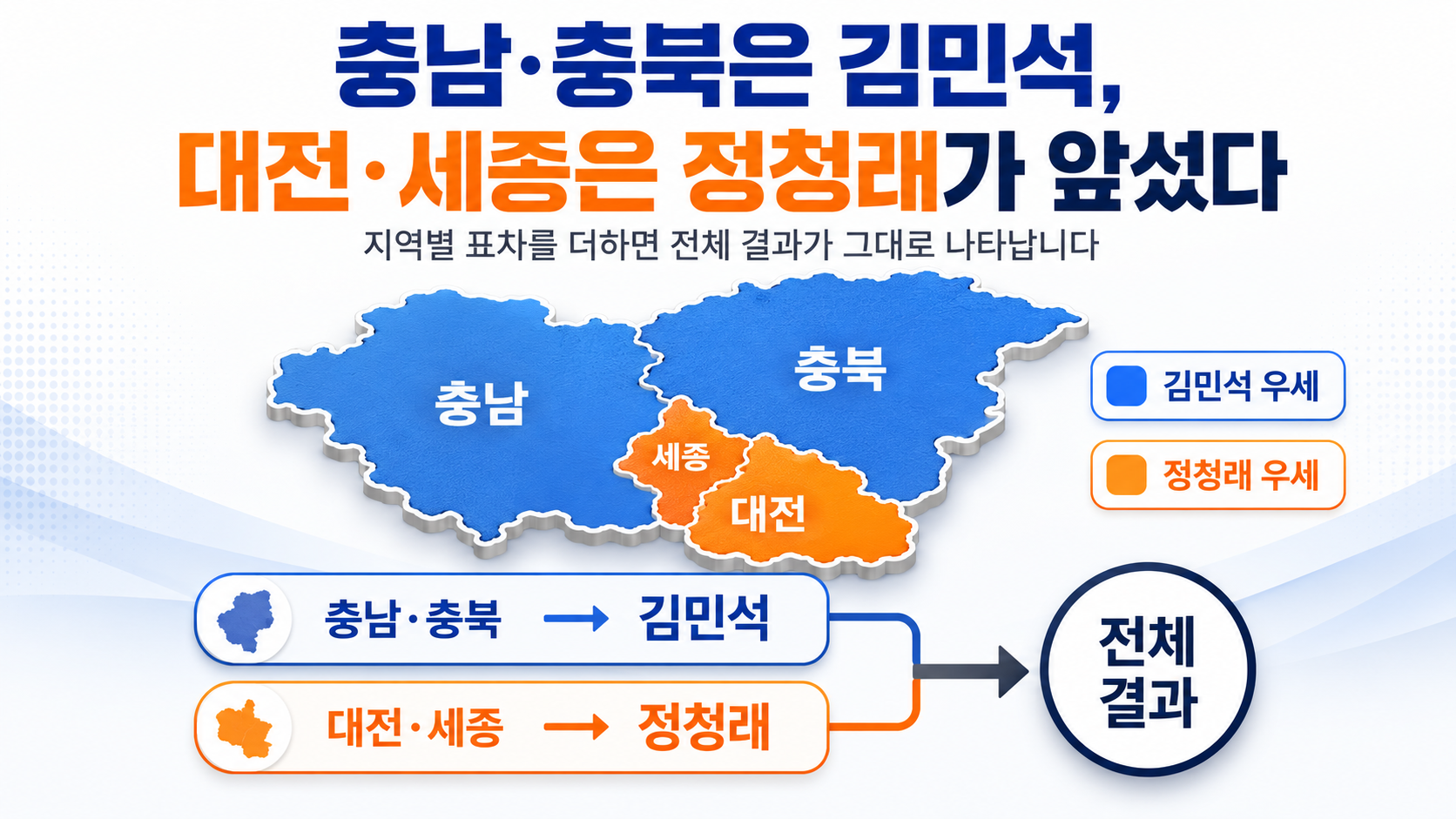
Kim Min-seok's combined advantage in South and North Chungcheong: 649 votes + 1,048 votes = 1,697 votes
Chung Cheong-rae's combined advantage in Daejeon and Sejong: 938 votes + 456 votes = 1,394 votes
Author's calculation: 1,697 votes - 1,394 votes = 303 votes
Although Chung Cheong-rae won in Daejeon and Sejong, Kim Min-seok's combined lead in South and North Chungcheong was larger. As a result, Kim Min-seok finished in 1 place across the Chungcheong region.
Chungcheong Regional Turnout Among Eligible Party Members Was 41.50%
The Chungcheong region had 16 ten-thousand 3,846 eligible party-member voters, of whom 6 ten-thousand 7,988 actually voted.
Based on the author's calculation, the overall turnout was approximately 41.50%.
| Region | Eligible Voters | Actual Voters | Turnout |
|---|---|---|---|
| South Chungcheong | 69,980 people | 27,345 people | 39.08% |
| North Chungcheong | 46,769 people | 18,920 people | 40.45% |
| Daejeon | 37,937 people | 16,974 people | 44.74% |
| Sejong | 9,160 people | 4,749 people | 51.84% |
| Total | 163,846 people | 67,988 people | Approximately 41.50% |
Sejong recorded the highest turnout at 51.84%, while South Chungcheong had the lowest at 39.08%.
However, Sejong, despite having the highest turnout rate, had the fewest actual voters among the four regions, with 4,749 participants. The overall ranking depends not only on turnout percentages but also on the number of voters and the margins between candidates.
Does Kim Min-seok's Victory in Chungcheong Confirm Him as Party Leader?
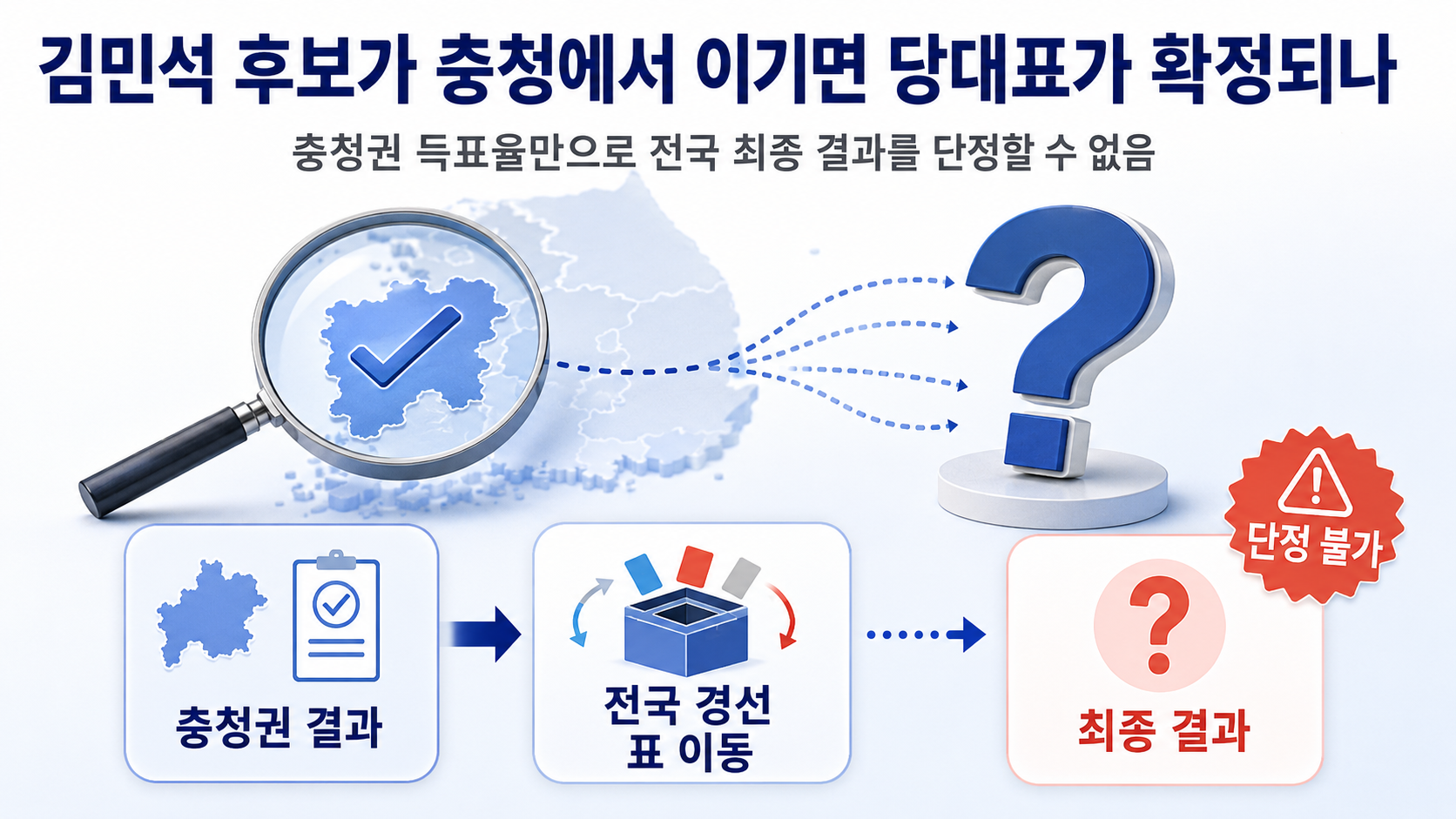
Finishing in 1 place in Chungcheong does not automatically determine the party leader.
The figures released in this regional primary represent votes cast by eligible party members in Chungcheong. The final result will incorporate votes from eligible party members and national delegates, weighted at 70%, as well as a public opinion survey weighted at 30%.
A preferential voting system also applies to the party leadership election.
Voters rank the three leadership candidates from 1 preference through 3 preference. If no candidate receives a majority of 1-preference votes in the overall count, the 2-preference votes of voters who selected the 3-place candidate are redistributed to the leading candidates to determine the final winner.
Therefore, the Chungcheong vote shares currently available cannot establish the final nationwide result or predict how votes will transfer during the subsequent counting process.
Another factor to consider when reviewing subsequent cumulative results is that valid votes from delegates and eligible party members in Daegu, North Gyeongsang, and South Gyeongsang are scheduled to receive a strategic-region weighting of 5% for this party convention only.
When Is the Next Democratic Party Leadership Primary?
The Busan, Ulsan, and South Gyeongsang regional primary will take place on 2026-08-02.
As of 11:2 a.m. on August 2, the Busan-Ulsan-South Gyeongsang results had not yet been included in the Chungcheong results. Joint campaign speeches will continue in Ulsan, Busan, and South Gyeongsang, and the voting results of eligible party members in the southeastern region are expected to be announced after the South Gyeongsang event concludes.
The remaining voting schedule for eligible party members is as follows.
| Region | Voting Period for Eligible Party Members |
|---|---|
| Jeju and Incheon | August 4–August 7 |
| Gangwon, Daegu, and North Gyeongsang | August 5–August 8 |
| Honam Region | August 11–August 14 |
| Seoul and Gyeonggi | August 12–August 15 |
National delegates will vote on August 17, the day of the national party convention. The final party leadership result is also expected to be announced on August 17 after combining eligible party-member votes, delegate votes, and the public opinion survey.
Detailed event schedules and announcement times may change depending on how proceedings unfold. For accurate information, it is advisable to check notices issued by the Democratic Party of Korea's Central Election Management Committee.
Key Takeaways From the Chungcheong Primary Results
The confirmed result is that Kim Min-seok led the first regional primary by 303 votes.
Kim Min-seok performed better in South and North Chungcheong, while Chung Cheong-rae led in Daejeon and Sejong. The region did not overwhelmingly support either candidate, and the difference in vote share between 1 and 2 place was only 0.44% percentage points.
When interpreting the political significance, it is important to distinguish winning the first primary from winning the overall election. The final outcome can only be assessed after considering the remaining regional votes of eligible party members, the public opinion survey, delegate voting, and the redistribution of 2-preference votes under the preferential voting system.
Frequently Asked Questions
What Was the Exact Vote Difference Between Kim Min-seok and Chung Cheong-rae?
Kim Min-seok received 3 ten-thousand 632 votes, while Chung Cheong-rae received 3 ten-thousand 329 votes. The exact difference was 303 votes.
Was Kim Min-seok's Vote Share 45.05% or 45.06%?
Most news reports announced 45.05%. Dividing the officially reported number of votes by the total number of votes produces approximately 45.055%, so the figure may appear as either 45.05% or 45.06% depending on how decimal places are handled.
Do the Chungcheong Results Represent the Nationwide Cumulative Vote Share?
No. The figures announced on August 1 represent votes cast by eligible party members in South Chungcheong, North Chungcheong, Daejeon, and Sejong. They do not include votes from other regions, the public opinion survey, or national delegates.
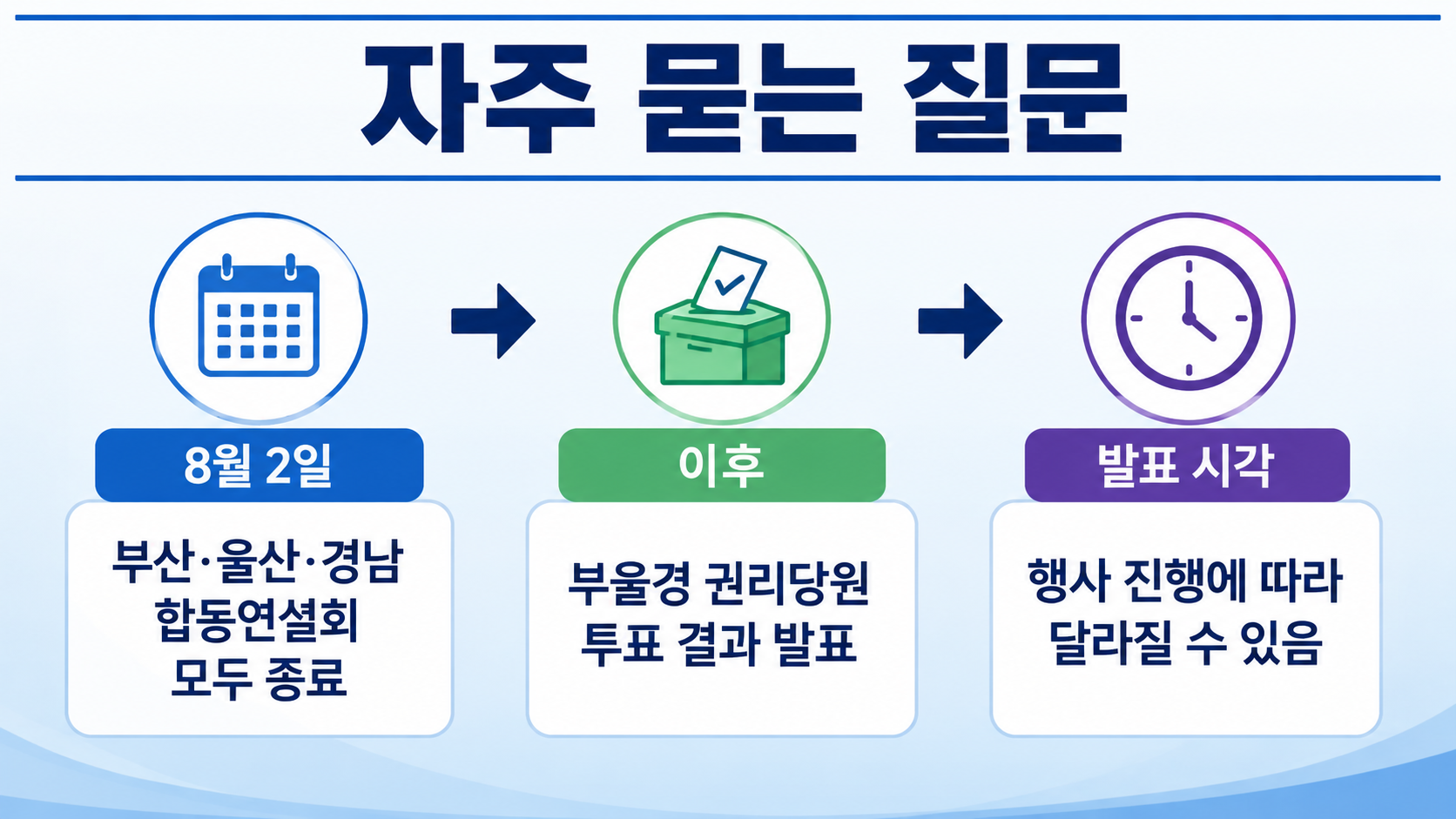
When Will the Next Results Be Announced?
The voting results of eligible party members in Busan, Ulsan, and South Gyeongsang are expected to be announced after all joint campaign speeches in those regions conclude on August 2. The exact announcement time may vary depending on how the events proceed.