

Livelihood Recovery Consumption Vouchers: 2026 Findings Show 43.3% of KRW 13,520,000,000,000.00 in Payments Translated into Increased Net Sales
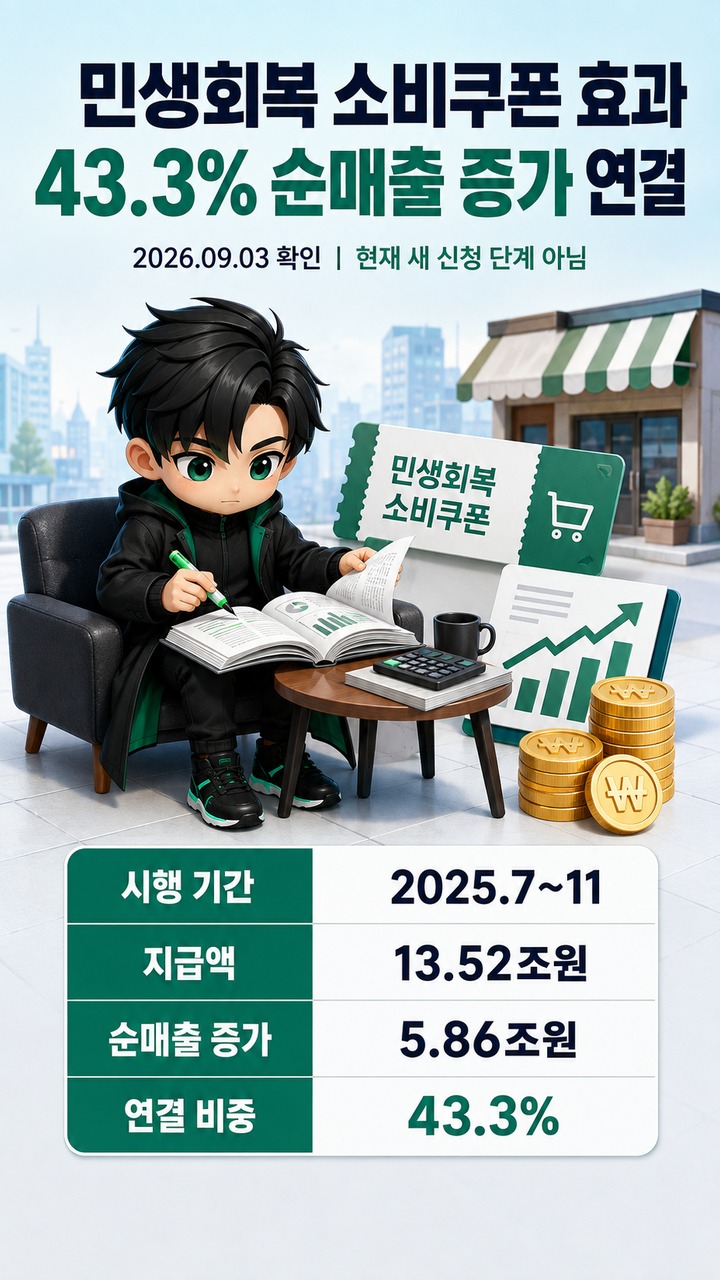
The Livelihood Recovery Consumption Voucher program ran from July 2025 to November, and as of 2026-09-03, it is no longer accepting new applications. A subsequently released policy impact analysis estimated that KRW 13,520,000,000,000.00 in total voucher payments increased small-business net sales by KRW 5,860,000,000,000.00. That represents 43.3% of the total amount distributed.
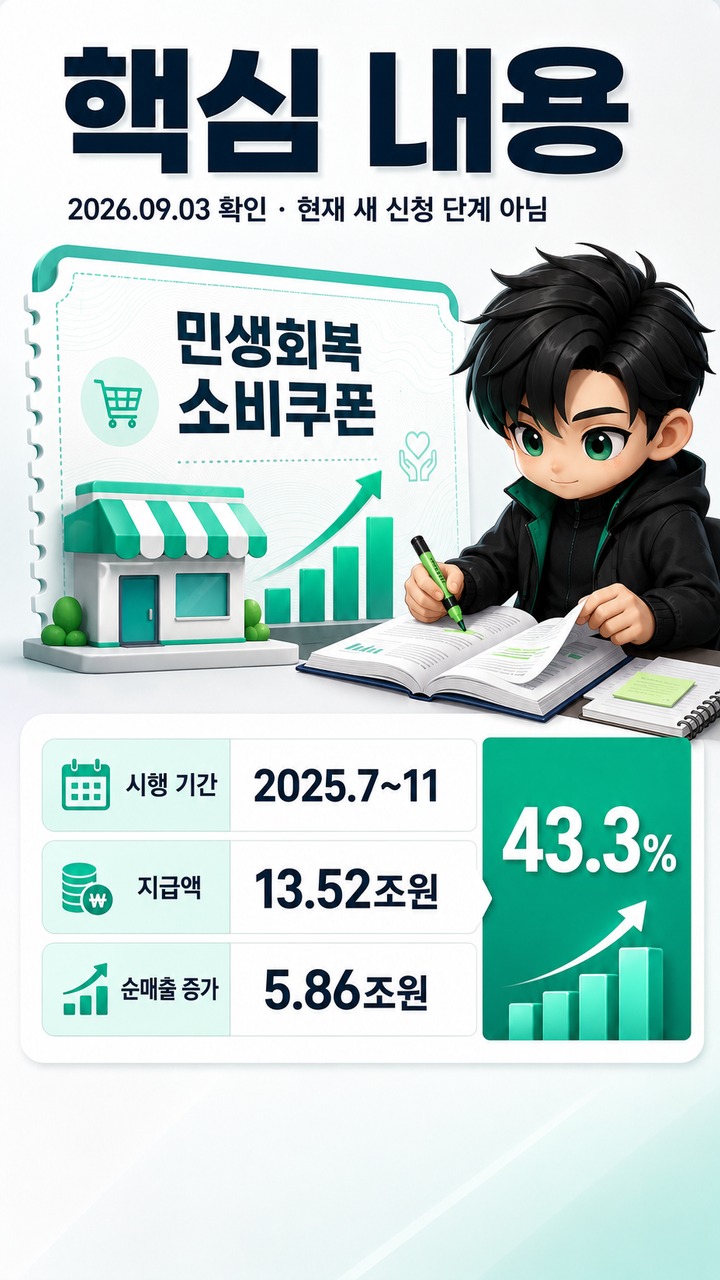
Anyone looking up how much they received in 2025 or whether applications are still open needs to distinguish the original payment schedule from the program's current status. Those wondering why the policy has recently attracted renewed attention should instead focus on the economic impact analysis released in 2026.
Can You Still Apply for Livelihood Recovery Consumption Vouchers?
The Livelihood Recovery Consumption Voucher program currently being discussed is one for which applications and spending ended in 2025. The 1-round distribution began on 2025-07-21, while applications for the 2-round distribution were accepted from September 22 through October 31 of the same year. The deadline for using vouchers received in the 1 and 2 rounds was 2025-11-30.
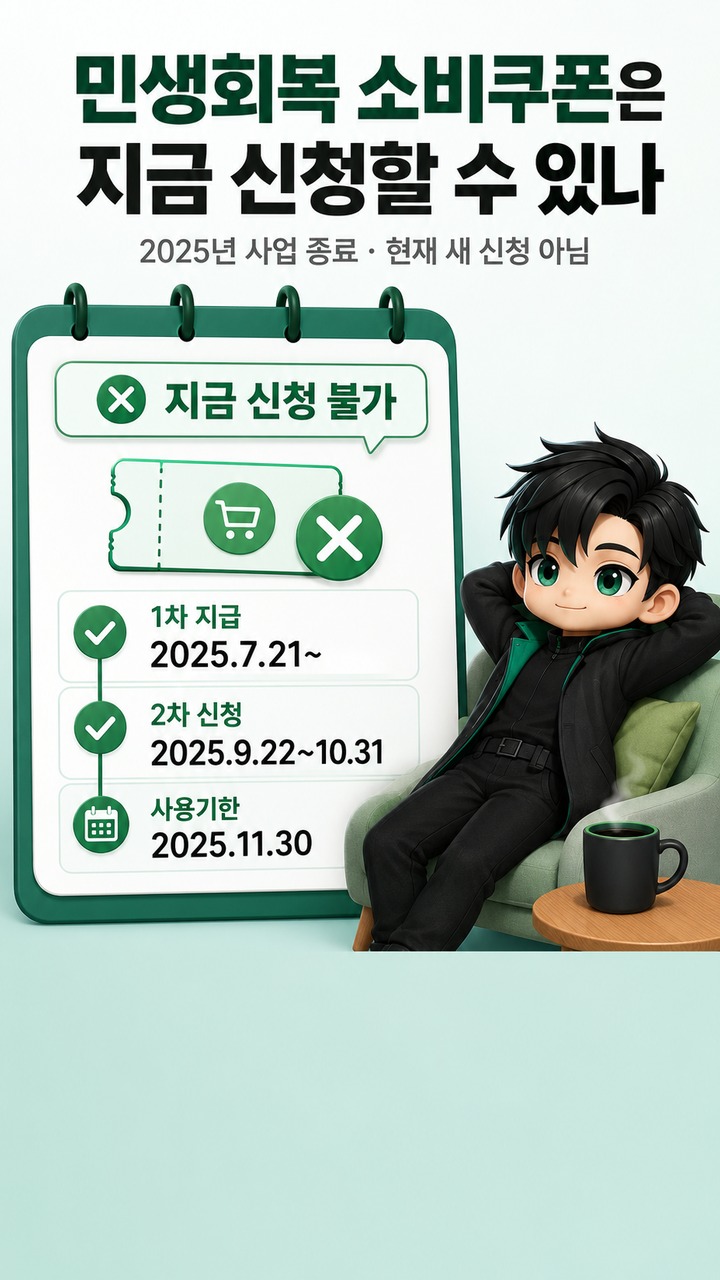
This means unused balances from previously distributed vouchers cannot be used again in 2026. The original program guidance specified that balances remaining after the expiration date would not be refunded and would automatically expire.
It is also important to distinguish the payment amounts for the 1 and 2 rounds.
The 1 round provided a basic payment of KRW 150,000 to all citizens, with differentiated payments of KRW 300,000 for near-poverty households and single-parent families and KRW 400,000 for recipients of basic livelihood security benefits. Residents outside the Seoul metropolitan area received an additional KRW 30,000, while residents of rural areas experiencing population decline received an additional KRW 50,000.
The 2 round provided an additional KRW 100,000 per 1 person to 90% of the population, based on income and other eligibility criteria. Eligibility was determined using individual contributions to health insurance premiums assessed in June 2025, household characteristics, and other factors. Individuals with high-value assets above specified thresholds were excluded.
Ultimately, the total amount received by each individual varied according to their place of residence, income, and household or socioeconomic category.
The Amount Actually Distributed Was KRW 13,520,000,000,000.00
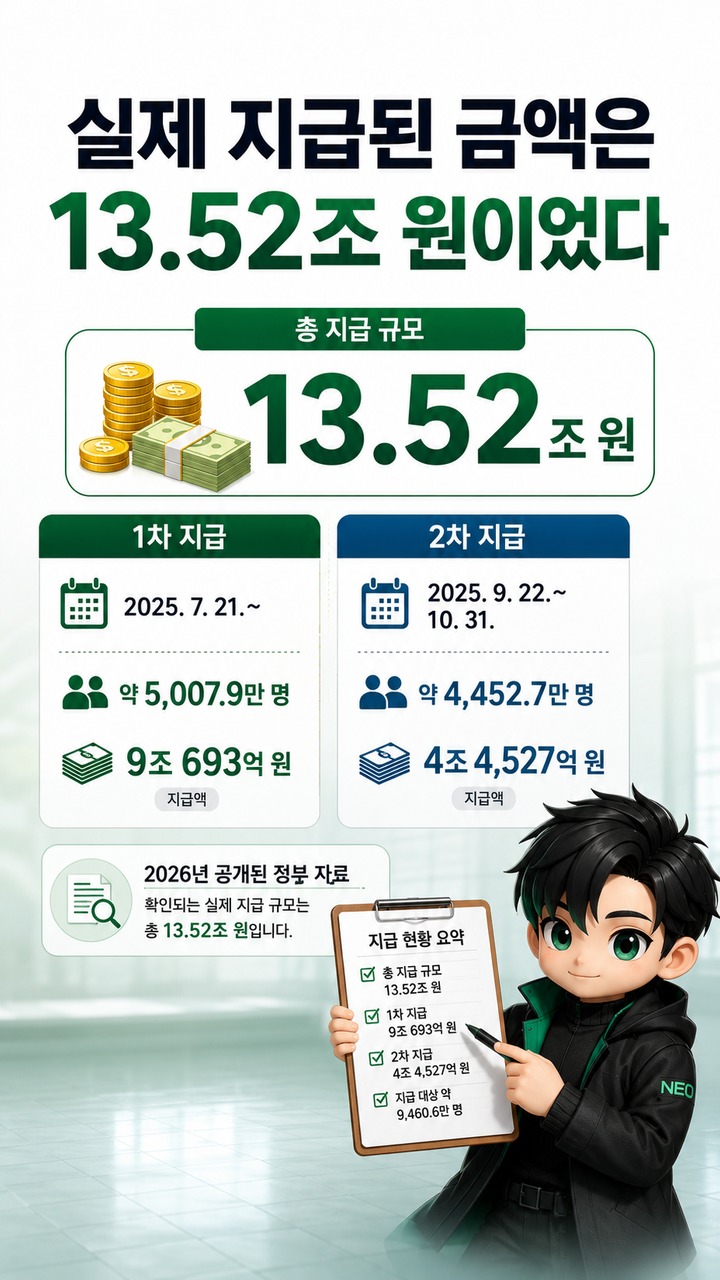
Government materials released in 2026 confirm that the total amount actually distributed was KRW 13,520,000,000,000.00. In the 1 round, approximately 5,007.9 million people received KRW 9,069,300,000,000, while approximately 4,452.7 million people received KRW 4,452,700,000,000 in the 2 round.
This figure matters when distinguishing the budget announced at the program's launch from its actual implementation results. Anyone seeking to determine how much was ultimately distributed, rather than the amount originally planned, should use KRW 13,520,000,000,000.00 as the reference figure.
Looking specifically at the 2 round, approximately 4,453 million people had applied by the 2025-10-31 closing date, representing 97.5% of eligible recipients. The amount distributed was KRW 4,452,700,000,000.
Various payment methods were used, including credit and debit cards, local currency vouchers, and prepaid cards. However, the more important question in the 2026 impact analysis was not simply how much money was distributed, but how much of that money translated into genuinely additional consumption and higher sales for small businesses.
Why Did KRW 13,520,000,000,000.00 in Payments Produce Only KRW 5,860,000,000,000.00 in Increased Net Sales?
The entire amount distributed through consumption vouchers cannot automatically be counted as new revenue for small businesses. Some consumers used vouchers to pay for purchases they would otherwise have made with their own money.
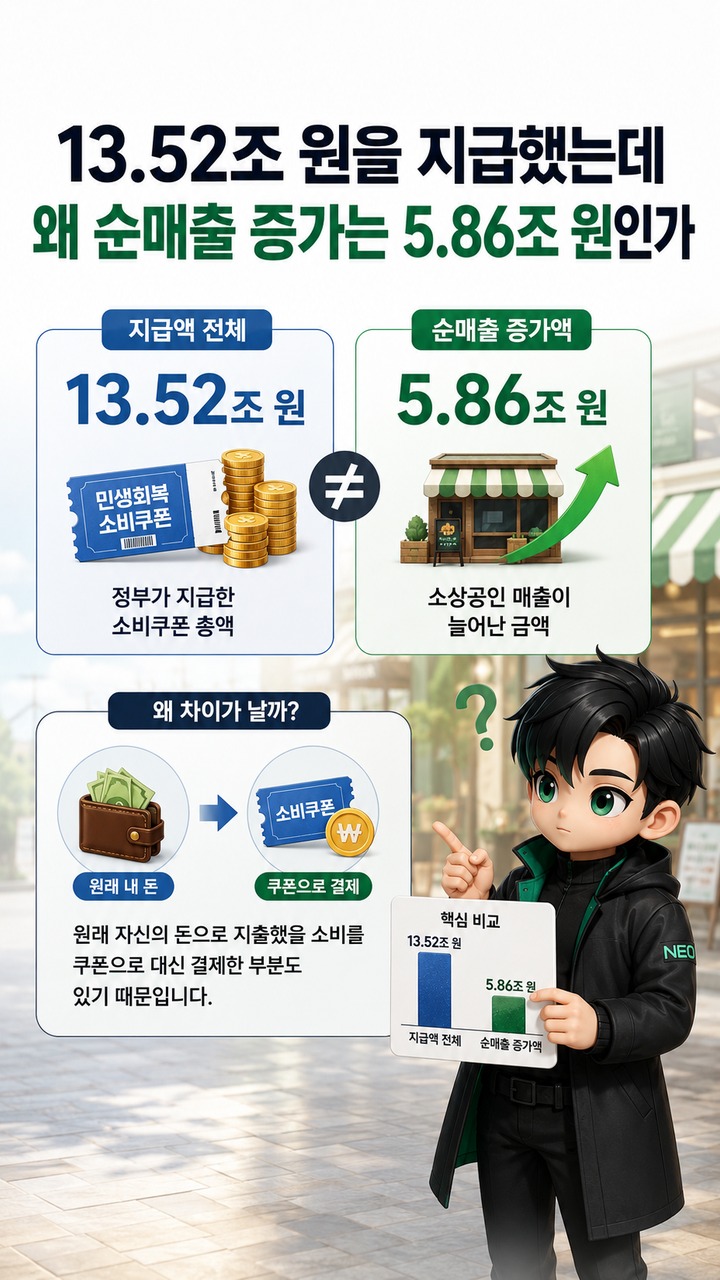
The study published in 2026 accounted for this distinction and estimated the additional net sales generated for small businesses specifically because of the vouchers. Its findings indicated that KRW 13,520,000,000,000.00 in voucher payments produced an estimated KRW 5,860,000,000,000.00 increase in small-business net sales.
KRW 5,860,000,000,000.00 ÷ KRW 13,520,000,000,000.00 × 100 = approximately 43.3%.
The author's own calculation also matches the 43.3% reported in the official analysis. Put simply, the findings indicate that distributing KRW 1,000,000 in consumption vouchers generated an estimated increase in small-business net sales equivalent to approximately KRW 433,000.
However, this should not be interpreted as meaning that spending KRW 1,000,000 in vouchers will necessarily increase a particular store's sales by KRW 433,000. It is an estimate of the overall policy impact, based on analyses of card payment data and other information across multiple regions and industries.
The Share That Generated Additional Consumption Is Not the Same as the Increase in Small-Business Sales
The proportion of voucher payments estimated to have generated additional consumption from the consumer perspective was 34.7%. This differs in both scope and meaning from 43.3%, the measure of increased small-business net sales.
The study estimated that 34.7% of the total voucher amount translated into additional consumption. Results also varied according to the income characteristics of different regions.
In areas with incomes at or above the median, 25.5% of voucher payments was estimated to have generated additional consumption, compared with 53.2% in areas below the median income level. The corresponding figure was 72.6% in areas with a high proportion of vulnerable residents.
Therefore, it would be misleading to frame the findings as a question of whether 34.7% or 43.3% is the correct figure.
34.7% measures the effect on additional consumer spending, whereas 43.3% compares the increase in small-business net sales with the total voucher amount distributed. The two figures answer different questions.
Which Industries Experienced the Largest Sales Increases?
The analysis found that 49.6% of the overall increase in small-business net sales occurred in everyday consumer-facing industries, including restaurants, general retail, non-store retail, and food, beverage, and tobacco retail.
When the increase in net sales was calculated by industry for each KRW 1,000,000 in voucher payments, the reported figures were KRW 56,700 for specialty retail of other goods, KRW 49,000 for restaurants, KRW 37,700 for general retail, KRW 36,900 for non-store retail, and KRW 34,400 for food- and beverage-related retail.
An important distinction applies here as well. These figures do not mean that KRW 1,000,000 in vouchers was actually spent in each industry. Rather, they represent the estimated increase in net sales within each industry relative to the total amount distributed under the policy.
Results also differed by region. The analysis observed relatively higher sales growth rates in areas outside the Seoul metropolitan region, areas experiencing population decline, and communities with larger proportions of low-income or vulnerable residents. The effects were comparatively limited in central districts of major metropolitan cities within the Seoul metropolitan area.
Understanding these differences requires considering the policy's additional payments for certain regions and its restrictions on where vouchers could be used.
The Study Also Examined Whether the Vouchers Increased Inflation
When a large amount of public funding is spent over a short period through a program such as consumption vouchers, it is important to determine whether the resulting increase in consumption also puts upward pressure on prices.
The macroeconomic analysis published in 2026 reported statistically significant increases in major indicators, including private consumption, retail sales, service-sector production, and employment, during the voucher distribution period. By contrast, it found no statistically significant change in consumer price inflation before and after the policy was introduced.
The researchers also used a model to compare scenarios in which the same amount of funding was distributed through consumption vouchers or direct cash payments.
The simulation estimated consumption growth of 1.2% under the voucher approach, compared with 1.0% under the cash payment approach. The estimated contribution to GDP growth was 0.6% for vouchers and 0.25% for cash payments.
These findings must be understood as model-based simulation results, not an observed comparison of two policies implemented simultaneously in the real world. They are different in nature from the KRW 5,860,000,000,000.00 increase in net sales estimated using actual payment data.
What Data Was Used for the Impact Analysis?
The analysis released in 2026 was based on a commissioned research project conducted from November 2025 to April 2026. Payment data from 6 major domestic credit card companies was used. According to the government, the card data included in the analysis covered 74.23% of all credit card transaction value.
The research was not limited to small-business sales. It included microeconomic analysis examining the recovery of small-business activity and consumer spending behavior, macroeconomic analysis of consumption and economic indicators, and a public opinion survey.
The survey covered 1,000 adult men and women aged 20 to 69 across 17 cities and provinces nationwide. 84.6% of respondents said measures to stimulate consumption were necessary during an economic downturn, while 73.6% believed the vouchers had contributed to the recovery of sales among small businesses and self-employed operators. The proportion who said the program had helped restore consumption among the general public was 67.9%.
Survey responses should also be distinguished from estimates of economic effects based on card transaction data. The survey measures public perceptions of the policy, while KRW 5,860,000,000,000.00 and 43.3% are findings derived from analyses using payment records and other data.
What Should You Check If You Search for the Program Again in September 2026?
When searching for Livelihood Recovery Consumption Vouchers in September 2026, the most important thing is to avoid confusing application procedures with policy impact findings.
Both the application and spending periods for vouchers distributed in 2025 have ended. The deadline for using those earlier payments was 2025-11-30. Therefore, old application pages or informational graphics should not be taken as evidence that applications are still being accepted.
The main focus of currently available follow-up information is the program's actual distribution results and economic impact. According to the analysis released in 2026, a total of KRW 13,520,000,000,000.00 was distributed, generating an estimated KRW 5,860,000,000,000.00 increase in small-business net sales. That represents 43.3% of the amount distributed.
If a new payment program or additional application schedule is announced separately, applicants should not assume that it follows the same rules as the earlier 1 and 2 rounds. Instead, they should check the new announcement for eligibility requirements, payment amounts, reference dates, and application periods. The conditions of the previous program cannot automatically be applied to a new policy.