

Where Can You Check the Probability of a US Interest Rate Hike? How to Use CME FedWatch and Understand Its Impact on Bitcoin
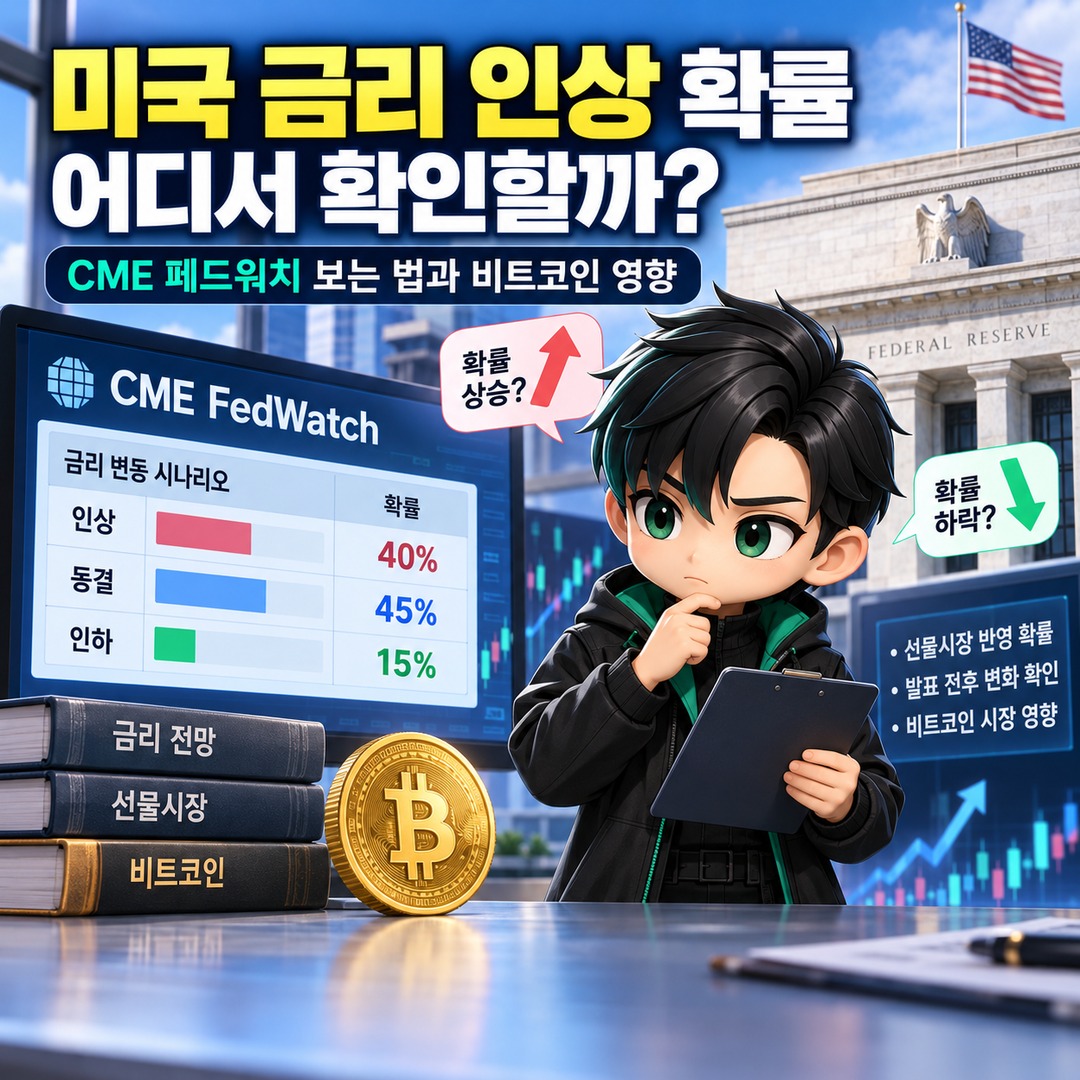
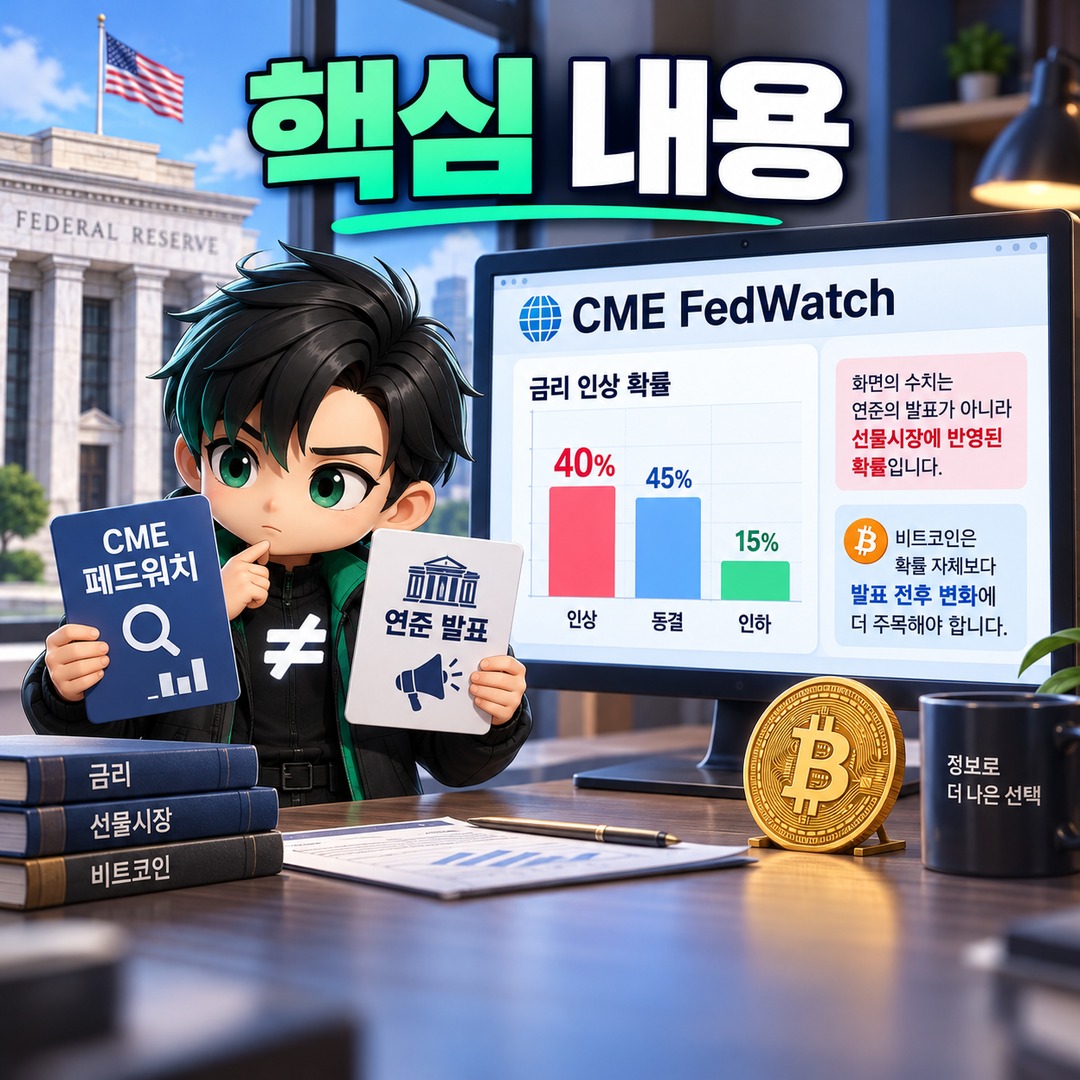
You can check the probability of a US interest rate hike using CME FedWatch. However, the 40% displayed on the screen is not a figure announced by the Federal Reserve (Fed) indicating that it will raise interest rates. It represents the probability of a rate hike implied by futures market prices. Bitcoin investors should examine not only the probability itself but also how much it changes before and after major announcements.
As of 9 a.m. Korea Standard Time on 2026-10-15, renewed attention to inflationary pressures in the United States has made three factors particularly important for investors monitoring interest rate expectations.
The key is to check whether the probability of a rate hike, US Treasury yields, and the value of the dollar are moving in the same direction.
1. What Is CME FedWatch? Where to Check US Interest Rate Hike Probabilities
CME FedWatch is an interest rate forecasting tool provided by CME Group, which operates the Chicago Mercantile Exchange in the United States.

It displays the probabilities of the benchmark interest rate reaching different levels at upcoming meetings of the Federal Open Market Committee (FOMC).
Official website: CME FedWatch
FedWatch uses federal funds futures prices for 30 to calculate the probabilities assigned by the market to different interest rate levels.
There are three important categories to distinguish.
| Displayed Item | Meaning |
|---|---|
| Probability of a rate hold | Likelihood that the current interest rate level will remain unchanged |
| Probability of a rate hike | Likelihood that the benchmark interest rate will increase |
| Probability of a rate cut | Likelihood that the benchmark interest rate will decrease |
For example, if the probability of a rate hike is displayed as 40%, it means the market is pricing in approximately 40% probability for that particular rate hike scenario.
It does not mean the Fed has officially announced a 40% probability of raising rates.
FedWatch probabilities also change with real-time market prices, so the figures you checked yesterday may differ from those shown today.
2. What Does It Mean When the Probability of a Rate Hike Rises from 20% to 40%?
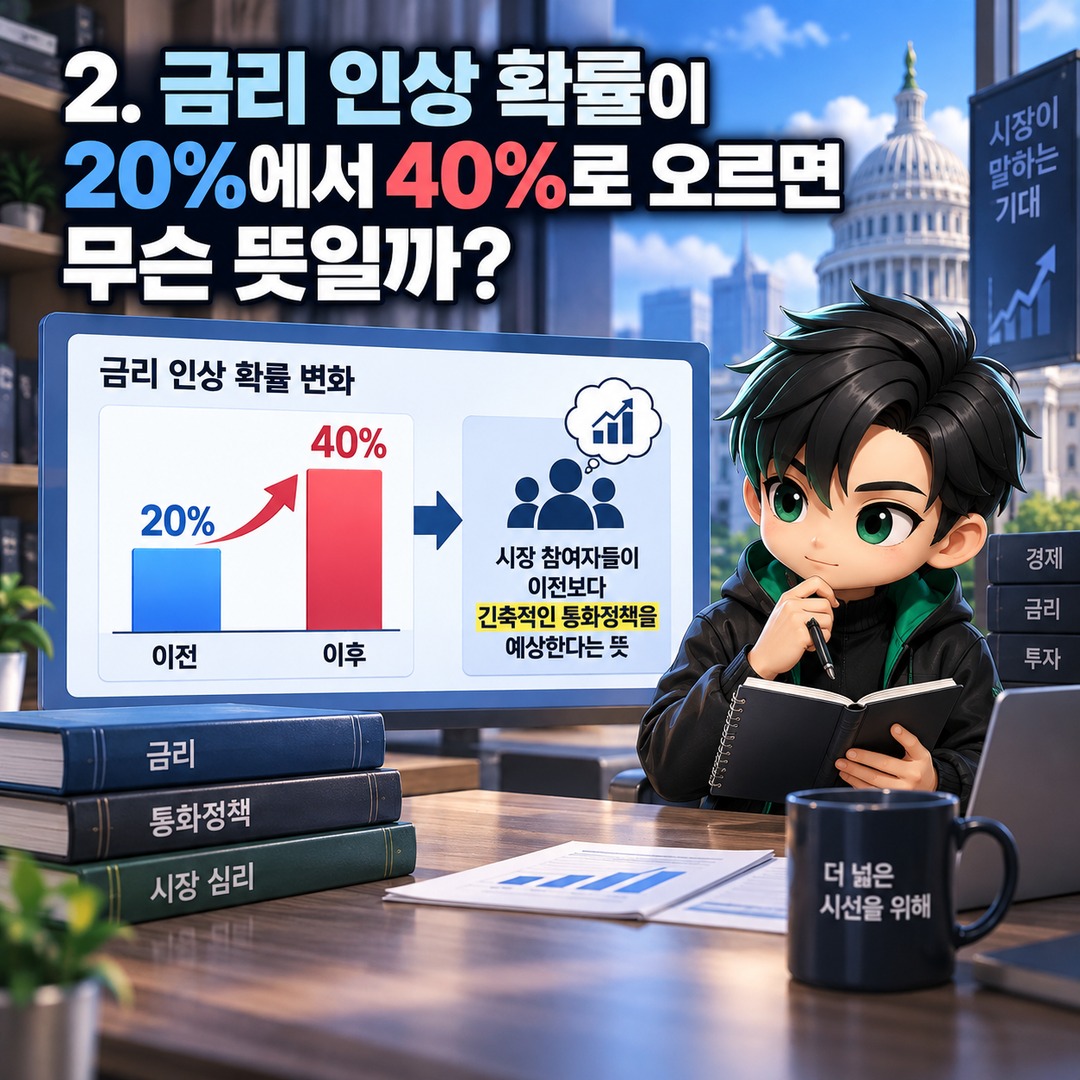
An increase in the probability of a rate hike means market participants expect tighter monetary policy than they did previously.
What matters is not only the absolute probability but also how quickly it has changed.
The following is a hypothetical example for illustration.
| Category | Before Announcement | After Announcement |
|---|---|---|
| Probability of a rate hike | 20% | 40% |
| Probability of a rate hold | 80% | 60% |
This example assumes that only two interest rate scenarios exist. These are not actual FedWatch figures for 2026-10-15.
In this example, the change in the probability of a rate hike is as follows.
Probability difference: 40% - 20% = an increase of 20% percentage points
Relative increase: (40 - 20) ÷ 20 × 100 = an increase of 100%
In other words, the probability of a rate hike has doubled.
However, the figure 40% alone should not be interpreted as confirmation that a rate hike will occur.
That is because the probability of rates remaining unchanged is still higher at 60%.
In actual markets, several interest rate levels may be displayed, including an increase of 0.25% percentage points, larger increases, and rate cuts. It is therefore important not to confuse the probability of a particular interest rate level with the overall probability of a rate hike.
3. Does Higher US CPI Always Increase the Probability of a Rate Hike?

Not necessarily.
Even if the US Consumer Price Index (CPI) comes in at a high level, concerns about interest rate hikes may ease if the reading is lower than market expectations. Conversely, inflation that exceeds expectations may intensify concerns about monetary tightening.
The September Consumer Price Index released by the US Bureau of Labor Statistics (BLS) on 2026-10-14 increased 3.7% year over year.
In the same release, core CPI, which excludes food and energy, increased 2.6% year over year and 0.3% month over month.
There is an important distinction here.
Headline CPI includes volatile components such as gasoline and food, while core CPI excludes food and energy.
The Fed considers whether rising prices reflect a temporary increase in energy costs or whether inflationary pressures are spreading to other goods and services.
Furthermore, the Fed's inflation target is based on the Personal Consumption Expenditures (PCE) price index, not CPI.
It is therefore difficult to predict the next interest rate decision with certainty based on a single CPI report.
Employment, wages, economic growth, and financial market conditions also influence monetary policy decisions.
4. Why Can a Higher Probability of US Rate Hikes Put Pressure on Bitcoin?
Stronger expectations of US interest rate hikes can generally create headwinds for Bitcoin.
This is because interest rate expectations affect borrowing costs and investors' appetite for risk.
The main transmission mechanism can be summarized as follows.
Stronger Expectations of Rate Hikes → Upward Pressure on US Treasury Yields → Potential Dollar Strength and Weaker Risk Appetite → Downward Pressure on Bitcoin Prices
When US Treasury yields rise, relatively safe bonds may become more attractive investments.
At the same time, a stronger dollar can change the conditions under which global investors allocate capital to risk assets.
Bitcoin may face selling pressure during this process.
However, a rising probability of rate hikes does not always lead to a decline in Bitcoin prices.
Other factors, including inflows into spot Bitcoin ETFs, institutional investor demand, derivatives liquidations, and market liquidity, may have a greater influence.
In particular, if concerns about rate hikes have already been fully priced in, Bitcoin may not decline significantly even after a new inflation report.
5. 3 Indicators to Check Alongside FedWatch
Comparing US Treasury yields and the US Dollar Index alongside FedWatch can provide a more comprehensive understanding of market reactions than looking at FedWatch alone.
| Indicator to Monitor | Changes to Examine First |
|---|---|
| CME FedWatch | Changes in the probabilities of rate hikes and rate holds |
| 2-year US Treasury yield | Changes in short-term monetary policy expectations |
| US Dollar Index (DXY) | Dollar strength or weakness |
2-Year US Treasury Yield
The 2-year US Treasury yield is an indicator that responds sensitively to market expectations about future monetary policy.
If the probability of a rate hike increases while the 2-year Treasury yield also rises, this may indicate that expectations of tighter monetary policy are being reflected in the bond market as well.
However, Treasury yields are influenced not only by interest rate expectations but also by supply and demand and risk premiums.
US Dollar Index (DXY)
The US Dollar Index measures the relative value of the US dollar against major currencies.
Stronger expectations of rising US interest rates can support the dollar.
However, monetary policies in other countries and international financial market conditions also have an influence, so the Dollar Index does not always move in the same direction as US interest rate expectations.
Bitcoin Trading Volume and Price Reactions
If the probability of a rate hike increases but Bitcoin's price barely moves, it may be worth considering whether the development has already been priced into the market.
Conversely, if trading volume surges alongside a price decline, investors should examine whether selling pressure has intensified.
However, an increase in trading volume alone cannot determine whether a downward trend will continue.
6. How to Check CME FedWatch Step by Step
Even first-time users can follow these steps.
1. Visit the official CME FedWatch page.
2. Check the date of the next FOMC meeting.
3. Review the probabilities for each target interest rate range at that meeting.
4. Compare them with the current benchmark interest rate range to distinguish between rate hike, hold, and cut scenarios.
5. If a screen showing historical probabilities is available, compare the changes before and after the announcement.
6. Compare these movements with the 2-year US Treasury yield and the US Dollar Index.
One of the most common mistakes is interpreting an increase in the probability of a rate hike as an immediate signal to sell Bitcoin.
FedWatch probabilities do not guarantee future policy decisions, and market expectations may already be reflected in Bitcoin prices.
Additionally, as an FOMC meeting approaches, new economic data and statements from Fed officials can cause substantial changes in these probabilities.
7. When Are the Next US Interest Rate Decision and CPI Release?
As of 2026-10-15, the next major scheduled events are as follows.
| Event | Date |
|---|---|
| Next FOMC interest rate decision | 2026-10-28 (US local time) |
| Release of US October CPI | 2026-11-10 |
| October CPI release in Korea Standard Time | November 10 at 10:30 p.m. |
The US Bureau of Labor Statistics has scheduled the release of October CPI for 8:30 a.m. US Eastern Time.
Because US Eastern Standard Time will be in effect on November 10, the corresponding time in Korea will be 10:30 p.m.
Release schedules may change due to circumstances at the issuing agencies, so it is advisable to check the official calendars again.
Around the CPI release, it can be helpful to compare how much FedWatch probabilities change and whether those changes are also reflected in Treasury yields and the Dollar Index.
8. Frequently Asked Questions
Q. If the FedWatch Probability of a Rate Hike Exceeds 50%, Is a Rate Hike Confirmed?
No. Even if it exceeds 50%, this only means the market considers a rate hike more likely. The actual benchmark interest rate is determined at the FOMC meeting.
Q. Can Bitcoin Fall Even If Interest Rates Remain Unchanged?
Yes. Even if rates are held steady, risk assets may come under pressure if the Fed emphasizes the possibility of future rate hikes or fails to deliver the dovish comments the market had expected.
Q. Will Bitcoin Always Rise If the Probability of a Rate Cut Increases?
No. If expectations of rate cuts rise because of growing recession concerns, risk assets may actually decline. Investors need to understand why interest rate expectations have changed.
Conclusion: What Bitcoin Investors Should Watch in FedWatch Is the Change in Probabilities
The probability of US interest rate hikes is a useful indicator for understanding risk factors in the Bitcoin market.
However, an increase in the probability of a rate hike alone cannot definitively predict whether Bitcoin will rise or fall.
There are three things investors should actually check.
First, how much has the probability of a rate hike changed compared with the previous reading? Second, are the 2-year US Treasury yield and the Dollar Index moving in the same direction? Third, has Bitcoin's price already reflected those expectations?
Examining these three factors together can help investors interpret short-term price movements immediately following a CPI release in the context of changing interest rate expectations.
However, cryptocurrencies are highly volatile and can generate sudden, substantial losses. It is therefore important not to make trading decisions based on a single economic indicator.
Information reference time: 2026-10-15 at 9 a.m., Korea Standard Time. The probability calculations used in this article are hypothetical examples for explanatory purposes. Investors should consult the latest market data when making actual investment decisions.
---
Publication Information
※ This article is provided for informational purposes to help readers understand market trends and does not constitute an investment recommendation for any particular security or asset. All final investment decisions and responsibilities rest with the individual investor.
Related Articles
How Beginners Can Draw Lines on Bitcoin Charts: Start by Connecting 2 Lows and 2 Highs