

ROKIT America IPO Price of 9.50 vs. Book Value of 0.94? What ‘8.56 Dilution’ Means

The estimated IPO price range of 8.50–10.50 is not the only figure worth examining in ROKIT America's S-1/A filing. Assuming an offering at the midpoint price of 9.50, the net tangible book value per share attributable to new investors immediately after the offering would be approximately 0.94, resulting in dilution of 8.56 per share. However, this does not mean the stock price will fall to 0.94 immediately after listing.
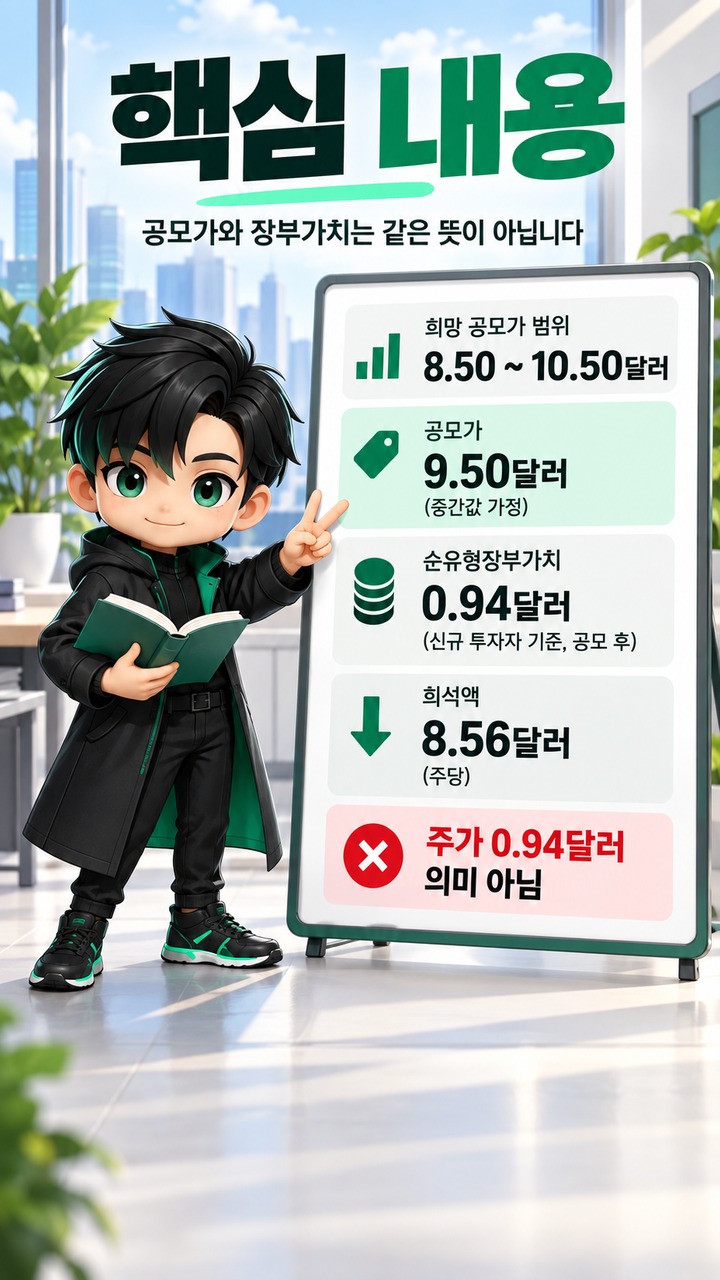
What Does ‘8.56 Dilution per Share’ Mean?
In this context, dilution refers to the difference between the IPO price and the net tangible book value per share immediately after the offering.

The calculation used in the S-1/A filing released by ROKIT America on 2026-06-04 is as follows.
| Category | Based on S-1/A |
|---|---|
| Assumed IPO price | 9.50 |
| Net tangible book value per share before the offering | 0.16 |
| Adjusted net tangible book value per share after the offering | 0.94 |
| Dilution per share for new investors | 8.56 |
The calculation itself is straightforward.
9.50 - 0.94 = 8.56
Expressed as a percentage, 8.56 ÷ 9.50 × 100 equals approximately 90.1% (author's calculation).
In other words, assuming an investor purchases IPO shares at 9.50, the accounting-based net tangible book value per share immediately after the offering would be 8.56 lower than the purchase price.
Does This Mean a Stock Priced at 9.50 Is Actually Worth 0.94?

No. A net tangible book value of 0.94 should not be interpreted as a fair share price or a target price.
Net tangible book value is calculated using accounting-based net assets, including tangible assets. An IPO price, by contrast, may reflect factors that do not appear directly on the balance sheet, including growth prospects, future earnings potential, business competitiveness, market demand, and valuations of comparable companies.
Therefore, a high dilution percentage does not necessarily mean the IPO price is excessive. Conversely, growth potential alone does not establish that the offering price is reasonable.
The dilution section of S-1/A is best understood as one indicator of how much new investors are paying relative to existing shareholders.
Why Is There Such a Large Difference Between Existing and New Shareholders?
ROKIT America has 2,500만100 shares outstanding before the offering. According to the table in S-1/A, existing shareholders paid approximately 25만 in total consideration for these shares, at a weighted-average price of 0.01 per share.
New investors, meanwhile, would purchase 263만1,579 shares at the assumed IPO price of 9.50. Under S-1/A, new investors would own approximately 10% of the total shares outstanding after the offering while contributing approximately 99% of the total consideration paid.
This difference is why the dilution figures matter.
When evaluating an IPO, investors should look beyond simply asking what price the company will list at. They should also examine how much existing shareholders invested and what ownership stake they hold, compared with how much new investors must pay for the ownership stake they receive.
How Much Will IPO Proceeds Increase Net Tangible Book Value?
As of 2026-03-31, before the offering, ROKIT America's net tangible book value was approximately 396만8,032, or 0.16 per share.
Assuming the issuance of 263만1,579 shares at 9.50 per share, after deducting underwriting discounts and estimated offering expenses, adjusted net tangible book value after the offering would be approximately 2,590만, or about 0.94 per share.
For existing shareholders, this means net tangible book value per share would increase by approximately 0.78, from 0.16 to 0.94.
New investors, by contrast, would pay 9.50 to acquire shares representing 0.94 in net tangible book value per share immediately after the offering.
This explains why the same IPO produces an increase in book value for existing shareholders while being reported as dilution for new investors.
How Much Will Existing Ownership Be Reduced If 263만1579 Shares Are Issued?
Adding the 263만1,579 shares in the base offering to the 2,500만100 shares outstanding before the offering would bring the total number of shares outstanding immediately afterward to 2,763만1,679.
S-1/A shows that ROKIT Healthcare, which owns all outstanding shares before the offering, would hold 90.48% of the company after the offering.
If the underwriters fully exercise their option to purchase up to 39만4,737 additional shares, the total number of shares outstanding could rise to as many as 2,802만6,416.
The company has also adopted the 2026 Omnibus Equity Incentive Plan, which permits the issuance of up to 250만 shares. Whether and when those shares are actually issued are separate questions, but the plan is another item worth reviewing when assessing potential changes in the share count after the IPO.
‘Dilution’ and ‘Lock-Up Expiration’ Are Different Issues
These two concepts are often confused when evaluating IPOs.
Dilution concerns changes in ownership interests per share or book value relationships resulting from the issuance of new shares and similar events. A lock-up, on the other hand, is a restriction preventing existing shareholders and certain other parties from selling their shares in the market for a specified period.
ROKIT America's S-1/A includes provisions requiring directors, officers, existing shareholders, and certain other parties to enter into lock-up agreements that generally restrict the disposal of securities for 180 days after the completion of the offering. However, the specific conditions outlined in the filing, including exceptions requiring prior written consent from underwriter Maxim, must also be considered.
Investors should therefore examine the offering price and dilution immediately around the listing, while separately monitoring the actual number of freely tradable shares and lock-up conditions after the listing.
Which Figures Should Investors Check First Right Now?
The 9.50 figure in the current S-1/A is not the final IPO price. It is the midpoint of the estimated 8.50–10.50 price range. The proposed offering of 263만1,579 shares is also presented using this assumed price.
Accordingly, investors should first verify the final offering price and final number of shares issued when those figures become available.
If the offering price changes, the dilution calculation for new investors may also change. The SEC filing explicitly states that the current dilution calculations are illustrative and may change depending on the actual offering price and terms.
Ultimately, the key point about ‘8.56 dilution’ in ROKIT America's IPO is that it does not mean the stock price will decline by 8.56. Rather, it represents the difference between the assumed IPO price of 9.50 and the estimated net tangible book value per share of 0.94 immediately after the offering.
At a stage when the listing status and offering price have not yet been finalized, investors should avoid judging the investment's attractiveness based on this figure alone. Instead, they should consider the final offering price, actual number of shares issued, post-offering ownership structure, and number of shares available for trading.
※ This article is based on publicly available SEC materials as of 2026-09-19 Korea Standard Time. It does not recommend or guarantee the purchase, sale, or profitability of any particular security.
※ This article is provided for informational purposes to help readers understand market developments and does not constitute investment advice regarding any particular security or asset. All investment decisions and associated responsibilities rest with the individual investor.
Related Articles
What Has Changed Since the Initial S-1 Filing?
Why Did the Dow Fall 1.18% While the Nasdaq Declined 0.32% Despite the Same Oil Price Shock?