

Gyeonggi Provincial Office of Education Launches RAS Reading, Arts and Sports Education in the 2 Semester: What Will Change in Schools with 435 Billion in Funding?
이 포스팅은 쿠팡 파트너스 활동의 일환으로, 이에 따른 일정액의 수수료를 제공받습니다.
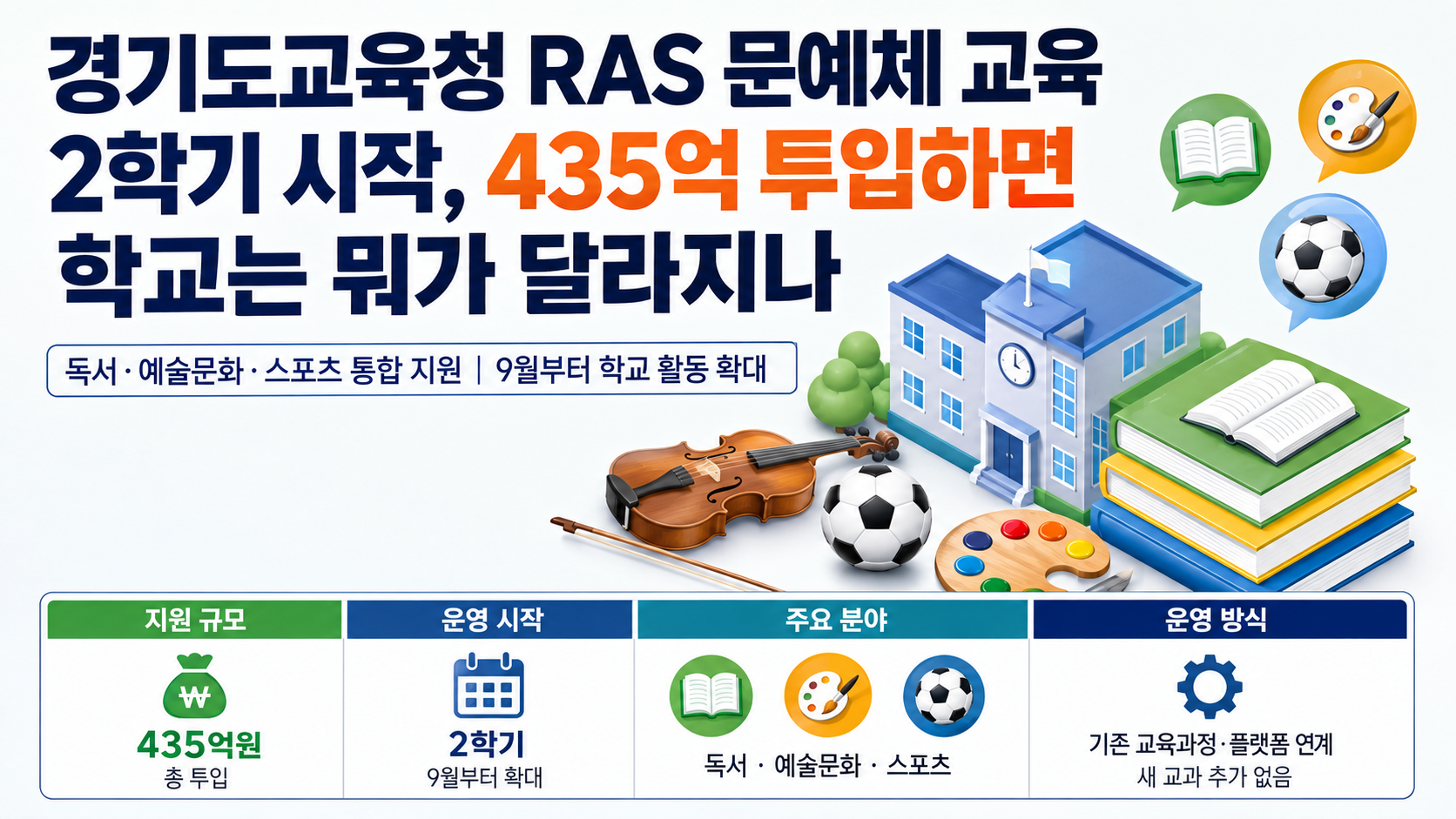
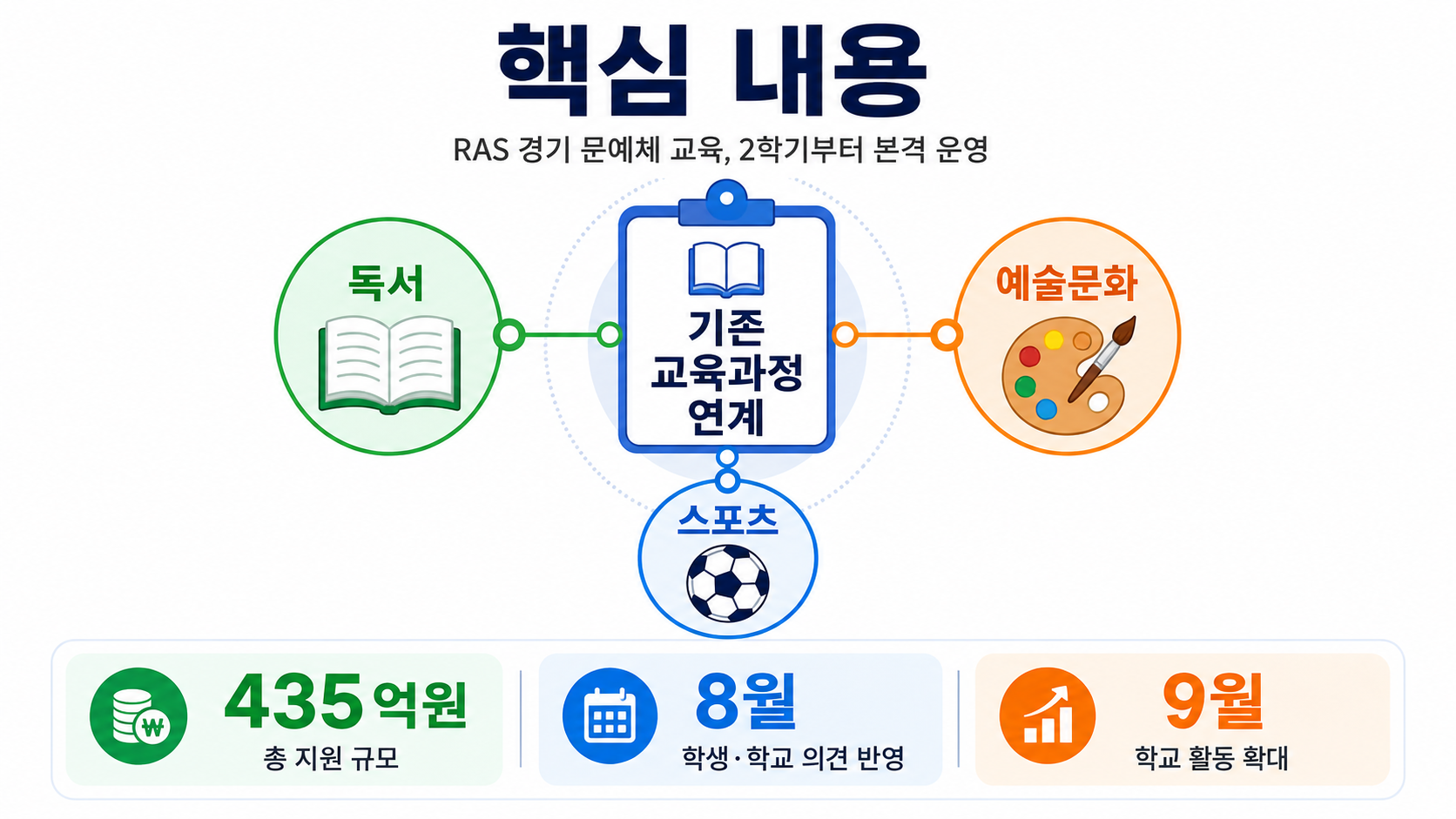
The Gyeonggi Provincial Office of Education will begin full-scale implementation of its 'RAS Gyeonggi Reading, Arts and Sports Education' initiative, combining reading, arts and culture, and sports, starting in the 2 semester of the 2026 academic year. Total funding amounts to KRW 43,500,000,000. After gathering feedback from students and schools during August, the office plans to expand school-based activities beginning in September. The key is to connect existing curricula and school activities rather than introduce another identical subject for every student.
Students and parents following recent announcements from the Gyeonggi Provincial Office of Education may be particularly confused about whether 'Phone-Free School' and RAS are the same initiative, whether students must surrender their smartphones, and how KRW 43,500,000,000 will be spent.
Although the two policies are connected, they are not the same. RAS is an educational initiative designed to expand reading, arts, and sports activities throughout school life. Phone-Free School, meanwhile, encourages students to reduce smartphone use unrelated to educational activities by establishing school-specific agreements and practices.
What Exactly Is Gyeonggi's RAS Education Initiative?
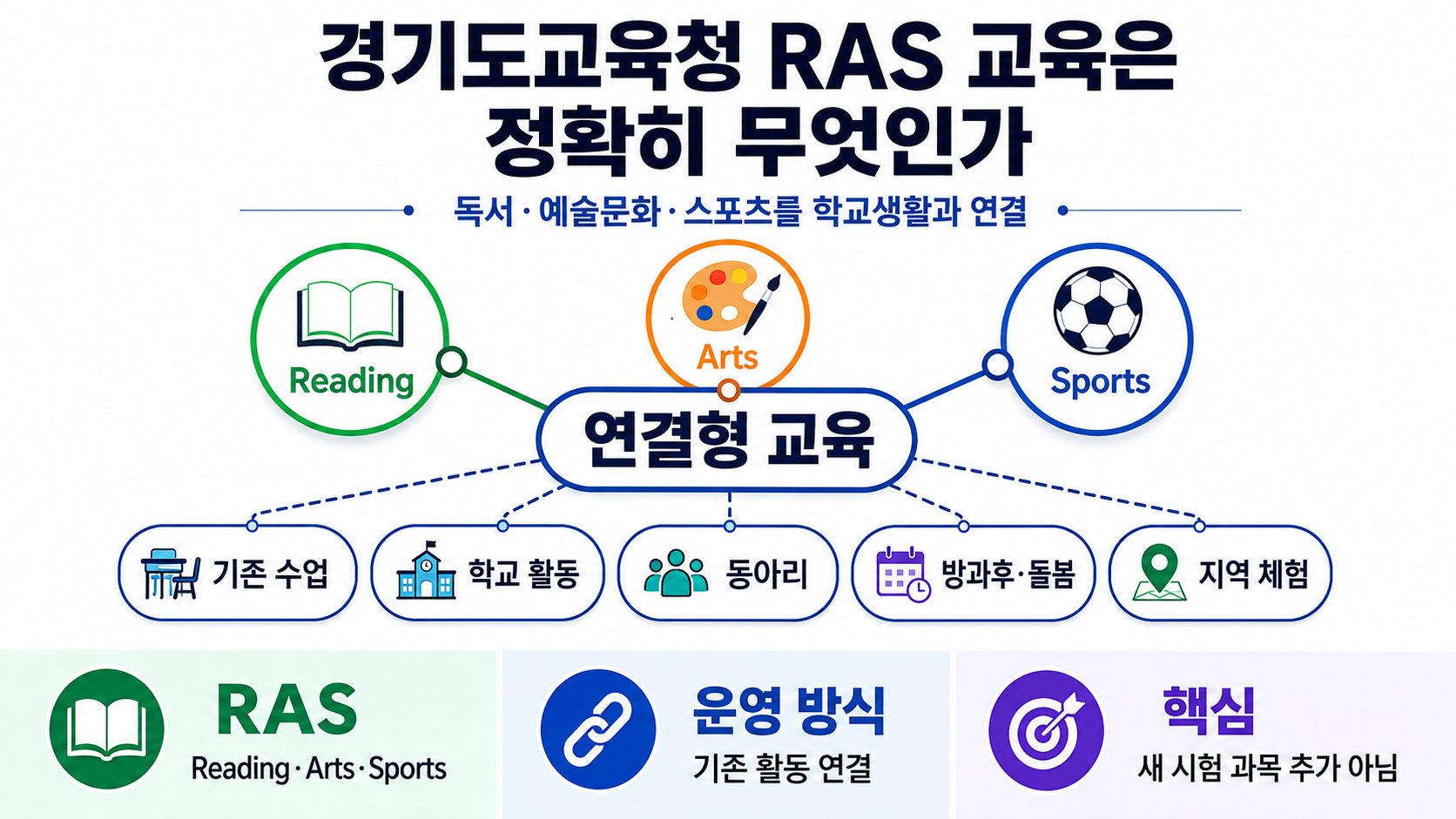
RAS stands for Reading, Arts, and Sports, an initiative designed to give students opportunities to experience reading, arts and culture, and sports as part of everyday school life. Rather than adding a separate examination subject, the approach connects existing lessons, school activities, clubs, after-school programs, childcare services, and community-based experiential programs.
The implementation schedule has also been outlined in relatively specific terms. The office plans to gather additional feedback from students and schools during August 2026 and support full-scale implementation of RAS activities in schools beginning in September.
Activities will not be limited to regular classroom lessons. Schools may also use available periods throughout the school day, including morning time after students arrive but before 1 period, breaks, midmorning playtime, and lunch breaks.
Examples include reading and discussing books, creating books, participating in school orchestras and arts clubs, organizing school exhibitions, running, and taking part in morning sports programs. Schools can adapt these activities to their circumstances. Students may also choose among existing programs or help design new activities.
In other words, the central principle of RAS is not that every student must follow a prescribed program, but that student participation should increase.
How Will KRW 43,500,000,000 Be Spent?
The Gyeonggi Provincial Office of Education has announced total RAS-related funding of KRW 43,500,000,000. The funding structure allocates KRW 20,000,000,000 to school curricula and reading, arts, and sports activities, and KRW 23,500,000,000 to RAS activities connected with after-school programs and childcare services. Of this amount, KRW 5,000,000,000 represents new funding drawn from resources designated for current educational needs.
Calculating the proportions makes the differences easier to understand.
Author's Calculations
School curricula and reading, arts, and sports activities: KRW 20,000,000,000 ÷ KRW 43,500,000,000 ≈ 46.0%
After-school and childcare-related RAS activities: KRW 23,500,000,000 ÷ KRW 43,500,000,000 ≈ 54.0%
Difference in funding between the two categories: KRW 3,500,000,000
Newly allocated KRW 5,000,000,000: Approximately 11.5% of the total KRW 43,500,000,000
However, KRW 5,000,000,000 is not an additional budget on top of KRW 43,500,000,000. It is already included in the total funding amount, so KRW 43,500,000,000 + KRW 5,000,000,000 must not be calculated as KRW 48,500,000,000.
Looking at the allocations, funding for after-school and childcare activities is slightly larger than funding for school curricula. The figures reinforce that RAS is intended to extend beyond classroom instruction, connecting activities throughout the school day and into after-school hours.
What Will Students Actually Do?
The Gyeonggi Provincial Office of Education has identified three main areas: reading, arts and culture, and sports. Rather than having schools operate activities in only one area, the goal is to provide a balanced range of experiences across all three.
Representative activities announced so far include family reading activities, reading discussions, student book-writing projects, school orchestras, student-led arts clubs, school galleries, running projects, and morning sports activities. The announced policy centers on 10 representative programs in total, but students will not be limited to choosing from existing activities. They will also have opportunities to propose and plan new programs themselves.
An important distinction is that the announcement does not require every school to follow an identical timetable or offer identical programs.
The initiative also includes school-specific programs and activities connected with local arts and cultural institutions, public libraries, and sports facilities. Actual implementation may therefore differ depending on local resources and individual school circumstances.
For example, a school surrounded by cultural facilities does not need to operate exactly the same programs as a school in an area with strong sports infrastructure. The Gyeonggi Provincial Office of Education also intends to expand existing curricula and activities rather than add a separate administrative project to every school's workload.
Are RAS and Phone-Free School the Same Policy?
They are separate policies, but they are closely connected.
Phone-Free School aims to reduce smartphone use that is not directly related to educational activities and encourages students to establish their own usage agreements with other members of the school community. RAS provides educational programs that can fill smartphone-free time with reading, arts, and sports activities.
Understanding this distinction is important to avoid interpreting the announcement as meaning that every school in Gyeonggi Province will collect students' smartphones across the board starting in the 2 semester.
The Gyeonggi Provincial Office of Education has announced that approximately 300 schools will be separately selected as Phone-Free School implementation schools. The initiative covers elementary, middle, high, special education, and other types of schools, with recruitment conducted over 3 rounds. Student councils will take the lead in designing practical agreements and activities suited to smartphone usage conditions at their respective schools.
Recruitment for the 1 round runs from 2026-07-28 through August 14, targeting 100 schools. Recruitment for the 2 round is scheduled for September 1–14, while the 3 round is scheduled to run from September 28 through October 9.
Therefore, the expansion of RAS education in the 2 semester should be distinguished from the selection of 300 Phone-Free School implementation schools.
Does This Mean Smartphones Will Be Completely Banned at School?
According to the Gyeonggi Provincial Office of Education's currently announced approach, Phone-Free School focuses on student councils developing school-specific rules and encouraging voluntary participation, rather than schools uniformly collecting students' mobile phones.
Students may examine when and under what circumstances smartphone use becomes problematic at their school, then work with other members of the school community to establish usage agreements.
Proposed approaches also include organizing activities with friends instead of using smartphones during breaks or lunchtime, as well as allowing students to design their own campaigns and practical projects.
For parents and students, therefore, rather than searching for a single province-wide rule such as 'smartphone use is prohibited throughout Gyeonggi Province after a certain time,' it is more accurate to check whether their school is participating in the Phone-Free School initiative and what smartphone usage standards the school is developing.
Because RAS implementation may also vary by school, students and parents should consult their school's 2 semester announcements for details about available programs and schedules.
What Should Students and Parents Check First Starting in the 2 Semester?
As of 2026-08-12, the most immediate developments are the collection of feedback during August and the implementation of RAS education beginning in September. For Phone-Free School, recruitment for the 1 round ends on August 14, with additional recruitment scheduled for September and October.
The steps students and parents should take are straightforward.
First, check the school's 2 semester curriculum information or notices sent home to see whether RAS programs will be offered. Next, identify which reading, arts, and sports programs will actually be available and whether they will take place during regular school hours, after-school programs, or childcare periods.
For information about smartphone use, separately check whether the school is participating in the Phone-Free School initiative and whether its student council is discussing new usage agreements.
What matters more than the KRW 43,500,000,000 budget is how RAS translates into actual activities at each school. The Gyeonggi Provincial Office of Education has outlined an approach that connects existing lessons, clubs, after-school activities, and community resources rather than adding another administrative responsibility for schools. The initiative's actual effectiveness will likely become clearer after September, as individual schools finalize their program offerings and student participation arrangements.
---
이 포스팅은 쿠팡 파트너스 활동의 일환으로, 이에 따른 일정액의 수수료를 제공받습니다.