

Where Can You Get a Disaster Confirmation Certificate in Geoje and Tongyeong? Small Business Owners Must Report Damage First
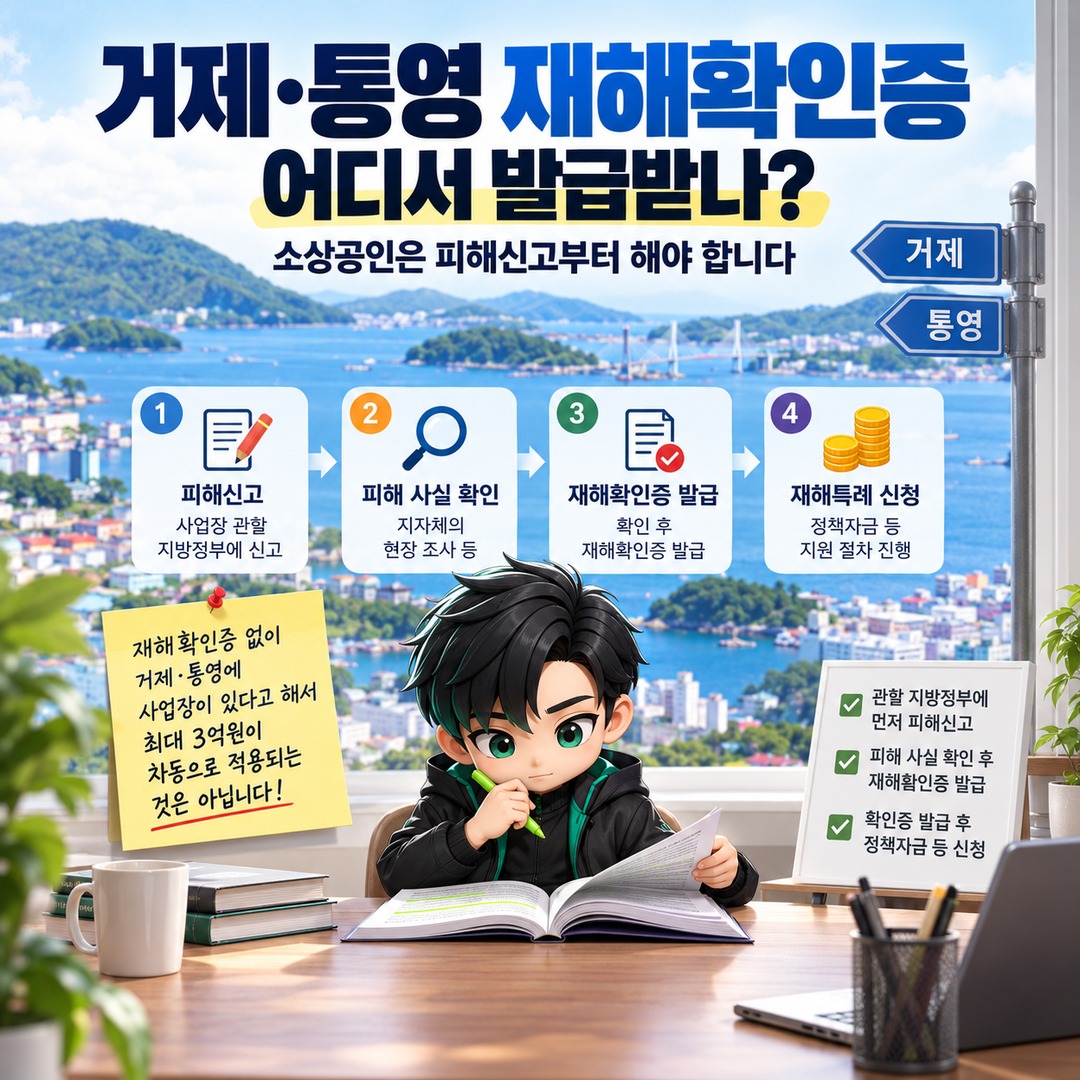
Small business owners affected by heavy rainfall in Geoje and Tongyeong must first report the damage to the local government responsible for their business location, have the damage verified, and obtain a disaster confirmation certificate before applying for special disaster relief policy loans. Simply operating a business in Geoje or Tongyeong does not automatically qualify an applicant for special disaster relief loans of up to KRW 300,000,000 without a disaster confirmation certificate.

With the disaster confirmation certificate serving as a key document for determining eligibility under the special support measures for Geoje and Tongyeong announced by the Ministry of SMEs and Startups on October 2026, the first question affected business owners need to resolve is not 'How much can I borrow?' but 'Where and how can I obtain a disaster confirmation certificate?'
A Disaster Confirmation Certificate Is Not a Document You Obtain First from SEMAS
A disaster confirmation certificate is not something you obtain after first submitting a loan application through the policy loan website.
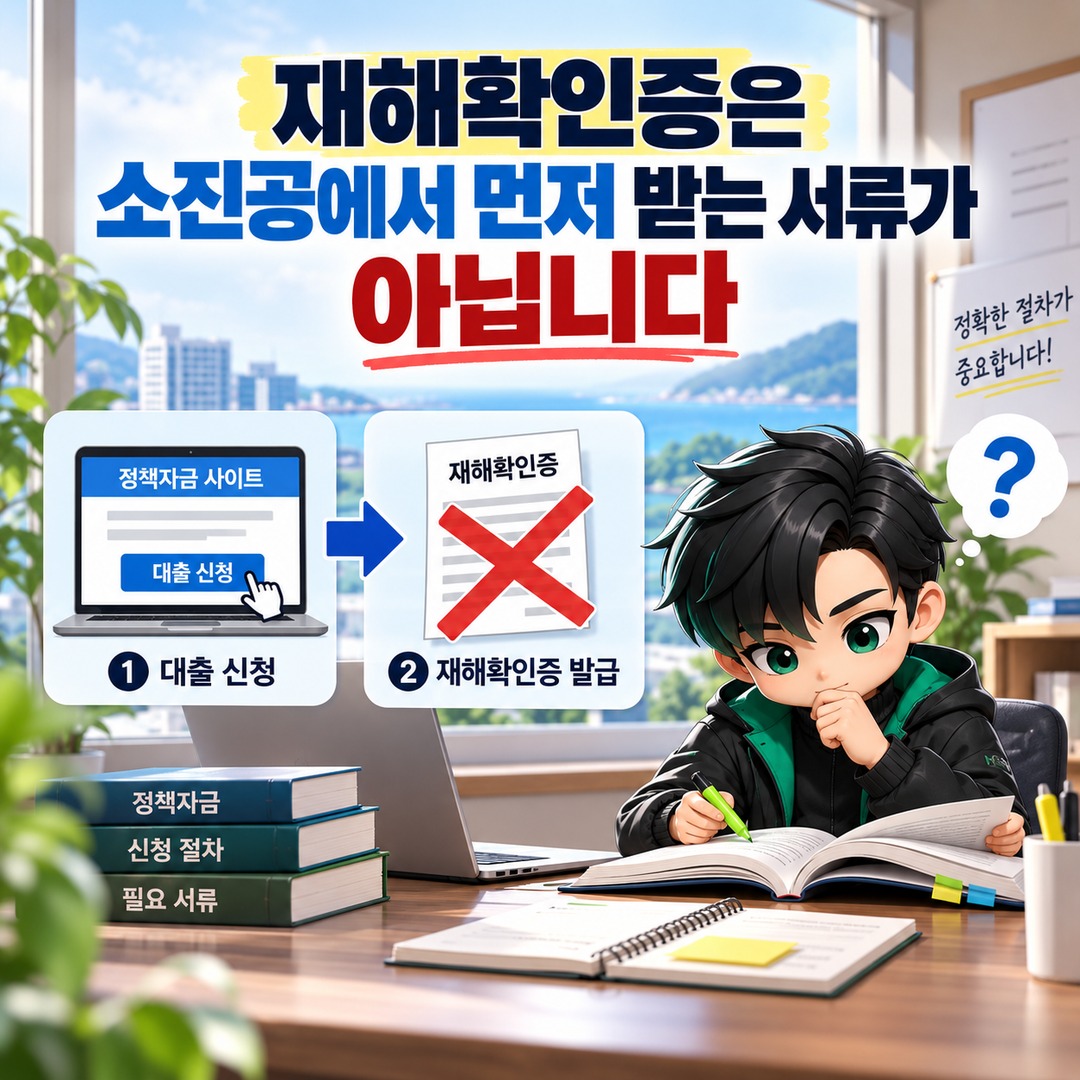
The procedure outlined by the Ministry of SMEs and Startups is report damage to the relevant local government → obtain a disaster confirmation certificate → apply for policy financing. In other words, affected business owners must first have the damage verified by the local government responsible for the location of their business.
In Geoje, business owners are advised to first contact the relevant local administrative office, such as the myeon or dong office responsible for their business location, to check whether their damage report was received and whether a disaster confirmation certificate can be issued. If they already reported damage during the heavy rainfall, the appropriate next step is to check whether a disaster confirmation certificate can be issued based on the existing report rather than immediately submitting a new loan application.
Conversely, business owners who did not report damage at the time should not assume they now qualify for special disaster relief. They must ask the local government responsible for their business location whether additional reporting or retrospective damage verification is possible.
Reporting Damage and Obtaining a Disaster Confirmation Certificate Are Separate Steps
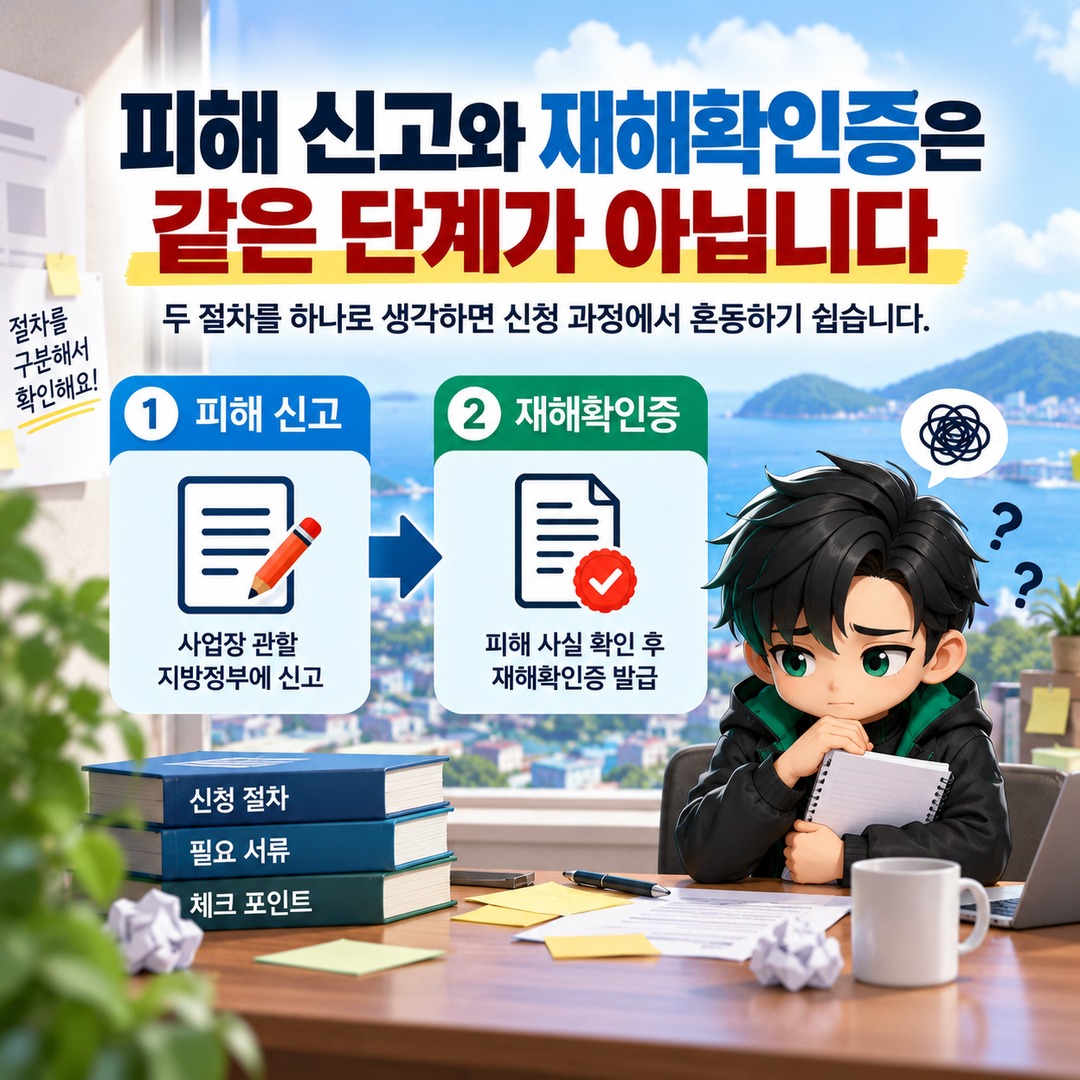
Treating these two procedures as a single step can easily cause confusion during the application process.
A damage report is the procedure for notifying the local government that a business has suffered actual disaster-related damage. A disaster confirmation certificate is an official document issued based on verified damage that can be used when applying for disaster relief policy financing.
It is therefore advisable to check the following steps in order.
Step 1. Check Your Damage Report with the Local Government Responsible for Your Business Location
Business owners who submitted a report during the August heavy rainfall should first confirm that it was received. Those who did not report damage should first ask whether additional verification is currently possible.
Step 2. Have the Damage Verified
Reporting flooding or damage to facilities or inventory does not automatically guarantee approval for policy financing. The local government's damage verification procedure must take place first.

Step 3. Confirm Whether a Disaster Confirmation Certificate Has Been Issued
Check whether a disaster confirmation certificate that can be used for policy financing has been issued. Required documents and detailed issuance procedures must be confirmed with the relevant local government, as they may vary depending on the type of damage.
Step 4. Apply for Disaster Relief Policy Financing
After obtaining the disaster confirmation certificate, proceed with the small business policy loan application process.
In its official announcement, the Ministry of SMEs and Startups also describes this sequence as 'complete the damage report, obtain a disaster confirmation certificate, and then apply for financing.'
Does Obtaining a Disaster Confirmation Certificate Mean You Can Borrow the Full KRW 300,000,000?
No. KRW 300,000,000 is the maximum loan limit under the special disaster relief measures for small business owners affected by heavy rainfall in Geoje and Tongyeong. It does not mean that a loan of KRW 300,000,000 is automatically approved when a disaster confirmation certificate is issued.
Under the small business policy financing announcement revised on 2026-10-01, the conditions for disaster-affected small business owners in Geoje and Tongyeong were changed as follows.
| Category | Geoje and Tongyeong Special Disaster Relief |
|---|---|
| Loan limit | Up to KRW 300,000,000 |
| Direct loan interest rate | Fixed annual rate of 1.5% |
| Indirect loan interest rate | Fixed annual rate of 1.4% |
| Loan term | 10 years |
| Grace period | 5 years |
Compared with the existing general disaster relief financing program, the maximum loan limit for small business owners increased from KRW 100,000,000 to KRW 300,000,000, while the repayment period was extended from 5 years to 10 years. The grace period was also extended from 2 years to 5 years.
The important point is not to treat 'issuance of a disaster confirmation certificate' and 'loan disbursement' as the same thing. In practice, final eligibility and the approved loan amount are determined through the applicable lending method and review procedures.
You Also Need to Check Whether Applications Are Currently Being Accepted
As of 2026-10-07, the actual implementation date of the preferential conditions for small business owners still needs to be confirmed.
According to the Ministry of SMEs and Startups' official announcement, preferential conditions for disaster-affected SMEs in Geoje and Tongyeong took effect on October 1, while the preferential conditions for small business owners were scheduled to take effect from the third week of October.
Small business owners should therefore check the actual application opening date and the procedures for direct and indirect loans while preparing their disaster confirmation certificates.
For inquiries about small business policy financing, the designated contact is the Small Business Integrated Call Center at 1533-0100.
A 'Small Business Status Certificate' Is Different from a 'Disaster Confirmation Certificate'
Although their names may sound similar, these are not the same documents.
A standard SME or small business status certificate verifies whether a company meets the criteria for classification as an SME or small business. According to guidance on Government24, this is a separate administrative service that accepts applications online or by mail.
By contrast, the disaster confirmation certificate required for the Geoje and Tongyeong special disaster relief measures is a document used to establish eligibility for disaster relief financing based on damage caused by the relevant heavy rainfall.
Therefore, obtaining a 'small business status certificate' online does not mean that you have also obtained a disaster confirmation certificate.
What Should You Check First If You Already Reported Damage in August?
If you completed a damage report immediately after the heavy rainfall, the key is to first check the processing status of your existing report and whether a disaster confirmation certificate has been issued by the relevant local government, rather than assuming you need to report the same damage again from the beginning.
Conversely, if your business suffered damage but you did not report it, your first step should be to ask the relevant local government whether additional damage verification is possible, rather than immediately applying for a special disaster relief loan.
In summary, the sequence is straightforward.
Confirm Damage Report → Verify Damage → Obtain Disaster Confirmation Certificate → Apply for Policy Financing
For the Geoje and Tongyeong special disaster relief program, the starting point is whether your business suffered qualifying damage and can obtain a disaster confirmation certificate, rather than the loan limit of KRW 300,000,000. Before applying, you should also reconfirm whether the preferential conditions for small business owners, scheduled for implementation in the third week of October 2026, have actually taken effect.
The official criteria can be checked at and .