

Retail Investors' Net Purchases in South Korea's Stock Market Surpass 200 Trillion: 131 Trillion in Stocks and 70 Trillion in ETFs
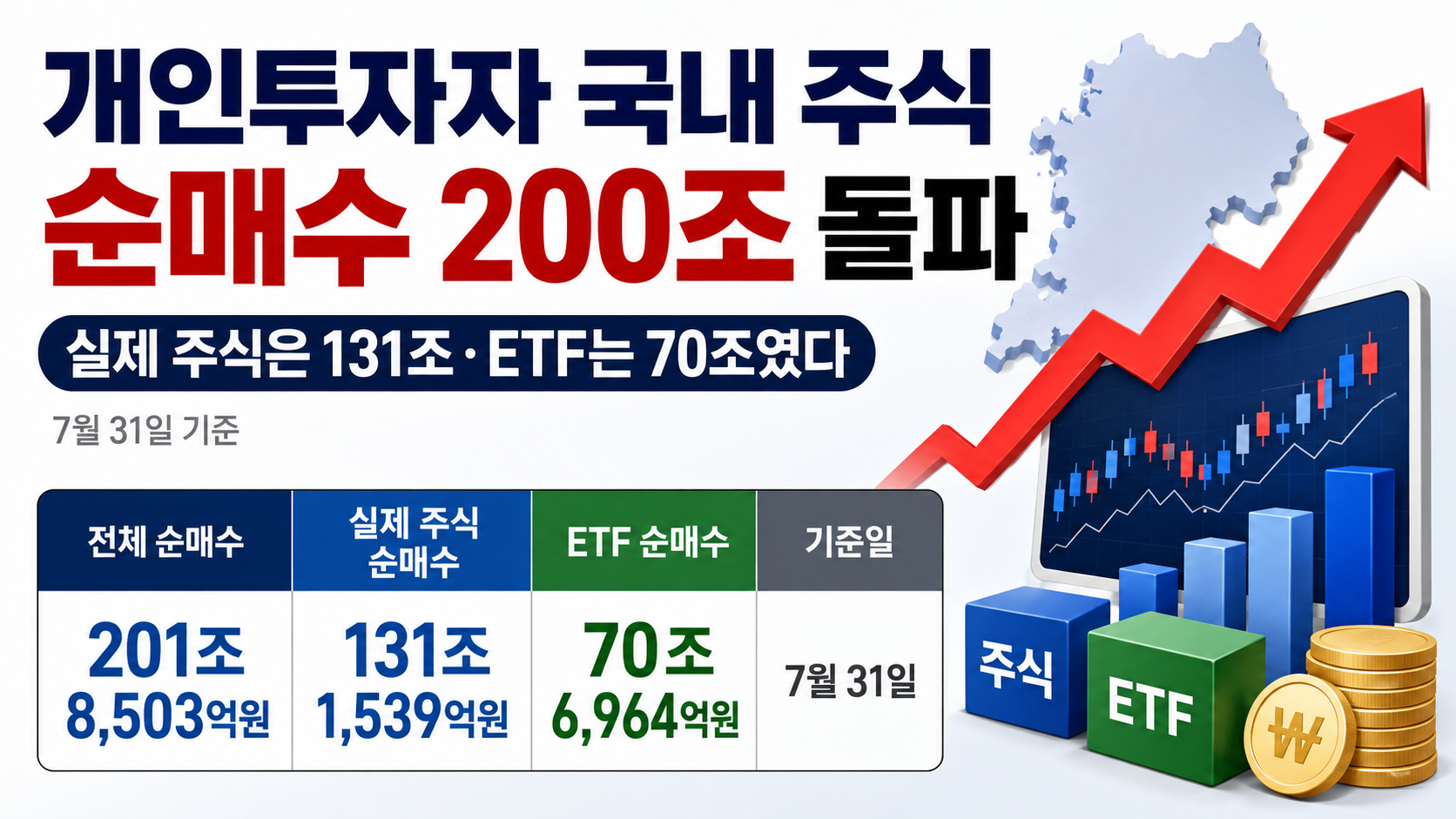
Retail investors' cumulative net purchases in South Korea's stock market reached KRW 201,850,300,000,000 as of July 31 this year. However, it would be inaccurate to interpret this simply as investors having bought KRW 200,000,000,000,000 worth of domestic stocks. The figure includes not only shares traded on the Korea Exchange and Nextrade but also KRW 70,696,400,000,000 in net ETF purchases.
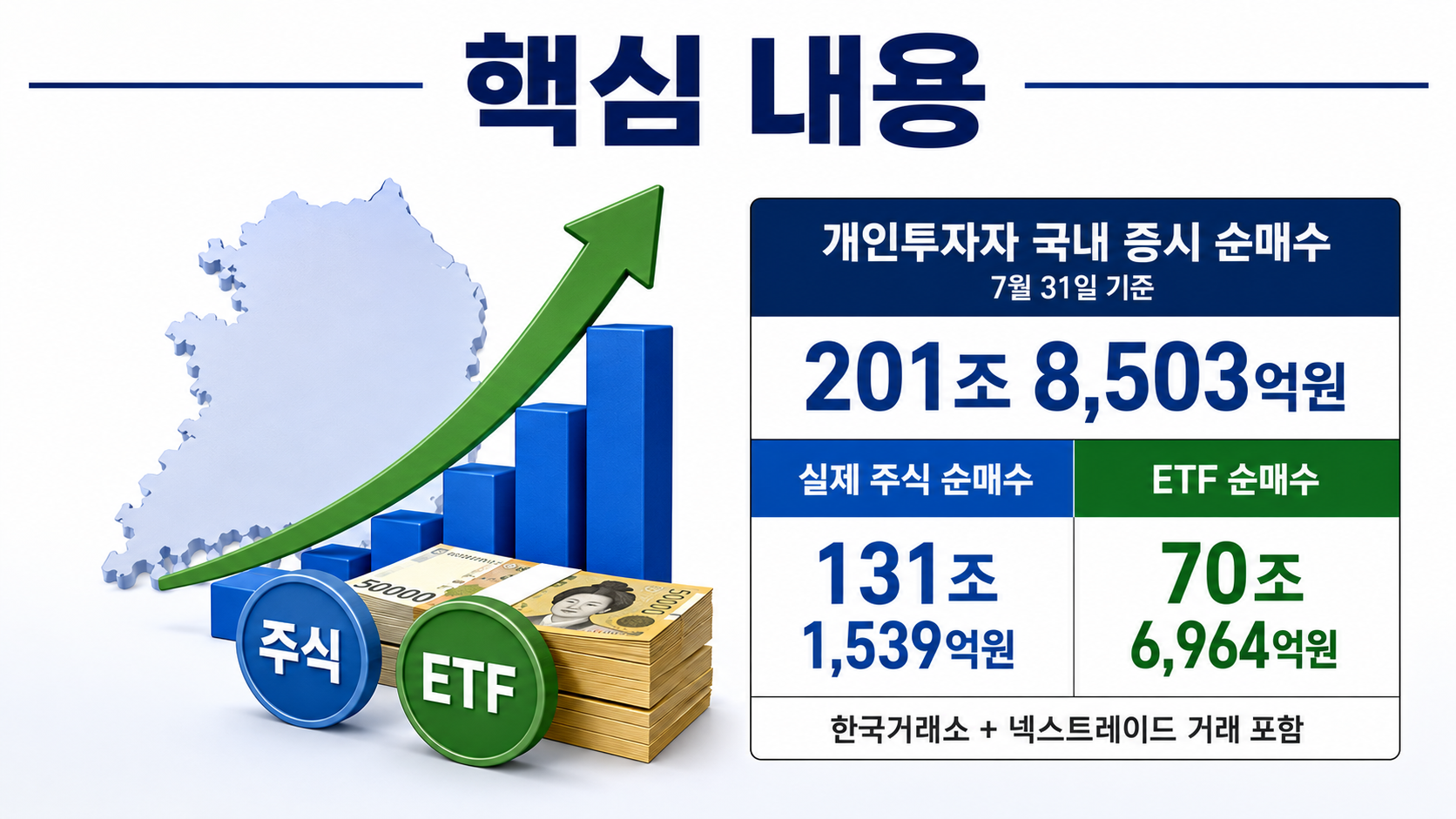
As of the more recent August 7, retail investors' cumulative net purchases of stocks and ETFs combined had increased to KRW 214,149,000,000,000. Rather than focusing solely on the KRW 200,000,000,000,000 milestone, it is important to examine which markets attracted the money.
How Was KRW 201,850,300,000,000 Calculated?
Through July 31, retail investors made net purchases of KRW 104,545,300,000,000 on the Korea Exchange's KOSPI market.
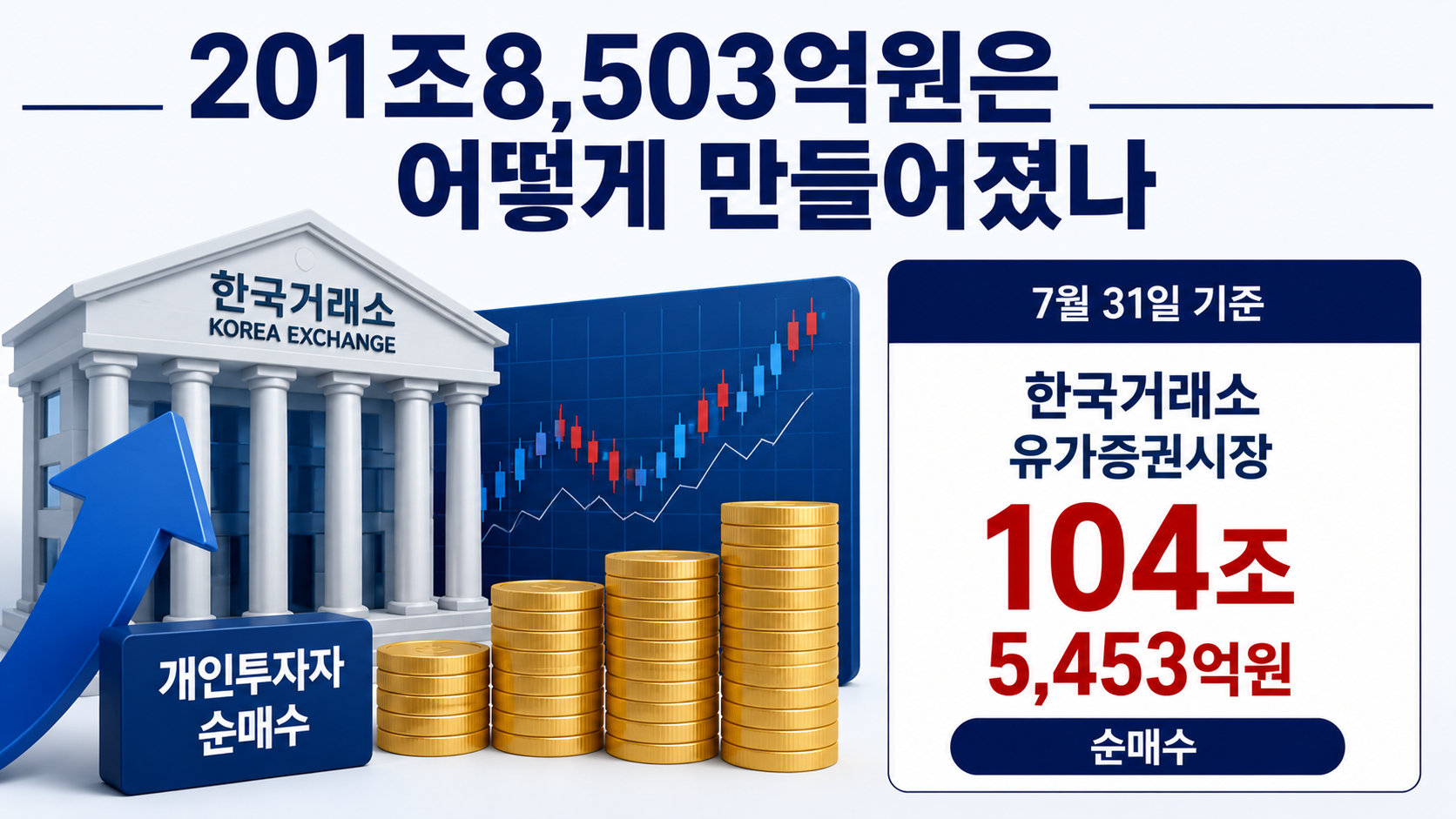
In contrast, they recorded net sales of KRW 10,336,500,000,000 on the KOSDAQ market.
On the alternative trading platform Nextrade, retail investors made net purchases of KRW 36,945,100,000,000, while their net ETF purchases totaled KRW 70,696,400,000,000. Adding these four amounts produces KRW 201,850,300,000,000.
Based on the author's calculations, the stock component amounted to approximately KRW 131,153,900,000,000, while ETFs accounted for KRW 70,696,400,000,000.
The calculation is:
KRW 104,545,300,000,000 - KRW 10,336,500,000,000 + KRW 36,945,100,000,000 = KRW 131,153,900,000,000.
In other words, of the total KRW 201,850,300,000,000, approximately 65.0% came from stocks, while approximately 35.0% came from net ETF purchases.
Nextrade is an alternative trading platform where KOSPI and KOSDAQ stocks can be traded. Its figures therefore represent a separate trading venue, not an entirely new asset class.
How Much Has the Scale Increased Compared With Last Year?
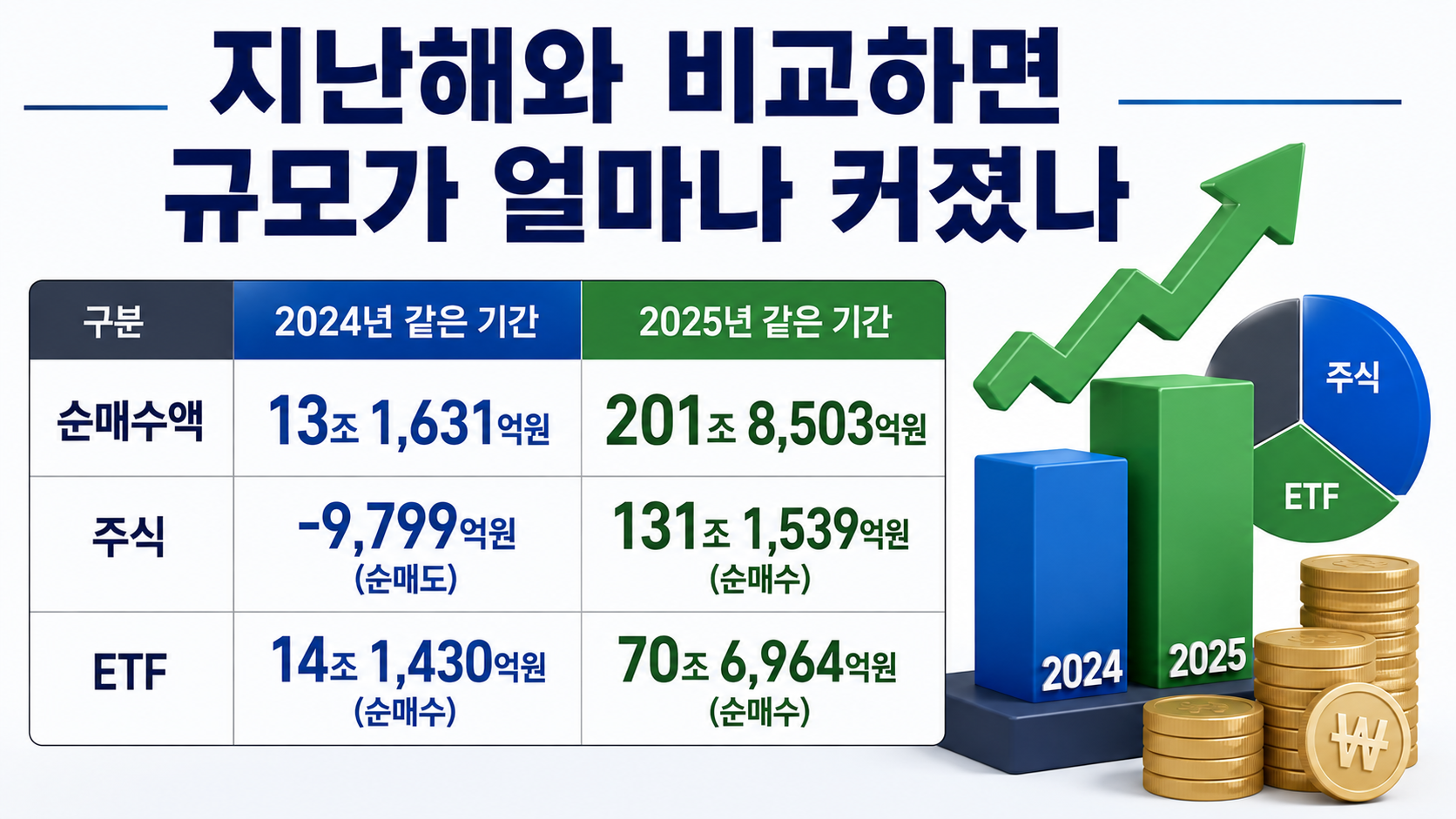
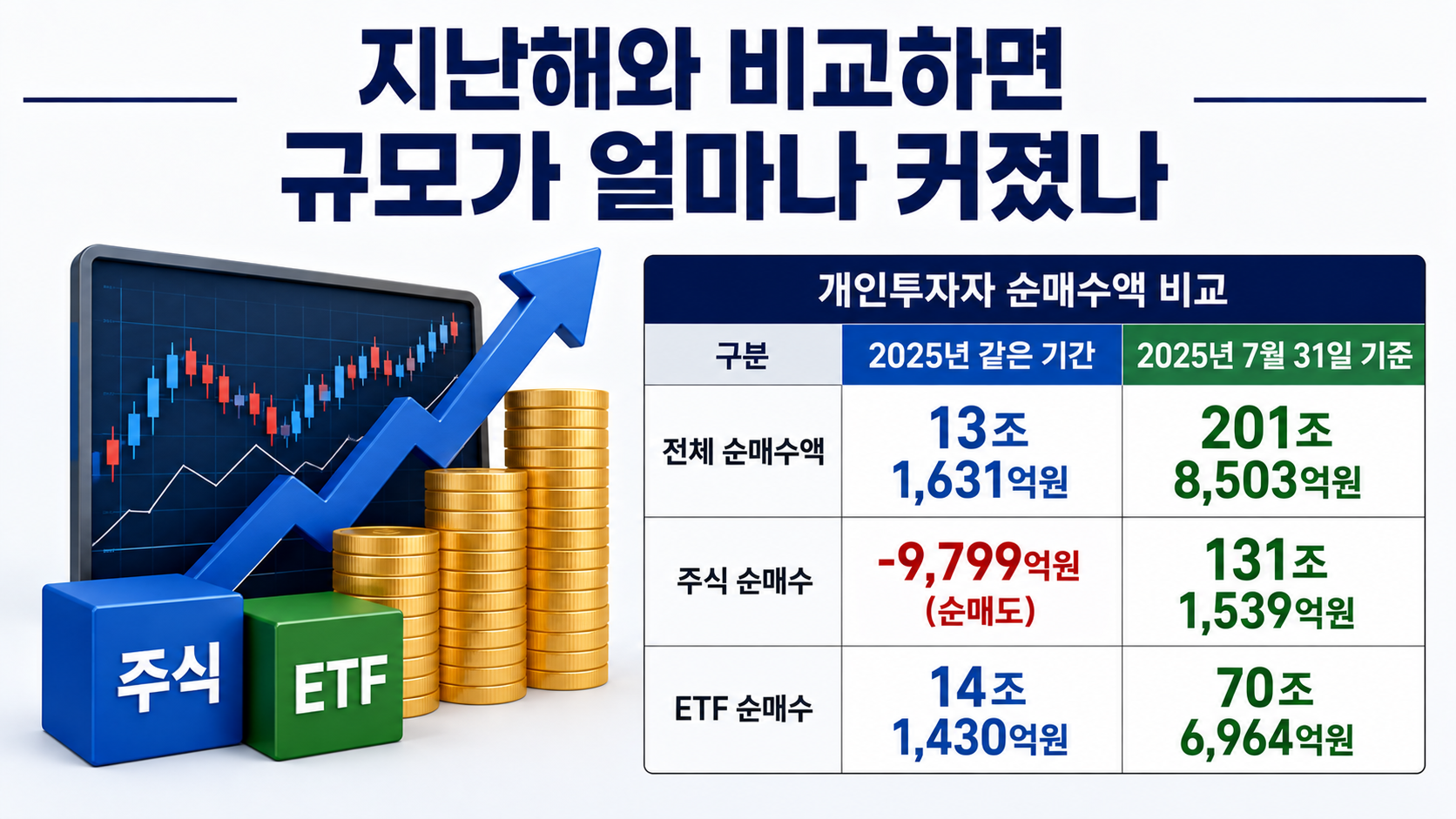
During the same period in 2025, retail investors' net purchases totaled KRW 13,163,100,000,000. At that time, they were net sellers of stocks, recording KRW 979,900,000,000 in net sales, while making net ETF purchases of KRW 14,143,000,000,000.
The KRW 201,850,300,000,000 recorded at the end of July this year was approximately 15.3 times the amount recorded during the same period last year.
Author's calculation:
KRW 201,850,300,000,000 ÷ KRW 13,163,100,000,000 ≈ 15.33 times
This was not merely a modest increase from last year. The difference suggests that the structure of market supply and demand changed substantially.
The Rise From KRW 100,000,000,000,000 to KRW 200,000,000,000,000 Was Also Rapid
Cumulative net purchases by retail investors exceeded KRW 100,000,000,000,000 when they reached KRW 107,000,300,000,000 on May 15.
By July 31, the figure had reached KRW 201,850,300,000,000, meaning an additional KRW 94,850,000,000,000 was accumulated in approximately two and a half months.
Looking only at the period since May 15, retail investors made net purchases of KRW 57,752,000,000,000 on the KOSPI market, KRW 12,335,500,000,000 on Nextrade, and KRW 27,840,700,000,000 in ETFs. During the same period, they recorded net sales of KRW 3,078,300,000,000 on KOSDAQ.
Therefore, rather than saying that retail investors bought across the entire domestic stock market equally, the more important characteristic is that they concentrated their purchases in KOSPI-related stocks and ETFs while actually withdrawing money from KOSDAQ.
Retail Investors Kept Buying Even as Stock Prices Fell
Retail buying did not increase only during rising markets.
After the KOSPI recorded 9,114.55 at the close on June 22, retail investors continued buying even as the index declined to 6,258.77 on August 7. During that period, they made net purchases of KRW 38,955,800,000,000 in stocks and KRW 16,460,800,000,000 in ETFs.
Combined, the amount exceeded KRW 55,000,000,000,000.
This suggests that a substantial amount of money treated the market correction as an opportunity to buy more rather than as a signal to sell.
However, large-scale net purchases do not necessarily translate into profits. Cumulative net purchases are a capital-flow indicator calculated by subtracting the value of sales from the value of purchases. They do not represent investors' unrealized gains or actual investment returns.
201 Trillion at the End of July, but KRW 214,000,000,000,000 by August 7
The widely reported KRW 201,850,300,000,000 figure represents cumulative net purchases through July 31.
As of August 7, which includes trading through the first week of August, combined net stock purchases had risen to KRW 141,828,800,000,000, while net ETF purchases had increased to KRW 72,320,200,000,000, bringing the total to KRW 214,149,000,000,000.
According to the author's calculations, cumulative net purchases increased by approximately KRW 12,298,700,000,000 in the week following July 31.
Therefore, when assessing the current trend, it is more important to determine whether retail investors have continued buying than to focus solely on the fact that purchases surpassed 200 trillion.
Whether Retail Investors Can Keep Buying Also Matters
It cannot be assumed that large-scale net purchases will continue at the same pace.
Investor deposits, which are frequently monitored as a measure of retail investors' available cash, approached KRW 140,000,000,000,000 in early June before declining to around KRW 104,000,000,000,000 on August 4. Outstanding margin loan balances also climbed to KRW 38,632,800,000,000 on June 24 before subsequently falling below KRW 30,000,000,000,000.
However, a decline in investor deposits alone does not necessarily mean that retail investors have exhausted their buying capacity. Investor deposits tend to respond to market movements and may change again depending on whether stock prices rebound.
Going forward, rather than focusing on a single cumulative net purchase figure, it is better to monitor whether retail investors continue buying, foreign investor flows, investor deposits, and outstanding margin loan balances together.
Three Things That Really Matter About Surpassing KRW 200,000,000,000,000
First, the entire KRW 200,000,000,000,000 does not represent purchases of individual domestic stocks. As of the end of July, approximately 70 trillion 7 hundred million was attributable to net ETF purchases.
Second, retail investor money did not move in the same direction across all markets. While investors made large net purchases on the KOSPI market and Nextrade, they recorded net sales exceeding KRW 10,000,000,000,000 on KOSDAQ.
Third, the KRW 201,850,300,000,000 recorded on July 31 was not the final figure. Extending the reporting period through August 7 shows that cumulative net purchases had already increased to approximately KRW 214,000,000,000,000.
Retail investors' KRW 200,000,000,000,000 in net purchases demonstrates how significantly the influence of individual investors' capital has expanded in South Korea's stock market. However, the scale of net purchases and investment performance are two separate matters. When analyzing market flows going forward, it is important to look beyond cumulative purchase amounts and examine which markets and products are attracting capital, as well as whether investors retain the capacity to keep buying.
※ This article is provided for informational purposes to help readers understand market trends and does not constitute investment advice or a recommendation to buy any particular stock or asset. All final investment decisions and responsibility for their outcomes rest with the individual investor.