

SK hynix Q3 Operating Profit Tops KRW 83,000,000,000,000: HBM Contracts and Investment Costs Matter More Than the Share Price Decline

SK hynix reported operating profit of KRW 83,333,800,000,000 for Q3 2026, although its shares had weakened ahead of the earnings announcement. A rebound was observed during morning trading on October 28. Investors now need to look beyond historical earnings and examine the profitability of long-term HBM supply contracts, expanding capital expenditure, and actual execution of shareholder returns.
As of 11:2 a.m. Korea Standard Time on 2026-10-28, there was no verified evidence supporting the conclusion that the share price had continued falling after the earnings announcement.
Why Were Shares Weak Despite a 632% Increase in Operating Profit?
SK hynix's Q3 results exceeded market expectations. Before the earnings announcement, however, concerns about the sustainability of AI investment and conditions in the semiconductor industry had weighed on the share price. Strong earnings and rising share prices do not necessarily occur at the same time.
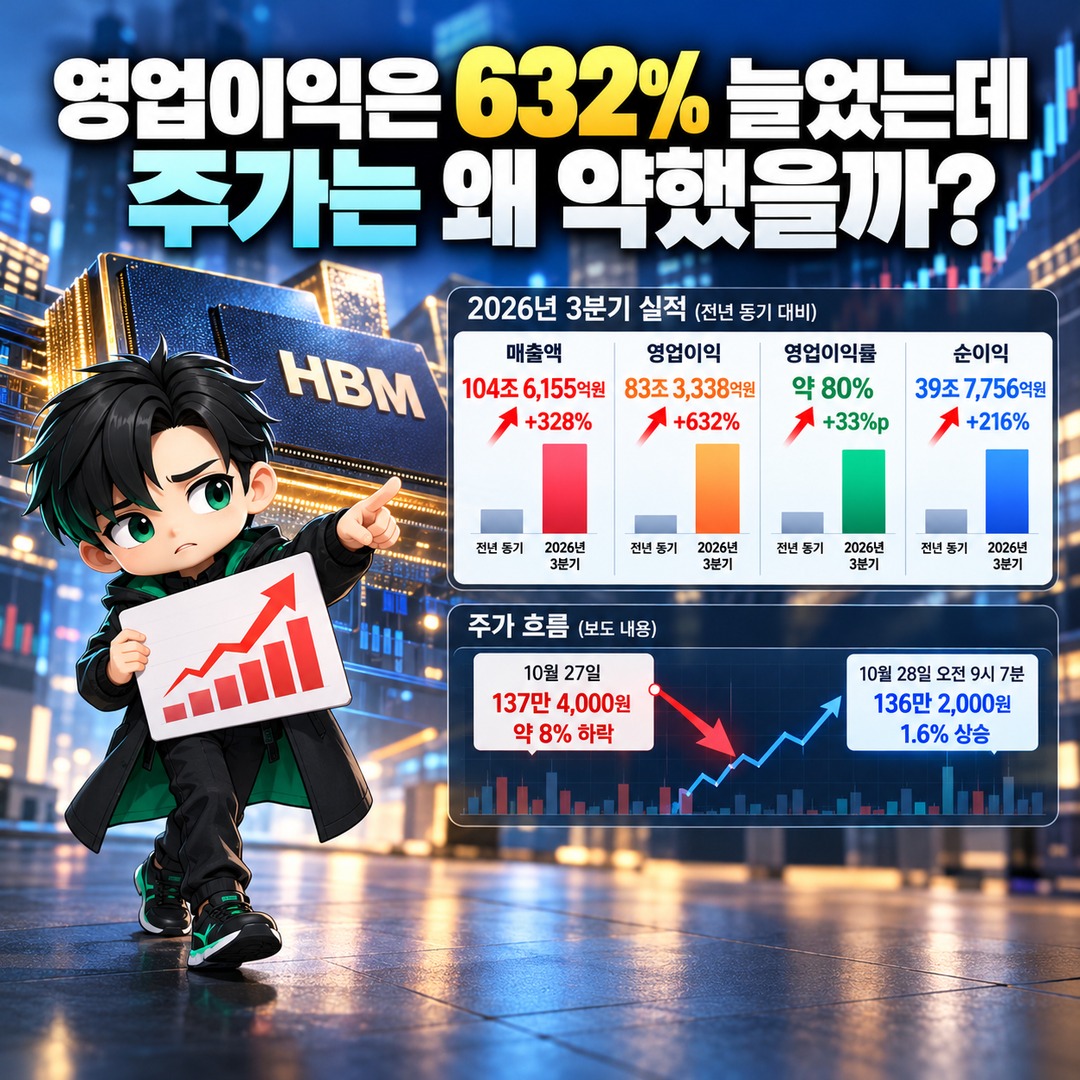
According to the preliminary earnings announcement for Q3 2026 released by SK hynix on October 28, both revenue and operating profit reached quarterly record highs.
| Metric | Q3 2026 | Year-over-year change |
|---|---|---|
| Revenue | KRW 104,615,500,000,000 | +328% |
| Operating profit | KRW 83,333,800,000,000 | +632% |
| Operating margin | Approximately 80% | +33% percentage points |
| Net income | KRW 39,775,600,000,000 | +216% |
Quarterly revenue exceeded KRW 100,000,000,000,000 for the first time. Operating profit increased by approximately 38% from the previous quarter.
A report by Aju Press on October 28 stated that SK hynix shares had fallen approximately 8% on 27, before the earnings announcement, closing at KRW 1,374,000. By contrast, the report said the shares were trading at KRW 1,362,000 at 9:7 a.m. on the announcement day, up 1.6% from the previous close.
The decline on 27 must therefore be distinguished from the share price movement following the earnings announcement on 28.
Reports discussing the weakness in SK hynix shares before the earnings announcement raised concerns about the sustainability of AI infrastructure investment, memory demand, and volatility across the semiconductor sector.
However, the available figures do not establish how much each of these factors actually contributed to the share price decline.
What Does Securing Long-Term Supply Contracts Covering More Than 50% of Production Capacity Mean?
SK hynix announced that it had secured long-term supply contracts covering more than 50% of its total production capacity for 2027 and 2028.

The contracts involve 14 customers, including major global cloud service providers.
There is an important distinction to make here.
Securing Long-Term Contracts for More Than 50% of Total Production Capacity Does Not Mean That More Than 50% of HBM Volume Alone Has Been Contracted.

The company's announcement refers to its total production capacity for 2027–2028. It did not disclose the proportion of HBM in each contract or the purchase amounts committed by individual customers.
SK hynix explained that it had introduced a pricing adjustment mechanism that reflects market conditions within price ranges agreed upon with customers.
Investors should focus on three key aspects of these contracts.
Whether contracted volumes translate into actual shipments and revenue
How changes in market prices are reflected in contract pricing
Whether profitability can be maintained as HBM4 production expands
HBM, or high-bandwidth memory, increases data processing speed by vertically stacking multiple DRAM chips.
SK hynix expects HBM4 to surpass HBM3E in both shipment volume and revenue during Q4.
This is the company's forecast, not a confirmed result for Q4.
The existence of long-term contracts is an important indicator of future demand. However, contracted volumes cannot be treated as equivalent to future operating profit.
Why Expanding Capital Expenditure Is Both an Opportunity and a Financial Burden to Monitor
SK hynix stated that it plans to increase capital expenditure substantially in 2027.
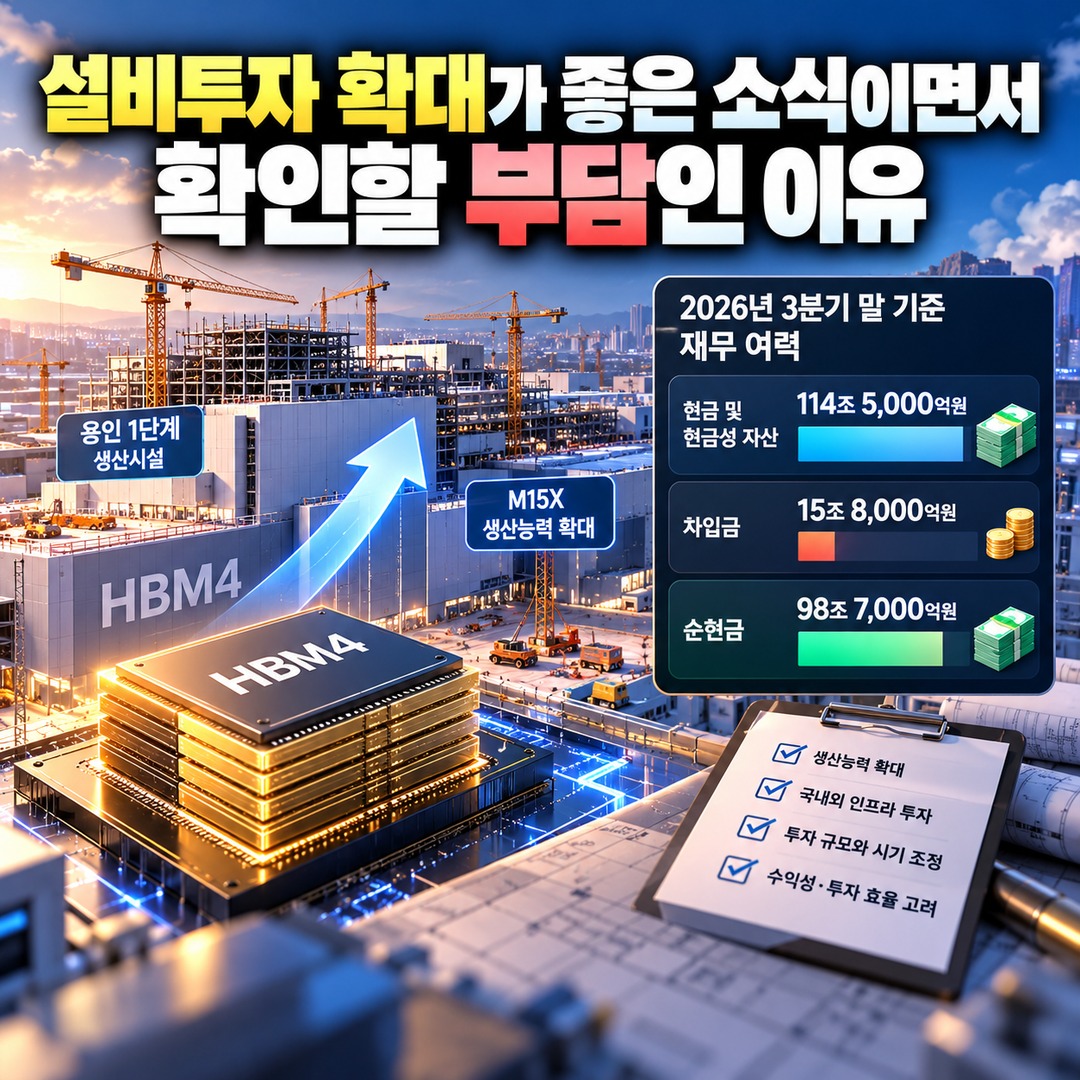
This reflects plans to bring the Yongin Phase 1 production facility into full operation and invest in infrastructure both in South Korea and overseas.
The company also plans to raise M15X production capacity to its maximum level by the end of 2026 to expand HBM4 production.
Expanding investment is necessary to increase production capacity. At the same time, investors need to assess how much cash will actually be spent and when those investments will begin generating returns.
However, the materials released on October 28 did not specify a definitive total capital expenditure amount for 2027.
SK hynix explained that it would adjust the scale and timing of investment based on customer demand, product competitiveness, profitability, and investment efficiency.
The company's current financial capacity also deserves attention.
The company disclosed the following figures as of the end of Q3.
| Item | End of Q3 2026 |
|---|---|
| Cash and cash equivalents | KRW 114,500,000,000,000 |
| Borrowings | KRW 15,800,000,000,000 |
| Net cash | KRW 98,700,000,000,000 |
Net cash is calculated by subtracting borrowings from cash and cash equivalents.
Our calculation also produces KRW 98,700,000,000,000 when KRW 15,800,000,000,000 is subtracted from KRW 114,500,000,000,000.
Having sufficient net cash does not, by itself, eliminate the burden of future investment.
Investors need to compare the amounts spent on new factories and production facilities with cash generated from operating activities and cash used for dividends and share repurchases.
Shareholder Returns of Approximately KRW 100,000,000,000,000: How Do Dividends and Share Repurchases Differ?
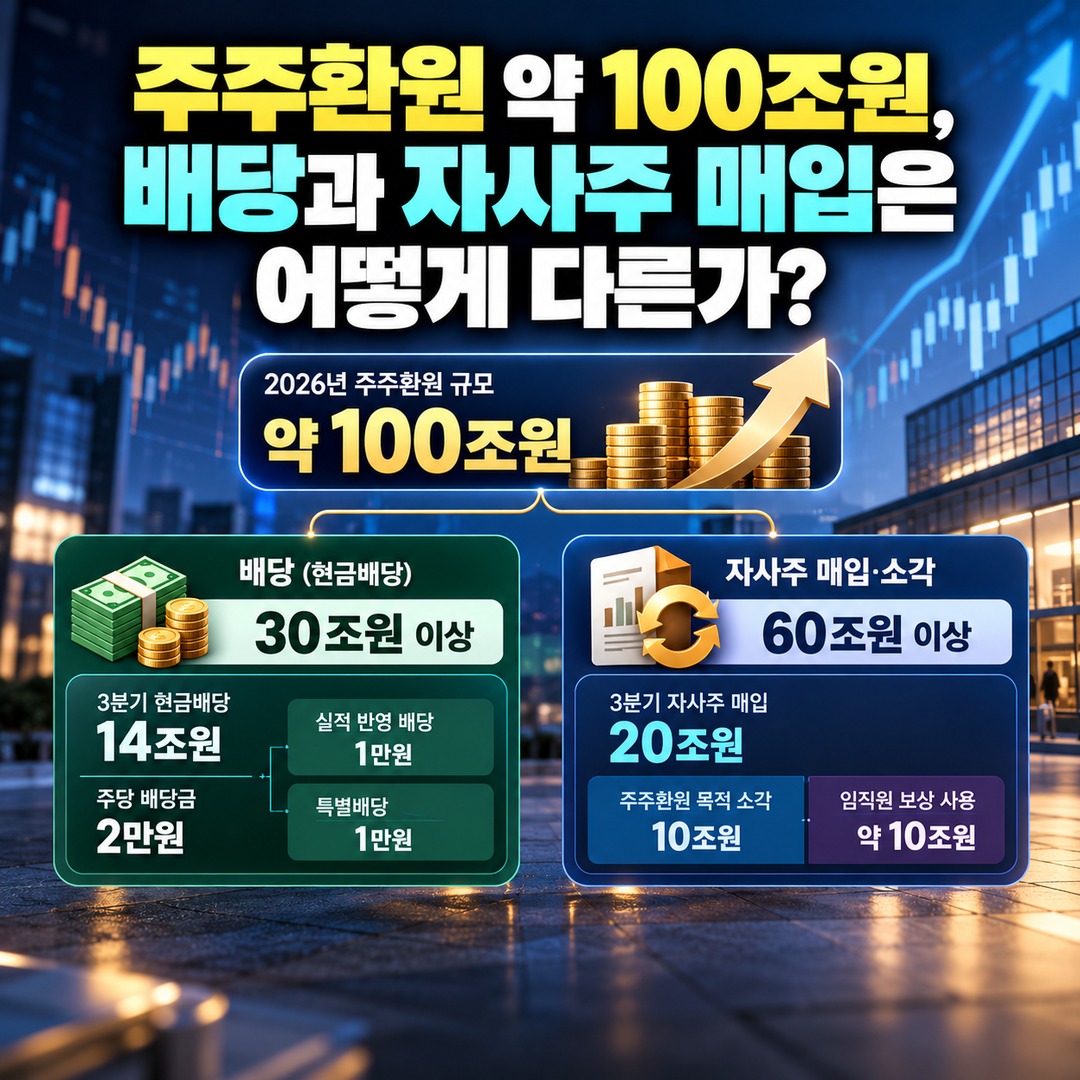
SK hynix announced plans to pursue shareholder returns totaling approximately KRW 100,000,000,000,000 in 2026.
The company's announcement includes cash dividends of at least KRW 30,000,000,000,000 and share repurchases and cancellations for shareholder returns of at least KRW 60,000,000,000,000.
In particular, at its board meeting on October 28, the company approved a Q3 cash dividend of KRW 14,000,000,000,000 and share repurchases totaling KRW 20,000,000,000,000.
The dividend per share for Q3 is KRW 20,000.
Of this amount, KRW 10,000 is a dividend reflecting improved earnings, while the remaining KRW 10,000 is a special dividend reflecting investment gains from Japan's Kioxia.
However, the entire KRW 20,000,000,000,000 share repurchase amount should not be counted as shareholder returns.
The company stated that it plans to cancel KRW 10,000,000,000,000 of the repurchased shares for shareholder returns and use the remaining approximately KRW 10,000,000,000,000 for employee compensation.
In other words, the announced repurchase amount differs from the amount attributable to shareholder returns.
The KRW 40,000,000,000,000 share repurchase program previously announced on August is also included in the 2026 shareholder return plan.
Therefore, adding KRW 40,000,000,000,000, KRW 20,000,000,000,000, and KRW 100,000,000,000,000 as three separate amounts would double-count portions of the actual plan.
When assessing the company's shareholder return plan, investors should distinguish not only the announced amounts but also the stages reached in dividend payments, share purchases, and actual share cancellations.
HBM Contracts, Capital Expenditure, and Shareholder Returns: What Should Investors Examine First?
Each of these three factors answers a different question.

| Item to Examine | Key Question |
|---|---|
| Long-term HBM contracts | How much future sales volume has been secured, and under what pricing terms? |
| Capital expenditure | How much cash is required to expand production, and how efficient will that investment be? |
| Shareholder returns | How much of the cash earned by the company actually reaches shareholders? |
It is difficult to determine the direction of the share price based on any one of these factors alone.
However, when assessing the sustainability of future earnings, a useful approach is to examine the terms of long-term supply contracts first, then connect those findings to capital expenditure and cash flow, and finally assess the actual execution of shareholder returns.
This is not a formula for predicting share price increases. It is an analytical sequence for comparing the company's announced growth plans with how it actually uses cash.
For example, even if volumes covered by long-term contracts increase, revenue growth and cash flow improvement may progress at different rates if product prices fall below expectations or investment costs for new production facilities rise.
Conversely, even if investment spending increases, the expansion itself does not necessarily justify a negative conclusion if production efficiency and sales profitability are sufficiently strong.
Similarly, investors need to distinguish between the size of announced shareholder returns and the actual economic benefit received by shareholders.
The Most Important Changes to Watch in the Next Earnings Report
SK hynix expects market conditions in which memory demand exceeds supply to continue through 2030.
However, this is the company's market outlook, not confirmation that future supply shortages are guaranteed.
Key developments to monitor include whether HBM4 actually establishes itself as a core product, whether volumes under long-term contracts translate into reported earnings, and whether the company maintains its cash-generating capacity even after expanding capital expenditure.
SK hynix's Q3 2026 results demonstrate that the company is currently achieving strong profitability.
However, investors in the stock market evaluate more than profits that have already been reported.
They must also assess the sustainability of future earnings, the investment required to generate those earnings, and the amount of cash that will ultimately be returned to shareholders.
Strong earnings do not guarantee a rising share price, just as a falling share price does not necessarily mean that the company's earnings competitiveness has weakened.
In the next quarter, investors would do well to examine actual changes in HBM4 shipments and revenue, along with details of capital expenditure execution.
※ This article is provided for informational purposes to help readers understand market developments and does not constitute an investment recommendation for any particular stock or asset. All final investment decisions and associated responsibilities rest with the individual investor.