

Bought Both QQQ and VOO ETFs—Is That Really Diversification? How to Calculate Overlapping U.S. Big Tech Holdings
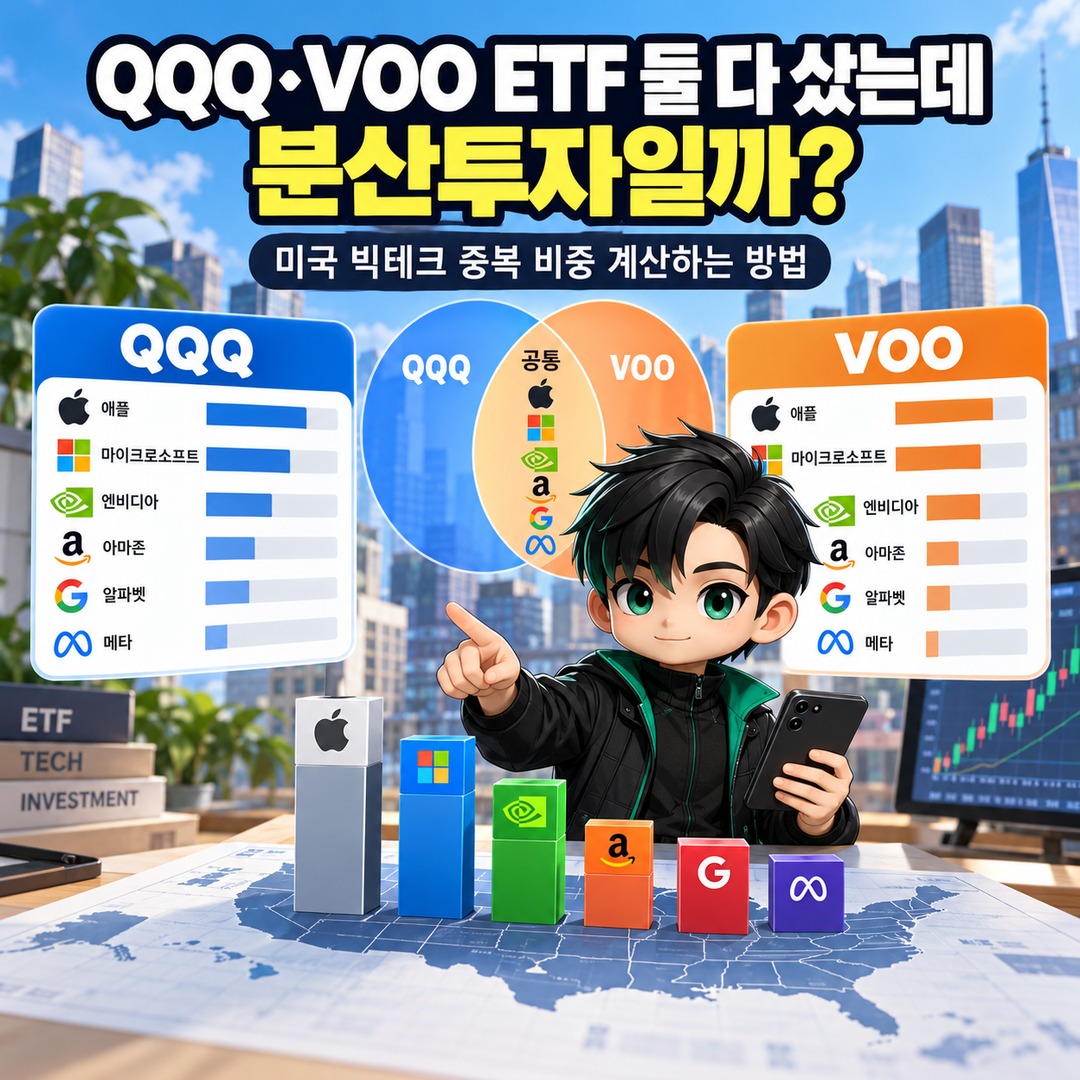
Holding both QQQ and VOO does not automatically mean your investments are diversified. If large technology companies such as Apple, Microsoft, and Nvidia account for significant portions of both ETFs, your investment risk may still be concentrated in specific companies despite owning two ETFs.

What matters is not the number of ETFs you own, but how much of your investment is allocated to each company.
As of 2026-10-23, with U.S. technology stocks and small-cap stocks moving in different directions, it is important to examine this overlapping exposure.
1. How Are QQQ and VOO Different, and Why Do Their Holdings Overlap?
QQQ is an ETF that tracks the Nasdaq-100 Index, while VOO tracks the S&P 500 Index.

Although they track different indexes, major U.S. companies can be included in both.
| Category | QQQ | VOO |
|---|---|---|
| Tracking index | Nasdaq-100 | S&P 500 |
| Main characteristics | Primarily large nonfinancial companies listed on Nasdaq | Broad exposure to the U.S. large-cap stock market |
| Technology sector influence | Relatively high | Also includes sectors outside technology |
| Stock weighting method | Modified market-capitalization weighting | Float-adjusted market-capitalization weighting |
| Diversification scope | Relatively narrow | Relatively broad |
QQQ is not an ETF that holds only technology stocks. It also includes companies in other sectors, such as consumer goods and communication services.
Nor can VOO automatically be considered an ETF with low technology exposure. As the market capitalizations of major U.S. technology companies increase, their weights in the S&P 500 can also rise.
Therefore, holding QQQ and VOO together provides exposure to different indexes, but exposure to certain large technology companies overlaps.
2. If You Invest 50% in QQQ and 50% in VOO, What Is Your Actual Big Tech Exposure?

If you invest half your money in each ETF, you can calculate your combined exposure by weighting each ETF's individual stock holdings according to your investment allocation.
The formula is as follows.
Actual portfolio weight of an individual stock = (QQQ allocation × Weight of that stock in QQQ) + (VOO allocation × Weight of that stock in VOO)
For example, suppose your total investment is KRW 10,000,000, allocated as follows.
QQQ: KRW 5,000,000
VOO: KRW 5,000,000
Now suppose Company A accounts for 8% and 6% of the two ETFs, respectively.
These figures are hypothetical examples used to explain the calculation, not the ETFs' actual latest portfolio weights.
| Calculation item | Result |
|---|---|
| Investment in Company A through QQQ | KRW 400,000 |
| Investment in Company A through VOO | KRW 300,000 |
| Total exposure to Company A | KRW 700,000 |
| Share of total investment | 7% |
Author's calculations:
KRW 5,000,000 × 8% + KRW 5,000,000 × 6% = KRW 700,000
KRW 700,000 ÷ KRW 10,000,000 × 100 = 7%
Although you appear to have invested KRW 5,000,000 in each of two different ETFs, 7% of your total assets is effectively allocated to a single company, Company A.
Applying this calculation to companies held by both ETFs, such as Apple, Microsoft, and Nvidia, allows you to assess the actual concentration of your portfolio.
However, if an ETF uses derivatives or other instruments in addition to directly held stocks, portfolio weights alone may not fully explain its overall risk.

3. Where Can You Check ETF Holdings Overlap?
The most reliable starting point is the holdings information published by the ETF providers.
For both QQQ and VOO, you can check their constituent holdings and portfolio weights on their respective official product pages.
QQQ:
VOO:
Follow these steps to check the overlap.
1. Find the Holdings or Portfolio section on each ETF's official product page.
2. Review or download the holdings and their weights for both ETFs.
3. Compare portfolio weights using the ticker symbols of companies held by both ETFs.
4. Multiply those weights by your investment allocation to each ETF to calculate your actual exposure to each company.
5. Sort the results from highest to lowest and examine the combined weights of the largest holdings.
One important point is to ensure that the holdings data for both ETFs refers to the same reporting date.
If one ETF's data is from October 20 and the other's is from the end of September, it is difficult to claim that you have accurately compared their overlapping weights at the same point in time.
Also, if the same company is included through different share classes, you should examine the underlying issuing company as well as its ticker symbols.
The U.S. Securities and Exchange Commission (SEC) also advises investors to review an ETF provider's official materials before investing, including its holdings, investment objectives, risks, and costs.
4. Is Having Many Overlapping Holdings Necessarily a Bad Investment?
Not necessarily. Overlapping investments do not inherently cause losses.
For example, if you want to place greater emphasis on the growth potential of major U.S. technology companies, holding both QQQ and VOO may be a reasonable choice.
The problem arises when the level of risk an investor intends to take differs from the risk actually present in the portfolio.
For instance, you may believe you have diversified across the entire U.S. stock market when, in reality, your portfolio's performance depends heavily on the share prices of a handful of large technology companies.
In particular, if technology stocks decline together, both ETFs may record losses at the same time.
Conversely, during periods of strong technology stock gains, overlapping exposure may contribute positively to returns.
Therefore, a more important question than whether holdings overlap is this:
Am I deliberately increasing my technology stock exposure, or am I unknowingly buying the same companies repeatedly?
5. What Changes When You Adjust Your QQQ-to-VOO Allocation?
Even when you hold both QQQ and VOO, your exposure to individual companies changes depending on how you allocate your investment.
Let's use the same hypothetical portfolio weights for Company A from the earlier example.
Assume Company A accounts for 8% of QQQ and 6% of VOO.
| QQQ: VOO | Actual weight of Company A |
|---|---|
| 100: 0 | 8.0% |
| 70: 30 | 7.4% |
| 50: 50 | 7.0% |
| 30: 70 | 6.6% |
| 0: 100 | 6.0% |
These are the author's calculations and do not represent actual ETF portfolio weights.
In this example, reducing the allocation to QQQ also reduces exposure to Company A.
However, the same result does not apply to every stock. Some companies may have higher portfolio weights in VOO.
Furthermore, reducing your QQQ allocation does not necessarily reduce technology sector risk by a proportional amount.
You should consider not only individual company weights but also sector allocations, correlations between holdings, and market volatility.
6. Why Overlapping ETF Holdings Can Be Riskier During a Sharp U.S. Technology Stock Sell-Off
The risks associated with overlapping investments may become much more noticeable when markets move sharply.
For example, suppose an investor holds equal amounts of QQQ and VOO, and the major technology companies included in both ETFs decline simultaneously.
Even though the ETFs track different indexes, falling share prices among their common holdings can affect the values of both funds.
There is an important distinction to understand here.
If QQQ falls 5% and VOO falls 3%, that does not mean the overlapping stocks cause an additional loss of 8%.
If each ETF accounts for 50% of the investment, the portfolio return based solely on ETF price movements is calculated as follows.
(50% × -5%) + (50% × -3%) = -4%
Based on a total investment of KRW 10,000,000, this represents a loss of KRW 400,000.
This calculation does not include exchange-rate fluctuations, trading fees, taxes, or other costs.
Because the impact of falling share prices among overlapping holdings is already reflected in each ETF's return, it should not be added again as a separate loss.
The main risk of overlapping investments is not that losses are counted twice, but that different ETFs can be affected simultaneously by the same companies and risk factors.
7. Three Things to Check Before Buying Another ETF
Adding another ETF does not necessarily improve diversification.
If the new fund holds many of the same companies as your existing ETFs, you may simply increase the number of investment products you own.
Therefore, it is worth checking three things before making an additional purchase.
First, examine the holdings shared by your existing ETF and the new ETF. Look not only at the number of overlapping stocks but also at the portfolio weight of each one.
Second, check the proportion of assets concentrated in the top 10 companies. Even if an ETF holds a large number of stocks, a substantial concentration in its largest companies may produce less diversification than expected.
Third, compare sectors and investment exposures. Adding another U.S. large-cap ETF and investing in a different region or asset class can produce very different outcomes in terms of risk diversification.
When purchasing a new ETF or adjusting existing allocations, you should also consider trading commissions, bid-ask spreads, currency conversion costs, and taxes. Frequent rebalancing can increase expenses.
8. Frequently Asked Questions
Is Holding QQQ and VOO at the Same Time Inefficient?
Not necessarily. The two ETFs have different investment objectives and holdings, and owning both may align with an investor's intentions. However, it is important to determine how much overlapping exposure you have to major technology companies.
Will Switching From QQQ to QQQM Reduce Overlapping Holdings?
Both QQQ and QQQM track the Nasdaq-100 Index. Therefore, simply replacing QQQ with QQQM does not resolve the overlap in major holdings with VOO.
When comparing the two products, you should also review their total expense ratios and trading liquidity.
Doesn't an ETF With More Stocks Automatically Provide Better Diversification?
A larger number of holdings alone does not guarantee sufficient diversification.
If a portfolio is heavily concentrated in particular companies or sectors, its holdings may still exhibit similar price movements despite containing many stocks.
How Low Should ETF Holdings Overlap Be to Be Considered Safe?
There is no single safe threshold that applies to every investor.
An appropriate level of concentration depends on your investment horizon, risk tolerance, other asset holdings, and investment objectives.
Conclusion: Your Actual Company Exposure Matters More Than Owning Two ETFs
Investing in both QQQ and VOO is not inherently a mistake.
However, you should not assume that your investment risk is sufficiently diversified simply because you own different ETFs.
To assess your exposure to major U.S. technology companies, multiply each ETF's individual stock weights by your actual allocation to that ETF, then add together the weights of holdings issued by the same company.
Especially during periods when technology stocks and other sectors move in sharply different directions, examining company-level and sector-level concentration within your portfolio can be more useful than simply comparing ETF returns.
Investment decisions should consider not only an ETF's recent performance but also your overall asset allocation, investment horizon, and potential losses.
※ This article is provided for informational purposes to help readers understand market trends and does not constitute a recommendation to invest in any particular security or asset. You are responsible for your final investment decisions and their outcomes.