

Does Microsoft Own OpenAI? Its 27% Stake Is Different from Actual Control
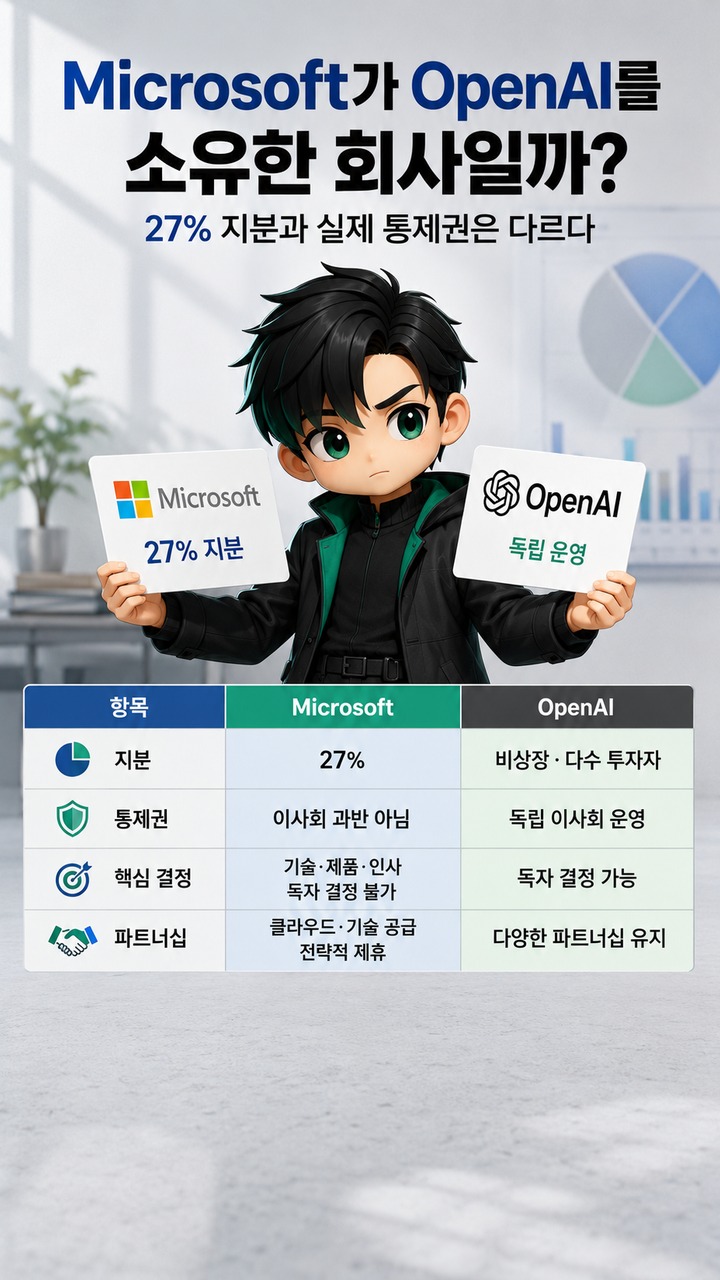
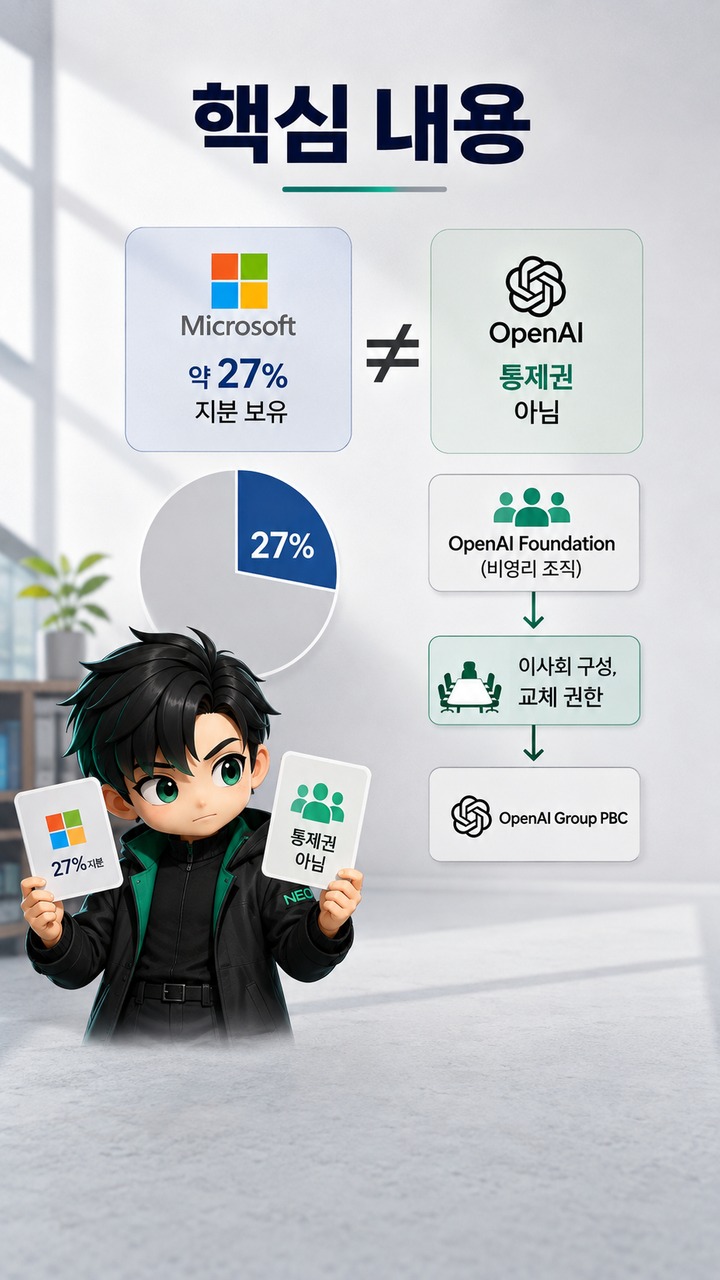
Microsoft is a major shareholder holding approximately 27% of OpenAI, but it is not the parent company that controls OpenAI. As of 2026-09-01, the nonprofit OpenAI Foundation has the authority to appoint and replace the directors of OpenAI Group PBC, meaning that economic ownership and corporate control must be considered separately.
The FTC's examination of investment and partnership arrangements involving major cloud companies and AI developers, including Microsoft and OpenAI, was not simply about who owned what percentage. These relationships also involve forms of influence that ownership percentages alone cannot reveal, such as cloud dependency, access to technology, and contractual rights.
How Much of OpenAI Does Microsoft Actually Own?
When OpenAI completed its capital restructuring in October 2025, Microsoft's investment stake in OpenAI Group PBC was approximately 27% on an as-converted, diluted basis, with an estimated value of approximately USD 135,000,000,000 at the time.
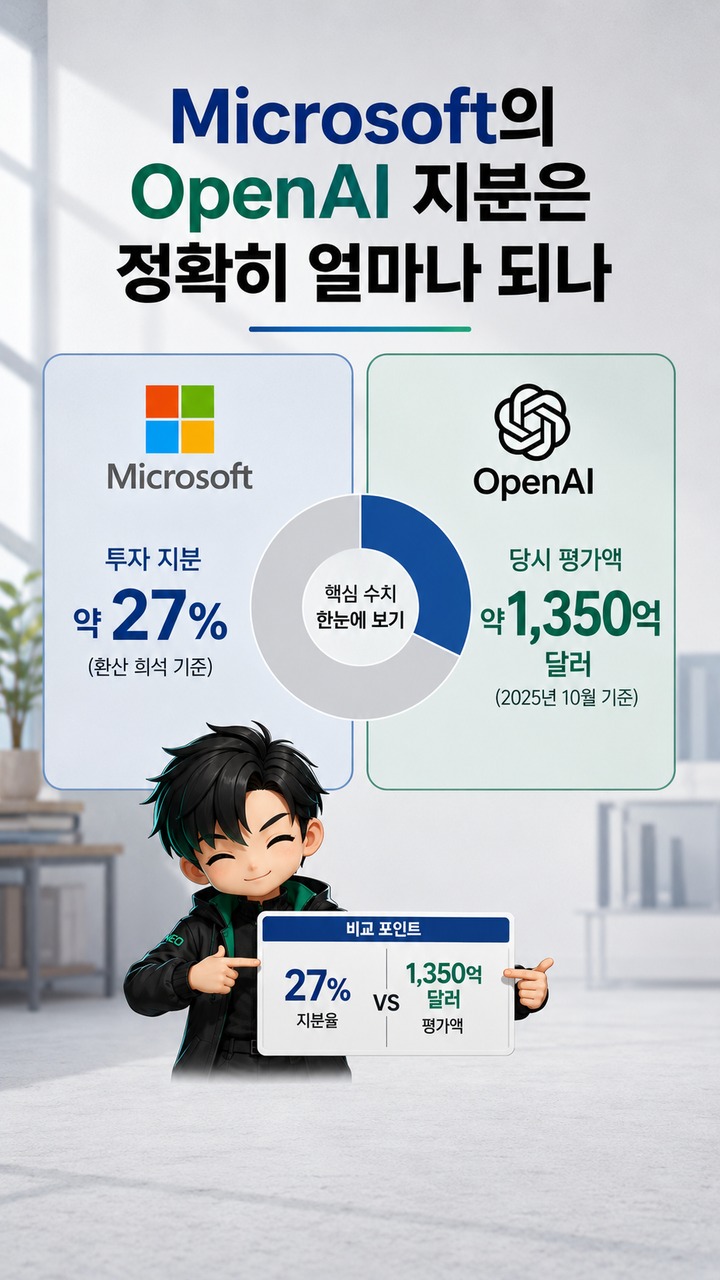
Here, 'as-converted, diluted basis' refers to a method of calculating the total ownership percentage by assuming that rights held by various parties, including employees, investors, and the OpenAI Foundation, have been converted into shares.
At the same time, OpenAI disclosed an ownership structure in which the OpenAI Foundation held approximately 26%, while current and former employees and other investors held the remaining approximately 47%.
| Shareholder Category | Disclosed Ownership Structure |
|---|---|
| Microsoft | Approximately 27% |
| OpenAI Foundation | Approximately 26% |
| Employees and other investors | Approximately 47% |
However, interpreting these figures as evidence that Microsoft effectively owns OpenAI overlooks an important distinction.
Why Doesn't Microsoft Control OpenAI Despite Its 27% Stake?
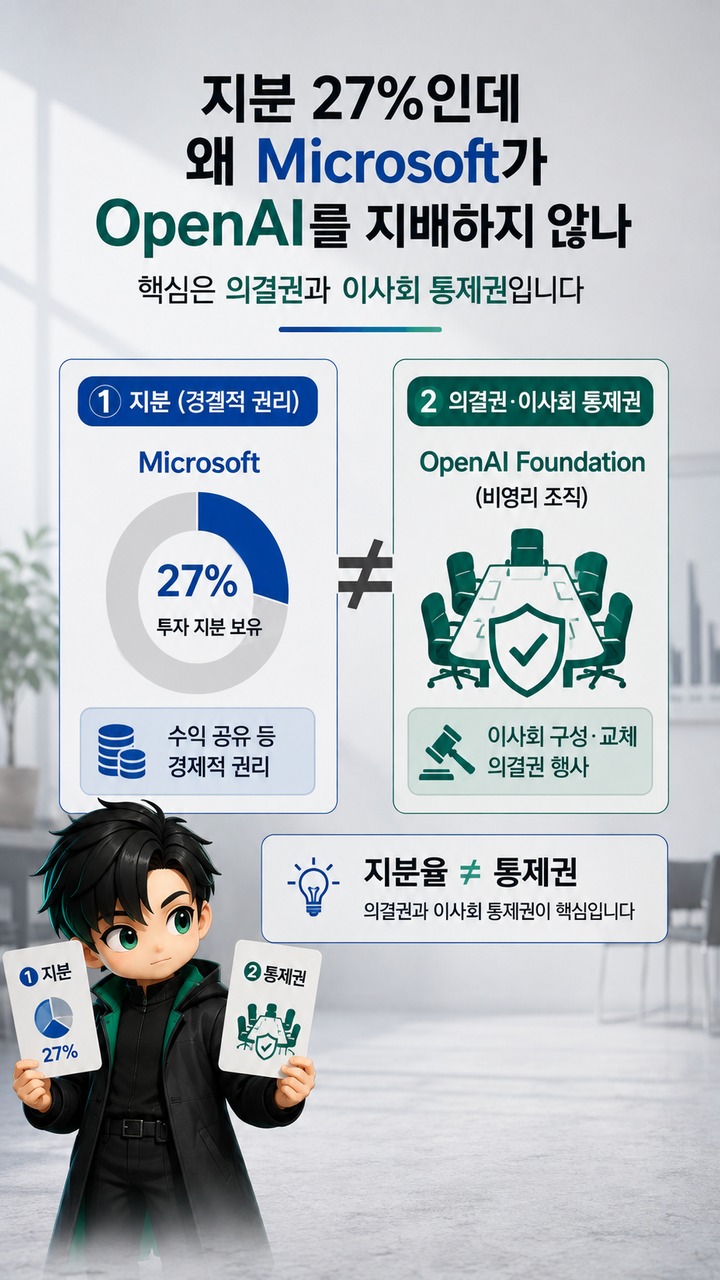
The key distinction lies in voting rights and control over the board of directors.
According to OpenAI's official governance structure, the OpenAI Foundation has special voting and governance rights that allow it to appoint every director of OpenAI Group and replace directors when necessary. In other words, even though Microsoft holds a substantial economic stake, ultimate governance control of OpenAI Group rests with the OpenAI Foundation.
In stock investing, ownership percentage and management control are not always the same thing.
For example, even a shareholder with a large equity stake cannot necessarily be considered to have direct control over a company's ultimate decisions if its rights to appoint directors or exercise special voting powers are restricted.
The current structure can therefore be summarized as follows.
Microsoft = A major economic shareholder and strategic partner of OpenAI; OpenAI Foundation = The entity holding control over OpenAI Group.
Does That Mean Microsoft's Influence Is Limited?
Not at all. Not having control and having no influence are two entirely different things.
The relationship between Microsoft and OpenAI involves not only equity ownership but also cloud services, intellectual property (IP), product distribution, and revenue-sharing agreements.
Under the agreement revised in April 2026, Microsoft remained a major OpenAI shareholder and retained its IP license for OpenAI models and products through 2032. However, the license was changed to a less exclusive arrangement than before.
In its 2026 annual report, Microsoft also stated that it continued to maintain its long-term strategic partnership with OpenAI and its rights to integrate OpenAI technology into Microsoft products.
Rather than reducing the relationship to a simple question of ownership versus non-ownership, it is more accurate to examine four separate factors.
1. Who owns the equity, and how much does each party hold?
2. Who controls the board of directors and management decisions?
3. Who holds the rights to use the technology and intellectual property?
4. How closely connected are the cloud and revenue agreements?
If OpenAI Uses AWS or Another Cloud Provider, Does That Mean It Has Parted Ways with Microsoft?
No.
Under the agreement revised in April 2026, Microsoft remains a major cloud partner of OpenAI, while OpenAI has gained the flexibility to offer its products to customers through other cloud providers.
Therefore, news that OpenAI has signed an agreement with Amazon or another infrastructure company should not automatically be interpreted as evidence that it has severed ties with Microsoft.
Instead, the central change in the 2026 agreement was not the termination of the Microsoft–OpenAI relationship but rather a partial reduction in exclusivity while preserving the existing investment, technology, and revenue relationships.
Microsoft's IP license for OpenAI technology also remains in effect through 2032, and disclosed terms indicate that OpenAI's revenue-sharing payments to Microsoft will continue through 2030.
Why the FTC Investigated These Partnerships: It Wasn't Just About Ownership Percentages
The FTC investigation launched in 2024 covered not only Microsoft and OpenAI but also the investment and partnership relationships between Amazon and Anthropic, and between Google and Anthropic.
The FTC staff report released in 2025 examined issues extending well beyond simple ownership percentages.
Major areas of scrutiny included the possibility that agreements between large cloud providers and AI developers could affect access to computing resources or talent, increase switching costs when AI companies move to other cloud platforms, and give partner companies access to technical or business information unavailable to competitors.
Therefore, asking what percentage of OpenAI Microsoft owns is only the starting point.
To assess the actual competitive relationship, it is necessary to consider equity ownership + cloud dependency + technology usage rights + contractual rights together.
Common Mistakes Investors Make When Assuming Microsoft Owns OpenAI
The first mistake is assuming that any increase in OpenAI's valuation belongs entirely to Microsoft.
Microsoft's economic ownership stake of approximately 27% and OpenAI's total corporate valuation are two different figures. Actual accounting recognition, equity dilution, and future financing terms may also change, making it difficult to calculate the benefits to Microsoft shareholders through simple multiplication alone.
The second mistake is assuming that Microsoft loses the value of its OpenAI investment whenever OpenAI signs a contract with another cloud provider.
The currently disclosed agreements instead establish a structure that gives OpenAI greater flexibility to work with other cloud providers while preserving a substantial portion of Microsoft's equity stake and major contractual rights.
The third mistake is assuming that changes in the Microsoft–OpenAI relationship directly determine the price direction of AI-related stocks or cryptocurrencies.
Investment and cloud agreements involving major AI companies are important variables in the AI infrastructure market. However, the prices of individual stocks and AI-themed tokens are simultaneously affected by numerous factors, including market liquidity, earnings, token supply, business revenue, and regulation. A single partnership agreement cannot establish with certainty whether prices will rise or fall.
What Matters Now Is How the Agreements Change, Not Simply Who Owns OpenAI
As of September 2026, the relationship between Microsoft and OpenAI is best described not as a structure in which Microsoft owns OpenAI, but as a strategic investment relationship strongly connected through a substantial equity stake and long-term technology and business agreements.
The significant change in 2026 was a relaxation of exclusivity, not the end of the relationship. OpenAI gained more room to collaborate with other cloud providers, but Microsoft remains a major shareholder and continues to maintain long-term licensing rights to OpenAI technology and a revenue-sharing relationship.
When following future developments, it is more useful to examine whether Microsoft's ownership percentage changes, whether the OpenAI Foundation's control rights change, whether the 2030 revenue-sharing agreement changes, and whether the terms of the 2032 IP license change, rather than simply asking whether Microsoft and OpenAI have parted ways.
※ This article is provided for informational purposes to help readers understand market developments and does not constitute investment advice or a recommendation to buy any particular security or asset. All final investment decisions and responsibilities rest with the individual investor.
Related Articles
Why Bitcoin Prices Can Fall Despite Net Inflows into Spot Bitcoin ETFs: How to Interpret Fund Flows
Do You Own Bitcoin When You Buy a Bitcoin ETF or Spot ETP? Structural and Fee Differences in 2026