

Microsoft, OpenAI and Google AI Partnership Investigation: What the FTC Actually Found After Launching Its 2024 Inquiry
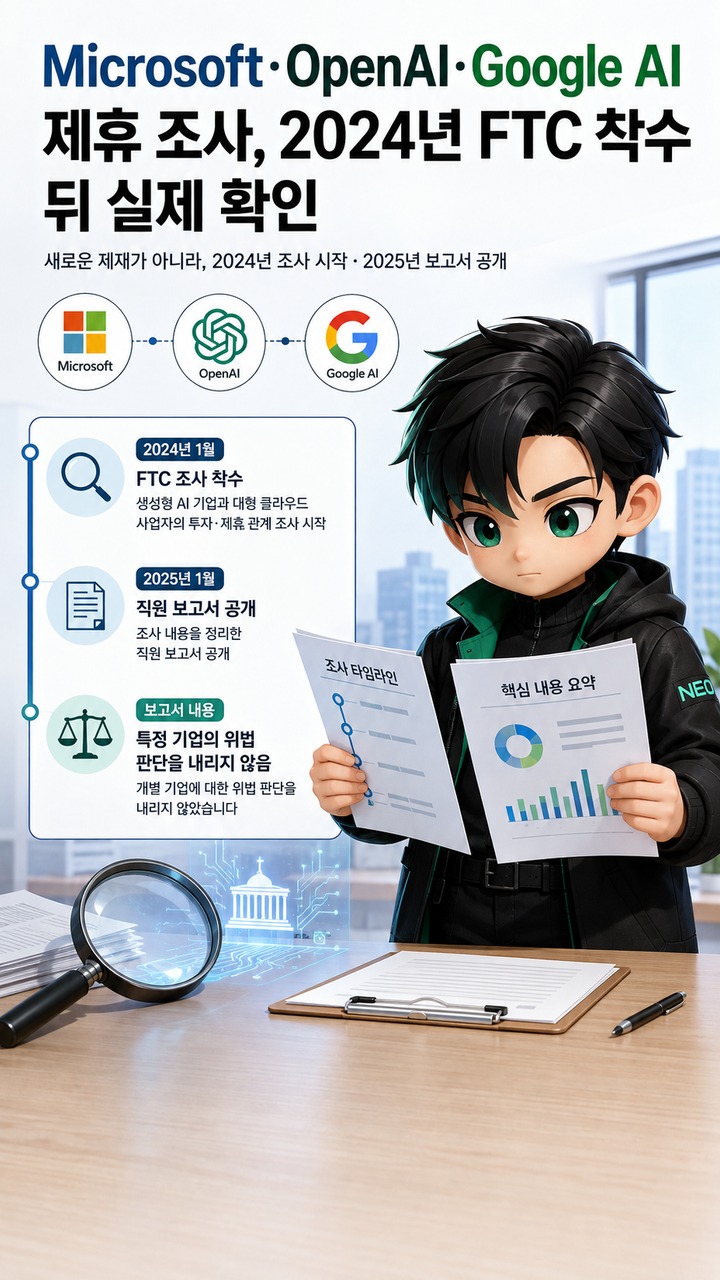
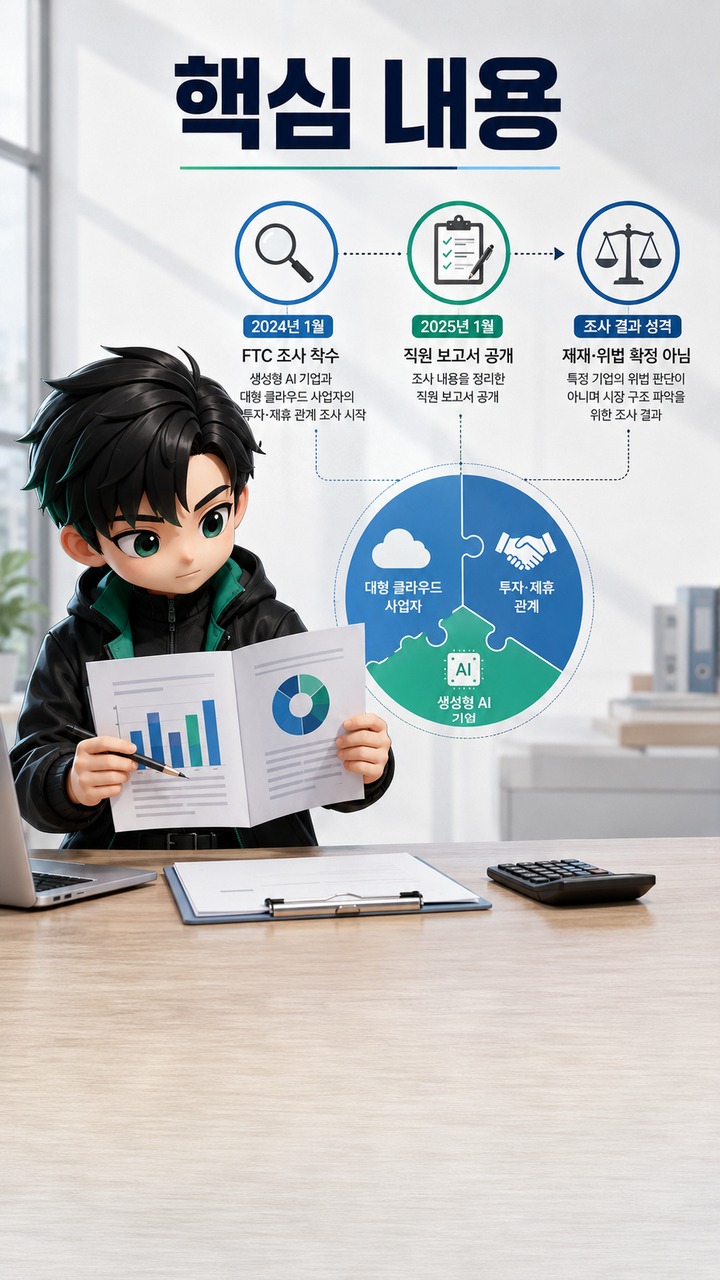
Microsoft, OpenAI and Google were not all subjected to new sanctions together in September 2026. The U.S. Federal Trade Commission (FTC) began investigating investment and partnership relationships between generative AI companies and major cloud providers in January 2024 and released a staff report summarizing its findings in January 2025. The report was not a ruling or enforcement decision establishing that any particular company had violated the law. Rather, it presented findings from an investigation intended to better understand the structure of the market.
The information is current as of 2026-09-01, Korea Standard Time. Headlines may make it appear that the FTC investigated a single transaction involving Microsoft, OpenAI and Google. In fact, the agency examined three separate partnerships: Microsoft-OpenAI, Amazon-Anthropic and Google (Alphabet)-Anthropic.
Which Companies and Transactions Did the FTC Actually Investigate?
On 2024-01-25, the FTC ordered 5 companies, including Alphabet, Amazon, Anthropic, Microsoft and OpenAI, to provide information. The investigation focused on investment and commercial partnerships between generative AI developers and major cloud providers.

Specifically, the investigation covered the relationships between Microsoft and OpenAI, Amazon and Anthropic, and Alphabet and Anthropic. It would therefore be inaccurate to interpret the investigation as an FTC inquiry into a transaction between Google and OpenAI. Google's partner under examination was Anthropic.
The FTC relied on Section 6(b) of the Federal Trade Commission Act. This authority does not constitute a process for punishing companies after violations have already been established. Instead, it allows the agency to request information and conduct research to gain a deeper understanding of transaction structures and market practices involving particular industries and companies. At the time, the companies were required to submit the requested information within 45 days of receiving the orders.
Why Did Cloud Contract Structures Matter More Than AI Investment Alone?
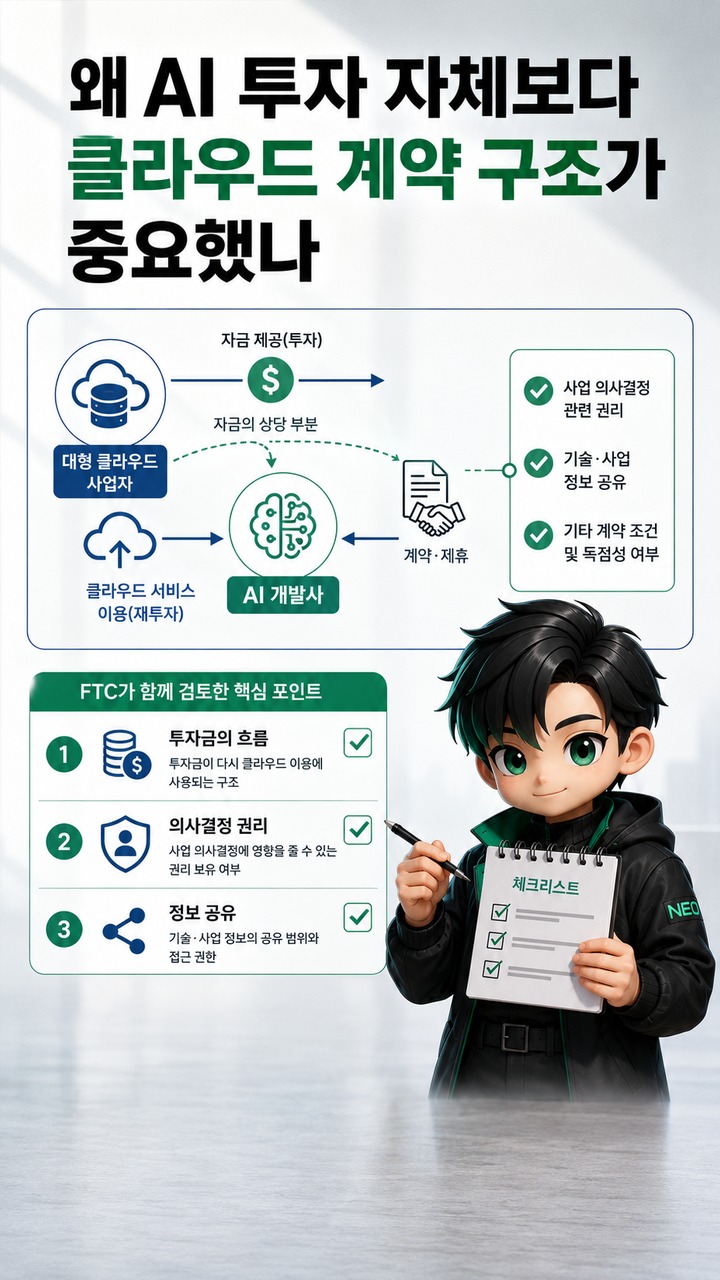
The FTC was interested in more than just the size of the investments. It also examined arrangements in which major cloud providers supplied funding to AI developers, which then spent a substantial portion of that funding on the investors' cloud services. Rights related to business decision-making and the sharing of technical and commercial information were also reviewed.
According to FTC materials released in January 2025, cumulative financial investments across the Microsoft-OpenAI, Amazon-Anthropic and Google-Anthropic partnerships exceeded USD 20,000,000,000. This figure represents the combined investments across all three partnerships, not the amount received by any single company.
The FTC staff report explained that the partnerships included equity interests and certain profit-sharing rights, various consultation, control and exclusivity-related rights, and substantial cloud usage commitments. The investigation also identified arrangements in which AI developers gained access to large amounts of computing capacity at discounted rates, while cloud providers obtained opportunities to integrate AI models and related technologies into their own products and platforms.
For this reason, describing the situation simply as 'Big Tech investing in AI startups' misses the central point of the investigation. The FTC examined how capital, GPUs and cloud computing resources, AI models, data and commercial information were interconnected within individual partnerships.
Did the FTC Report Conclude That Competition Had Been Restricted?
No such definitive conclusion can be drawn. The FTC staff report identified several potential concerns that competition authorities might examine in the future, but it did not conclude that the three partnerships were illegal. The FTC itself also acknowledged that the scope of the study was limited in terms of providing a comprehensive economic and legal analysis of the partnerships.
One issue raised in the report concerned access to the computing resources and engineering talent needed to develop AI. As relationships between major cloud providers and particular AI companies become stronger, regulators may also need to examine the market conditions under which other AI developers can access those same resources.
A second issue was switching costs. The investigation considered whether contractual terms or technical arrangements could make it difficult for AI developers to change their existing cloud providers or use multiple cloud services simultaneously.
A third issue involved access to information. The FTC identified potential concerns arising from cloud partners' access to AI model development information, chip co-design information, financial information, and customer usage and revenue data that might not be readily available to other market participants.
The important word here is 'potential.' The report did not establish that these arrangements had actually restricted competition across every partnership examined.
How Did the 2024 Investigation Lead to the 2025 Report?
Looking at the events chronologically makes the nature of the investigation much clearer.
On 2024-01-25, the FTC launched its investigation by issuing Section 6(b) orders to 5 companies. The companies provided relevant information through September 2024, and FTC staff prepared their report using those submissions and information publicly available through January 2025.
The staff report summarizing the investigation's findings was released in January 2025. The FTC Commission authorized publication of the report by a vote of 5 to 0. Its purpose was to explain publicly how partnerships between AI developers and cloud providers were structured and to gather information that could help assess similar transactions in the future.
The 2024 reports about the 'launch of an investigation' should therefore not be confused with the publication of the 'investigation report' in 2025. Even when discussing this matter as of September 2026, it is essential to distinguish the original investigation date from the subsequent report publication date.
How Did the UK Assess Microsoft-OpenAI and Google-Anthropic?
The U.S. FTC investigation and the proceedings conducted by the UK's Competition and Markets Authority (CMA) were separate matters. The CMA independently examined whether the Microsoft-OpenAI partnership constituted a merger that could be reviewed under UK enterprise law. Subsequently, on 2025-03-05, it determined that the partnership did not meet the jurisdictional requirements for investigation under the merger control regime, and the case was closed.
The relationship between Google and Anthropic was also reviewed separately in the UK. According to the CMA's case listings, the Alphabet Inc. (Google LLC)-Anthropic merger inquiry began on 2024-07-30 and concluded on 2024-11-19. Subsequent CMA materials also explained that all four partnerships—Microsoft-Mistral, Amazon-Anthropic, Google-Anthropic and Microsoft-OpenAI—were ultimately found not to meet the jurisdictional requirements for UK merger review.
These outcomes should not be interpreted as meaning that AI partnerships raise no competition concerns. The primary question in the UK proceedings was whether the transactions met the legal requirements for the CMA to review them as mergers.
Will Anything Change Immediately for Microsoft, OpenAI and Google Users?
The FTC's Section 6(b) investigation in 2024 and its staff report in 2025 did not themselves directly change the terms of use or pricing of ChatGPT, Microsoft Copilot or Google Gemini. The report also contained no orders requiring any particular service to be discontinued or restricting consumer access.
Instead, the investigation clarified which factors should be considered when evaluating similar large-scale AI investments and partnerships in the future. Investment amounts alone are not enough. Important considerations also include how heavily an AI developer depends on a particular cloud provider, what rights the investor holds, how extensively technical and commercial information is shared, and whether the arrangement allows the developer to move to another provider.
Reading only a recent headline about this matter could easily create the impression that 'Microsoft, OpenAI and Google have been caught up in a new regulatory investigation.' The actual timeline is different. The FTC's principal investigation began in 2024 and led to a staff report in 2025. Moreover, the investigation covered not just three companies but five—Alphabet, Amazon, Anthropic, Microsoft and OpenAI—and three AI-cloud partnerships.
As of 2026-09-01, the first distinctions to make are whether a report concerns a new investigation or a renewed discussion of an existing investigation's findings, and which country's competition authority examined the matter under which legal procedure. Even when described by the same phrase, 'AI deal investigation,' the U.S. FTC's market study and the UK CMA's merger reviews had different objectives and conclusions.
※ This article is provided for informational purposes to help readers understand market developments and does not constitute investment advice or a recommendation to buy any particular security or asset. Readers are responsible for their own final investment decisions and the associated risks.
Related Articles
Mangos, Bug Bounties and Continuation Vehicles: How to Interpret Them as of August 2026
When Can You Buy the MANGOS ETF FRUT? August 31 Effectiveness, Holdings and How It Invests in OpenAI