

When Can You Buy the MANGOS ETF FRUT? August 31 Effective Date, Holdings, and OpenAI Investment Structure
이 포스팅은 쿠팡 파트너스 활동의 일환으로, 이에 따른 일정액의 수수료를 제공받습니다.
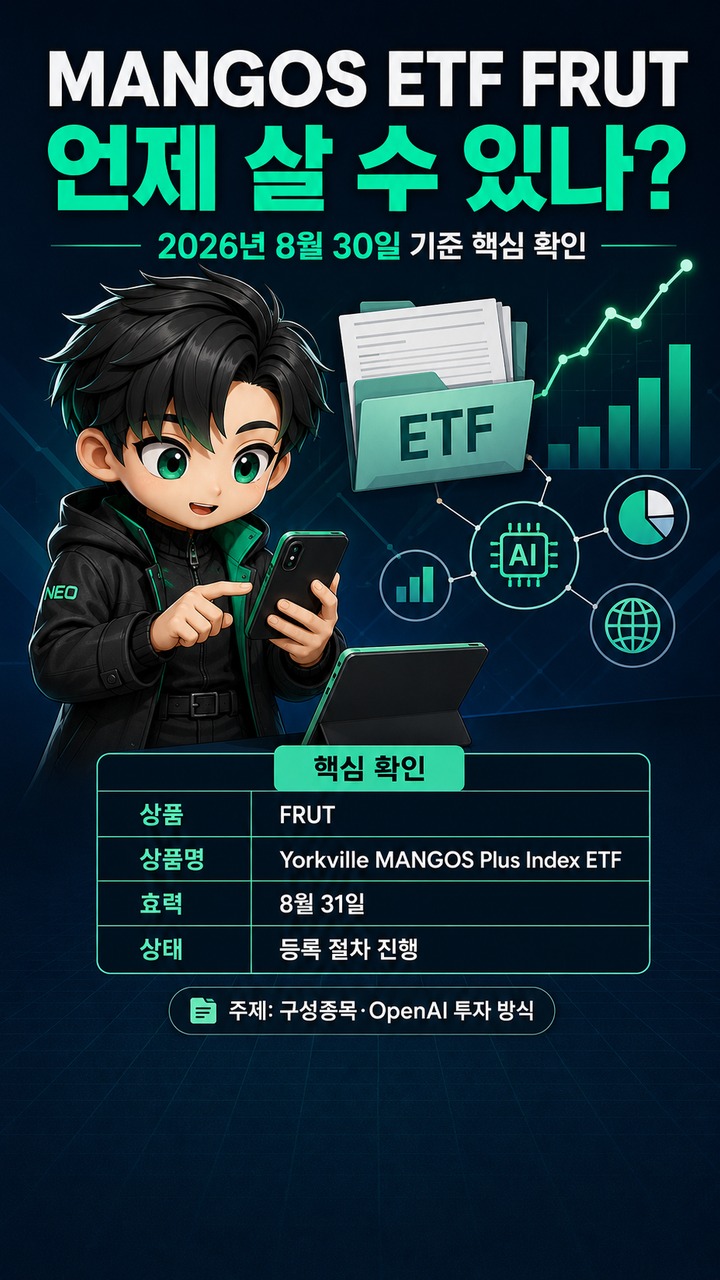
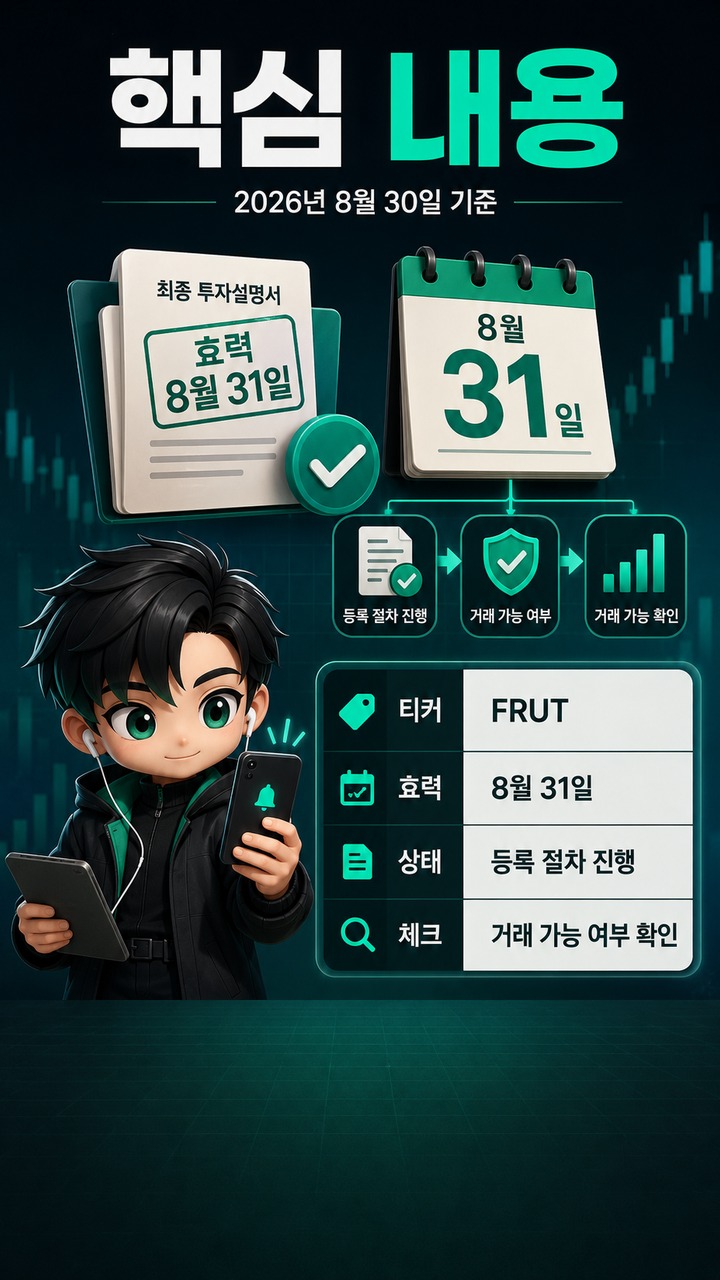
If you're looking for a MANGOS-related ETF, the first product to check is the Yorkville America MANGOS Plus Index ETF, ticker FRUT. As of 2026-08-30 Korea time, the final prospectus specifies August 31 as its effective date, and the registration process for listing on a U.S. exchange has also progressed. However, the registration effective date does not necessarily coincide with the date when investors can actually place orders through Korean brokerages, so it is important to verify FRUT's trading availability.
Can You Buy the MANGOS ETF FRUT Starting on August 31?
FRUT's prospectus date and registration effective date are 2026-08-31. The prospectus identifies FRUT as a product to be listed on NYSE Arca and NYSE Texas, and FRUT is also registered as the Yorkville America MANGOS Plus Index ETF in U.S. securities depository and clearing records.
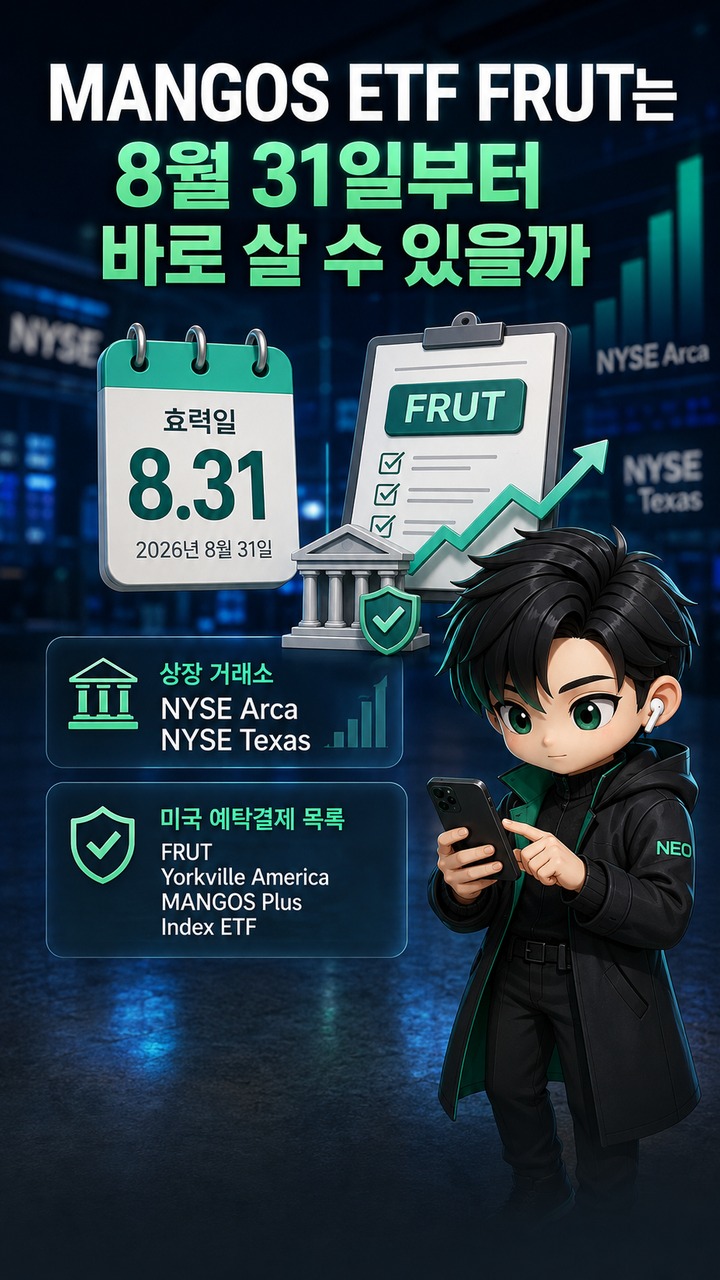
However, as of August 30, the prospectus also states that the fund has not yet commenced operations. Therefore, Korean investors need to check more than just a single date.
| Item to Check | As of 2026-08-30 |
|---|---|
| Fund name | Yorkville America MANGOS Plus Index ETF |
| Ticker | FRUT |
| Prospectus effective date | 2026-08-31 |
| Planned listing exchanges | NYSE Arca and NYSE Texas |
| Annual management fee | 0.50% |
| Investment strategy | Tracks the MANGOS Plus Index |
| Investing from South Korea | Check whether your brokerage supports U.S. stock orders for FRUT |
Therefore, the safer approach is to search for FRUT in your brokerage's U.S. stock trading platform after August 31, verify that the fund name matches exactly, and then determine whether trading is available. Because the same ticker symbol may be used for securities in other countries or markets, checking the full fund name is also advisable.
FRUT Is Not an ETF That Holds Only 6 MANGOS Companies
The name may lead investors to assume that the ETF holds six companies—Meta, Anthropic, NVIDIA, Google, OpenAI, and SpaceX—in equal proportions, but its actual structure is different.
According to the prospectus, the underlying index consists primarily of 67% allocated to MANGOS companies and 33% allocated to AI infrastructure companies. By adding AI infrastructure businesses involved in semiconductors, data centers, and related industries alongside the MANGOS segment, the fund has broader exposure than a simple '6-stock MANGOS ETF.'
The core MANGOS companies listed are as follows:
Meta Platforms
Anthropic
NVIDIA
OpenAI
SpaceX
The index also includes AI infrastructure companies such as SanDisk, Marvell Technology, Micron Technology, Intel, Dell Technologies, AMD, and Broadcom.
As a result, FRUT's returns may be influenced not only by leading AI companies such as NVIDIA and Meta but also by developments across the memory, CPU, server, networking, and data center supply chains.
The ETF Does Not Directly Purchase OpenAI and Anthropic Shares
One particularly important aspect of FRUT is how it gains exposure to OpenAI and Anthropic.
According to the prospectus dated 2026-08-31, both companies are privately held, meaning their shares cannot be continuously bought and sold on public markets like ordinary listed stocks. Accordingly, the fund intends to use instruments such as total return swaps (TRS) to gain economic exposure to changes in the valuations of these companies.
In the underlying index, OpenAI and Anthropic are each subject to a maximum weighting of 5%. Their actual weightings could be substantially lower than 5%, depending on liquidity in private-market transactions, funding rounds, and pre-IPO derivatives markets. Any unallocated weighting may be redistributed among other MANGOS companies.
MarketVector's published MANGOS Plus Index also combines a publicly traded company index with indicators related to private companies. In the index composition disclosed in late August, the listed-company MANGOS Plus Index accounted for most of the allocation, while the Anthropic-related futures index represented approximately 1%. The inclusion of private companies should not be interpreted as meaning that a large portion of ETF assets is invested directly in OpenAI or Anthropic shares.
Why Does MANGOS Have 6 Companies While the ETF Invests in More?
The key to understanding FRUT lies in the word 'Plus' in its name.
MANGOS refers to a group of six companies representing the AI industry, but the index tracked by FRUT adds AI computing infrastructure companies to that group. The underlying index allocates 67% to the MANGOS segment and 33% to the additional AI infrastructure segment.
For example, NVIDIA and AMD are associated with GPUs and accelerators; Micron and SanDisk with memory and storage; Broadcom and Marvell with semiconductors and networking; and Dell with servers and data center equipment.
In other words, buying FRUT is less about 'investing in only six companies, including OpenAI and NVIDIA' and more about investing across AI platforms and model developers, semiconductors, memory, and computing infrastructure as a combined investment theme.
What Risks Should You Consider Before Buying FRUT?
The first is concentration risk. Unlike broad U.S. market ETFs, FRUT concentrates its investments in AI and related infrastructure. If investor sentiment toward AI weakens or earnings expectations for related companies decline simultaneously, multiple holdings could move in the same direction.
The second is private-company valuation risk. Companies such as OpenAI and Anthropic, which are not traded on public exchanges, have less transparent pricing information and lower trading frequency than listed companies. The prospectus also identifies the possibility that prices and index weightings associated with private companies may not accurately reflect their actual market values as a risk factor.
The third is derivatives risk. Using total return swaps and similar instruments can introduce counterparty risk, tracking errors, and liquidity issues that would not arise in the same way from simply holding shares directly.
The fourth is trading volume and bid-ask spreads for a newly launched ETF. Trading volume may be insufficient during the initial listing period, potentially widening the difference between bid and ask prices. An ETF's market price does not always match its net asset value exactly. The prospectus explicitly states that market prices may trade at a premium or discount to NAV.
Finally, Korean investors also need to consider the U.S. dollar exchange rate. Even if FRUT's price rises, a strengthening Korean won could reduce returns when measured in won, while the opposite situation is also possible.
The Most Important Factors When Evaluating FRUT and MANGOS
More important than the MANGOS name itself is which assets FRUT actually provides exposure to and how much exposure each receives.
The structure confirmed as of 2026-08-30 can be summarized as follows.
**6 MANGOS companies → Core segment of the underlying index
7 AI infrastructure companies → Separate 33% segment
OpenAI and Anthropic → Each capped at 5%, with actual weightings potentially lower
Private companies → Economic exposure primarily through instruments such as total return swaps
FRUT → Scheduled to become effective on August 31, with an annual management fee of 0.50%**
MarketVector's MANGOS Plus Index was officially launched on 2026-08-26, and its first scheduled rebalancing date is also set for August 31. Therefore, determining whether MANGOS remains merely a new market buzzword or develops into an established category of investment products will require monitoring FRUT's trading volume and changes in portfolio weightings after its listing.
In particular, it would be inaccurate to interpret 'buying the MANGOS ETF is equivalent to directly owning OpenAI shares.' Exposure to private companies is limited and may involve derivatives, while a substantial portion of FRUT's overall portfolio also includes AI infrastructure companies outside the MANGOS group.
※ This article is provided for informational purposes to help readers understand market developments and does not constitute a recommendation to invest in any particular security or asset. Investors are responsible for their own final decisions and investment outcomes.
Related Articles
MANGOS, Bug Bounties, and Continuation Vehicles: How to Understand Them as of August 2026
Bitcoin ETFs: Does Buying a Spot ETP Mean You Own Bitcoin? Structural and Fee Differences in 2026
이 포스팅은 쿠팡 파트너스 활동의 일환으로, 이에 따른 일정액의 수수료를 제공받습니다.