

KRX Physical Gold, Gold Banking, and Gold ETFs: How Much After-Tax Profit Remains When Gold Prices Rise 10% After Investing KRW 10,000,000?
This post contains Coupang Partners affiliate links. We may earn a commission from qualifying purchases.

If gold prices rise by 10%, the pretax profit on an investment of KRW 10,000,000 is KRW 1,000,000. However, the amount you actually keep depends on the investment method. Applying the product terms confirmed in 2026-11-02, the estimated net profits are approximately KRW 928,000 for KRX physical gold, KRW 833,000 for gold ETFs, and KRW 662,000 for KB Gold Banking. This is a hypothetical comparison that takes trading fees, taxes, and holding costs into account.
Why Returns Differ Even When Gold Prices Rise by the Same 10%
The differences between gold investment products mainly come down to three factors.

First, whether capital gains from trading are subject to taxation.
Second, the transaction costs incurred when buying and selling gold.
Third, management fees and other expenses that accrue during the holding period.
In particular, KRX physical gold and KRX physical gold ETFs have similar names and underlying assets, but they are subject to different tax systems.
Trading gold directly through a Korea Exchange physical gold account and purchasing a physical gold ETF are two different investment methods.
This comparison uses the conditions applicable to ordinary individual investors holding standard taxable investment accounts, based on 2026-11-02.
Comparing After-Tax Returns on an Investment of KRW 10,000,000
Let's start with the comparison results.
The following is a hypothetical scenario in which gold prices rise by 10% over 1 years, followed by the sale of the entire investment of KRW 10,000,000.
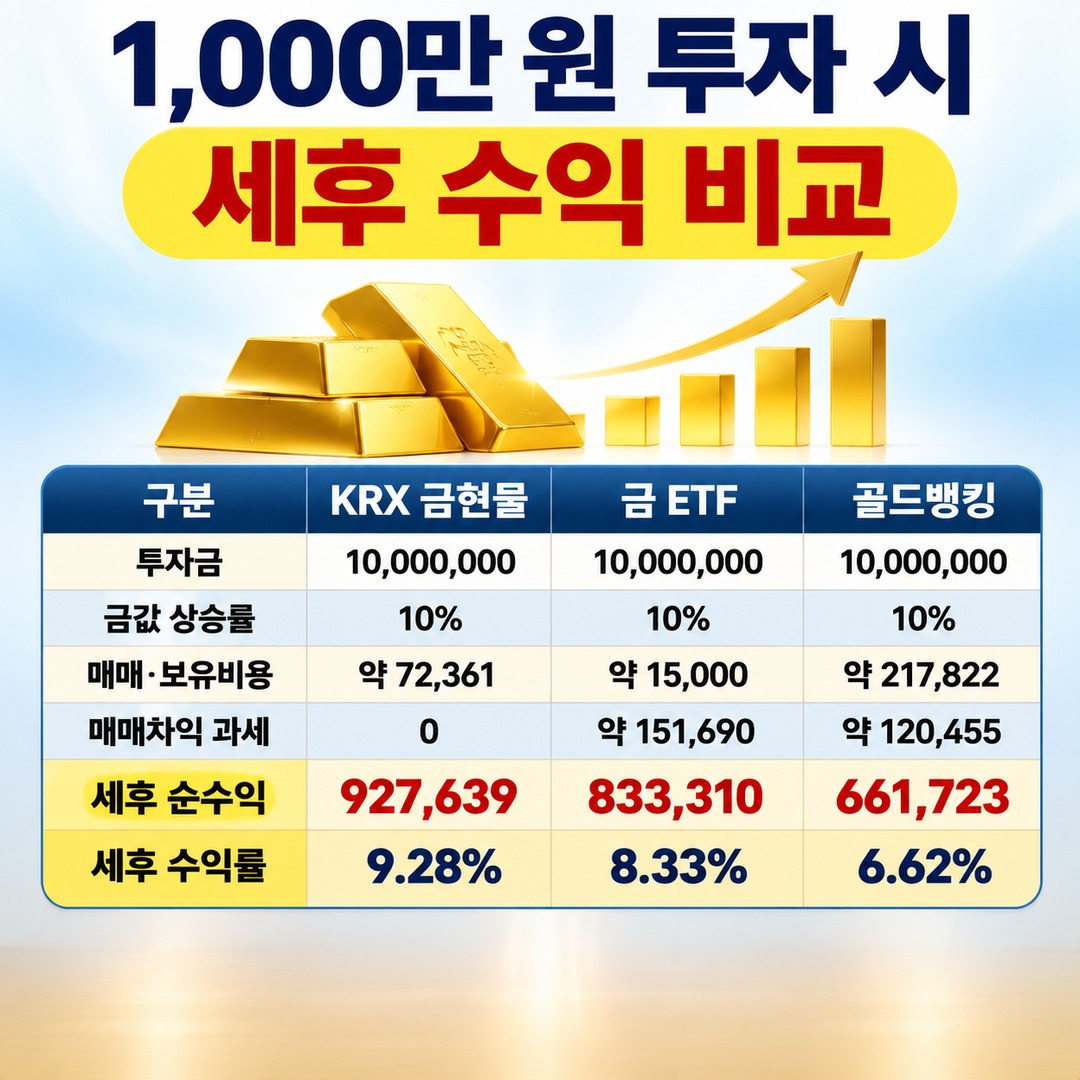
Unit: KRW / Author's calculations / Taxes and costs based on the assumptions below
| Category | KRX Physical Gold | Gold ETF | Gold Banking |
|---|---|---|---|
| Investment Amount | 10,000,000 | 10,000,000 | 10,000,000 |
| Gold Price Increase | 10% | 10% | 10% |
| Trading and Holding Costs | Approx. 72,361 | Approx. 15,000 | Approx. 217,822 |
| Capital Gains Tax on Trading | 0 | Approx. 151,690 | Approx. 120,455 |
| Net Profit After Tax | 927,639 | 833,310 | 661,723 |
| After-Tax Return | 9.28% | 8.33% | 6.62% |
These figures do not represent actual realized returns for individual products. They are based on a comparison model using publicly available fee and tax conditions. The calculation assumes that the increase in the ETF's tax base reference price is equal to the taxable profit assumed in this scenario.
Under this scenario, KRX physical gold generates the highest net profit.
The difference between KRX physical gold and Gold Banking is approximately KRW 266,000.
Even with the same assumed increase in gold prices, the results differ because of transaction costs and taxation methods.
Why Does KRX Physical Gold Generate the Highest After-Tax Return?
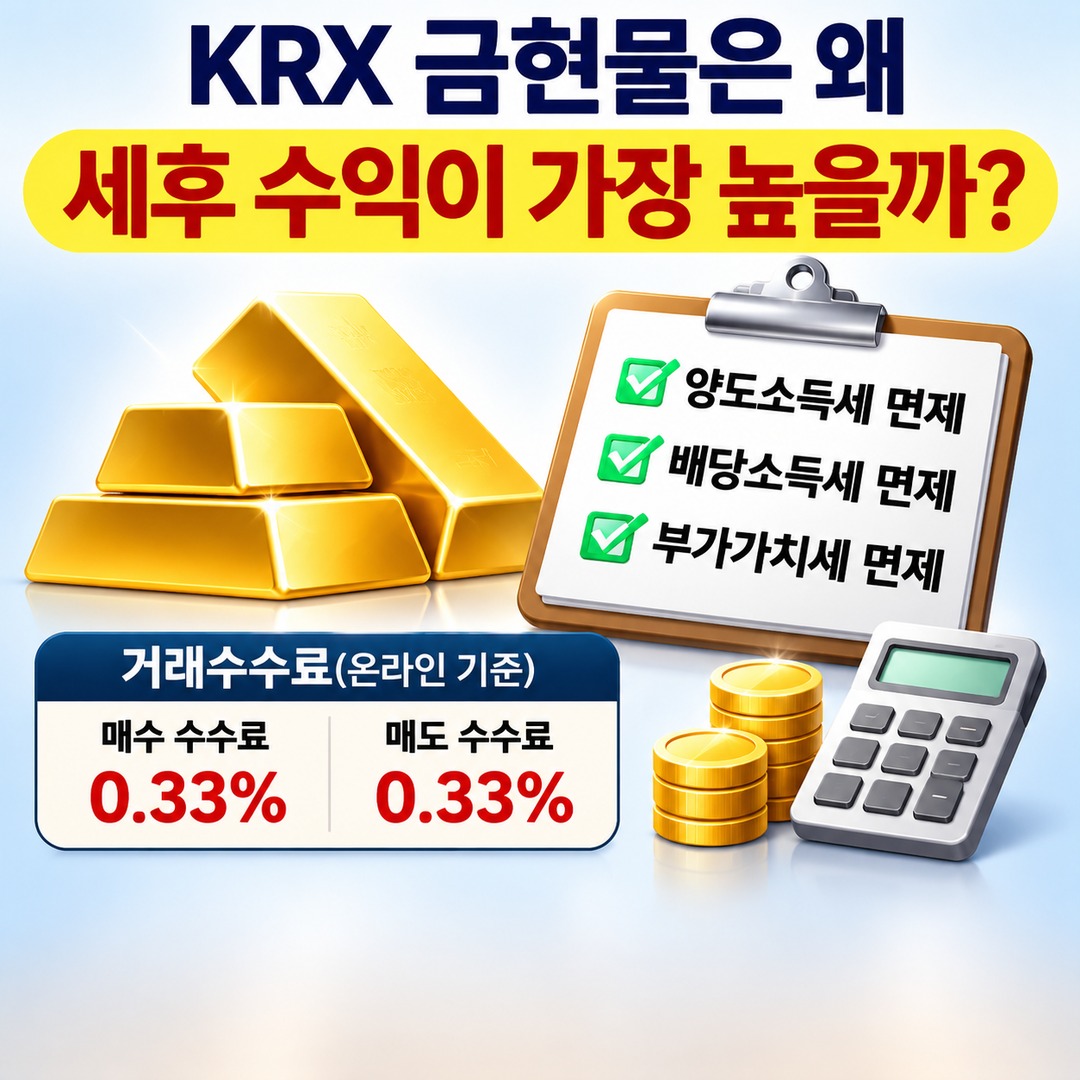
KRX physical gold involves directly buying and selling gold on the Korea Exchange Gold Market.
For ordinary individual investors, capital gains from on-exchange transactions are not subject to capital gains tax or dividend income tax. Value-added tax is also exempt on on-exchange transactions.
The Korea Exchange's official KRX Gold Market guidance explains these tax benefits and the conditions for withdrawing physical gold.
However, tax-exempt status does not mean that there are no transaction costs.
Both Buying and Selling Fees Must Be Included
Actual fees vary depending on the securities firm and trading platform.
For this calculation, we applied the online physical gold trading commission listed in Kiwoom Securities' 2026-year 1-quarter quarterly report.
Buying commission: 0.33% (including VAT)
Selling commission: 0.33% (including VAT)
If KRW 10,000,000 is treated as the total investment amount, including the buying commission, the calculation is as follows.
At the Time of Purchase
KRW 10,000,000 ÷ 1.0033
Selling After Gold Prices Rise by 10%
Market Value of Purchased Gold × 1.10 × 0.9967
Calculation Results:
Final Amount Recovered: Approx. KRW 10,927,639
Tax on Trading Gains: KRW 0
Net Profit: Approx. KRW 927,639
This is an example using the fees listed in Kiwoom Securities' 2026-year quarterly report.
If another securities firm charges different fees, the final return will also differ.
The Calculation Changes If You Withdraw Physical Gold
The tax exemption for KRX physical gold should be understood as applying to on-exchange transactions.
If you withdraw the actual gold in the form of a gold bar, value-added tax of 10% and a separate withdrawal fee will apply.
Therefore, if your investment objective is to profit from rising gold prices, you should distinguish from the outset whether you intend to withdraw the physical gold.
With Gold Banking, Check the Buy-Sell Price Spread Before Focusing on Taxes
Bank gold banking allows you to accumulate gold holdings in an account without physically storing the gold yourself.
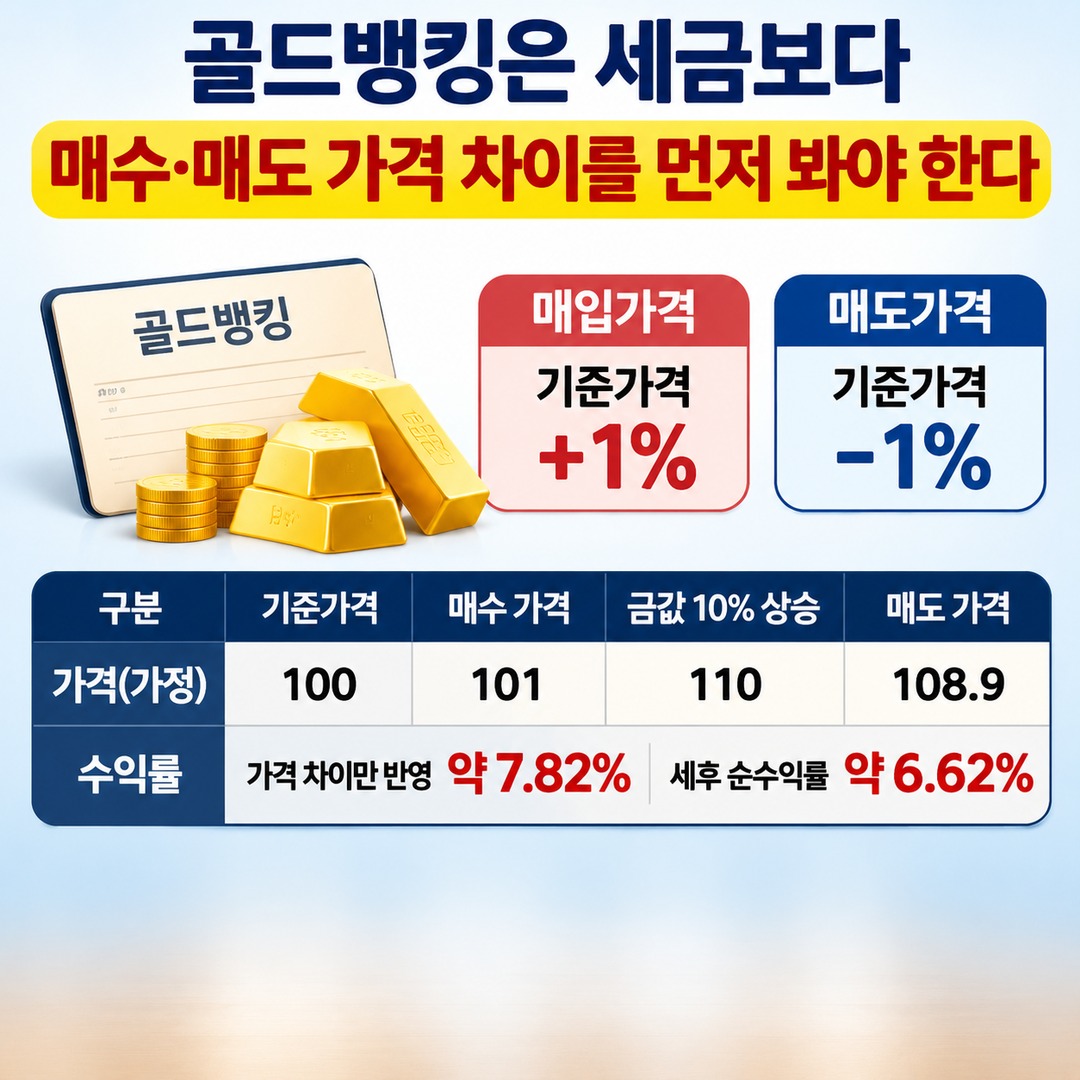
One representative example is KB Kookmin Bank's KB Gold Investment Account.
According to KB Kookmin Bank's official product information, the trading unit is 0.01g, and the KRW-denominated reference price is calculated based on international gold prices and the KRW/USD exchange rate.
An important cost to consider here is the 1% fee applied to the trading price.
1% When Buying, and 1% When Selling
According to the product information provided by KB Kookmin Bank, prices are calculated as follows.
Purchase price: Reference price + 1%
Selling price: Reference price - 1%
In other words, even if gold prices rise by 10%, an investor's actual return will be lower than 10%.
Let's work through a hypothetical calculation.
Assuming an initial reference price of 100, the calculation is as follows.
| Category | Reference Price |
|---|---|
| Initial purchase reference | 100 |
| Purchase price | 101 |
| Gold price increase of 10% | 110 |
| Selling price | 108.9 |
Because the gold is actually purchased at 101 and sold at 108.9, the return relative to the original investment is approximately 7.82%, even when considering only the price difference.
After applying the dividend income tax of 15.4% to the trading profit, the net return becomes approximately 6.62%.
Based on an investment of KRW 10,000,000, the calculation is as follows.
Initial investment: KRW 10,000,000
Pre-tax profit after selling: approximately KRW 782,178
Dividend income tax: approximately KRW 120,455
Net profit after tax: approximately KRW 661,723
The advantages of Gold Banking include the ability to accumulate gold with small amounts of money and trade through a bank's mobile app.
However, returns are affected by exchange rates as well as gold prices.
Even if international gold prices rise, a decline in the USD/KRW exchange rate can reduce returns measured in Korean won.
Gold ETFs Have Different Tax Rules from KRX Spot Gold
Gold ETFs offer the convenience of being traded like stocks through a securities account.

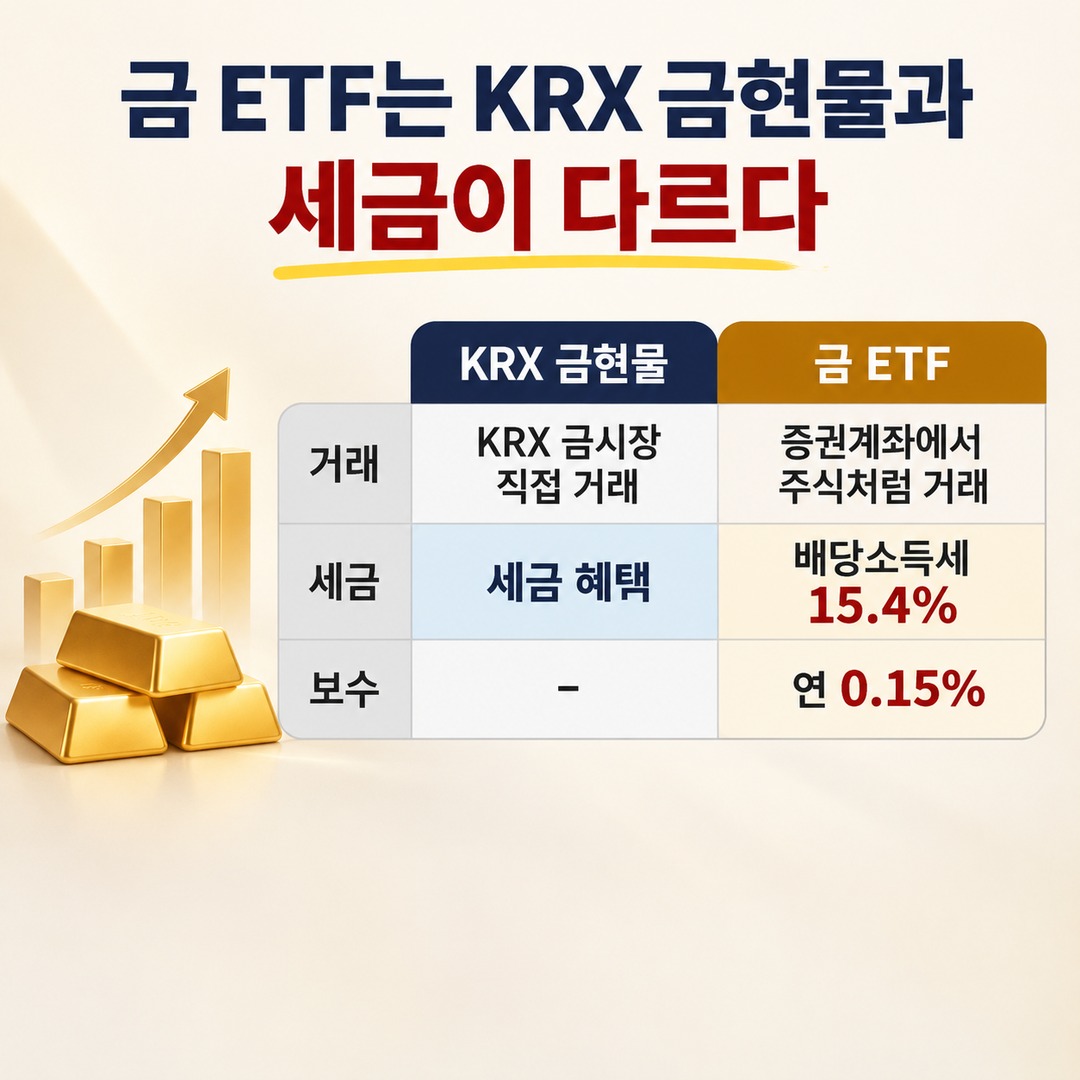
However, the fact that an ETF tracks the KRX spot gold price does not mean it receives the same tax benefits as directly trading gold on the KRX Gold Market.
For example, TIGER KRX Gold Spot is an ETF that tracks the KRX Gold Spot Index.
Mirae Asset Global Investments states in its investment prospectus that the tax treatment differs between directly trading gold on the KRX Gold Market and holding an ETF.
15.4% Taxation in Standard Brokerage Accounts
Capital gains from trading domestically listed commodity ETFs are generally taxed as dividend income.
However, the actual taxable amount is based on the lower of the trading profit and the increase in the tax base reference price.
Therefore, the actual tax on every ETF does not necessarily equal 15.4% of the trading profit.
This calculation assumes that the increase in the tax base reference price is equal to the actual trading profit.
ETF Management Fees Also Matter for Long-Term Investors
The total annual expense ratio stated in the investment prospectus for TIGER KRX Gold Spot, used in this comparison, is 0.15%.
Assuming a holding period of 1 years for an investment of KRW 10,000,000, the estimated cost would be approximately KRW 15,000.
If gold prices rise by 10%, the calculation can be made as follows.
Profit from the increase in gold prices: KRW 1,000,000
Assumed management fees over 1 years: KRW 15,000
Profit after deducting management fees: KRW 985,000
Dividend income tax of 15.4%: KRW 151,690
Net profit after tax: KRW 833,310
Actual management fees are reflected in the fund's net asset value, so the calculation above is a simplified illustration. Brokerage trading commissions and other costs should also be checked separately.
Gold ETFs should also be distinguished by whether they are physically backed or futures-based.
Gold futures ETFs: Track gold futures prices
Currency-hedged ETFs: Managed with the aim of reducing the impact of exchange rate fluctuations
These three investment products differ in their underlying assets and currency exposure. Therefore, the same percentage increase in gold prices does not necessarily translate directly into the same return for each ETF.
Which of the Three Investment Methods Is Most Suitable?
Your investment method should be chosen based not only on after-tax returns but also on your investment objectives.

| Investment Objective | Option to Consider | Key Considerations |
|---|---|---|
| Gold price gains and tax savings | KRX spot gold | Check brokerage fees |
| Accumulating gold through a banking app | Gold Banking | Check the purchase and selling price spread |
| Convenient trading like stocks | Gold ETFs | Check the tax classification and total expense ratio |
| Physical ownership of gold | Products allowing physical withdrawal | Check VAT and withdrawal costs |
KRX spot gold offers clear tax advantages, but requires a dedicated spot gold account.
Gold Banking is convenient and accessible, but the difference between buying and selling prices can reduce your returns.
Gold ETFs are convenient to trade, but their tax treatment and fund structures should be checked individually.
Three Important Conditions Investors Often Overlook
1. Financial Income Comprehensive Tax Threshold
Profits from Gold Banking and taxable gold ETFs held in standard brokerage accounts are classified as dividend income.
If your combined annual interest and dividend income exceeds KRW 20,000,000, you may become subject to comprehensive taxation on financial income.
Investors with other sources of financial income should not assume that the 15.4% withholding tax is necessarily their final tax liability.
2. ISA and Pension Accounts Require Separate Calculations
Holding gold ETFs in tax-advantaged accounts, such as ISA or personal pension savings accounts, may result in different tax treatment and timing compared with regular investment accounts.
Therefore, the calculations for regular taxable accounts in this article should not be applied directly to tax-advantaged accounts.
3. Gold Prices and Returns in Korean Won Are Not the Same
Even when international gold prices rise, a stronger Korean won can change the returns domestic investors receive when measured in Korean won.
In particular, exchange rate movements should also be considered when investing through gold banking or currency-unhedged gold ETFs.
KRW 10,000,000 Key Points to Remember About Gold Investing
※ This article is for informational purposes only and is intended to help readers understand market trends. It does not constitute a recommendation to invest in any specific security or asset. All investment decisions and responsibility for those decisions rest with the individual investor.
This post contains Coupang Partners affiliate links. We may earn a commission from qualifying purchases.