

IC 1101 Confirmed to Be Approximately 170 × 10,000 Light-Years Across: Why the Size of the Universe's Largest Galaxy Has Changed

The object measured at approximately 170 × 10,000 light-years in diameter is IC 1101, a giant galaxy at the center of the Abell 2029 galaxy cluster. A new 2026 study measured IC 1101's main stellar mass structure extending approximately 260 kiloparsecs (kpc) from its center, giving it a total diameter of about 520 kpc, or approximately 170 × 10,000 light-years.

However, interpreting this as the discovery of a new galaxy 170 × 10,000 light-years across misses an important distinction. IC 1101 has been known for a long time. The key achievement of this research is that scientists used deep observations of its faint outskirts to reassess where the physical boundary of the galaxy itself lies.
There is another intriguing question. IC 1101 has previously been described as spanning millions of light-years, while Alcyoneus, extending more than 1600 × 10,000 light-years, has also been called the largest galaxy. How, then, can IC 1101, measuring approximately 170 × 10,000 light-years, once again be described as the largest galaxy?
The answer depends on which parts of a galaxy are included when measuring its size.
How Was the 170 × 10,000 Light-Year Figure Calculated?
The new study measured the boundary radius of IC 1101 at approximately 260 kpc along its major axis. Since 1 parsec is approximately 3.26 light-years, doubling the radius gives a diameter of 520 kpc, equivalent to approximately 169 × 10,000 plus 6000 light-years.
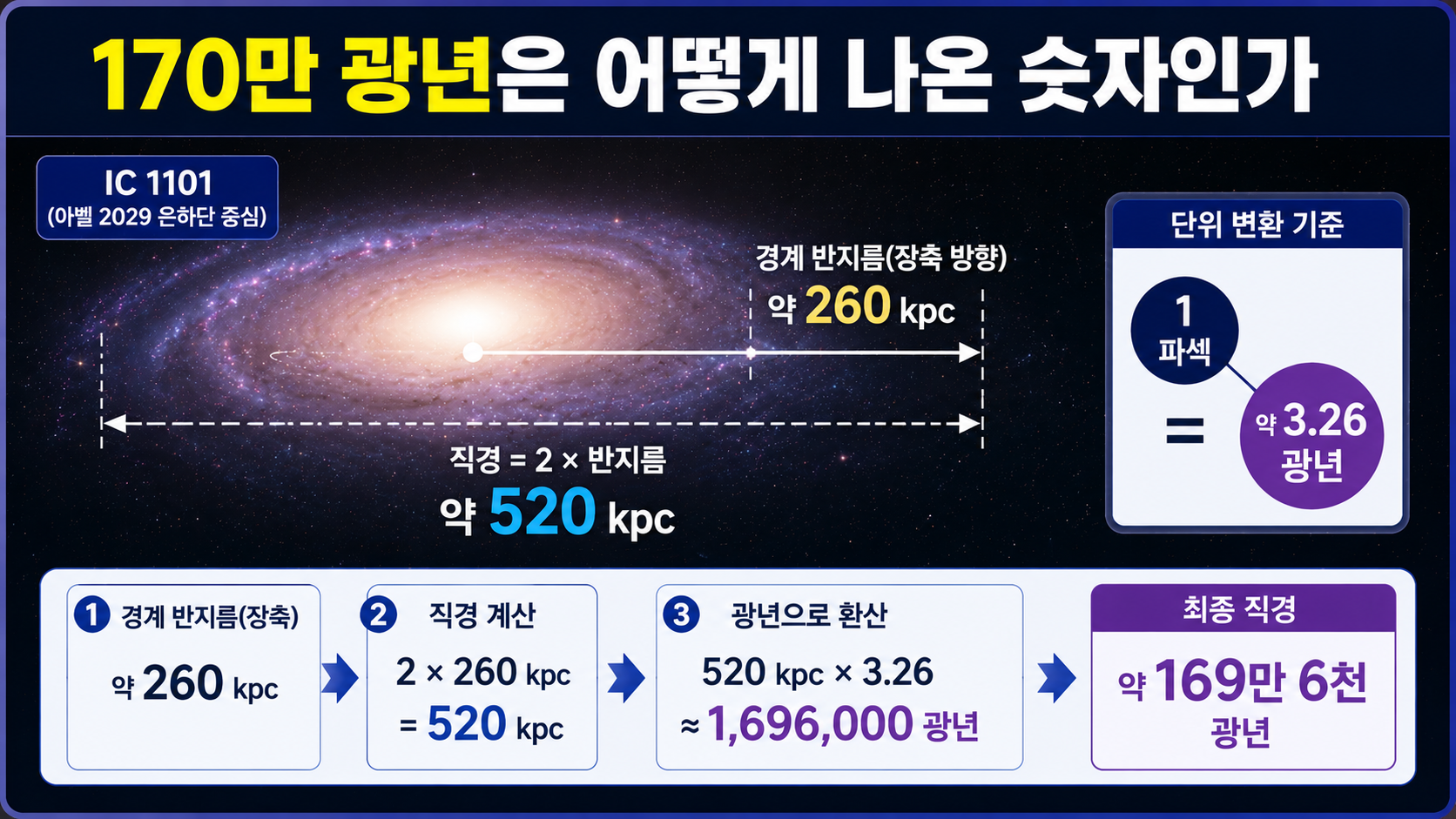
Author's calculation:
520 kpc × 1,000 pc/kpc × approximately 3.26 light-years/pc = approximately 1,695,000 light-years
This is why articles and explanations may round the measurement to approximately 170 × 10,000 light-years.
The figure was not obtained simply by identifying the faintest visible point in an image and measuring the distance to it. Researchers used ultra-deep images in the g and r bands, modeling and removing the effects of surrounding starlight and scattered light within the telescope.
They then examined how surface brightness, color, and stellar mass density changed with radius in multiple directions. Their goal was to identify where the distribution of stars changed significantly with increasing distance from the center, allowing them to define the boundary of the galaxy's main body.
This process is particularly important for enormous galaxies. Their central regions are relatively easy to observe, but the light becomes extremely faint farther out, making it difficult to distinguish stars belonging to the galaxy from diffuse light spread throughout the surrounding galaxy cluster.
IC 1101 Was Not Discovered for the First Time in This Study

Calling IC 1101 a newly discovered record-breaking galaxy is inaccurate.
IC 1101 is not a newly identified celestial object. It has long been recognized as an exceptionally large and luminous galaxy at the center of the Abell 2029 galaxy cluster. The question this study sought to answer was 'Where exactly does the main body of IC 1101 end?'
Previous observations had already shown that extremely faint light extended considerable distances from the center. The challenge was determining whether all of that light actually belonged to IC 1101 itself.
At the centers of massive galaxy clusters, stars can be spread across enormous regions without being clearly associated with any individual galaxy. Their collective glow is known as intracluster light, or ICL. It is faint light produced by stars stripped from galaxies or dispersed into the cluster environment through interactions between galaxies.
For a giant galaxy such as IC 1101, located at the heart of a cluster, its outer starlight can appear to blend naturally into the ICL. This is why the measured size can vary dramatically depending on where scientists draw the boundary of IC 1101.
A more accurate description of the new findings is therefore that researchers identified a physically meaningful boundary for the main stellar mass structure of the already well-known giant galaxy IC 1101, establishing a diameter of approximately 520 kpc, rather than discovering an entirely new record-breaking galaxy.
Why Is the New Measurement 170 × 10,000 Light-Years When Earlier Estimates Were 400 × 10,000 to 600 × 10,000 Light-Years?
Searching for older estimates of IC 1101's size produces figures such as 400 × 10,000 light-years, 500 × 10,000 light-years, and even larger values. Compared with the new estimate of approximately 170 × 10,000 light-years, it might seem as though the galaxy has somehow become smaller.

But the galaxy has not suddenly shrunk. The measurement criteria are different.
Unlike a planet, a galaxy does not have a sharply defined surface where it abruptly ends. Stellar density and surface brightness gradually decrease with distance from the center. At the heart of a massive galaxy cluster, this faint light can also blend with diffuse light from the surrounding cluster.
Astronomers therefore use several methods to define galaxy size. They may measure out to a particular surface-brightness threshold or use the radius enclosing a specified fraction of the galaxy's total light. They may include an extremely faint outer halo or identify a boundary where the stellar mass distribution changes in a physically meaningful way.
The new study follows an approach closer to the last method. Rather than relying solely on surface brightness, researchers also analyzed color and stellar mass density to locate the outer boundary of IC 1101's main body.
Therefore, the change from an older estimate of 500 × 10,000 light-years to a new measurement of 170 × 10,000 light-years should not be interpreted as a straightforward reduction in the galaxy's size. It is more like measuring the same object with different rulers.
Without understanding this distinction, readers may understandably wonder why every source seems to report a different size for the largest galaxy.
How Large Is IC 1101 Compared With the Milky Way?
If the Milky Way's diameter is commonly described as approximately 10 × 10,000 light-years, then IC 1101's diameter of about 170 × 10,000 light-years is roughly 17 times larger.
Author's calculation:
Approximately 170 × 10,000 light-years ÷ approximately 10 × 10,000 light-years = approximately 17
However, this comparison also depends on where the boundary of each galaxy is defined. The Milky Way's size changes depending on whether the measurement refers to its stellar disk, stellar halo, gas distribution, or dark matter halo.
Rather than claiming that IC 1101 is exactly 17 times larger than the Milky Way, it is more accurate to say that a simple comparison of broadly similar diameter measurements suggests a scale difference of approximately 17 times.
The new study calculated the stellar mass enclosed within the identified boundary at approximately 3 trillion plus 4000 hundred million times the mass of the Sun. This means the object is not merely an unusually extended galaxy; its stellar mass is also extraordinarily large.
Its immense size is related to its location. IC 1101 sits at the center of the Abell 2029 galaxy cluster and is classified as a brightest cluster galaxy, or BCG, the brightest and dominant galaxy in its cluster. Such central galaxies can grow over long periods by merging with other galaxies and accumulating surrounding material.
But Isn't Alcyoneus, at 1600 × 10,000 Light-Years, Even Larger?
One of the most confusing comparisons involves Alcyoneus, a giant radio galaxy reported to span approximately 1600 × 10,000 light-years. Judging by the numbers alone, it appears overwhelmingly larger than IC 1101.
However, the two measurements describe different things.
The enormous size attributed to Alcyoneus does not mean that stars belonging to its central galaxy are densely distributed across 1600 × 10,000 light-years. Instead, the measurement refers to the length of its entire radio-emitting structure, including enormous radio lobes created by jets launched from the active galactic nucleus and extending far into space.
By contrast, the approximately 170 × 10,000 light-year measurement for IC 1101 refers to the boundary of the galaxy's main stellar body, defined in the new study using starlight and stellar mass distributions.
Separating the comparison into two questions helps resolve the confusion.
If the question is how far the physically defined main body of a galaxy composed of stars extends, the new study identifies IC 1101 as the largest known galaxy under that criterion.
If the question is how far the entire structure created by a central galaxy extends, including radio jets and lobes, giant radio galaxies can reach much greater dimensions, approaching tens of millions of light-years.
This is why the 170 × 10,000 light-year and 1600 × 10,000 light-year figures should not be directly compared to assign 1st and 2nd place rankings.
Why Did IC 1101 Grow So Enormous?
The extraordinary size of IC 1101 reflects the history of a galaxy that has grown over billions of years. Giant galaxies at the centers of clusters can continually expand their outer regions by absorbing smaller galaxies or merging with other large galaxies.
The new ultra-deep images also revealed extremely faint, asymmetric structures around IC 1101. The researchers explained that these outer features are spatially associated with large-scale disturbances observed in the Abell 2029 galaxy cluster.
An important point is that IC 1101 should not be imagined as a single perfectly smooth, fully formed giant sphere.
The outer regions of galaxies can preserve evidence of past interactions and mergers. If stars and matter continue to flow inward, these structures can evolve over time. The researchers also reported evidence that mass assembly is still taking place in the outskirts of IC 1101.
In other words, the approximately 170 × 10,000 light-year measurement does not represent the discovery of an absolute upper limit on galaxy size imposed by the universe. It is a measurement of IC 1101's main body based on current observations and the physical boundary criteria adopted in this study.
The Title 'Largest Galaxy in the Universe' Comes With Qualifications
Based on the findings of the 2026 study, IC 1101 is an exceptionally large example among known galaxies, with a measured diameter of approximately 520 kpc. The researchers assessed it as the largest galaxy known to date.
However, the phrase 'largest galaxy' must always be considered alongside the measurement criteria.
Galaxies do not have solid surfaces, and their starlight becomes increasingly faint toward their outskirts. At the centers of galaxy clusters, distinguishing the outer regions of individual galaxies from intracluster light is particularly difficult. Radio galaxies can also produce jets and lobes extending far beyond their stellar bodies.
Consequently, deeper future observations or different definitions of physical boundaries could change the record for the largest galaxy.
There is another important qualification. As of 2026-08-14, the available original research on IC 1101 is a publicly released preprint. It is therefore appropriate to allow for the possibility that detailed measurements or interpretations may be revised through subsequent peer review and additional research.
The three most important points to remember are these.
IC 1101 was not discovered for the first time in this study. The new research measured its main stellar mass structure at approximately 520 kpc in diameter, equivalent to about 170 × 10,000 light-years. And the approximately 1600 × 10,000 light-year measurement for Alcyoneus includes its radio lobes, meaning it cannot be directly compared with the stellar mass boundary of IC 1101.
Ultimately, the real advance in this research is not the discovery of another enormous galaxy, but a more precise understanding of how a galaxy's edge can be defined and how far that boundary can be measured through actual observations.