

Fed Minutes Released: How Far Did Discussions of Further Rate Hikes Go After the U.S. Rate Decision of 3.75~4.00%?
이 포스팅은 쿠팡 파트너스 활동의 일환으로, 이에 따른 일정액의 수수료를 제공받습니다.
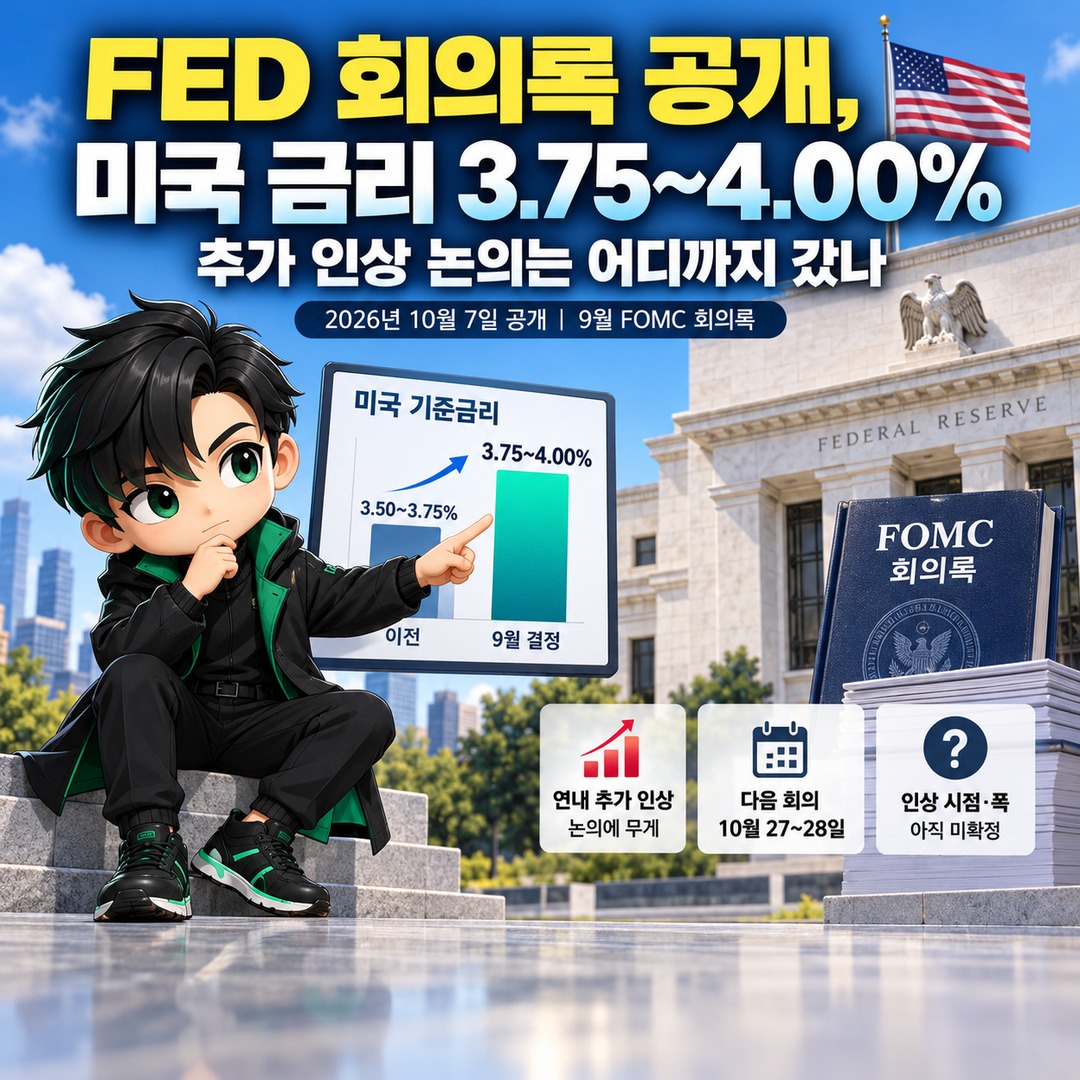
Minutes from the September Federal Open Market Committee (FOMC) meeting, released by the U.S. Federal Reserve (Fed) on 2026-10-07, show that participants leaned toward another interest rate increase before year-end. However, neither the timing nor the size of the next increase has been finalized. At the September meeting, the benchmark interest rate was raised by 0.25% percentage points to an annual range of 3.75~4.00%. The next meeting will take place on October 27~28.
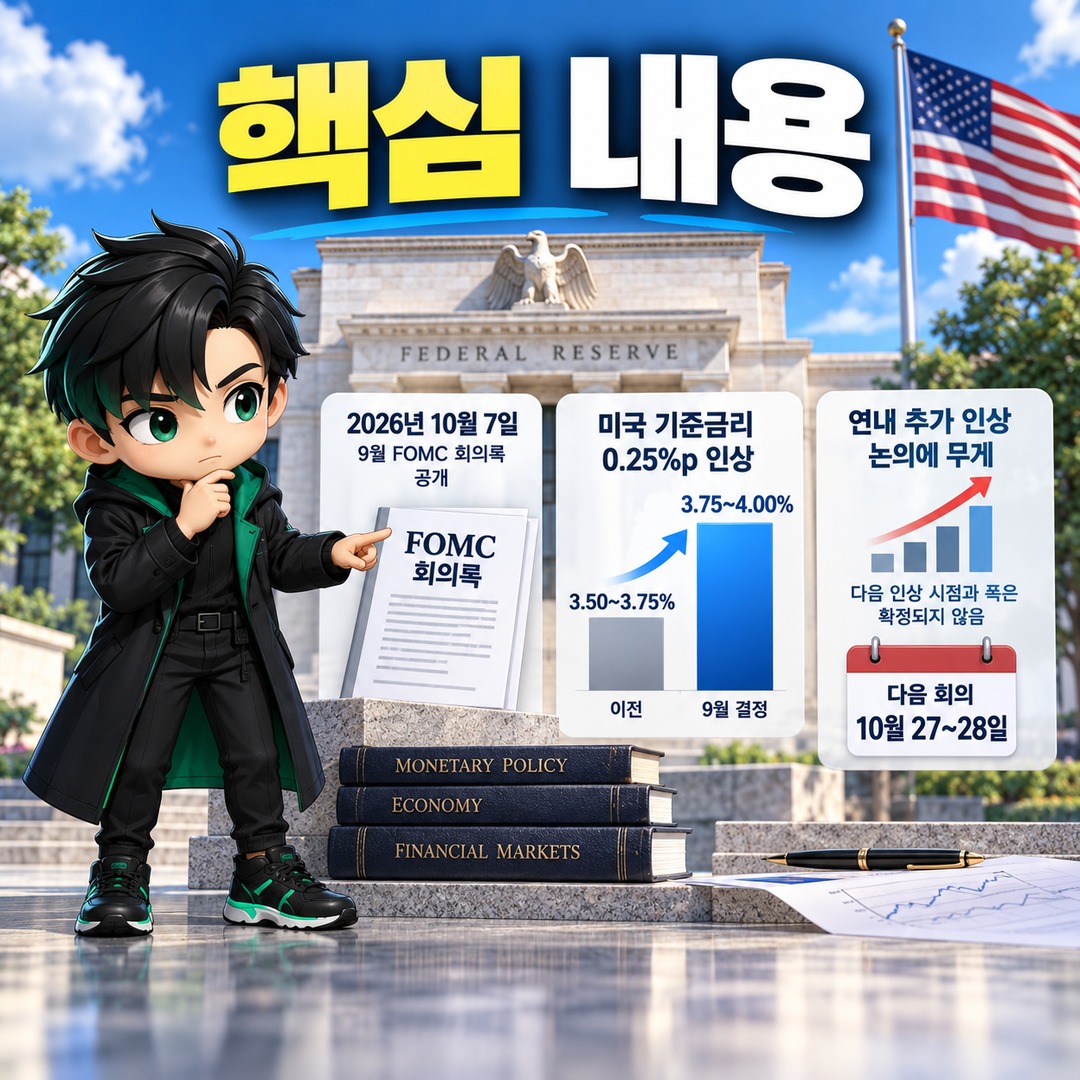
The most important aspect of these minutes is not the rate increase itself, but how participants assessed the need to maintain a restrictive monetary policy stance going forward.
Interest Rate Decision Confirmed in the September FOMC Minutes
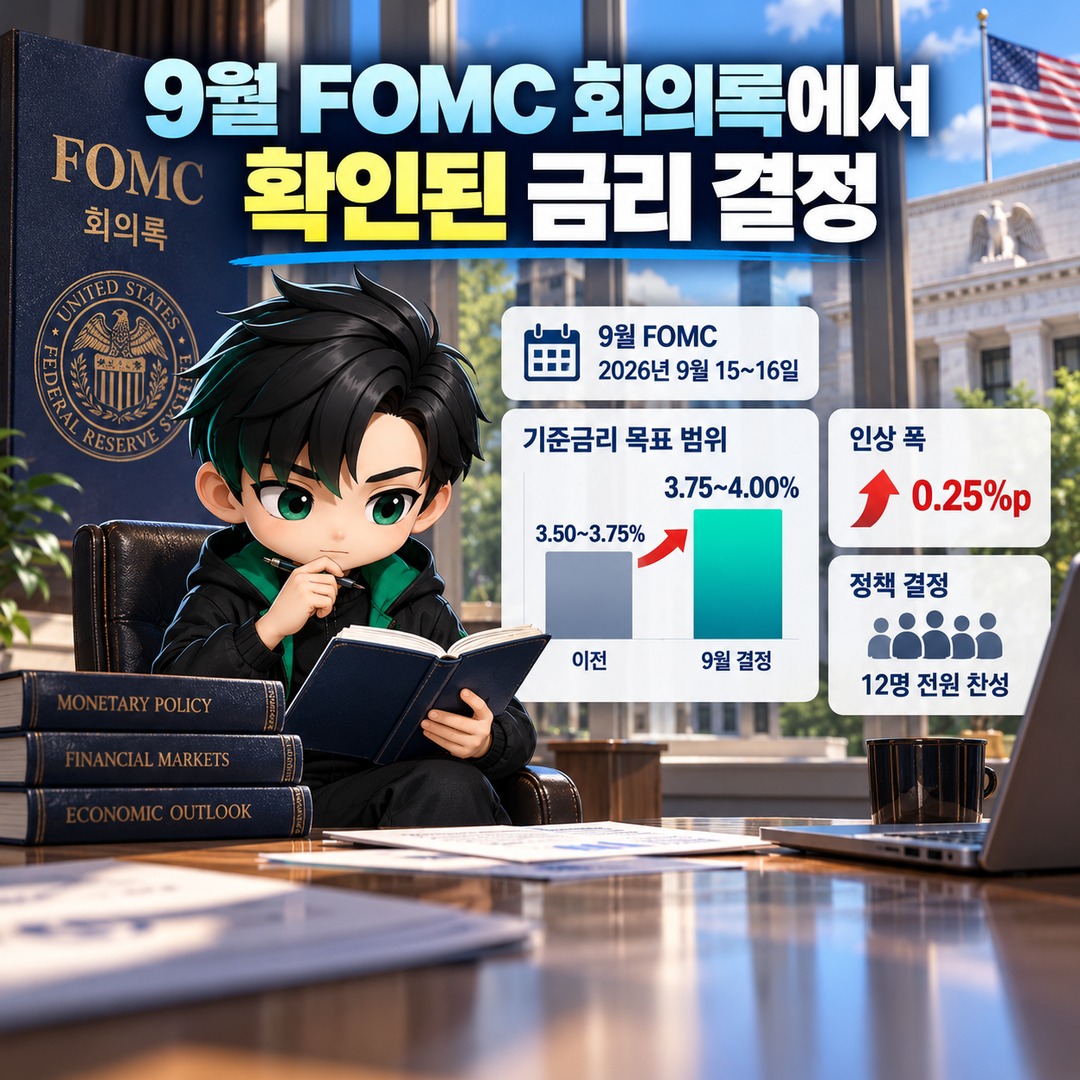
At its September 15~16 FOMC meeting, the Federal Reserve raised its target range for the benchmark interest rate from the previous annual range of 3.50~3.75% to 3.75~4.00%. The increase was 0.25% percentage points, and the decision was approved unanimously by all 12 voting members.
The interest rate statement announced on September 16 and the meeting minutes released on October 7 serve different purposes.
The interest rate statement communicates the policy decision that was finalized at the time. The minutes, by contrast, reveal the economic conditions and risk factors discussed during the decision-making process.
Therefore, a reference to the possibility of additional rate increases in the minutes should not be interpreted as confirmation that another increase has already been decided.
How Did Fed Participants Assess the Possibility of Another Rate Hike This Year?

According to the minutes, most participants considered it likely to be appropriate to raise the benchmark interest rate once more by the end of 2026.
However, participants did not all share the same reasons for believing that interest rates should rise further.
Many participants viewed maintaining a higher projected interest rate path as a prudent response to inflation risks. They believed that stronger-than-expected demand or additional supply shocks could keep inflation elevated.
Some participants, on the other hand, believed that higher interest rates were necessary under their baseline economic outlook, rather than merely as a precaution against potential risks.
This distinction is important for understanding future policy decisions.
A rate increase intended to guard against inflation risks and one considered necessary because of underlying economic conditions may lead policymakers to interpret subsequent economic indicators differently.
The minutes also explicitly stated that future decisions would depend on incoming economic information and the balance of inflation and employment risks.

Energy Prices and AI Investment Were Key Inflation Factors Monitored by the Fed
The minutes discussed rising energy prices and investment related to artificial intelligence (AI) as factors contributing to inflationary pressure.
Participants assessed that increases in crude oil and fuel prices resulting from geopolitical developments, along with expanding AI-related investment, were affecting business costs and demand throughout the economy.
Some participants believed that the longer energy prices remained elevated, the greater the risk that cost pressures originating in particular industries would spread into broader inflation.
Different aspects of AI-related investment were also discussed.
Although the expansion of AI infrastructure supports business investment and economic activity, some participants believed that related demand growing faster than supply capacity could create medium-term inflationary pressure.
At the same time, participants also acknowledged that AI investment could eventually improve productivity and the economy's potential productive capacity. However, they considered the timing and magnitude of those benefits uncertain.
In other words, the Fed did not view AI investment exclusively as either a driver of economic growth or a source of inflation.
How Did Inflation Projections and Employment Assessments Differ?
According to estimates prepared by Federal Reserve staff at the time of the September meeting, the August Personal Consumption Expenditures (PCE) inflation rate was estimated at 3.8% year over year, while core PCE inflation was estimated at 3.4%.
However, these figures were estimates based on information available at the time and the existing calculation methodology.
Federal Reserve staff explained that incorporating the scheduled methodological changes by the U.S. Bureau of Economic Analysis (BEA) would produce estimated inflation rates for the same August period of 3.6% for headline PCE and 3.2% for core PCE.
This explains why different figures may appear when describing inflation for the same month.
| Category | Estimate Using Existing Method | Estimate Reflecting Revised Method |
|---|---|---|
| August Headline PCE Inflation | 3.8% | 3.6% |
| August Core PCE Inflation | 3.4% | 3.2% |
The difference between the two estimates is 0.2% percentage points in each case. These figures do not compare inflation rates from different periods; they reflect the application of different calculation methods to the same period.
Regarding employment, participants generally assessed labor market conditions as stable.
According to the minutes, the unemployment rate in July and August was 4.1%, and many participants believed that the labor market had strengthened somewhat recently.
However, some participants also noted that labor market activity remained subdued, with both hiring and layoffs staying at low levels.
Will Another Rate Hike Be Decided at the October FOMC Meeting?
As of 2026-10-08, the interest rate decision for the next FOMC meeting had not been finalized.
Most participants' assessment in the minutes that another increase this year would be appropriate is separate from whether an actual increase will be decided at the October meeting.
The currently confirmed schedule is as follows.
| Event | Date |
|---|---|
| September FOMC Meeting | September 15~16 |
| Release of September Meeting Minutes | October 7 |
| Next FOMC Meeting | October 27~28 |
| Scheduled Release of October Meeting Minutes | November 18 |
At the October meeting, newly available inflation and employment data, along with developments in economic activity, could play important roles in the discussion.
It will be particularly important to examine whether the assessments expressed by participants in these minutes remain supported by subsequent economic indicators.
What Should Investors Distinguish When Assessing U.S. Stocks, Treasury Yields, and the Dollar?
These minutes alone cannot establish the future direction of the U.S. stock market or the dollar exchange rate.
However, the minutes provide important economic context for understanding interest rate expectations.
The Fed recorded that U.S. Treasury yields and the policy rate path anticipated by markets had risen during the period preceding the September meeting. It explained that economic indicators, geopolitical developments, and monetary policy-related remarks had influenced financial markets at the time.
Corporate earnings and AI-related investment were cited as major factors affecting the stock market.
Regarding the dollar, participants also discussed changes in interest rate differentials between the United States and other major economies during that period.
However, these records describe financial market conditions up to the time of the September meeting. They do not directly explain the causes of stock price or exchange rate movements occurring after the release of the minutes on October 7.
Investors should distinguish three key points.
First, the September interest rate increase was an already finalized decision.
Second, the possibility of another increase before year-end reflected participants' policy assessments at that time, not a confirmed future decision.
Third, actual financial market prices are influenced not only by the meeting minutes but also by subsequently released economic indicators and expectations already priced into the market.
Key Points to Watch at the Next FOMC Meeting
The minutes released on 2026-10-07 show that the Federal Reserve continued to regard elevated inflation as a significant policy risk.
Although participants unanimously approved an increase of 0.25% percentage points at the September meeting, they differed in their reasoning about how high interest rates would ultimately need to rise.
The fact that many participants favored another increase before year-end should be distinguished from any claim that a future rate hike has already been confirmed.
The next event to watch is the FOMC meeting scheduled for October 27~28. Comparing the actual interest rate decision and policy statement released at that meeting with the assessments recorded in the September minutes will help clarify how the Fed's monetary policy direction has evolved.
※ This article is provided for informational purposes to help readers understand market developments and does not constitute an investment recommendation for any particular security or asset. Readers are responsible for their own final decisions and investment outcomes.
Related Articles
Moving Average Analysis: 4 Things to Check Before a Golden Cross
Nasdaq's All-Time High 27,122.09 Was 28.19 Points Above the June Record
What Is a Gap Up? Understanding a Higher Opening Stock Price and How to Identify Gap Filling
이 포스팅은 쿠팡 파트너스 활동의 일환으로, 이에 따른 일정액의 수수료를 제공받습니다.