

DRAM Surges 400% and NAND 300%: How Accurate Is the 18-Month Memory Price Outlook?
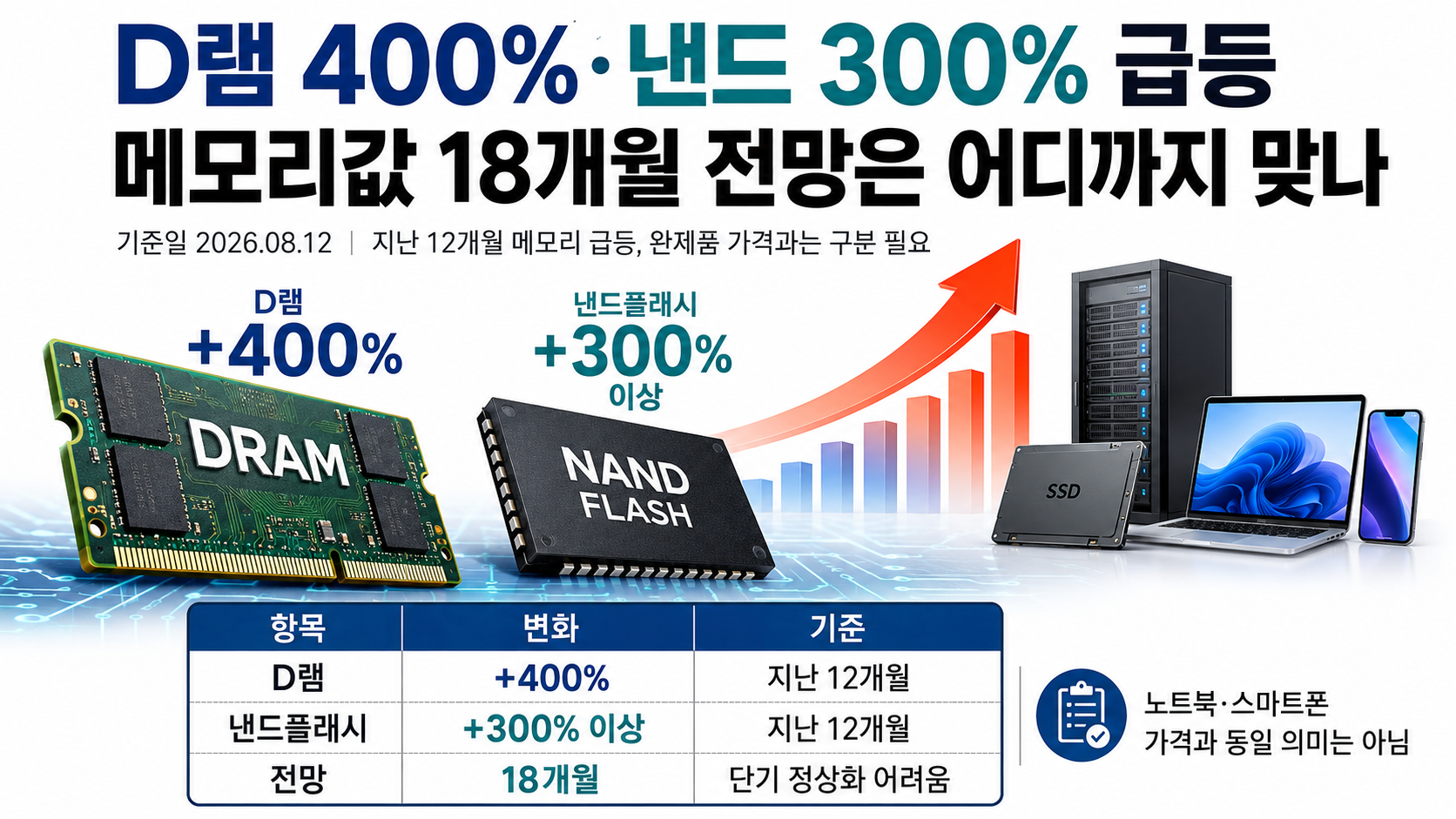
As of 2026-08-12, the sharp rise in memory prices is undeniable. Recent data shows that over the past 12 months, average selling prices for DRAM rose by 400%, while NAND flash prices increased by more than 300%. However, these figures do not mean that laptop and smartphone prices will rise by 400% and 300%, respectively, or that every type of memory will continue becoming more expensive each month over the next 18 months.
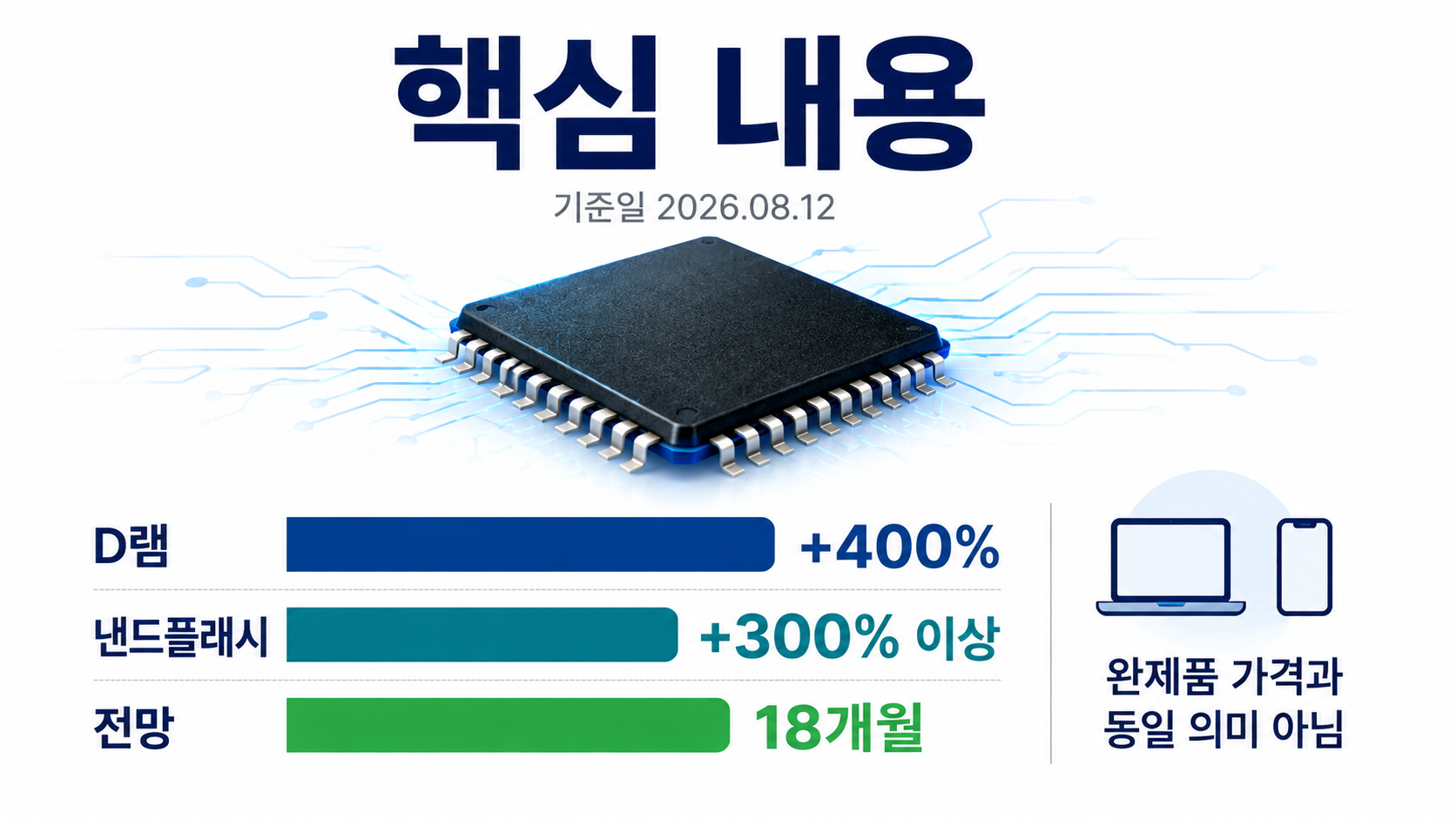
The central issue is that the memory market's supply shortage is unlikely to end quickly. AI servers are rapidly absorbing high-bandwidth memory (HBM), server DRAM, and enterprise SSDs, pushing memory for conventional PCs and smartphones further down the supply priority list.
Conversely, the trends for DRAM and NAND may diverge as the market moves into 2027. DRAM shortages are more likely to persist, while expanding NAND production has raised the possibility that supply and demand could begin easing from the second half of 2027.
What Exactly Do the 400% Rise in DRAM and 300% Rise in NAND Mean?
The first distinction to understand is that average selling prices for memory and fixed contract prices for specific memory specifications are different statistics. The recent 400% and 300% figures represent changes in average selling prices, or ASPs, over the past 12 months, calculated using memory price tracking data.
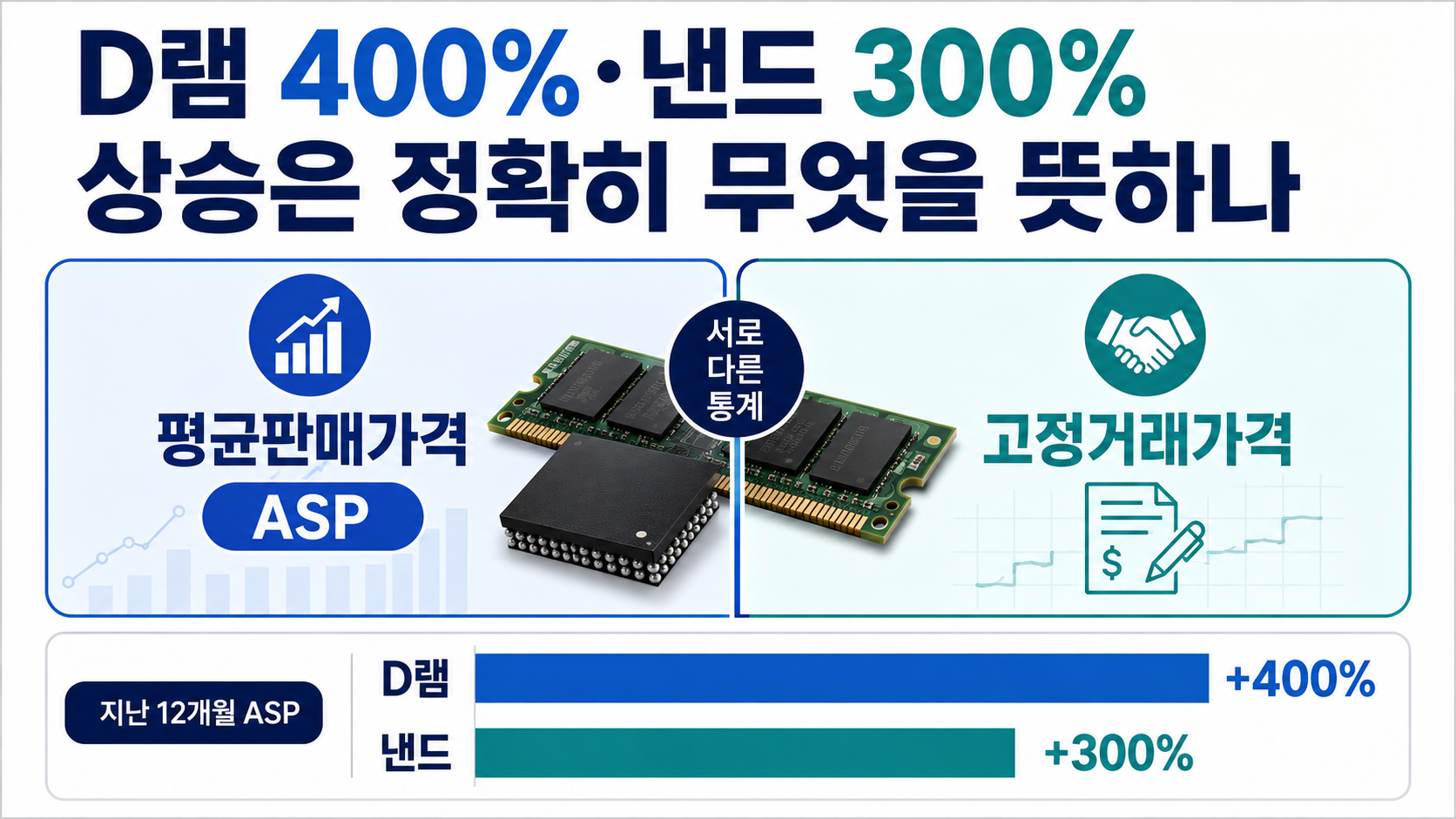
A '400% increase' does not mean the price became 400% of its original level.
Author's calculation
If the starting price is 100, a 400% increase means 100 + 400 = 500.
Therefore, a 400% increase in DRAM means the price reached approximately 5 times its original level.
If NAND rose by 300%, the price would move from 100 to 400, or approximately 4 times its original level. An increase of 'more than 300%' would be higher still.
However, when examining specific products, such as DDR4 for PCs or MLC NAND for memory cards, the increases can be substantially larger.
The monthly average fixed contract price for mainstream PC DDR4 8Gb products was USD 3.90 in July 2025, while 128Gb MLC NAND was USD 3.39. By July 2026, these had climbed to USD 24 and approximately USD 30.1, respectively.
| Category | July 2025 | July 2026 | Author's calculation |
|---|---|---|---|
| PC DDR4 8Gb | USD 3.90 | USD 24 | Approximately 6.15 times, +515% |
| 128Gb MLC NAND | USD 3.39 | Approximately USD 30.1 | Approximately 8.88 times, +788% |
| Memory price tracker ASP | Across the entire product category | 12-month comparison | DRAM +400%, NAND more than +300% |
The figures differ not because one set is incorrect, but because the products surveyed, customer groups, contract structures, and averaging methods are different.
Therefore, the statement that 'DRAM rose by 400%' should not be applied equally to all DDR4, DDR5, LPDDR, and server DRAM products.
Why Has RAM for Ordinary PCs Become More Expensive as AI Server Demand Grows?
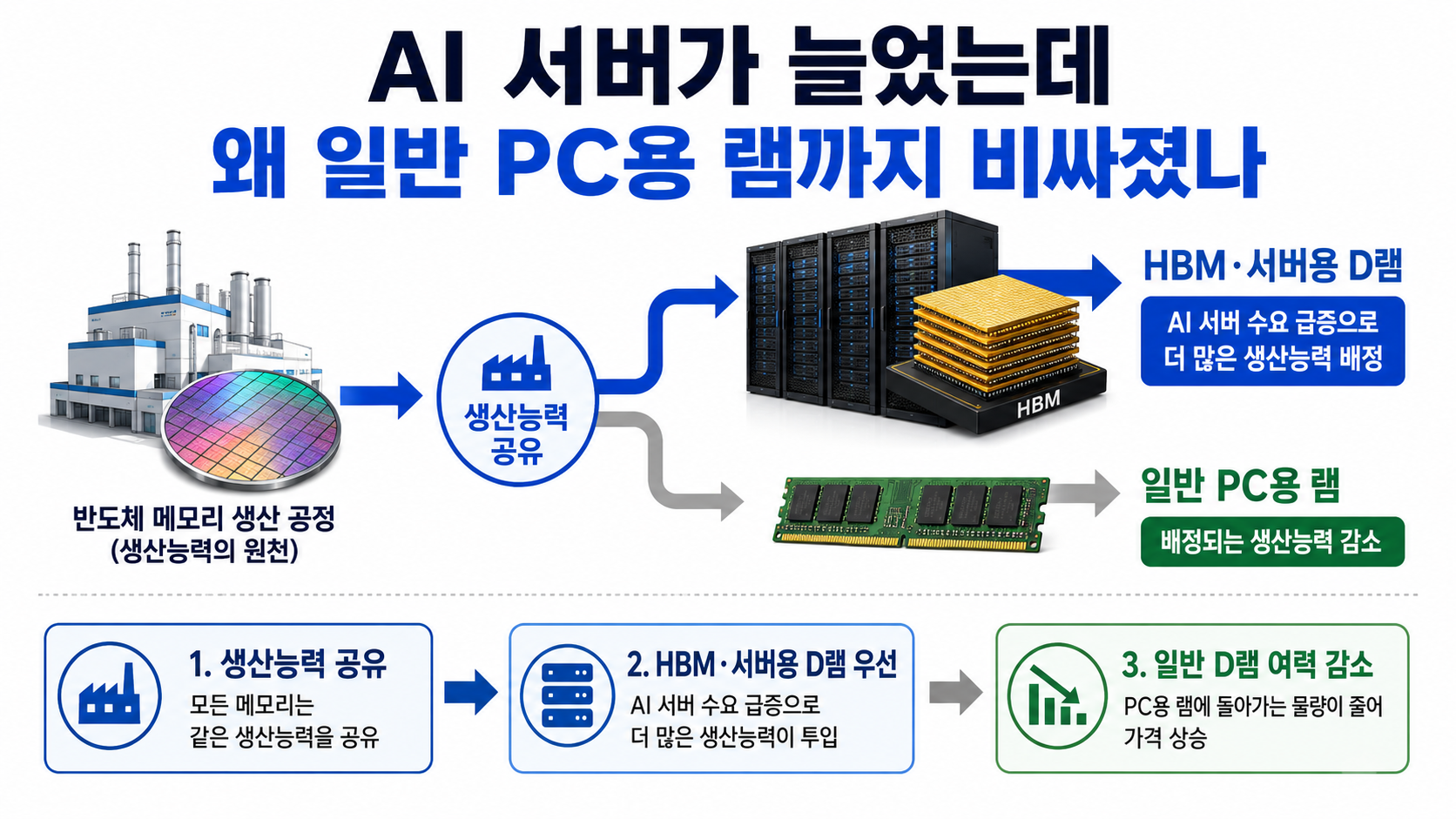
Memory used in AI servers is not exactly the same product as RAM in a home PC, but the two markets are connected because they share production capacity. When memory manufacturers allocate more production capacity to highly profitable, high-demand HBM and high-capacity server DRAM, relatively less capacity remains available for conventional DRAM.
HBM, in particular, has a more complex manufacturing process than conventional DRAM and requires greater wafer input. Expanding manufacturing facilities does not immediately increase the amount of saleable memory capacity by the same proportion. TrendForce expects a substantial portion of the meaningful supply contribution from new DRAM production facilities to emerge in 2028.
Meanwhile, major cloud providers are securing their required memory supplies in advance through long-term contracts. A supply priority structure is also emerging in which data centers and automotive applications take precedence over PCs and smartphones.
As a result, two developments are occurring simultaneously in the consumer market.
AI servers are consuming more memory, increasing demand, while manufacturers are prioritizing production capacity for higher-value products, further tightening the supply of mainstream memory.
The assumption that older DDR4 must always be cheaper than newer DDR5 may also break down. If production of older products declines rapidly, inventory shortages can drive their prices up more sharply, even though the technology is older.
Does the 18-Month Outlook Mean Memory Prices Will Keep Rising?
The '18-month outlook' should not be interpreted as a definitive prediction that DRAM and NAND prices will rise every month for the next 18 months. The central point of recent forecasts is that component cost pressures and supply constraints may not ease significantly for at least approximately 18 months.
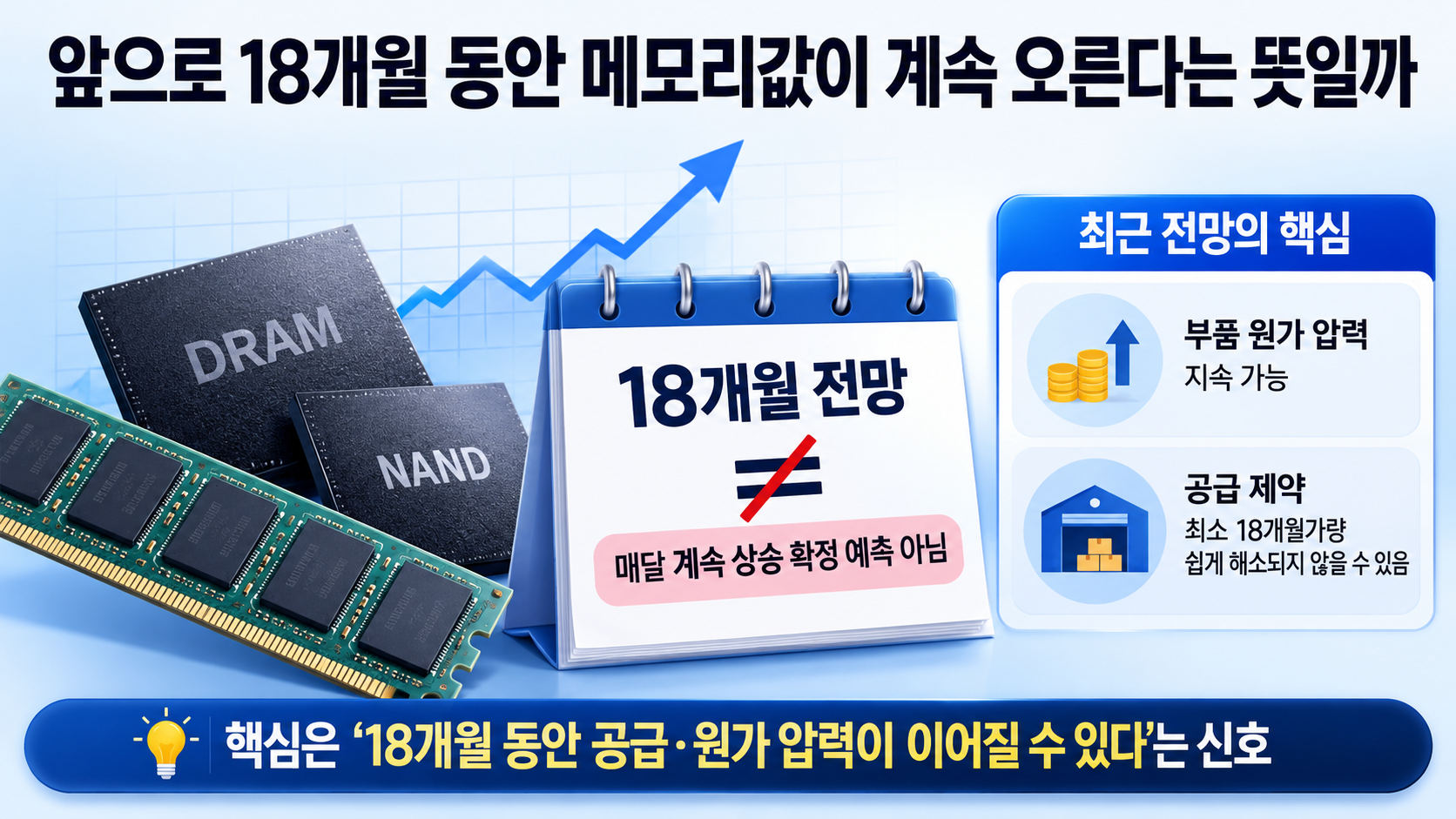
There are already periods in which the pace of price increases is slowing.
DRAM and NAND contract prices surged dramatically in the 2 quarter of 2026, but forecasts for the 3 quarter have moderated. TrendForce projected quarter-over-quarter contract price increases of 13~18% for conventional DRAM and 10~15% for NAND in the 3 quarter. In other words, prices may continue rising, but the rate of increase is expected to be lower than in the preceding quarter.
The more important distinction concerns 2027.
For DRAM, AI server and HBM demand may remain stronger than supply growth, creating the possibility that shortages will continue into 2027. Even when new factories begin operating, equipment installation and yield stabilization take time.
The outlook for NAND is somewhat different. Although a supply shortage of approximately 4~5% is expected in 2026, continued capacity expansion has led to projections that supply could begin exceeding demand in the second half of 2027.
Therefore, rather than saying 'memory prices will keep rising for another 18 months,' it is more accurate to understand that memory cost pressures are unlikely to normalize quickly, DRAM prices are likely to remain relatively strong through 2027, and NAND market conditions may ease sooner.
If Memory Prices Have Increased 4~5 Times, Why Haven't PC and Smartphone Prices Risen 4~5 Times?
Memory is only one of the many components that make up a finished device. Smartphones contain application processors, displays, cameras, batteries, and various communications components, while laptops also require CPUs, GPUs, display panels, motherboards, batteries, and other parts.
Therefore, a 400% increase in DRAM prices should not be used to calculate an equivalent 400% increase in smartphone retail prices.
However, the growing share of total manufacturing costs attributable to memory cannot be ignored. Analysis of the 2 quarter of 2026 found that memory accounted for approximately 40% of total component costs in some midrange smartphones. There were also cases in which rising memory prices pushed total component costs for entry-level devices approximately 70% higher than a year earlier.
Manufacturers have only a few ways to respond.
They can raise retail prices, adjust standard storage and RAM configurations, reduce spending on other components such as cameras and displays, or accept lower profit margins.
Consequently, even when products face the same memory price shock, their actual retail price increases can differ.
Recent component cost estimates for the iPhone 18 series illustrate this point. Analyses suggested that component costs for the highest-end model could rise by approximately USD 300 compared with the previous generation, while some 256GB and 512GB models could see increases of approximately 200~USD 250. However, whether manufacturers pass these additional costs directly on to consumers depends on their pricing policies.
Which Will Be Affected Most Directly: SSDs, RAM, Smartphones, or Laptops?
RAM and SSDs purchased as individual components are the most directly exposed to changes in memory market conditions. By contrast, smartphone and finished-PC manufacturers can use long-term contracts, existing inventories, savings on other components, and margin adjustments, so the timing and extent of price increases may differ.
Memory specifications also matter. Products such as DDR4, whose production share is being reduced by major manufacturers, may continue commanding high prices because of supply shortages even if the broader DRAM market stabilizes.
SSD prices are more directly linked to NAND prices, but NAND itself includes many different types. TLC and QLC, commonly used in consumer SSDs, do not necessarily follow the same price trends as SLC and MLC used in industrial and networking applications.
Indeed, in July 2026, the monthly price increase for SLC products, which were facing particularly severe shortages, reached 35~51%, while MLC products rose by approximately 4~8%. This illustrates substantial differences even within the NAND category.
Therefore, the fact that 'NAND prices are rising' does not mean every SSD will become more expensive at the same time or by the same percentage.
Finished-device prices may also respond with a delay because manufacturers must work through existing inventories before higher memory contract prices are reflected in new production costs.
Is It Better to Buy RAM, SSDs, or a PC in Advance Right Now?
A forecast suggesting that prices could rise further is not, by itself, a reason to buy products you do not need. However, if you must replace a PC or upgrade RAM or SSD capacity within 1~3 months, this is also a difficult market in which to postpone a purchase solely on the expectation that memory prices will fall substantially after a few months.
What matters most now is the actual price of the product you intend to buy, rather than the average increase across the memory market.
Even for RAM with the same 32GB capacity, DDR4 and DDR5 may follow different price trends. Likewise, prices for 2TB SSDs can vary significantly depending on TLC or QLC configurations, controllers, and manufacturers' inventory conditions.
The following purchasing sequence is practical.
1. First, determine when you actually need to replace your current PC or smartphone.
2. Compare recent prices for products with the same specifications to identify any short-term price spikes.
3. If you use an older DDR4 platform, also compare the total cost of moving to a newer DDR5 system.
4. For SSDs, check the NAND type and product warranty terms rather than looking only at capacity.
5. If a new product launch is approaching, compare potential inventory discounts on previous-generation products as well as memory prices.
The second half of 2027 could become an important turning point. NAND price pressures may ease sooner as supply expands, while DRAM shortages could persist longer if AI server demand and the allocation of production capacity to HBM remain strong.
The indicators to monitor go beyond whether 'memory prices have risen.' Quarterly DRAM and NAND contract prices, the actual start of mass production at new facilities, AI server investment growth rates, smartphone and PC shipments, and the share of HBM in memory manufacturers' production should all be considered to identify market turning points sooner.
The current situation can be summarized in one statement.
The 400% rise in DRAM and the increase of more than 300% in NAND reflect a genuine, observed surge in memory prices. However, not all memory products have risen equally, nor do these figures mean prices will keep increasing at the same pace over the next 18 months. DRAM supply pressures are likely to persist into 2027, while NAND conditions may begin easing in the second half of that year, making it important to assess the two markets separately.
---