

How to Calculate CAN SLIM Position Size: How Many Shares Should You Buy Based on Your Actual Fill Price and Stop-Loss Price?

In CAN SLIM investing, position size should be calculated from the maximum loss your account can bear and the difference between your actual purchase price and stop-loss price—not from how much you want to invest. The key formula is `매수 가능 주식 수 = 1회 허용 손실액 ÷ (실제 매수가 - 손절가)`. However, if the calculated number of shares exceeds the amount you can invest or your per-stock investment limit, you should buy fewer shares.
Why You Should Calculate Based on the Actual Purchase Price
CAN SLIM’s stop-loss guideline and position-size calculation are two separate steps. The stop-loss guideline sets how far the price can fall before you consider your purchase decision mistaken. Position size calculates how much your account would lose if that loss occurs.
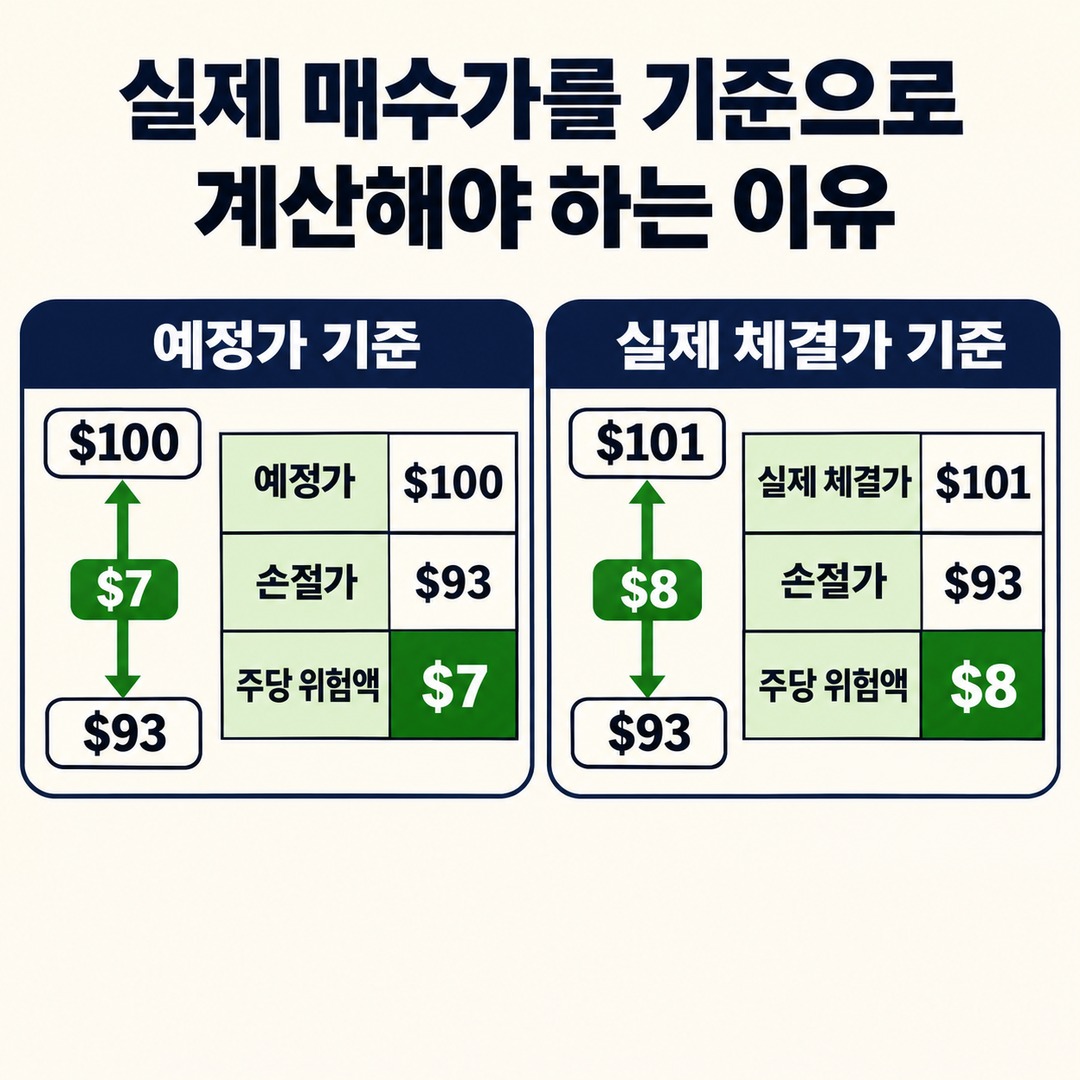
In its CAN SLIM investing education, the U.S. publication Investor's Business Daily (IBD) discusses a loss-management principle of 7~8% relative to the purchase price. To apply this guideline to your actual fill price, recalculate using the execution details rather than the price you had in mind when placing the order.
For example, if the planned purchase price was USD 100 but the actual average fill price was USD 101, then with a stop-loss price of USD 93, the risk per share is USD 8, not USD 7.
Therefore, the number of shares you buy also changes.
There Is One Formula for Determining Position Size
Calculate the number of shares in these two steps.
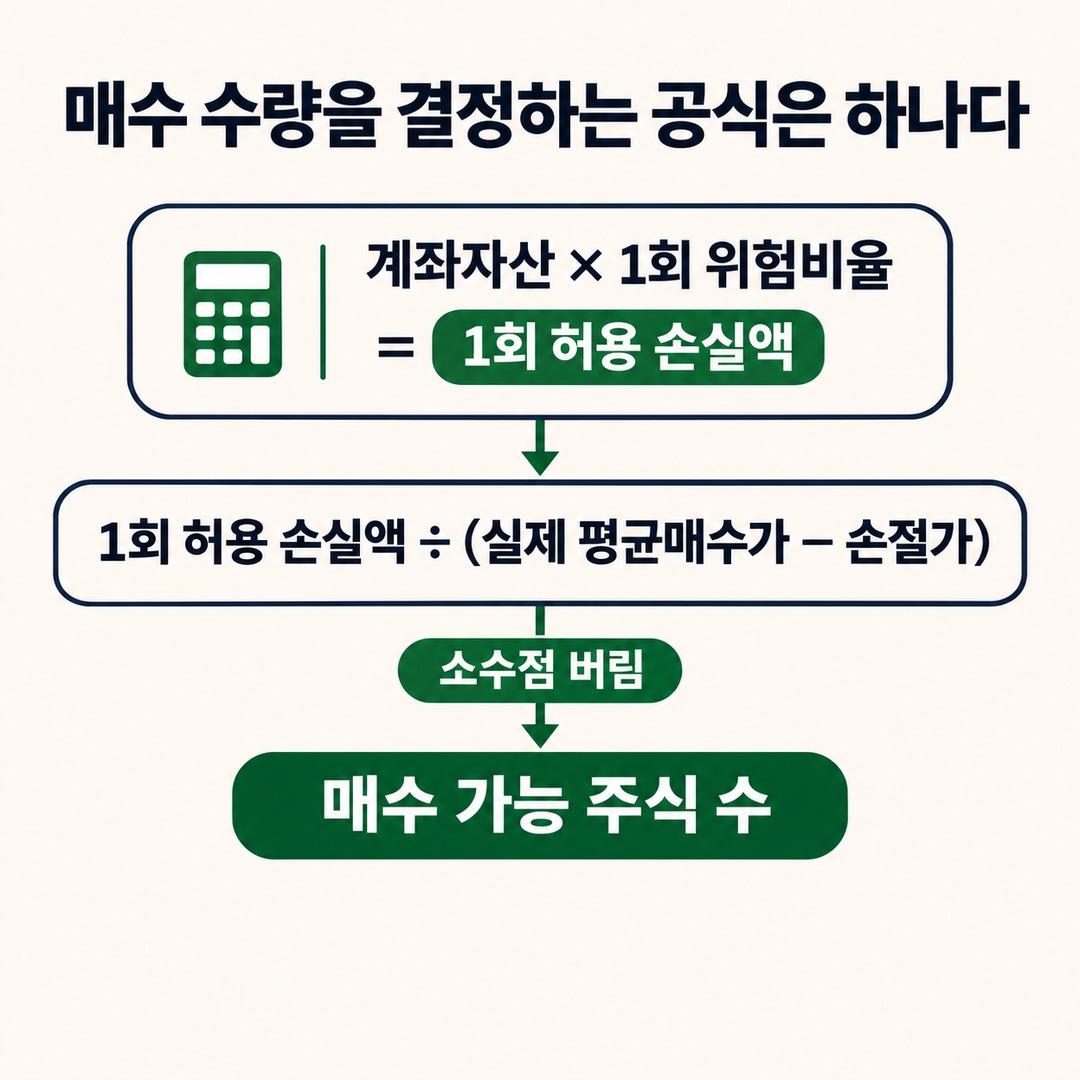
① 1 per-trade allowable loss
Account assets × 1 risk percentage② Shares you can buy
1 per-trade allowable lossActual average purchase price − stop-loss priceRound the result down to a whole number of shares.
This calculation method can also be seen in the Van Tharp Institute position sizing calculator. It calculates risk and the number of shares to buy based on inputs for account size, risk percentage per trade, entry price, and stop-loss price. Van Tharp Institute position sizing calculator
The most important principle is that the number of shares to buy decreases as the stop distance widens.
If you buy the same number of shares despite a wider stop distance, your account’s actual risk of loss increases.
Hypothetical Example: How Many Shares Can You Actually Buy in a KRW 20,000,000 Account?
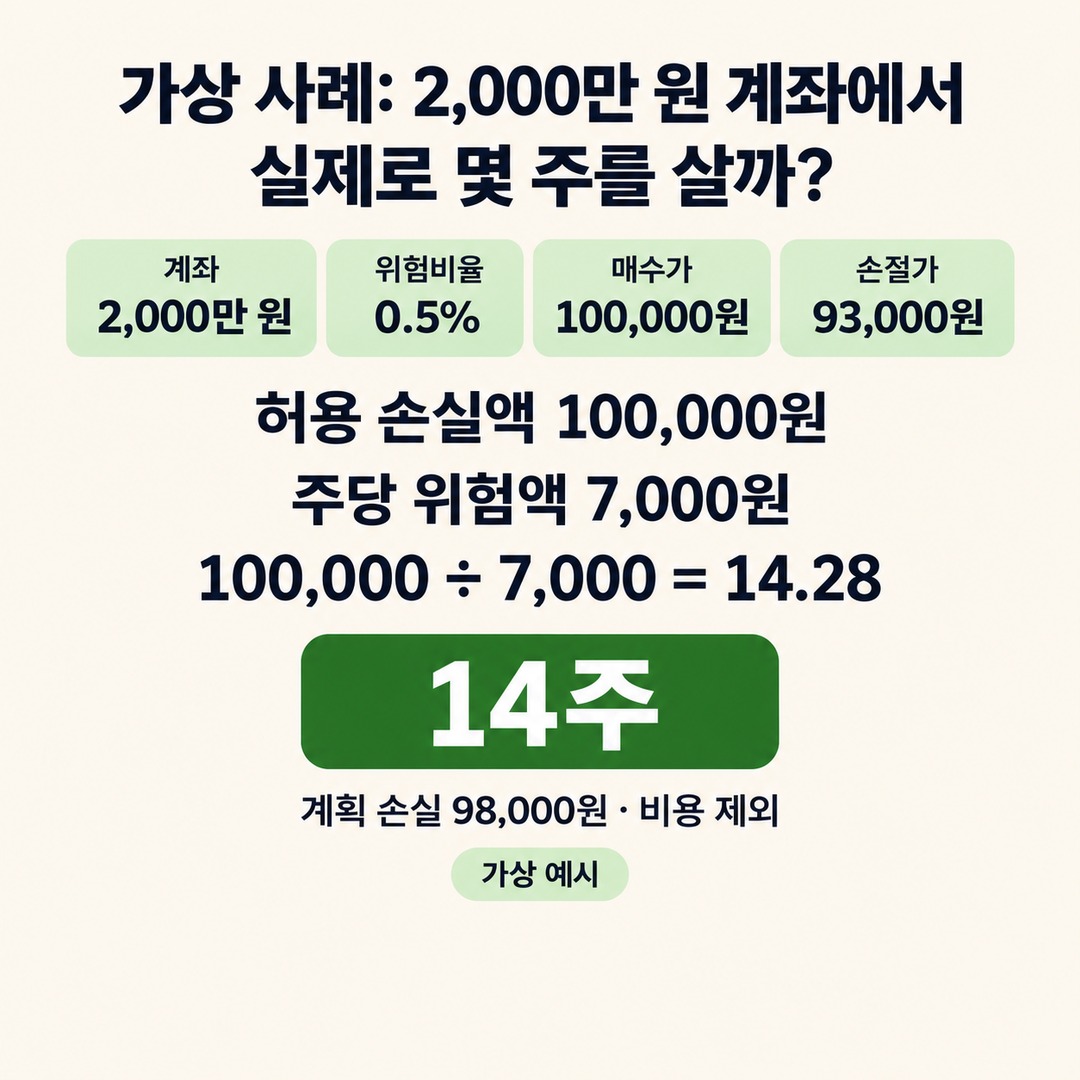
The following is a hypothetical example to explain the calculation. It does not represent an actual stock or investment performance.
Account and Trade Conditions
Account assets
KRW 20,000,000
1 risk percentage per trade
0.5%
Actual average purchase price
KRW 100,000
Stop-loss price
KRW 93,000
1 per-trade allowable loss
KRW 100,000
Risk per share
KRW 7,000
100,000÷(100,000−93,000)=14.28 calculation result# 14 shares
Purchase amount KRW 1,400,000 · Planned loss if stop-loss is triggered KRW 98,000 (excluding costs)
Here is the calculation step by step.
Account assets: KRW 20,000,000
Allowable loss: 20,000,000 × 0.005 = KRW 100,000
Risk per share: 100,000 - 93,000 = KRW 7,000
Calculated quantity: 100,000 ÷ 7,000 = 14.28 shares
Actual calculated purchase quantity: 14 shares
If you buy 14 shares, the loss would be KRW 98,000, assuming all shares are sold at the stop-loss price of KRW 93,000.
In other words, it does not exceed the allowable loss of KRW 100,000.
The Quantity Changes Even if the Actual Fill Price Changes by Only KRW 1,000
Keep the same account and stop-loss price, and change only the actual purchase price.
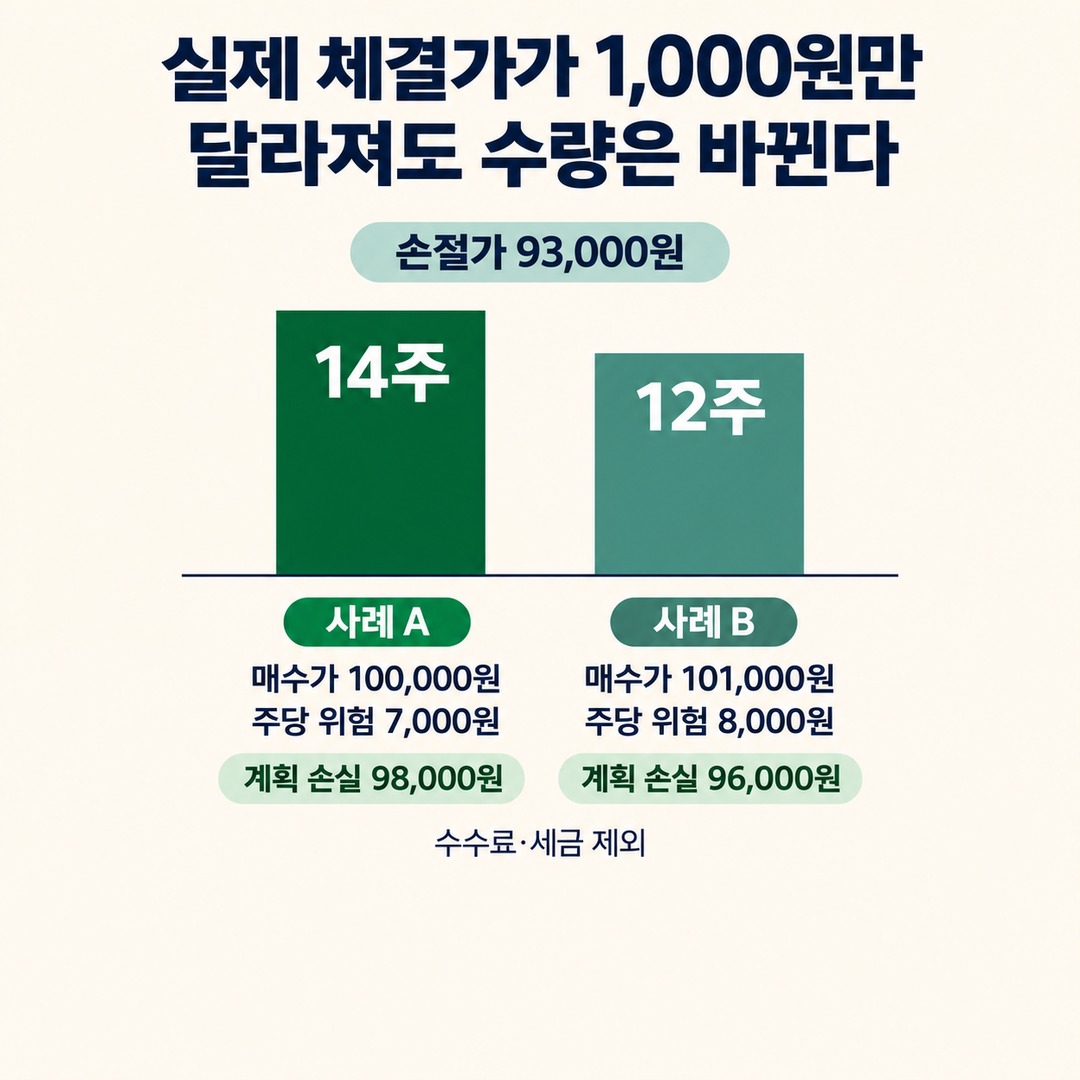
| Category | Example A | Example B |
|---|---|---|
| Actual purchase price | KRW 100,000 | KRW 101,000 |
| Stop-loss price | KRW 93,000 | KRW 93,000 |
| Risk per share | KRW 7,000 | KRW 8,000 |
| Calculated quantity | 14.28 shares | 12.5 shares |
| Final purchase quantity | 14 shares | 12 shares |
| Planned loss | KRW 98,000 | KRW 96,000 |
Author's calculation · Excludes commissions and taxes
Although the actual purchase price rose by 1%, the risk per share increased from KRW 7,000 to KRW 8,000.
As a result, the purchase quantity decreases from 14 shares to 12 shares.
This is why CAN SLIM position size should be recalculated based on the actual fill price.
Confusing the planned purchase price with the actual fill price can cause you to exceed the loss limit you initially set.
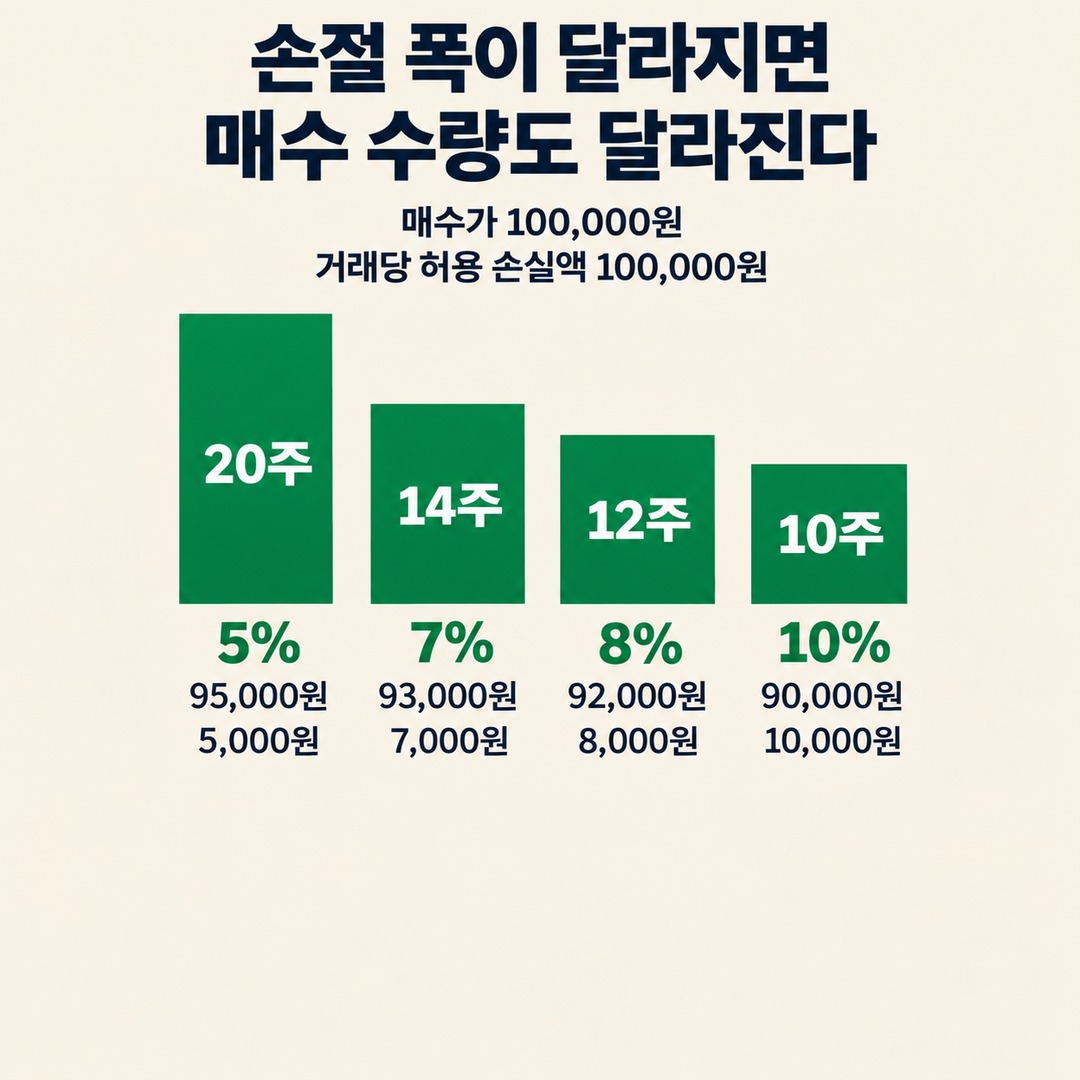
A Change in Stop Distance Also Changes the Number of Shares
Keeping the purchase price at KRW 100,000 and changing only the stop-loss price gives the following results.
| Stop distance | Stop-loss price | Risk per share | Purchase quantity |
|---|---|---|---|
| 5% | KRW 95,000 | KRW 5,000 | 20 shares |
| 7% | KRW 93,000 | KRW 7,000 | 14 shares |
| 8% | KRW 92,000 | KRW 8,000 | 12 shares |
| 10% | KRW 90,000 | KRW 10,000 | 10 shares |
Author's calculation, assuming an account of KRW 20,000,000 and a per-trade risk amount of KRW 100,000
When the stop distance doubles from 5% to 10%, the purchase quantity is halved, from 20 shares to 10 shares.
One thing to keep in mind is that you should not arbitrarily raise the stop-loss price just to narrow the stop distance.
First determine the price at which the chart-based rationale for buying is invalidated, then calculate the position size from the difference between that price and the actual purchase price.
What If Your Order Was Filled at Multiple Prices?
If a single order was filled across multiple prices, use the average fill price.
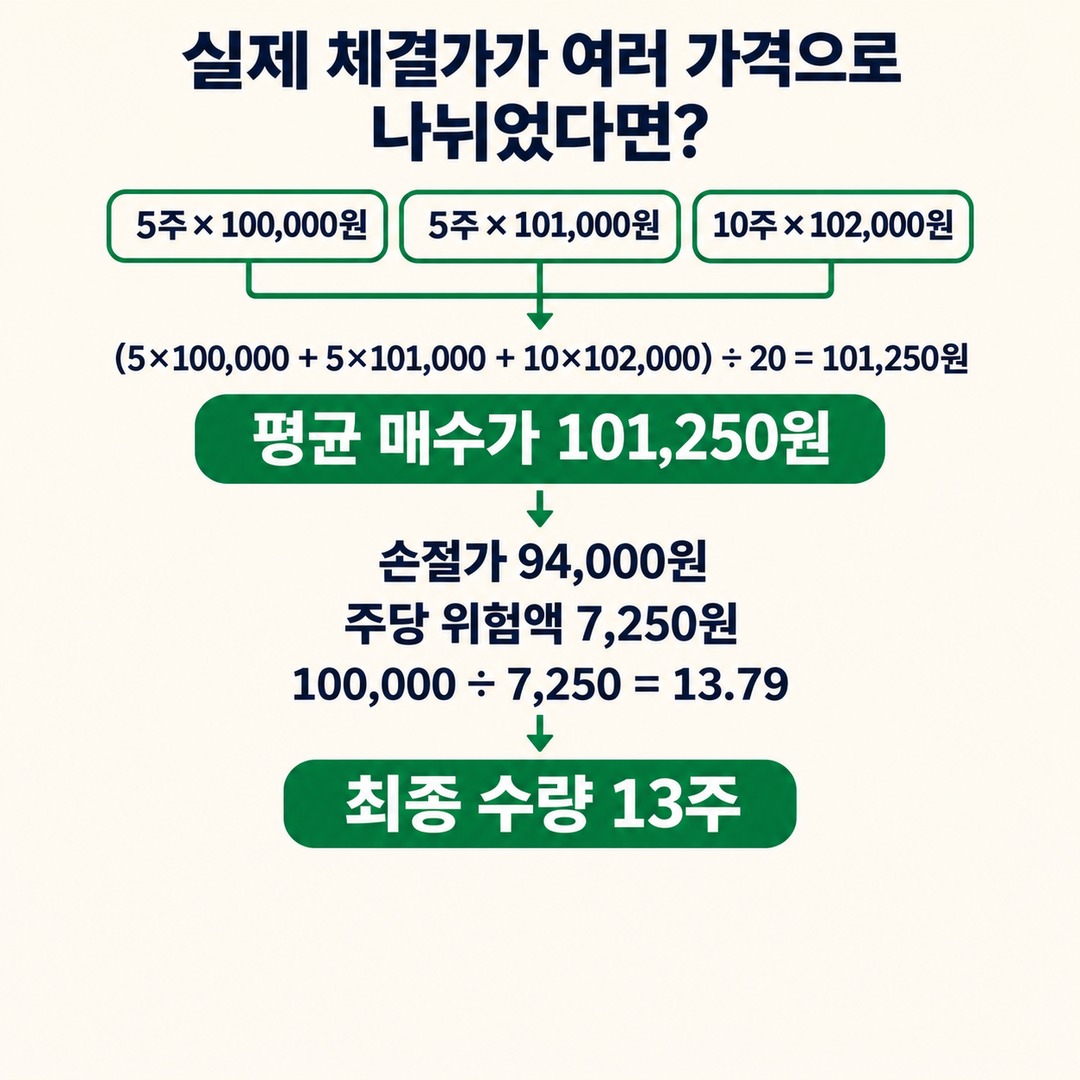
For example, suppose the order was filled as follows.
| Filled quantity | Fill price |
|---|---|
| 5 shares | KRW 100,000 |
| 5 shares | KRW 101,000 |
| 10 shares | KRW 102,000 |
The weighted average purchase price is calculated as follows.
(5×100,000)+(5×101,000)+(10×102,000)20=KRW 101,250 Therefore, the actual average purchase price is KRW 101,250.
If the stop-loss price is KRW 94,000, the risk per share is KRW 7,250.
Applying the allowable loss amount set earlier, KRW 100,000, gives the following.
100,000÷7,250=13.79 The final calculated quantity is 13 shares.
The calculation may differ if you use only the initial order price without checking the actual execution details.
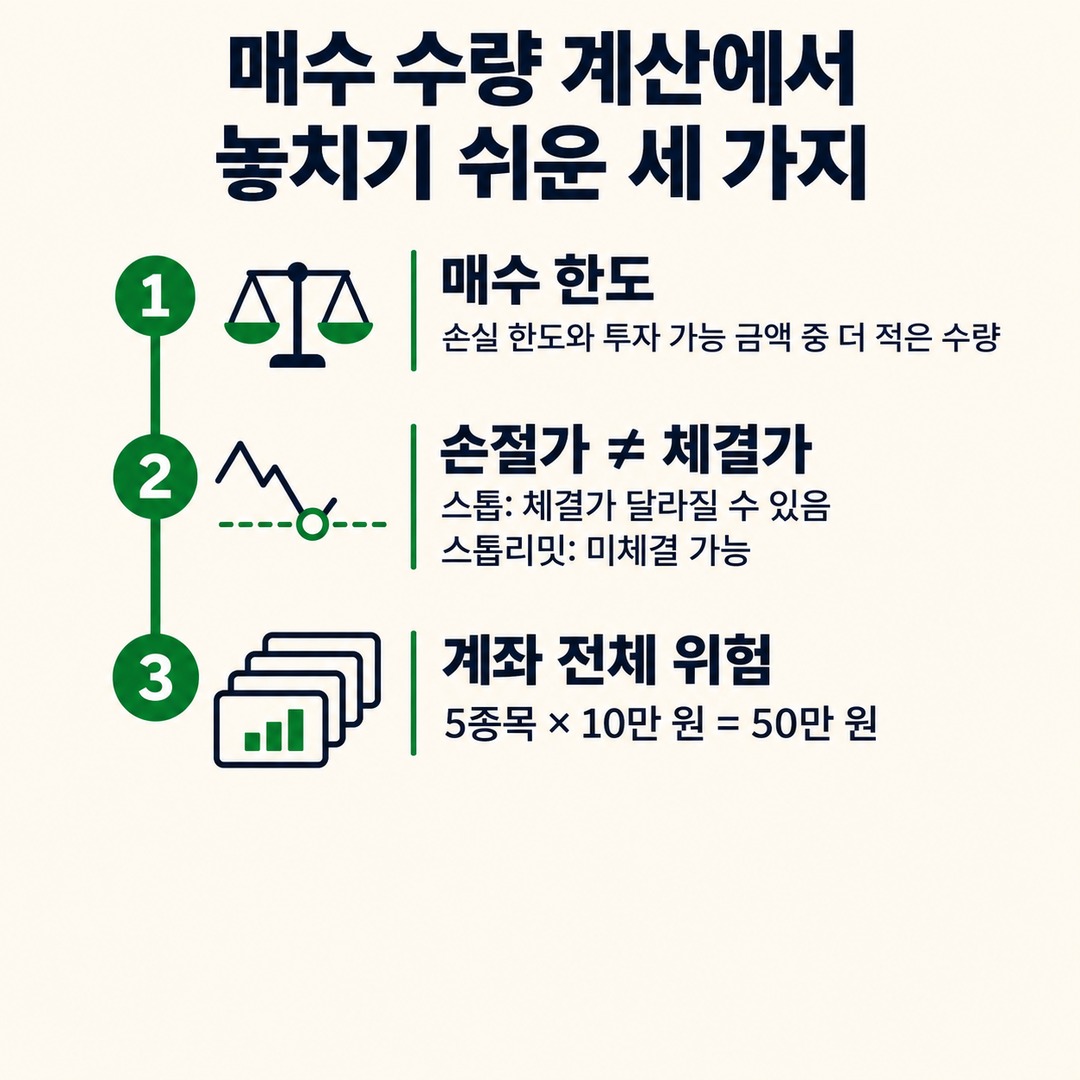
Three Things That Are Easy to Overlook When Calculating Position Size
1. The amount you can invest may be less than the calculated quantity would require.
Even if you can buy 100 shares based on the risk amount, you cannot actually buy them if your account does not have enough cash.
Therefore, you need to check both of the following conditions.
The number of shares you can buy based on your loss limit
The number of shares you can buy based on your account cash and per-stock investment limit
The final purchase quantity is the smaller of the two.
2. A stop-loss price does not guarantee the actual sale price.
In its updated guidance on order types, 2026-08-18, the U.S. Securities and Exchange Commission's Investor.gov explains that when a stop order is triggered, it becomes a market order, and the actual execution price may differ from the specified stop price.
During a sharp price drop or when liquidity is low, the actual loss may exceed the expected loss.
A stop-limit order, on the other hand, can limit execution at a price worse than the specified limit, but if prices move sharply, the sell order may not execute at all.
3. Add up the risk across multiple stocks.
Even if you are willing to risk only KRW 100,000 on one stock, holding several stocks at the same time increases the risk to your account as a whole.
For example, if a loss limit of KRW 100,000 is applied to each of 5 stocks, the total planned loss limit across the individual trades is KRW 500,000.
Therefore, before buying a new stock, also check the stop-loss levels and remaining risk for your existing holdings.
Steps to Take Before Buying
Calculate CAN SLIM position size in the following order.
1. Check the current value of your account assets.
2. Set the maximum loss you are willing to accept on a single trade.
3. Set the stop-loss price based on the chart and your trading rationale.
4. Check the actual average fill price.
5. Subtract the stop-loss price from the actual purchase price to find the risk per share.
6. Divide the allowable loss by the risk per share.
7. Round down to a whole number of shares, then check your available investment amount and overall portfolio risk.
If you add to your position after the purchase, increasing the number of shares held or changing the average purchase price, recalculate the expected loss if the stop-loss is triggered.
Conclusion: Finding a Good Stock and Buying the Right Quantity Are Separate Things
In CAN SLIM, stock selection is the process of finding buying opportunities, while position sizing limits the losses your account would bear if one of those opportunities fails.
There are three key points.
Use the actual average fill price, not the planned purchase price.
Set the stop-loss price first, then calculate the risk per share.
Round down the number of shares so the allowable loss is not exceeded.
Even when using the 7~8% stop-loss guideline, you do not need to invest the same amount in every stock. The number of shares should vary with the stop distance.
Ultimately, position size should be determined by the risk your account can bear, not by how confident you are in a stock.
What price did I actually pay, at what price will I exit, and how much would my account lose as a result of that difference?
Calculating these three things first is the starting point for consistent CAN SLIM money management.
※ This article is for informational purposes to help readers understand market trends. It is not a recommendation to invest in any particular stock or asset. You are responsible for your final decisions and investments.