

August 20 Showers in Southern Gyeonggi, Chungcheong and Southern Regions, Followed by Renewed Heat Waves and Tropical Nights
이 포스팅은 쿠팡 파트너스 활동의 일환으로, 이에 따른 일정액의 수수료를 제공받습니다.
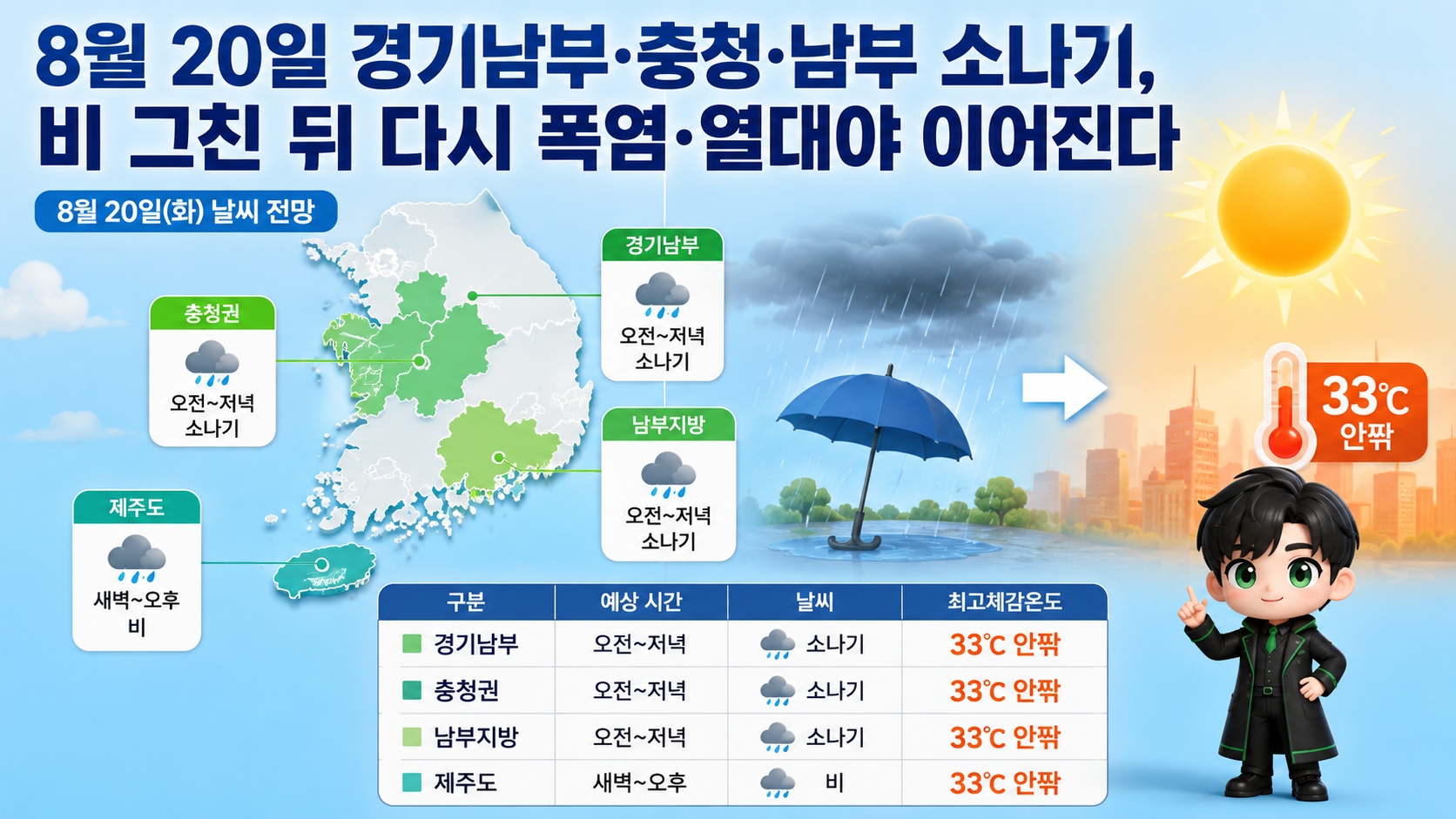
Showers are not expected across the entire country on August 20. Showers are forecast in southern Gyeonggi Province, the Chungcheong region and southern regions from morning through evening, while parts of Jeju Island may receive rain from early morning through the afternoon. Temperatures may temporarily fall while it rains, but the maximum feels-like temperature could rise again to around 33°C across most of the country, making precautions against extreme heat and tropical nights necessary.
This information was verified as of 2026-08-20 at 1:6 a.m. Korea Standard Time, using the short-range forecast issued at August 19 17 and the weather commentary and advisory information issued at 22:10. Because the location and intensity of showers can change within a short period, checking local weather radar and the latest short-range forecast immediately before going out is recommended.
Where and When Will Showers Occur on August 20?
The main areas expected to receive showers on 20 are southern Gyeonggi Province, the Chungcheong region and southern regions. According to the Korea Meteorological Administration's short-range forecast, scattered showers are expected in these areas between 9 a.m. and 9 p.m. Jeju Island may receive rain from early morning through the afternoon, separately from the showers forecast elsewhere.
From early morning through the morning hours, isolated raindrops amounting to less than 0.1 mm may also fall in the Seoul metropolitan area, southern inland and mountainous areas of Gangwon Province, the Chungcheong region, North Jeolla Province and the Gyeongsang region. Seoul and most of Gangwon Province are not among the main areas expected to receive daytime showers on 20, but skies may remain mostly cloudy, with considerable differences in weather between locations.
Expected precipitation varies significantly by region.
Southern Gyeonggi Province: 5–40 mm
Daejeon, Sejong and South Chungcheong Province: 5–50 mm
North Chungcheong Province: 5–40 mm
North Jeolla Province, Gwangju and South Jeolla Province: 5–60 mm
Daegu, North Gyeongsang Province, Busan, Ulsan and South Gyeongsang Province: 5–60 mm
Jeju Island, from rainfall: 10–40 mm
Even within the same city or county, one neighborhood may receive almost no rain while another nearby area experiences a sudden, heavy shower. Rather than deciding that an umbrella is unnecessary based solely on the day's total expected rainfall, it is safer to check radar conditions for the actual time you plan to travel.
Why Will It Become Hot Again Despite the Showers?
Temperatures may temporarily decline in areas receiving rain or showers on 20. However, once the rain stops, temperatures may rise again while humidity remains high, rapidly increasing the perceived heat. Heat wave advisories and warnings may also be expanded.
The Korea Meteorological Administration expects maximum feels-like temperatures to reach around 33°C across most of the country for the time being. The feels-like temperature is not simply the air temperature; it also accounts for humidity to indicate how hot conditions actually feel to people. On humid days, the perceived heat can be more intense even when the air temperature is not significantly higher than the previous day.
The morning low on 20 is forecast at 21–26°C, with the daytime high reaching 28–33°C. Compared with seasonal averages of 20–24°C for minimum temperatures and 27–32°C for maximum temperatures, these readings are similar to or slightly above normal. Although the figures alone may not appear to indicate the extreme heat of midsummer, outdoor activities during the day could become considerably more demanding in areas where high humidity pushes maximum feels-like temperatures to around 33°C.
In particular, places directly exposed to sunlight and heat radiating from the ground, such as outdoor workplaces, rice paddies, fields and roads, may feel hotter than the environments where official weather observation equipment is installed. Anyone planning prolonged travel or outdoor work during the day should check feels-like temperatures and heat impact forecasts rather than relying solely on the forecast maximum air temperature.
Tropical Night Advisories Have Also Been Issued in Some Areas
Daytime heat is not the only concern. Some areas are expected to experience tropical nights, when the overnight minimum temperature remains at or above 25°C, as temperatures fail to cool sufficiently overnight.
As of August 19, tropical night advisories have been issued for parts of Busan, Ulsan, parts of South Gyeongsang Province, parts of Pohang, Uljin and Gyeongju, and parts of Jeju Island. Existing tropical night advisories also remain in effect for areas including Gunsan, Tongyeong, Heuksando and Hongdo. Advisory areas may be added or removed as temperatures change, so anyone returning home late at night or planning nighttime outdoor activities should check the latest advisories.
A tropical night does not simply mean that temperatures briefly exceed 25°C during the night. Under the Korea Meteorological Administration's definition, a tropical night occurs when the lowest temperature recorded between 6:1 p.m. and 9 a.m. the following day is at least 25°C. The criteria for issuing a tropical night advisory are administered separately from the definition of the tropical night phenomenon itself.
When temperatures do not cool sufficiently overnight and maximum feels-like temperatures climb back to around 33°C the following day, the body has less time to recover from heat exposure. In areas that experienced particularly hot nights, it is important to adjust midday activity levels the following day and drink water frequently.
Areas Requiring Extra Caution During Sudden Showers
Showers on 20 may be accompanied by gusty winds, thunder and lightning. When rainfall intensifies, visibility can deteriorate and roads can become slippery within a short period. Drivers are advised to increase their following distance and reduce speed.
Areas along the southern coast that have recently experienced heavy rainfall require particular attention. Authorities have warned of the risk of landslides, soil runoff and structural collapse where additional showers fall on already weakened ground. Anyone passing near hillsides, steep slopes or retaining walls should avoid underestimating the danger simply because a shower is expected to be brief.
Fog, as well as rain, may affect conditions from early morning through the morning hours. Fog reducing visibility to less than 1 km is expected in some areas, particularly southwestern Gyeonggi Province, the Jeolla region, inland North Gyeongsang Province and western inland South Gyeongsang Province. Fog may become denser than in surrounding areas on roads near rivers, lakes and valleys, as well as on coastal bridges.
Commuters driving during the morning rush hour should check visibility ahead rather than assuming that conditions are clear simply because it is not raining.
Additional Rain Expected in Central Regions on 21
The possibility of precipitation will not end after the showers on 20. From early morning on 21, rain is expected in parts of the Seoul metropolitan area, inland and mountainous Gangwon Province, and northern Chungcheong. Further showers are forecast from afternoon through evening in southeastern inland South Chungcheong Province, the Jeolla region and inland North Gyeongsang Province. Parts of Jeju Island may also experience showers from morning through midday.
Expected rainfall on 21 is 5–40 mm in Seoul, Incheon and Gyeonggi Province; 20–60 mm on the 5 islands of the West Sea; 5–30 mm in inland and mountainous Gangwon Province; 5–40 mm in northern South Chungcheong Province; and 5–30 mm in northern North Chungcheong Province. Showers of 5–40 mm are expected in each of the following areas: southeastern inland South Chungcheong Province, the Jeolla region, Daegu, inland North Gyeongsang Province and Jeju Island.
Temperatures on 21 are also forecast to range from 20–25°C in the morning to 27–33°C during the day, making it difficult to expect an immediate shift to cooler weather after the rain passes. With hot daytime conditions and warm nights likely to continue for the time being, checking the forecast daily is recommended.
What Should You Check Before Going Out on 20?
Rather than simply bringing an umbrella, it is a day to prepare for both showers and extreme heat. People in southern Gyeonggi Province, the Chungcheong region and southern regions should first check whether their travel plans between morning and evening overlap with the forecast shower periods. On Jeju Island, attention should be paid to the rain forecast from early morning through the afternoon.
It is also advisable not to reduce preparations for cooling or hydration on the assumption that temperatures will remain lower after the showers. Hot conditions may return once the rain stops, accompanied by high humidity.
For anyone planning outdoor activities or work, checking radar again immediately before departure is more practical than relying solely on a forecast reviewed earlier in the morning. Showers can be brief and intense over small areas, meaning their actual location and timing may differ even within the regions covered by the forecast.
이 포스팅은 쿠팡 파트너스 활동의 일환으로, 이에 따른 일정액의 수수료를 제공받습니다.