

2027 Unemployment Benefit Reform: Will the New Payment Method Apply to Current Recipients?

As of 2026-10-05, no definitive rules have been established for applying the 2027 unemployment benefit reform to people already receiving benefits. The government's proposal to change job-seeking benefit payments from 7 days per week to 6 days per week still requires subsequent amendments to laws and subordinate regulations. The eligibility rules and transitional provisions for existing recipients cannot yet be determined from the information publicly available.

Therefore, receiving unemployment benefits now does not necessarily mean that the monthly payment method will automatically change in 2027.
What Will Change Under the Proposal to Switch from 7 Days to 6 Days of Payment per Week?
Under the employment insurance reform proposal released by the government on 2026-09-01, unpaid holidays would be excluded from job-seeking benefit payments, changing the current payment system from 7 days per week to 6 days per week.
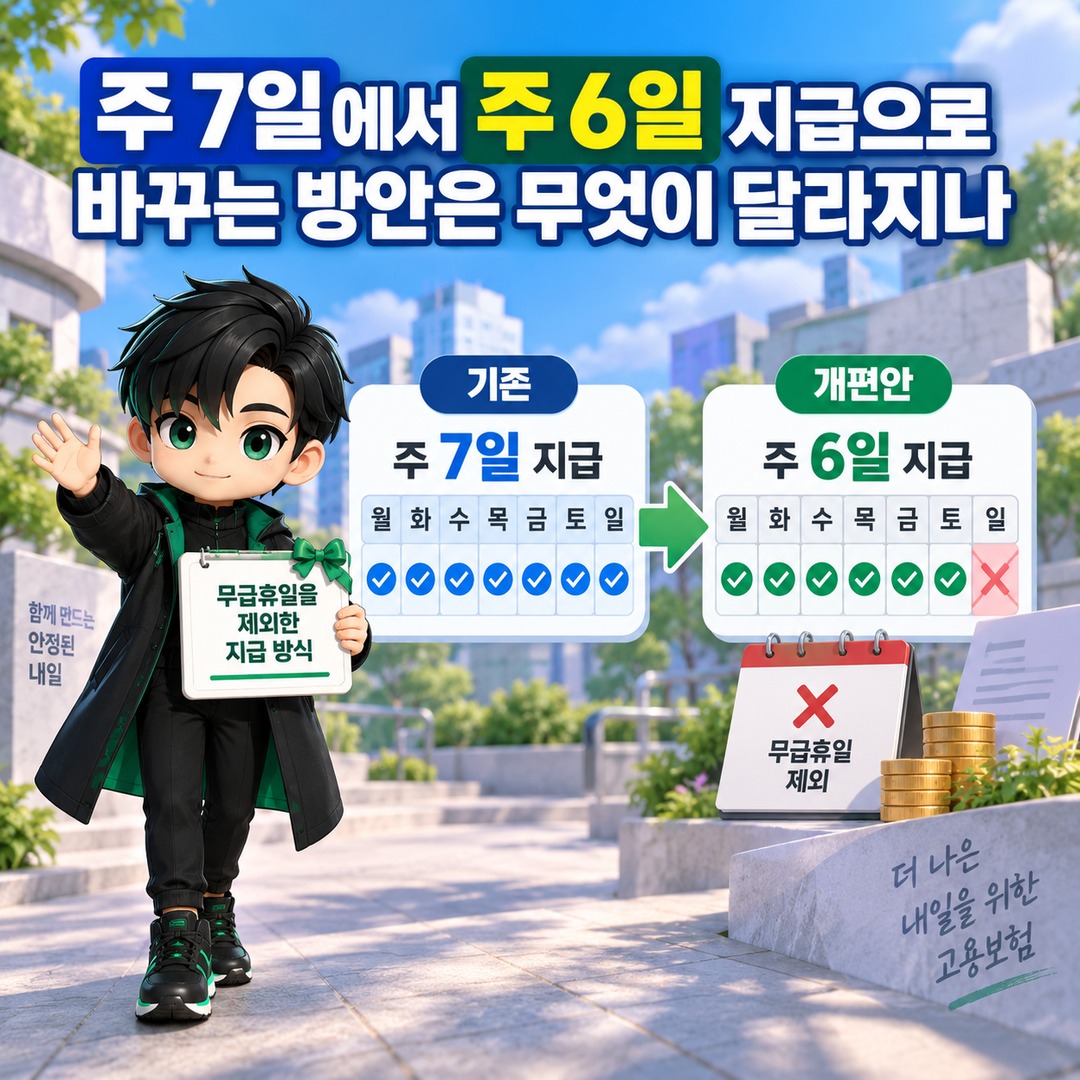
Importantly, the proposal is not intended to reduce total job-seeking benefits alongside the reduction in weekly payment days.
The government's announced framework is as follows.
Job-seeking benefit payment method: 7 days per week → 6 days per week
Total benefit entitlement days: Remain at 120~270 days
Total benefit amount: Unchanged
Method for determining the maximum benefit amount: Proposal to link it to 103% of the minimum benefit amount
Income threshold for exclusion from early reemployment allowance payments: Proposal to adjust the threshold from monthly income of KRW 5,740,000 or more to KRW 3,000,000 or more
In other words, the 6-day weekly payment system would change how job-seeking benefits are calculated and paid each week. According to the government's announcement, it is not structured to reduce the prescribed benefit entitlement period or the total amount paid.
Why Has It Not Yet Been Determined Whether the Reform Will Apply to Existing Unemployment Benefit Recipients?

Whether the new rules will apply to existing recipients depends on the effective date and transitional provisions of the final amended legislation.
In its announcement on 2026-09-01, the Ministry of Employment and Labor stated that it would pursue follow-up measures needed to adjust the job-seeking benefit payment system. It also said it would support the legislative process in the National Assembly and proceed with amendments to subordinate regulations, aiming to complete the necessary legal and regulatory revisions within the year.
Although the announcement establishes the policy direction of changing payments from 7 days per week to 6 days per week, it does not specify transitional rules for people whose benefit eligibility was recognized in 2026 and who will continue receiving job-seeking benefits into 2027.
Therefore, as of 2026-10-05, the distinction should be made as follows.
What has been confirmed: The government has announced a reform proposal to switch to 6 payment days per week while maintaining the total benefit amount and total number of benefit entitlement days.
What still needs to be confirmed: The final effective date, how people who left their jobs before the effective date will be treated, how people whose benefit eligibility was recognized before the effective date will be treated, and how people already receiving job-seeking benefits when the new rules take effect will be treated.

Leaving Your Job in 2026 Does Not Yet Guarantee That the Previous Rules Will Apply
It is still too early to determine which rules will apply based solely on the date someone leaves their job.
The final legislation could use the date of separation from employment as the determining factor, or it could use the date on which benefit eligibility is recognized or another criterion. The applicable standard can only be confirmed after the amended law and its supplementary provisions are released.
For people already receiving job-seeking benefits, the most important provisions to examine first are the application clauses and transitional measures in the supplementary provisions, rather than the main text of the law.
For example, even if the law changes, existing recipients may be unaffected by the new rules if the supplementary provisions specify that the previous regulations continue to apply to benefit eligibility established or employment separations occurring before the effective date. Conversely, the outcome could differ if separate application criteria are introduced.
At present, these details have not been finalized.
Employment Insurance Changes Taking Effect in 2027 Must Be Distinguished from This Unemployment Benefit Payment Reform
This is a particularly easy point to confuse when searching for information.
The Employment Insurance Act promulgated on 2026-03-17 already specifies that certain provisions will take effect from 2027-01-01. Separately, other amendments concerning the calculation of job-seeking benefits will take effect from 2028-01-01. In that case, the law explicitly includes a transitional provision requiring the previous regulations to be applied when calculating job-seeking benefits for workers who left their jobs before 2028-01-01.
However, those provisions are not the same amendments as the proposal announced on September 2026 to change payments from 7 days per week to 6 days per week.
Therefore, the transitional provisions of the already promulgated Employment Insurance Act should not simply be applied to conclude that the 2027 reform introducing 6 payment days per week will also not apply to existing recipients.
What Should You Check If You Are Already Receiving Unemployment Benefits?
If your job-seeking benefit entitlement period extends into 2027, it is more accurate to wait for the final amendments than to calculate your benefits on the assumption that your payments will change immediately.
The verification process is straightforward.
1. Whether the Employment Insurance Act has been amended to introduce 6 payment days per week
2. The effective date of the final promulgated legislation
3. The application clauses and transitional provisions in the supplementary provisions
4. The rules applicable to people who left their jobs before the effective date
5. The rules applicable to people already receiving job-seeking benefits when the amendments take effect
6. Actual implementation guidance from the Ministry of Employment and Labor and Employment 24
In particular, do not assume that your benefit amount will change simply because an explanation says the reform will take effect from 2027. The effective date of a law and the reference date used to determine whether it applies to an individual may differ.
What Can Be Confirmed Now?
As of 2026-10-05, it cannot be stated definitively that the 2027 unemployment benefit payment reform will also apply to existing recipients who are currently receiving job-seeking benefits.
The government has announced a proposal to change payments from 7 days per week to 6 days per week while maintaining the total benefit amount and total number of benefit entitlement days. However, the necessary amendments to the relevant laws and subordinate regulations are still being pursued.
If you are already receiving unemployment benefits or left your job in 2026 and expect to continue receiving benefits into 2027, you will need to check not only the effective date but also the transitional provisions for existing recipients in the supplementary provisions once the final legislation is promulgated to determine whether the new rules apply to you.
※ This article is provided for reference to help readers understand market trends and does not constitute an investment recommendation for any particular stock or asset. Final investment decisions and responsibility rest with the individual.