

2026 Childcare Service Support for Dual-Income Households: Eligibility Up to 250% of Median Income and Actual Out-of-Pocket Costs
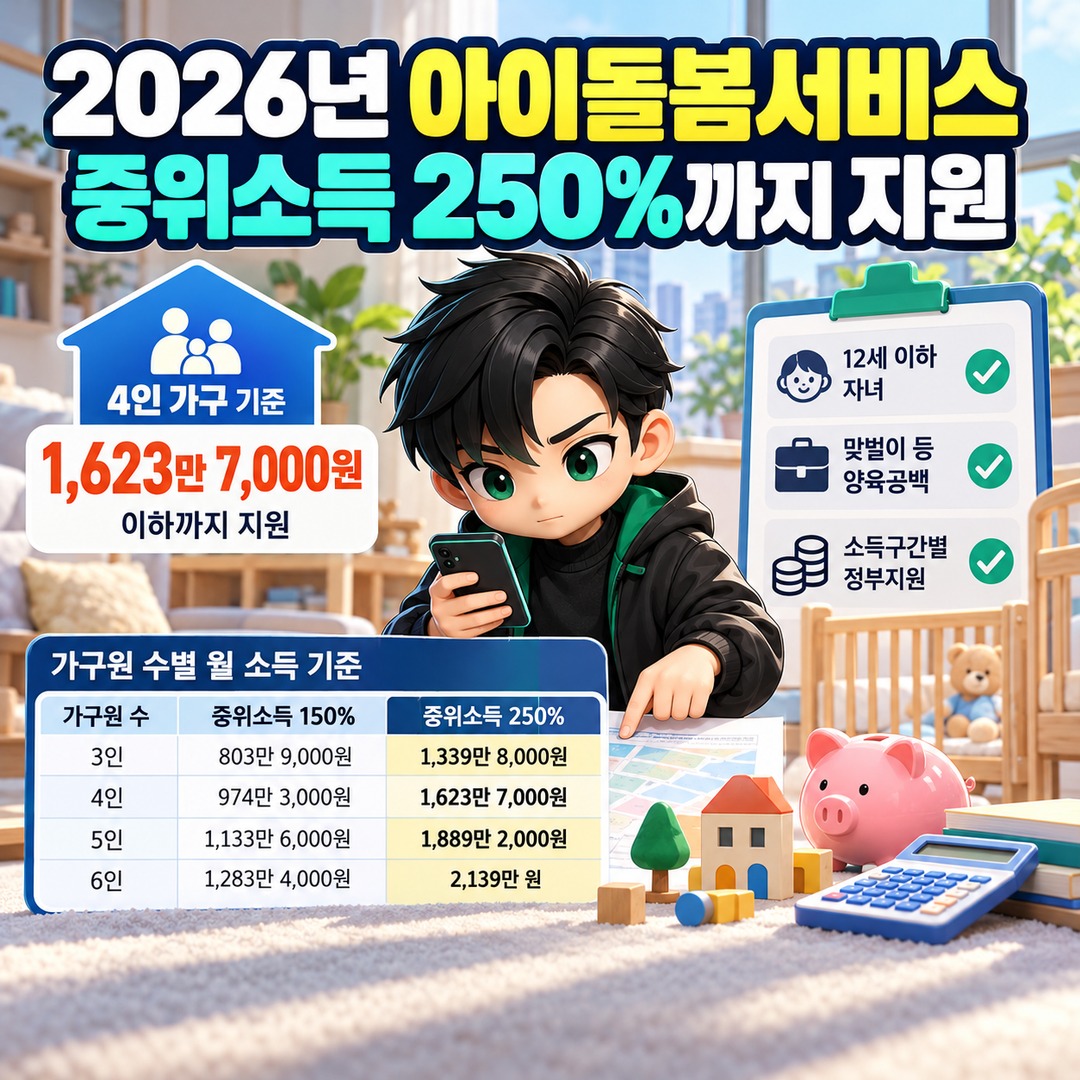
In 2026, dual-income households may qualify for government subsidies for childcare services if their income is at or below 250% of the standard median income. Eligibility has been expanded to households with 4 members whose assessed monthly income is KRW 16,237,000 or less. However, households must also meet requirements concerning the child's age and the need for childcare due to gaps in parental care. The actual subsidy varies by income bracket.
As of 2026-10-29, we examine the eligibility requirements and costs based on the Ministry of Gender Equality and Family's announcement expanding support and the amounts published by the government's Easy-to-Find Practical Law service.
What Is the Maximum Income for Dual-Income Households to Qualify in 2026?
In 2026, the income ceiling for government-supported childcare services is 250% of the standard median income. The eligibility threshold has been raised from 200% in 2025, bringing some households that were previously excluded because of their income into the support program.
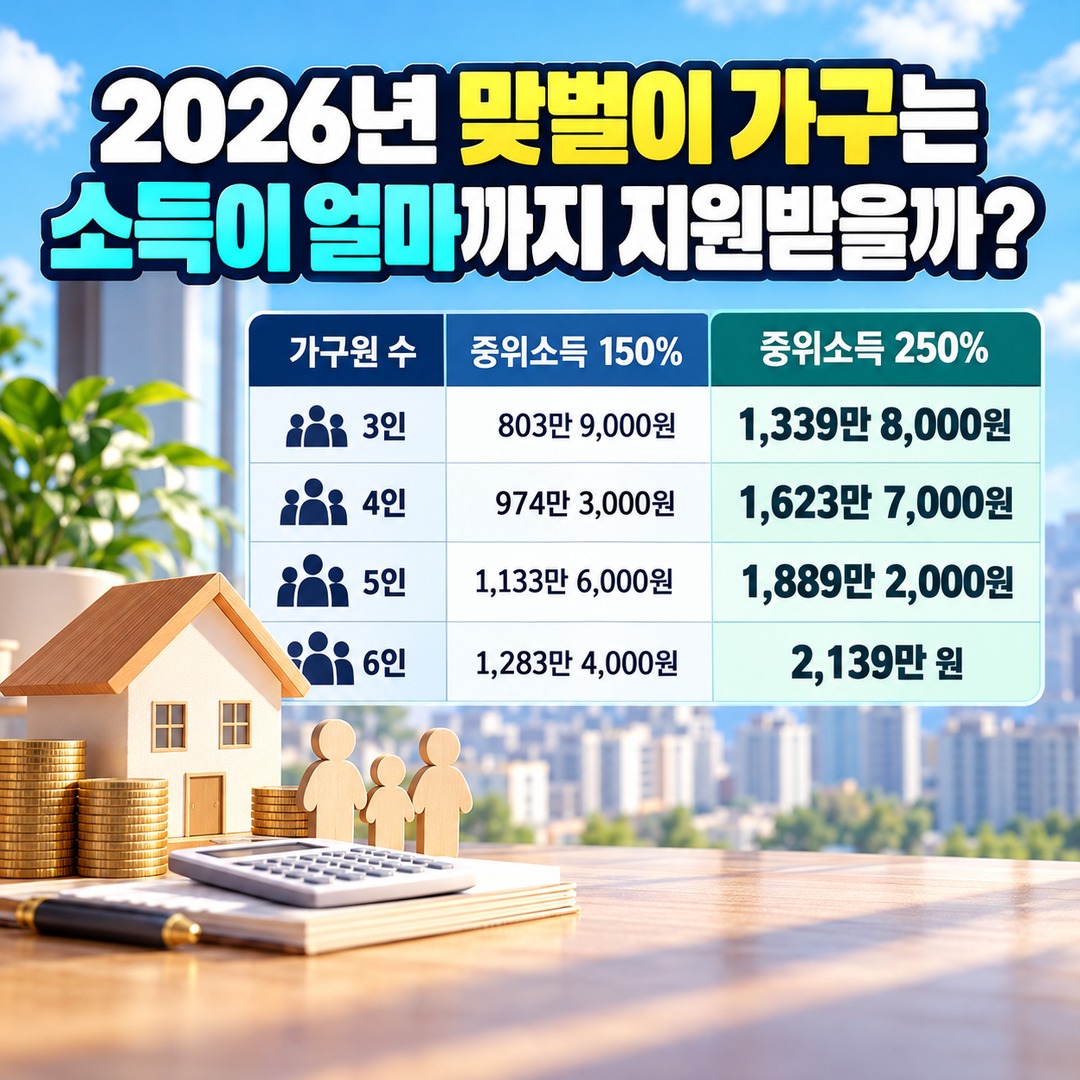
According to the childcare service support expansion announcement issued by the Ministry of Gender Equality and Family on 2026-01-16, government subsidy rates vary by income bracket.
The monthly household income thresholds for 2026, broken down by household size, are as follows.
| Household Size | 150% of Median Income | 250% of Median Income |
|---|---|---|
| 3 people | KRW 8,039,000 | KRW 13,398,000 |
| 4 people | KRW 9,743,000 | KRW 16,237,000 |
| 5 people | KRW 11,336,000 | KRW 18,892,000 |
| 6 people | KRW 12,834,000 | KRW 21,390,000 |
In this table, 250% represents the maximum income threshold for receiving government support. Having an income at or below 250% does not mean that every household receives the same subsidy amount.
In particular, dual-income households are subject to a provision that allows a deduction of 25% from the couple's combined income when determining income eligibility.
For example, assuming a couple has a combined monthly income of KRW 10,000,000, applying the 25% deduction produces a calculated income of KRW 7,500,000.
However, this is a hypothetical example intended only to illustrate the calculation method. The actual subsidy category is determined by the relevant administrative authority based on factors such as the household's share of health insurance premiums, household size, and whether it is officially recognized as a dual-income household.
Why Might a Household Be Ineligible Even If Its Income Is Below 250% of Median Income?
Meeting the income requirement does not automatically guarantee government support. The childcare service program is designed to assist households experiencing gaps in childcare because of circumstances such as parental employment.
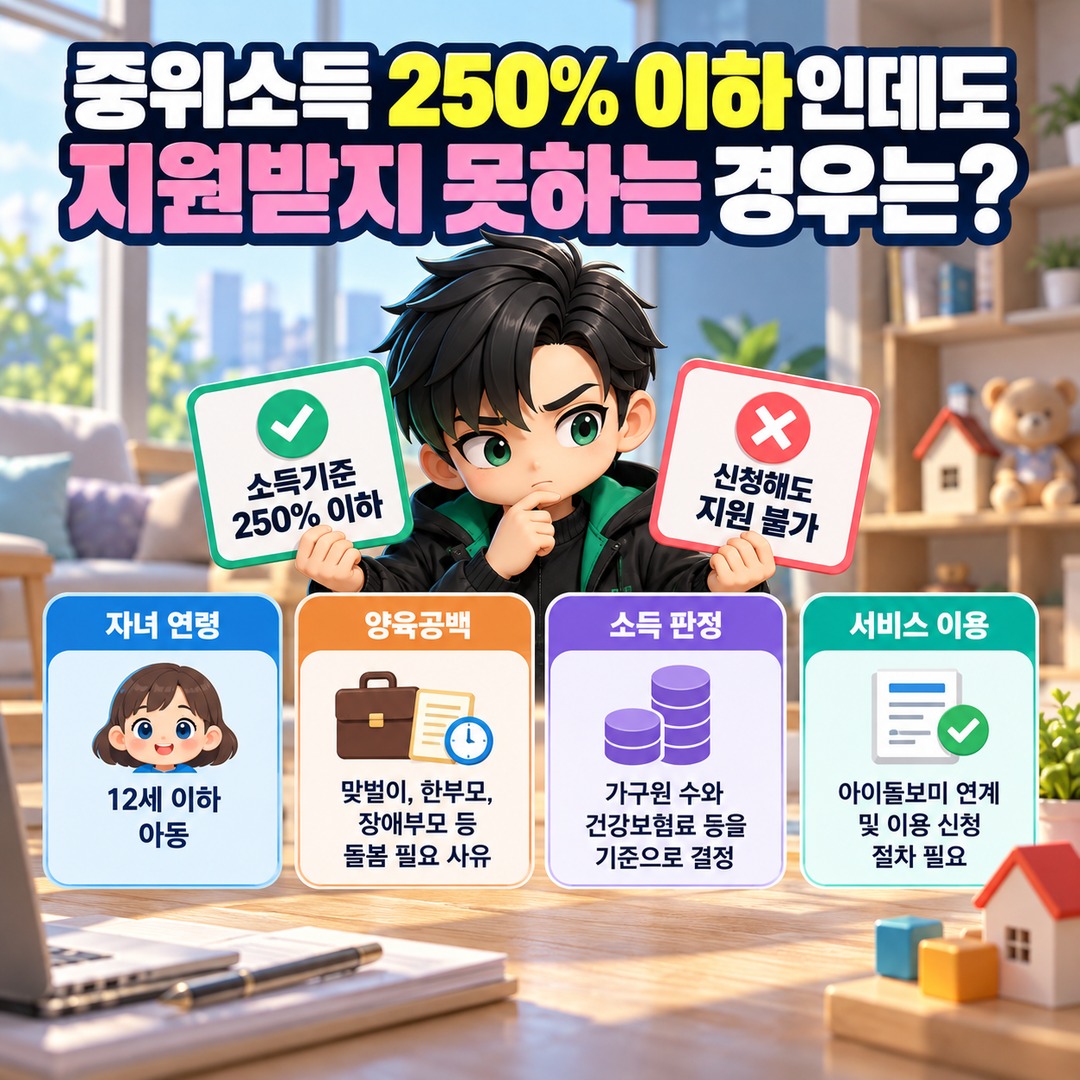
The main eligibility requirements to check are as follows.
Child's age: Hourly childcare services are available for children aged 12 or younger.
Childcare gap: The household must have a government-recognized reason for needing childcare, such as both parents working, being a single-parent household, or having a parent with a disability.
Income assessment: The government subsidy category is determined using factors such as household size and health insurance premiums.
Service use: Even after government subsidy eligibility is determined, families must separately complete the application process and arrange to be matched with a childcare provider.
Documents verifying employment status may be required when determining whether a household qualifies as dual-income. Applicants should confirm which documents they need to submit during the application process, as requirements may differ depending on whether they are salaried employees, self-employed, or in other employment circumstances.
Households that exceed the income threshold or do not meet the childcare-gap requirements may still use the service by paying the full cost without government subsidies.
How Much Do Families Pay Per Hour for Basic Hourly Childcare Services?
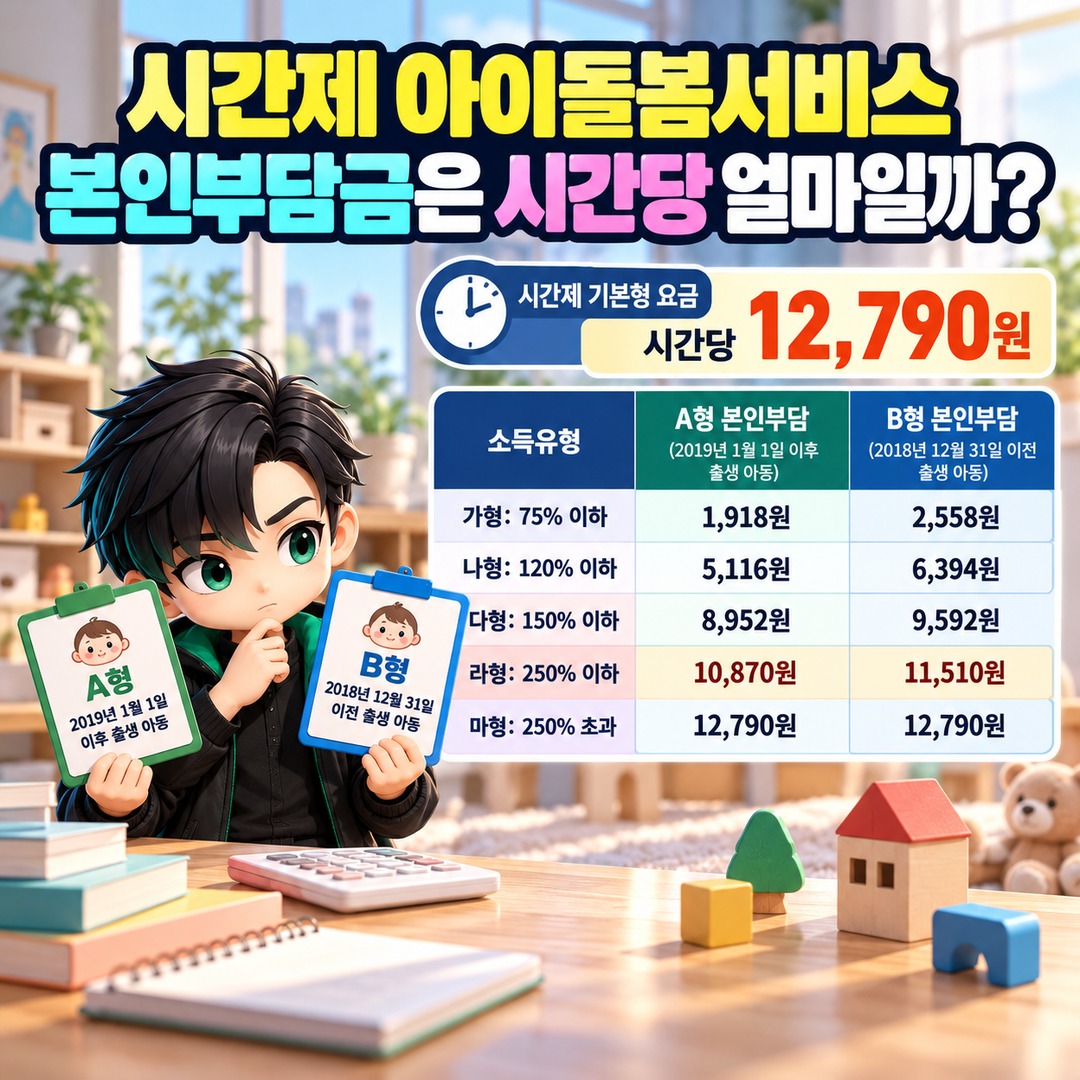
In 2026, the basic hourly childcare service costs KRW 12,790 per hour. Government subsidies are applied at different rates depending on the household's income category and the child's date of birth.
According to the government's published childcare subsidy information, the hourly out-of-pocket costs are as follows.
| Income Category | Type A Out-of-Pocket Cost | Type B Out-of-Pocket Cost |
|---|---|---|
| Category A: 75% or below | KRW 1,918 | KRW 2,558 |
| Category B: 120% or below | KRW 5,116 | KRW 6,394 |
| Category C: 150% or below | KRW 8,952 | KRW 9,592 |
| Category D: 250% or below | KRW 10,870 | KRW 11,510 |
| Category E: Above 250% | KRW 12,790 | KRW 12,790 |
Type A refers to children born after 2019-01-01, while Type B refers to children born before 2018-12-31.
The amounts in the table apply to basic hourly childcare services and represent the standard out-of-pocket costs before any additional subsidies or surcharges.
One category worth particular attention is Category D, which covers households with income above 150% but at or below 250%.
When Category D households use basic hourly childcare services, the government provides a subsidy of KRW 1,920 per hour for Type A children and KRW 1,280 per hour for Type B children.
In other words, having an income at or below 250% does not make childcare entirely free, but households may receive financial assistance covering part of the cost.
How Much Would You Actually Pay for 40 Hours of Childcare per Month?
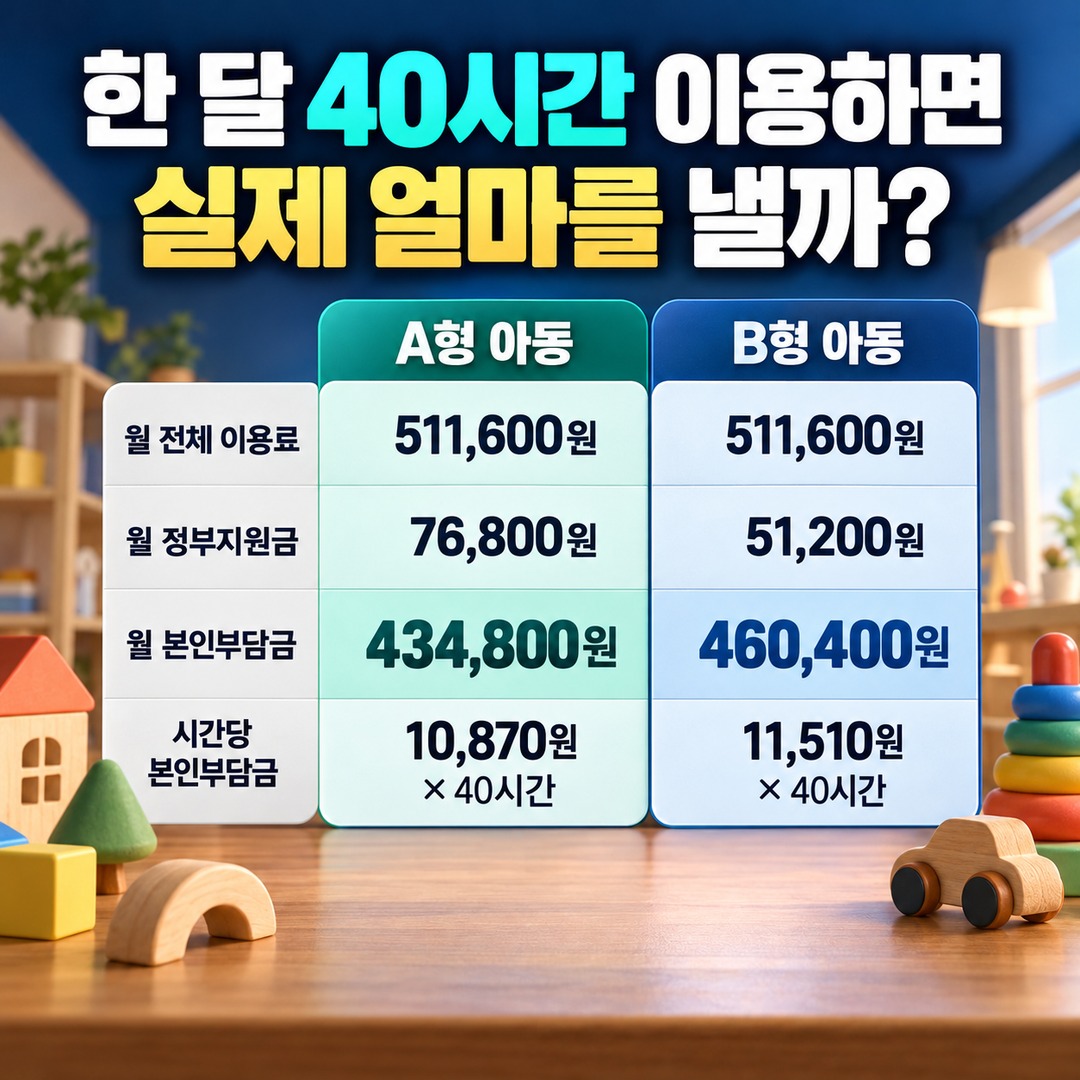
Let's calculate the cost using a hypothetical scenario in which a Category D household uses 40 hours of basic hourly childcare services per month in 2026.
Hypothetical example · 1 child · Excludes additional subsidies and surcharges · Author's calculation
| Item | Type A Child | Type B Child |
|---|---|---|
| Total monthly service fee | KRW 511,600 | KRW 511,600 |
| Monthly government subsidy | KRW 76,800 | KRW 51,200 |
| Monthly out-of-pocket cost | KRW 434,800 | KRW 460,400 |
For a Type A child, the calculation is the hourly out-of-pocket cost of KRW 10,870 × 40 hours = KRW 434,800.
For a Type B child, the calculation is KRW 11,510 × 40 hours = KRW 460,400.
Even within the same Category D household, the monthly out-of-pocket cost for 40 hours of care differs by KRW 25,600 depending on the child's date of birth.
These calculations are illustrative examples based on standard service fees, not actual service usage or billing results. They exclude nighttime and holiday surcharges, additional support for families with multiple children or residents of eligible regions, and changes in service type.
How Should Dual-Income Households Apply?
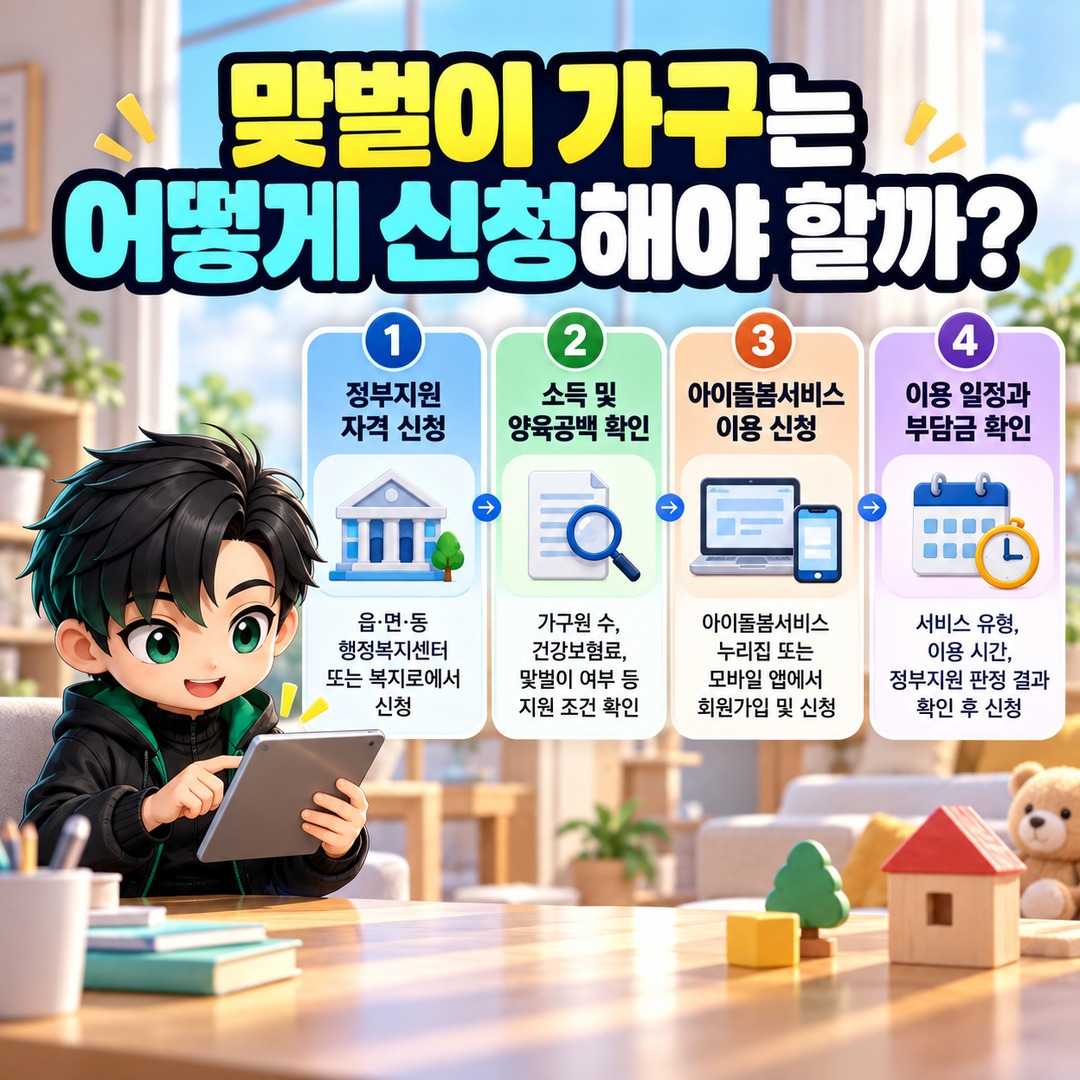
To receive government support, households need to distinguish between applying for government subsidy eligibility and applying to use the childcare service itself.
The Ministry of Gender Equality and Family advises applicants to apply for government support through their local eup, myeon, or dong community service center or the Bokjiro welfare portal. Applications to use the actual childcare service should be submitted through the official Childcare Service website or mobile app.
Step 1. Apply for Government Subsidy Eligibility
Apply for government support for childcare services at the administrative welfare center serving your registered address or through Bokjiro.
Step 2. Verify Income and Childcare Needs
Your household size, National Health Insurance premiums, dual-income status, and other eligibility conditions are reviewed to determine your service subsidy category, ranging from Category A through Category E.
Step 3. Apply to Use the Childcare Service
Register and complete the service application procedures through the official Childcare Service website or mobile app.
Step 4. Confirm Your Schedule and Out-of-Pocket Costs
Check the service type, hours of use, and government subsidy eligibility determination before requesting childcare services.
If you begin using the service before applying for government support, the subsidy you expected may not apply. It is therefore advisable to confirm your eligibility determination and the date from which support takes effect before using the service.
Can Families With Multiple Children and Residents of Population-Decline Areas Pay Less?
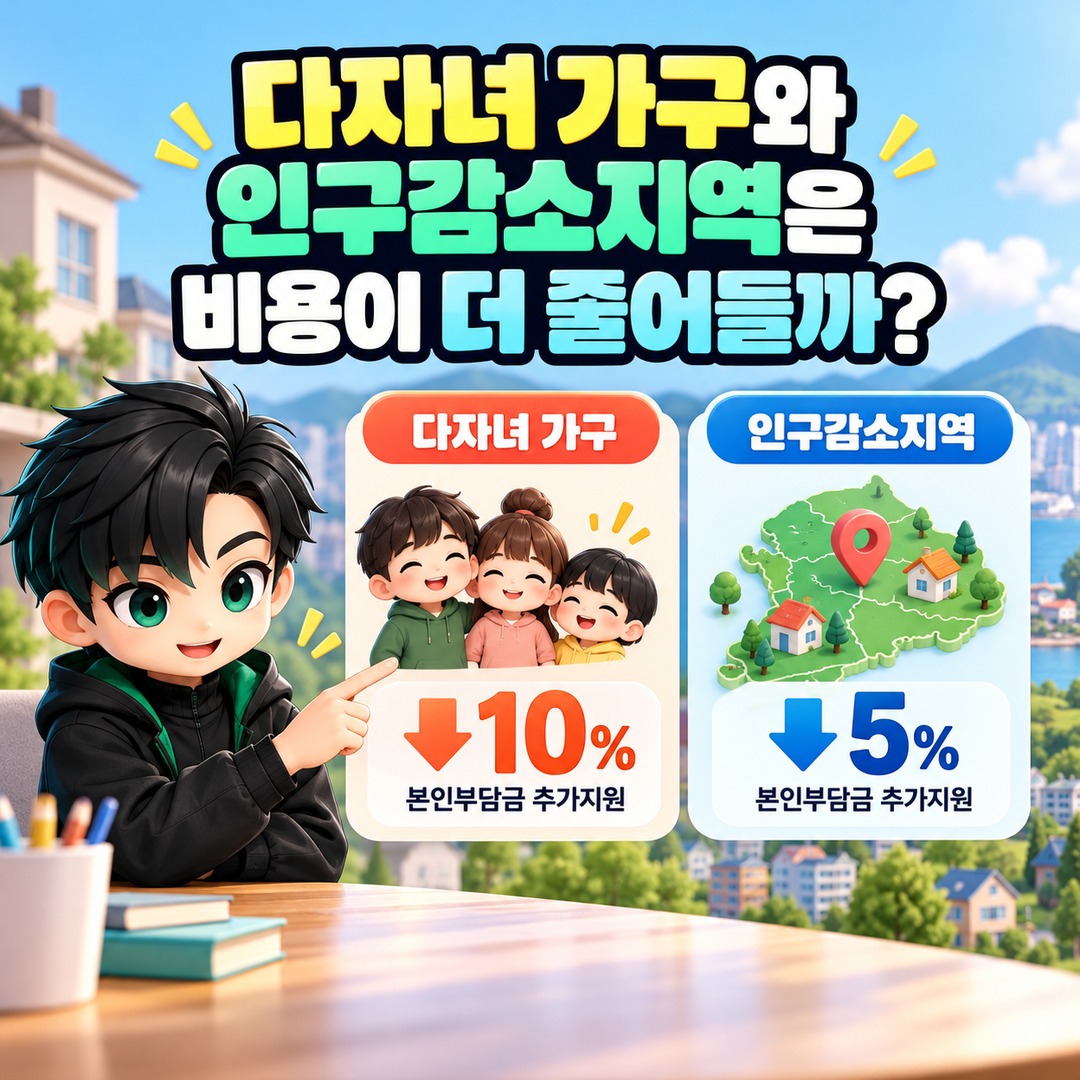
In 2026, additional support provisions are available for families with multiple children and households using childcare services in designated population-decline areas, beyond the standard subsidies based on income category.
In its 2026 program guidance, the Ministry of Gender Equality and Family specified 10% in additional support for out-of-pocket costs for families with multiple children and 5% in additional support for population-decline areas.
Rather than stopping after calculating the standard out-of-pocket cost, households should check whether they qualify for additional support based on where they live and how many children they have.
However, the actual application of these two provisions and the final billed amount must be confirmed according to each household's specific service conditions. The additional support should not be calculated simply by adding percentage points to the standard subsidy rate.
Fees may also differ from standard daytime rates when services are used at night or on holidays.
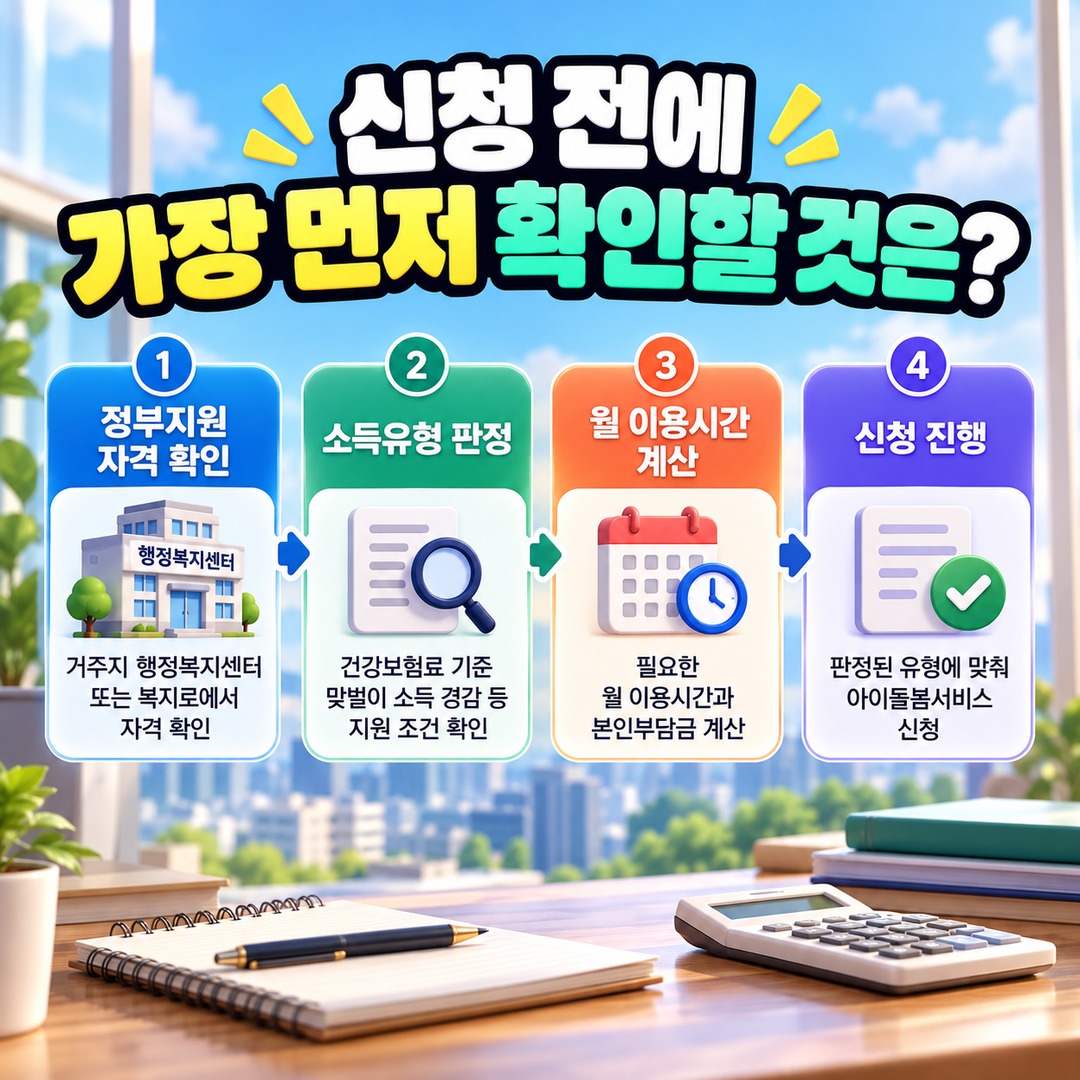
What Should You Check First Before Applying?
Although the income eligibility threshold for childcare service support has been expanded to 250% in 2026, the amount of support a household actually receives depends on its assigned income category.
Dual-income households, in particular, should not assume they are ineligible simply by adding together both spouses' monthly salaries. They also need to consider the income reduction provisions applicable to dual-income households and the National Health Insurance premium criteria.
Start by checking your government subsidy eligibility through your local administrative welfare center or Bokjiro. Once your subsidy category has been determined, calculate your expected monthly service hours and out-of-pocket costs accordingly.