

2026 Q4 Small Business Policy Loans: How to Choose Between Direct and Bank-Intermediated Loans Starting October 12

Applications for 2026 Q4 direct small business policy loans are scheduled to open at 10 a.m. on October 12. However, not all direct loan programs begin accepting applications on the same day. Bank-intermediated loans have separate application schedules and financial institution screening procedures, so applicants should first identify the funding program that matches their business circumstances rather than focusing only on the application date.

As of 2026-10-10, there are three key points to check: the differences between direct and bank-intermediated loans, eligibility requirements for each funding program, and the actual application schedules.
Direct and Bank-Intermediated Loans Differ in Which Institution Provides the Financing
Under South Korea's small business policy loan system, direct loans are reviewed and disbursed by the Korea SMEs and Startups Agency's Small Enterprise and Market Service (SEMAS). For bank-intermediated loans, SEMAS verifies whether an applicant qualifies for policy funding, while a financial institution handles the loan review and disbursement.
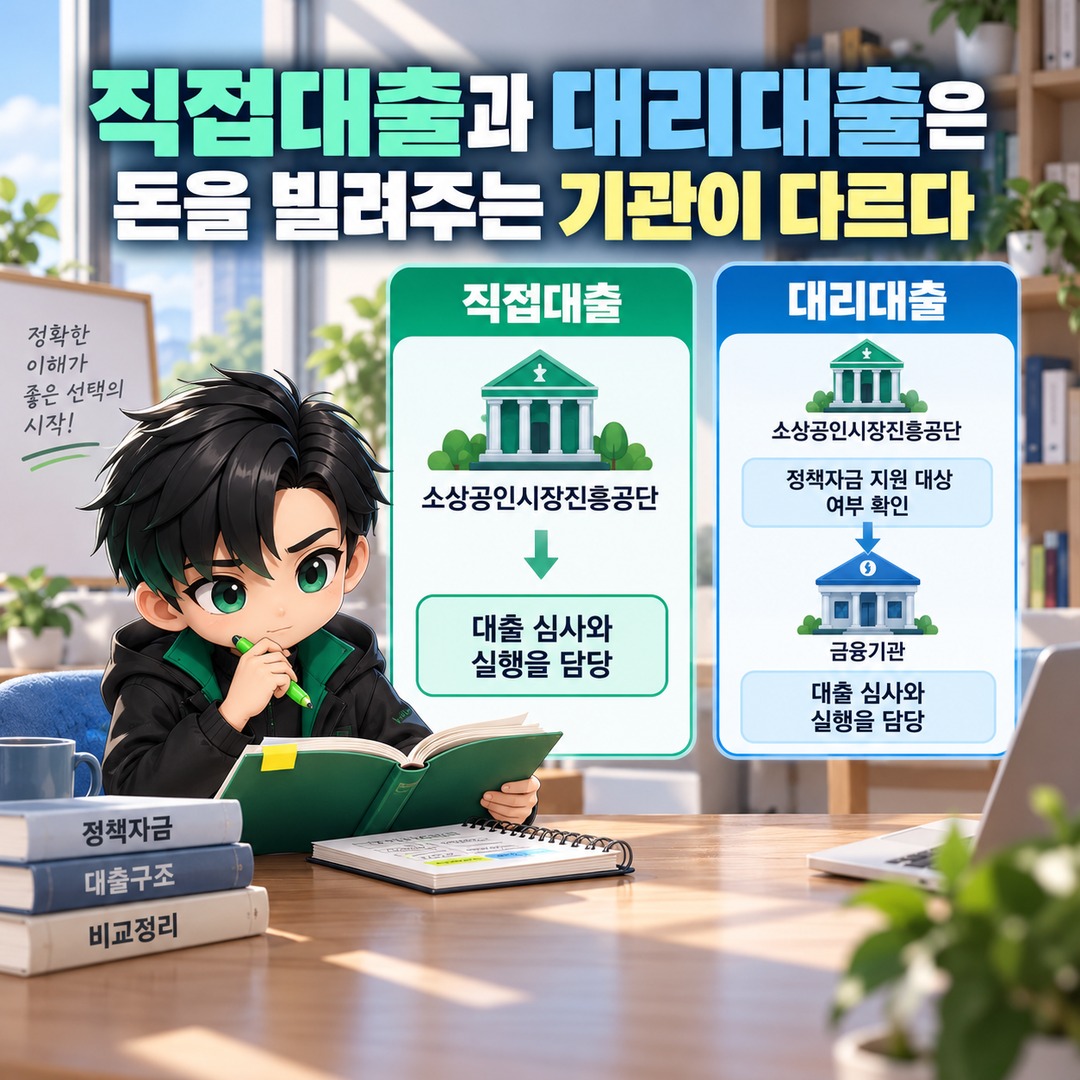
| Category | Direct Loans | Bank-Intermediated Loans |
|---|---|---|
| Loan disbursement | Small Enterprise and Market Service (SEMAS) | Financial institutions |
| Screening | Loan assessment by SEMAS | Financial institution assessment and any required guarantee review |
| Eligible funding programs | Programs designated for direct lending | Programs designated for bank-intermediated lending |
| Conditions to verify | Eligibility requirements for each funding program | Program eligibility and whether financing is available from the financial institution |
Receiving a certificate confirming eligibility for policy funding under the bank-intermediated loan system does not guarantee that the loan will be disbursed. The actual availability and amount of financing may vary depending on the financial institution's assessment.
Similarly, submitting an application for a direct loan does not automatically guarantee funding. Applicants must complete the screening and approval procedures applicable to the specific program.
Therefore, applicants should not assume that direct loans are always more advantageous than bank-intermediated loans or that bank-intermediated loans are easier to obtain.
Applying for a Direct Loan on October 12: What Should You Check First?

2026-10-12, Monday, at 10 a.m. has been announced as the start of the Q4 direct loan application period.
Guidance published by Geumcheon District Office in Seoul states that applications will be accepted from 10 a.m. on October 12 until the allocated budget is exhausted.
However, this announcement alone does not establish that all direct loan products have the same application closing time. Applicants must consult the detailed announcement for each funding program to verify its application period and selection procedures.
Small business owners preparing to apply should distinguish between the following requirements:
The exact name of the funding program they intend to apply for
Business circumstances that meet the program's eligibility requirements
Application opening and closing dates
Screening and selection procedures for each program
Loan limits, interest rates, and repayment periods
Required documents and application channels
In particular, the application opening date is not the same as the loan disbursement date. Screening and additional procedures may still be required after an application has been submitted.

Which Policy Loan Programs Should Different Small Business Owners Consider?
The types of policy funding worth considering vary according to a business owner's circumstances.
Businesses requiring funds for ordinary operating expenses may review the eligibility requirements for the General Management Stabilization Fund.
If a business experiences temporary operational difficulties, it may be appropriate to check the eligibility conditions and supporting documentation requirements for the Temporary Management Difficulties Fund.
Business owners who have difficulty obtaining financing because of their credit standing may review the application requirements for the Credit-Vulnerable Small Business Fund.
Small business owners working to restart or rebuild their businesses should check whether they qualify for the Special Rechallenge Fund.
Small business owners pursuing growth or business innovation may review the available support categories under the Innovation and Growth Promotion Fund.
However, having business circumstances that appear to match a program's name does not automatically establish eligibility. Applicants must satisfy the detailed requirements of the specific funding program.
Temporary Management Difficulties Funding: Distinguishing Direct Loans from Bank-Intermediated Loans
Business owners seeking policy financing related to temporary management difficulties should not rely solely on the funding program's name.
Even when funding programs are intended to support businesses experiencing temporary sales declines or operational difficulties, their application channels, screening procedures, and detailed eligibility requirements may differ depending on whether they use direct or bank-intermediated lending.
Applicants should first determine whether their business circumstances qualify as a recognized cause of management difficulties under the relevant program.
They should then review the requirements applicable to that program, such as business operating history, sales revenue, and evidence of declining sales.
Even when small business owners face similar financial difficulties, they may not all qualify for the same type of loan.
Documents and Business Information to Check Before Applying
When applying for policy funding, documents that establish the applicant's basic business information and eligibility for the selected program are important.
Before applying, it is advisable to organize business registration details, the length of time the business has been operating, sales-related records, and information about existing loans.
Because some funding programs may require additional evidence or have separate application conditions, applicants should avoid assuming that preparing only the standard documents will be sufficient to complete the process.
Online applications can be submitted through the Small Business Policy Funds website, and applications through SEMAS regional centers are also described in the official guidance. Anyone planning to apply in person should first confirm the relevant center's jurisdiction and the application procedures for the specific funding program.
Applicants who need assistance during the process can contact the Small Business Integrated Call Center at 1533-0100.
Can You Receive a Loan Immediately After Applying on October 12?
The application opening date is not the date on which loan funds are disbursed.
For direct loans, program-specific screening may take place after an application is submitted. Bank-intermediated loans require separate loan assessment and disbursement procedures conducted by the financial institution.
Furthermore, policy loans are not grants provided without repayment obligations. They are loans that must be repaid.
Applicants should therefore check not only whether they qualify to apply but also the interest they will actually pay, the repayment period, any grace period, and how the new loan relates to their existing debt obligations.
Small business owners preparing to apply for 2026 Q4 policy funding should first consult the Small Business Policy Funds website for the latest application guidance covering programs relevant to their circumstances.
Rather than applying solely because applications open on October 12, business owners should first determine whether direct or bank-intermediated lending better matches their eligibility and business conditions. Doing so can help avoid unnecessary application procedures.