

2026 Year-End Tax Settlement Card Deduction KRW 4,000,000: Spending KRW 4,000,000 on Your Card Doesn't Mean You Get That Amount Back… How Much Must You Spend with 2 Children?
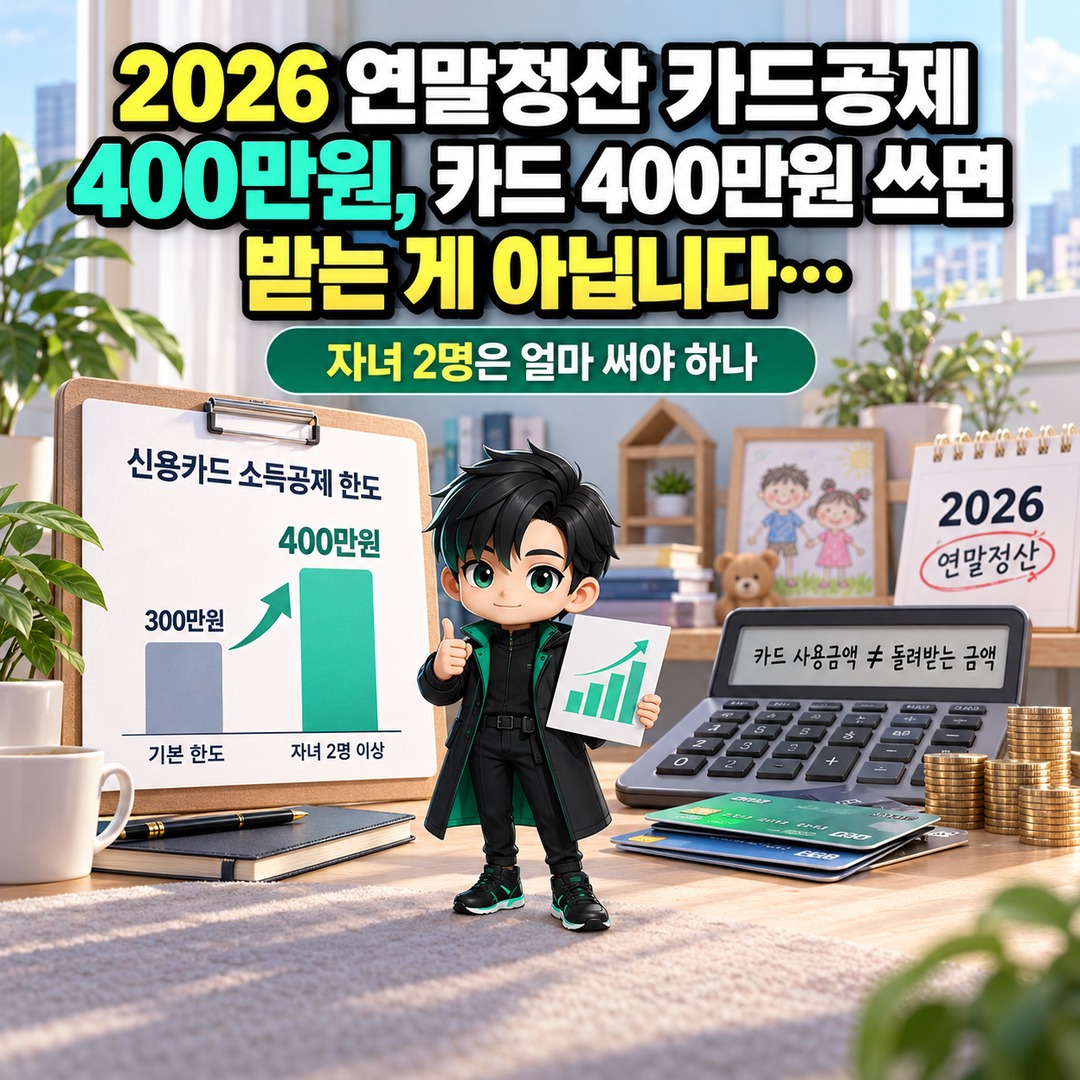
For the 2026 tax year, employees with 2 or more children and gross annual salary of KRW 70,000,000 or less can qualify for a basic income deduction limit of up to KRW 4,000,000 for credit card and other eligible spending. However, spending KRW 4,000,000 on your card does not mean you can deduct KRW 4,000,000. Your annual eligible spending must first exceed 25% of your gross salary. The deduction rates for each payment method are then applied to the excess spending, and the resulting deduction must reach KRW 4,000,000.
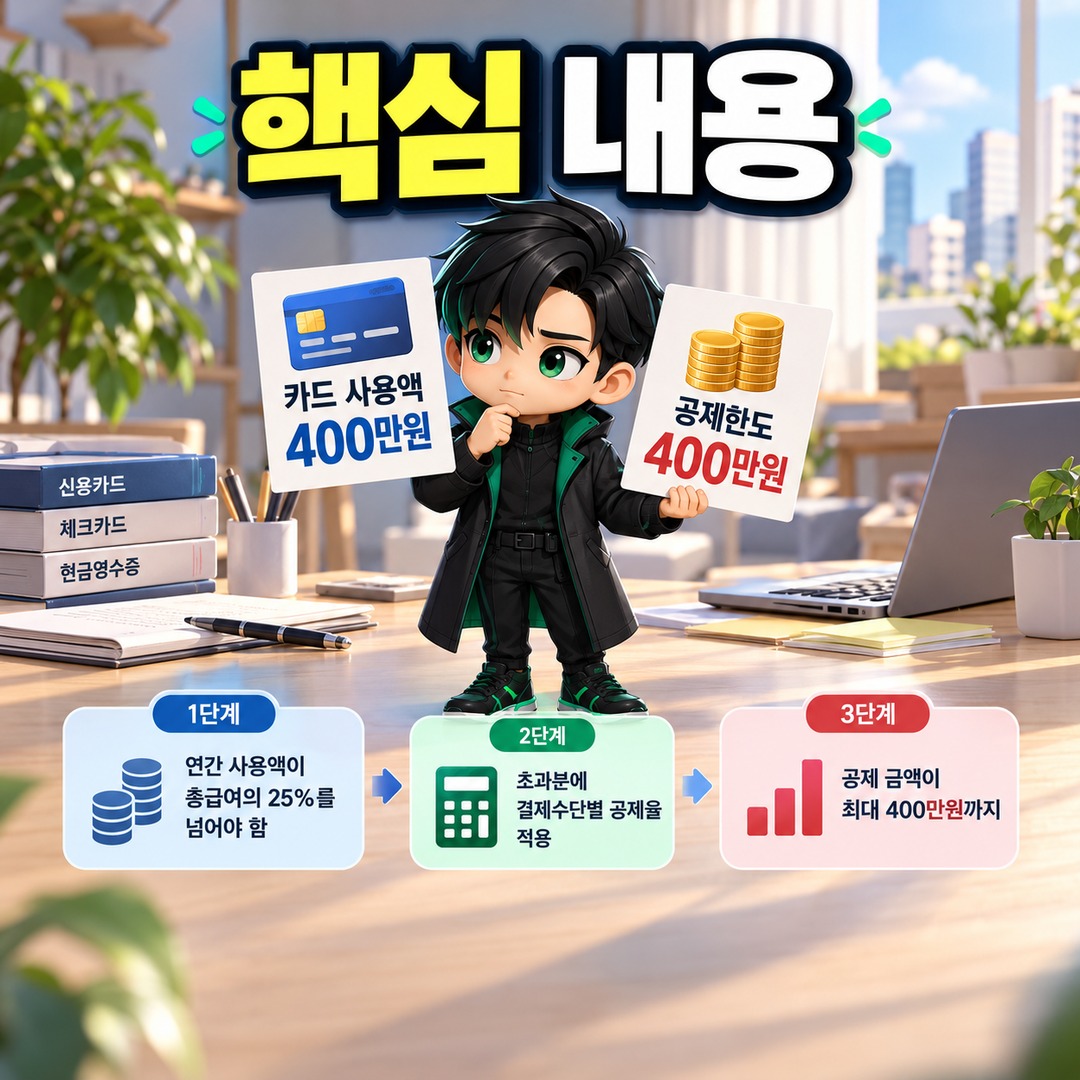
KRW 4,000,000 Is the Maximum Income Deduction, Not the Amount You Spend on Cards
There is an important distinction to understand first.

Starting in 2026, the basic income deduction limit for credit card and other eligible spending varies according to the number of children. For employees earning KRW 70,000,000 or less in gross annual salary, the basic limit increases from KRW 3,000,000 to KRW 3,500,000 with 1 child, and to KRW 4,000,000 with 2 or more children. If gross annual salary exceeds KRW 70,000,000, the respective limits are KRW 2,500,000, KRW 2,750,000, and KRW 3,000,000.
| Gross Annual Salary | No Children | 1 Child | 2 or More Children |
|---|---|---|---|
| KRW 70,000,000 or less | KRW 3,000,000 | KRW 3,500,000 | KRW 4,000,000 |
| Above KRW 70,000,000 | KRW 2,500,000 | KRW 2,750,000 | KRW 3,000,000 |
Therefore, having 2 children does not automatically reduce your taxable income by KRW 4,000,000 during year-end tax settlement, nor does it increase your tax refund by KRW 4,000,000.
KRW 4,000,000 is the maximum basic limit applied to the calculated income deduction for credit card and other eligible spending when the relevant requirements are satisfied.
Card Spending Must First Exceed 25% of Gross Annual Salary
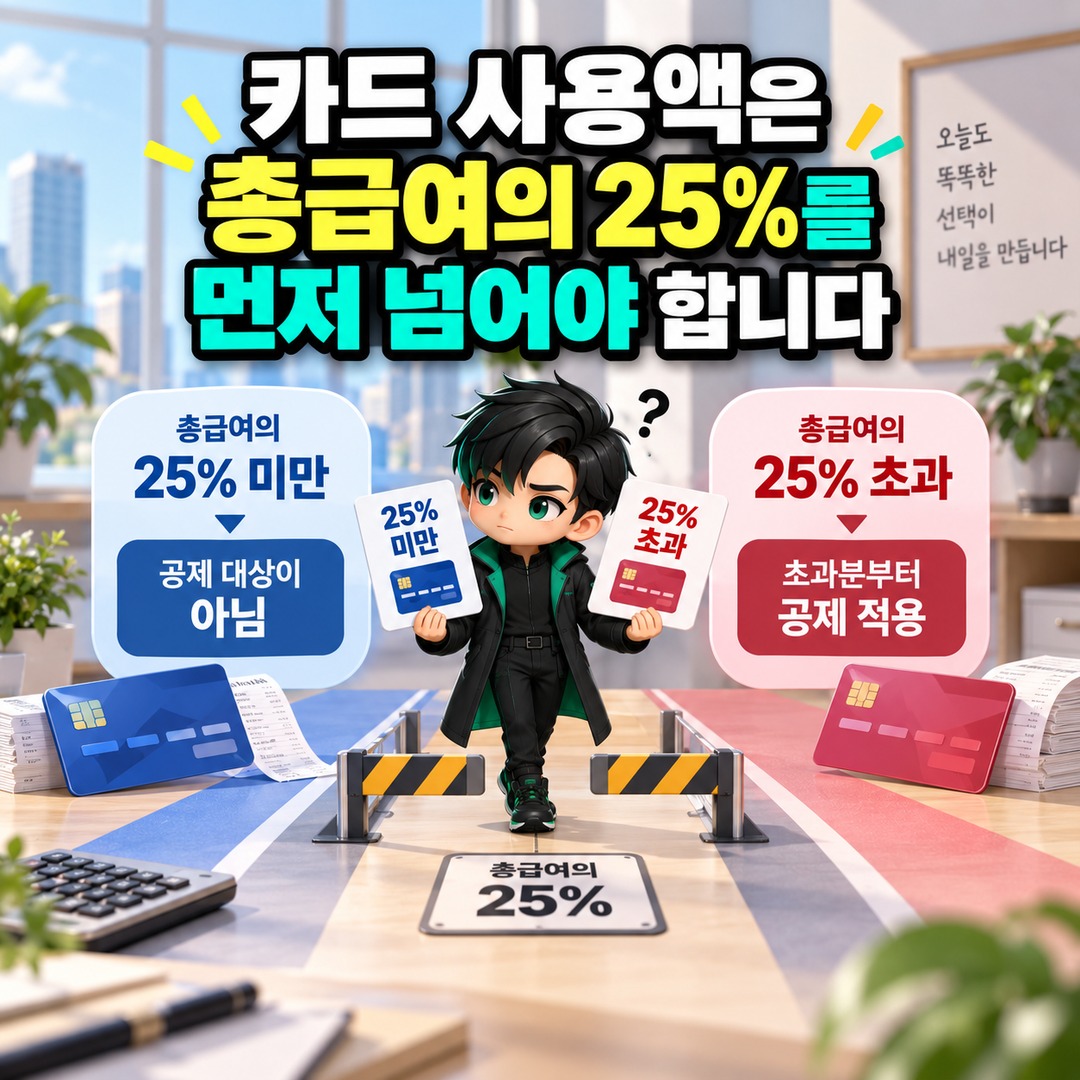
The income deduction for credit card and other eligible spending is not calculated by immediately multiplying all annual spending by the applicable deduction rate.
Spending must first exceed 25% of gross annual salary. The law also specifies that the income deduction applies when annual spending through credit cards and other eligible payment methods exceeds 25% of the taxpayer's gross salary for the relevant tax year.
For example, if gross annual salary is KRW 60,000,000, the threshold is calculated as follows.
KRW 60,000,000 × 25% = KRW 15,000,000
If annual spending through cards, cash receipts, and other eligible payment methods does not reach KRW 15,000,000, no income deduction for credit card and other eligible spending arises.
If gross annual salary is KRW 70,000,000, the threshold is KRW 17,500,000.
In other words, even if having 2 children increases the basic deduction limit to KRW 4,000,000, the initial requirement of exceeding 25% of gross annual salary still applies.
With Gross Annual Salary of KRW 60,000,000, How Much Spending Is Needed to Reach KRW 4,000,000?
The required spending amount varies significantly depending on the payment method.
Under the 2026 rules, the deduction rate for ordinary credit card spending is 15%, while cash receipts and debit or prepaid cards qualify for 30%. Spending at traditional markets and on public transportation qualifies for 40%.
Let's make a simplified calculation for someone earning KRW 60,000,000 in gross annual salary, with 2 or more children, excluding other additional deduction categories.
First, the spending up to KRW 15,000,000, equivalent to 25% of gross annual salary, represents the threshold that must be met before deductible spending begins to accumulate.
If All Spending Above the 25% Threshold Is Made with Credit Cards
The credit card deduction rate is 15%.
KRW 4,000,000 ÷ 15% = approximately KRW 26,667,000
Adding the 25% threshold of KRW 15,000,000 gives:
Approximately KRW 41,667,000
In other words, under these simplified assumptions, someone earning KRW 60,000,000 in gross annual salary would need approximately KRW 41,670,000 in annual credit card spending alone to reach the basic income deduction amount of KRW 4,000,000.
If Spending Above the 25% Threshold Is Made with Debit Cards or Cash Receipts
The calculation changes when the 30% deduction rate is applied.
KRW 4,000,000 ÷ 30% = approximately KRW 13,333,000
KRW 15,000,000 + KRW 13,333,000 = approximately KRW 28,333,000
This explains why the spending required to reach the same basic deduction limit of KRW 4,000,000 can differ considerably depending on the mix of payment methods.
The amounts above are calculations prepared by the author to make the deduction structure easier to compare, excluding other eligible spending categories and exclusions. Actual year-end tax settlement results vary depending on the composition of credit card, debit card, cash receipt, traditional market, public transportation, and cultural and sports-related spending.
The Required Spending Also Changes When Gross Annual Salary Is KRW 70,000,000
Even when gross annual salary is exactly KRW 70,000,000, taxpayers with 2 or more children fall within the KRW 4,000,000 basic deduction limit category. This is because the law divides taxpayers into those earning 'KRW 70,000,000 or less' and those above that threshold.
The 25% spending threshold is calculated as follows.
KRW 70,000,000 × 25% = KRW 17,500,000
If we then make the simplified assumption that all subsequent spending is made with credit cards:
KRW 17,500,000 + (KRW 4,000,000 ÷ 15%)
= approximately KRW 44,167,000
If we instead assume that the spending qualifies for the 30% deduction rate, as with debit cards and cash receipts:
KRW 17,500,000 + (KRW 4,000,000 ÷ 30%)
= approximately KRW 30,833,000
Conversely, if gross annual salary exceeds KRW 70,000,000, the basic deduction limit for taxpayers with 2 or more children falls from KRW 4,000,000 to KRW 3,000,000.
That is why it is important to check whether the gross annual salary used for year-end tax settlement is KRW 70,000,000 or less, rather than judging eligibility simply by the stated annual salary figure.
Reaching the KRW 4,000,000 Basic Limit Does Not Necessarily Mean All Deductions End There
Even if the basic deduction limit is KRW 4,000,000 for taxpayers with 2 or more children and gross annual salary of KRW 70,000,000 or less, this does not mean every income deduction related to credit cards and other eligible spending must stop at KRW 4,000,000.
The 2026 system provides separate additional deduction limits for categories including cultural and sports-related spending, traditional market purchases, and public transportation. In its 2026 tax materials, the National Assembly Budget Office lists the additional limit as KRW 3,000,000 for gross annual salary of KRW 70,000,000 or less and KRW 2,000,000 for salary above KRW 70,000,000.
Therefore, taxpayers earning KRW 70,000,000 or less with 2 or more children should distinguish between the KRW 4,000,000 basic deduction limit and the separate additional deduction limit.
However, this does not mean KRW 3,000,000 is automatically added to KRW 4,000,000, allowing everyone to deduct KRW 7,000,000.
Additional deductions arise only after calculating actual eligible spending in the relevant categories, the applicable deduction rates, and whether the basic limit has been exceeded.
An KRW 4,000,000 Income Deduction Does Not Mean an KRW 4,000,000 Tax Refund
There is another point that frequently causes confusion.
The KRW 4,000,000 associated with credit card deductions is an income deduction limit, not an KRW 4,000,000 tax credit.
An income deduction reduces the income subject to taxation before taxes are calculated. Therefore, an income deduction of KRW 4,000,000 does not mean your final tax liability decreases by exactly KRW 4,000,000 or that you receive an KRW 4,000,000 refund.
The actual reduction in tax depends on the employee's taxable income base, applicable tax rates, other income deductions and tax credits, and taxes already paid.
Accordingly, the figures to check during year-end tax settlement should be reviewed in the following order.
Gross Annual Salary → 25% of Gross Annual Salary → Spending by Payment Method → Calculated Income Deduction → Basic and Additional Limits → Final Tax Liability
Calculating your expected refund on the assumption that 'having 2 children means an KRW 4,000,000 refund' can produce results that differ substantially from the actual outcome.
Not Every Household with 2 Children Receives the Same KRW 4,000,000 Limit
Although the 2026 system expands deduction limits according to the number of children, the law does not simply count every child listed in a household's family relationships.
The Restriction of Special Taxation Act provides for deduction limits based on the number of children when the taxpayer has qualifying dependents, including children and grandchildren, as prescribed by Presidential Decree.
Dual-income households and households that divide dependent deductions between taxpayers should pay particular attention to which children qualify under each taxpayer's deduction.
Separate provisions also allow spending through credit cards and other eligible payment methods by a spouse or qualifying direct ascendants and descendants to be included in an employee's income deduction calculation.
Therefore, you should not assume that all spending by family members can freely be combined and assigned to one taxpayer simply because family members used the cards.
At October, Check Your Current Eligible Spending Rather Than Focusing Only on 'KRW 4,000,000'
As of October 2026, there is no need to increase spending during the remaining period simply because you have 2 or more children.
The appropriate first step is to estimate this year's gross annual salary, calculate 25% of that amount, and then check how much eligible spending has accumulated through credit cards, debit cards, cash receipts, and other payment methods.
For example, if gross annual salary is KRW 60,000,000, the 25% threshold is KRW 15,000,000.
If your spending has already comfortably exceeded the threshold, you should review the deduction rates by payment method and the deduction amount calculated so far. Conversely, if spending has not yet reached KRW 15,000,000, you should not assume that 30% can immediately be deducted simply because debit cards have a higher deduction rate.
Above all, increasing unnecessary spending to reduce taxes can result in expenses far greater than the tax savings.
For the 2026 tax year, it is safest to confirm the final figures using National Tax Service simplified tax settlement records and documents submitted to your employer when the actual year-end tax settlement takes place in early 2027. In September 2026, the National Tax Service also revised its notice concerning the verification of spending eligible for income deductions on credit cards and other payment methods.
In conclusion, the 'KRW 4,000,000' available to taxpayers with 2 or more children is neither a spending amount nor a refund amount. It is the basic limit applied to the income deduction calculated using payment-method-specific deduction rates after eligible spending exceeds 25% of gross annual salary.
※ This article is provided for reference to help readers understand market trends and does not constitute an investment recommendation for any particular stock or asset. Final investment decisions and responsibility rest with the individual.