

2026 Energy Vouchers: Conditional Eligibility for Basic Livelihood Security Recipients, 8 Household Member Criteria, and Application Deadline
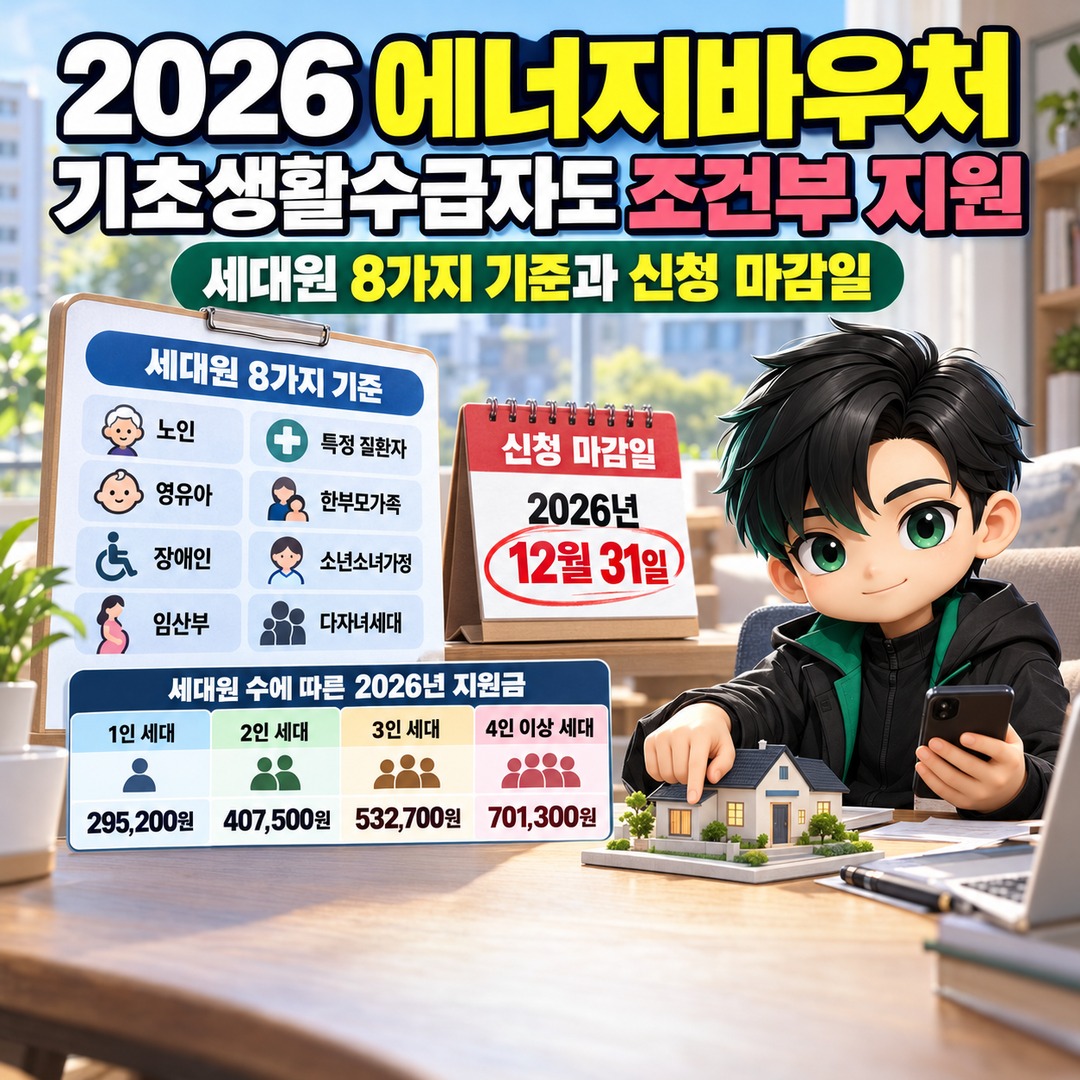
Not everyone receiving basic livelihood security benefits qualifies for energy vouchers in 2026. Recipients of livelihood, medical, housing, or education benefits must also meet the household member eligibility criteria. The application deadline is 2026-12-31. Total support varies by household size, ranging from KRW 295,200 to KRW 701,300.
As of 2026-10-29, the first thing to check when determining eligibility is not just income but also whether the members of the household listed on the resident registration record meet the required conditions.
Even Basic Livelihood Security Recipients Are Ineligible If Their Household Does Not Meet the Additional Criteria
In 2026, energy vouchers are available to households that meet both the income requirements and the household member eligibility criteria. The income requirements cover recipients of housing and education benefits as well as livelihood and medical benefits. However, receiving one of these benefits does not automatically establish eligibility for an energy voucher.
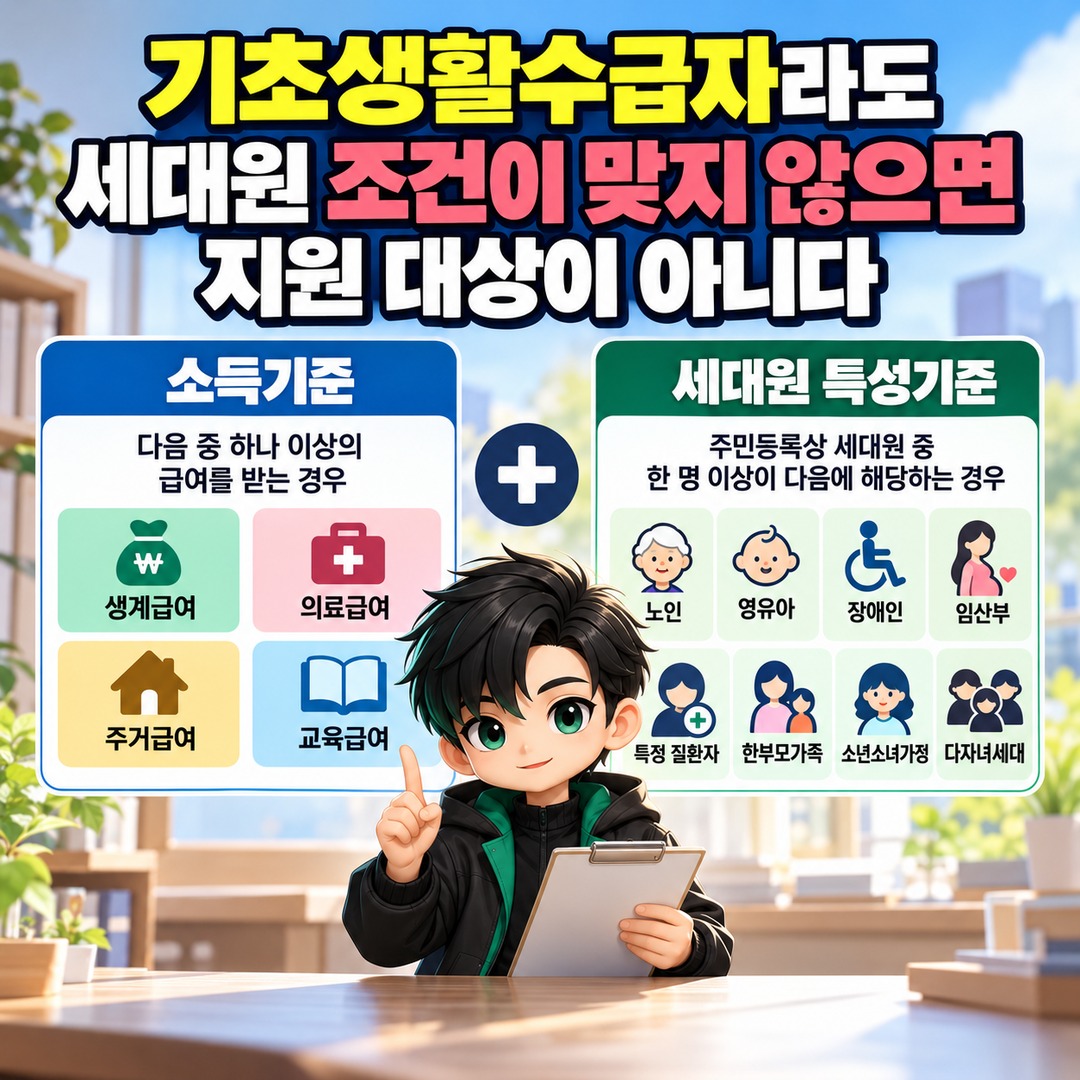
According to the Korea Energy Agency's official energy voucher eligibility criteria for 2026, the income requirement is met when a household receives at least one of the following four benefits.
| Basic Livelihood Security Benefit | Meets Income Requirement |
|---|---|
| Livelihood benefit | Yes |
| Medical benefit | Yes |
| Housing benefit | Yes |
| Education benefit | Yes |
Receiving any one of these four benefits satisfies the first requirement.
However, at least one person, either the benefit recipient or another household member listed on the resident registration record, must also meet one of the specified household member eligibility criteria.
For example, a household receiving education benefits does not automatically qualify for an energy voucher. Additional conditions, such as the children's ages or the criteria for households with multiple children, must also be checked.
Who Qualifies Under the Household Member Criteria in 2026?
In 2026, the household member eligibility categories include older adults, infants and young children, people with disabilities, pregnant women, people with certain medical conditions, single-parent families, child-headed households, and households with multiple children.
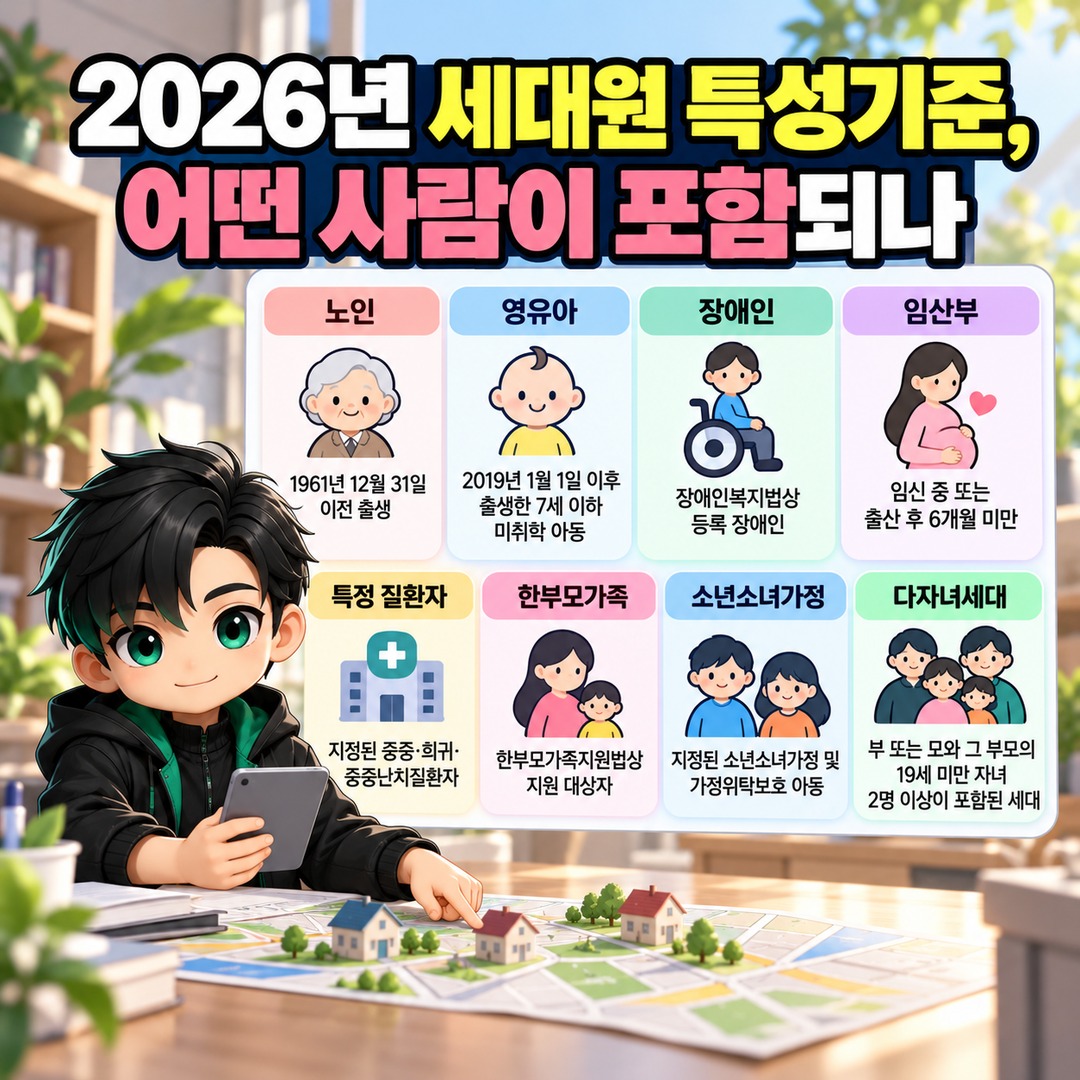
Notably, households with multiple children are also included in the official eligibility categories. This means that even a household without an older adult or a person with a disability may qualify, depending on the number and ages of its children.
| Category | Eligibility Criteria for 2026 |
|---|---|
| Older adults | Born before 1961-12-31 |
| Infants and young children | Preschool children aged 7 or younger, born on or after 2019-01-01 |
| People with disabilities | People officially registered as having a disability under the Welfare of Persons with Disabilities Act |
| Pregnant women | Currently pregnant or less than 6 months after childbirth |
| People with qualifying medical conditions | People with designated severe, rare, or severe intractable diseases |
| Single-parent families | Eligible beneficiaries under the Single-Parent Family Support Act |
| Child-headed households | Designated child-headed households and children in foster care |
| Households with multiple children | Households including a father or mother and at least 2 of that parent's children under 19 years of age |
Eligibility as a household with multiple children is not determined simply by having two children. The relationship between the parent and children, their ages, and the household composition recorded in the resident registration system must all be checked.
Likewise, receiving treatment at a hospital does not automatically qualify someone under the medical condition category. The condition must meet the disease classifications and special medical expense coverage criteria established under the relevant laws and regulations.
Why Eligibility Decisions Can Differ Between Basic Livelihood Security Recipients
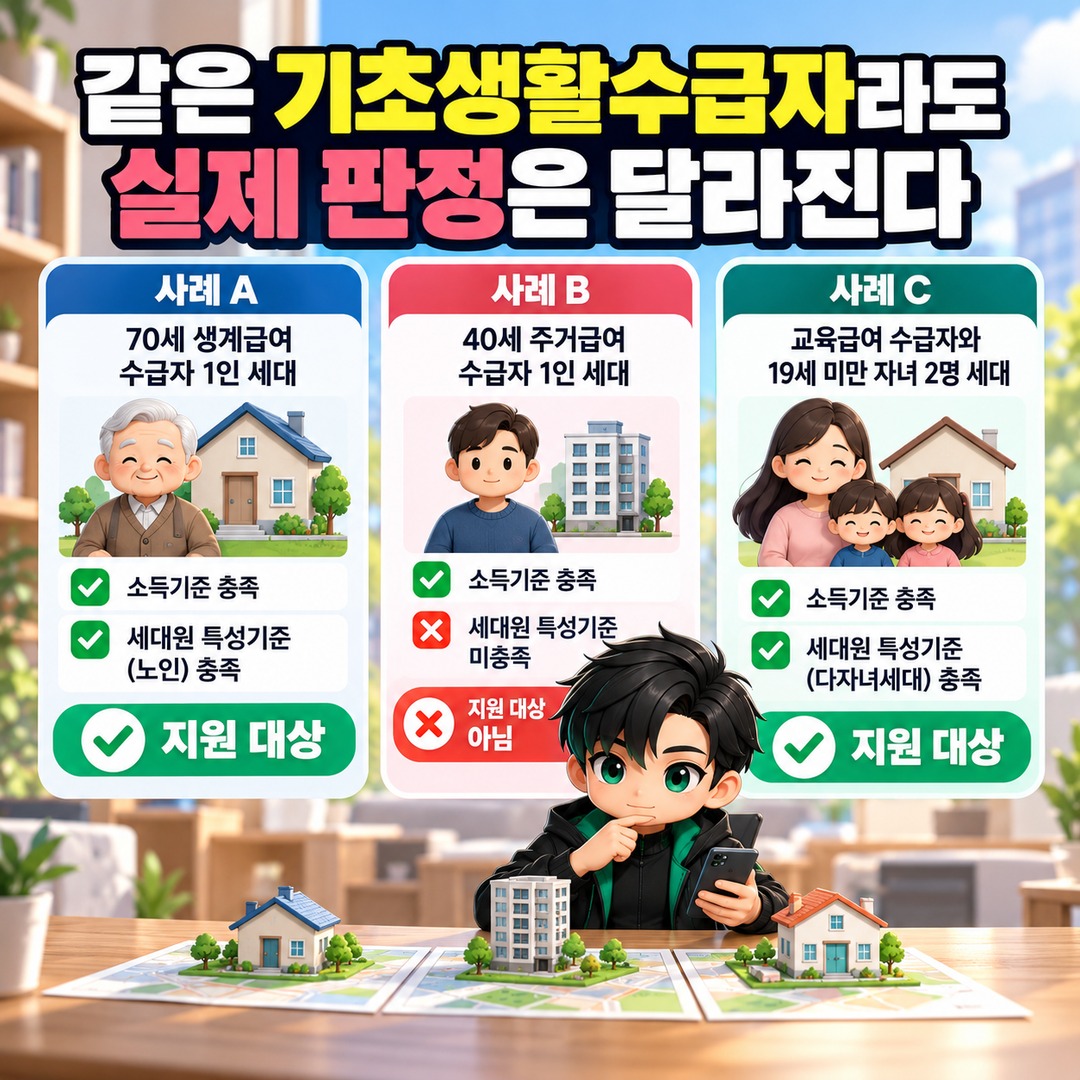
Comparing three hypothetical households makes it easier to understand how eligibility is determined.
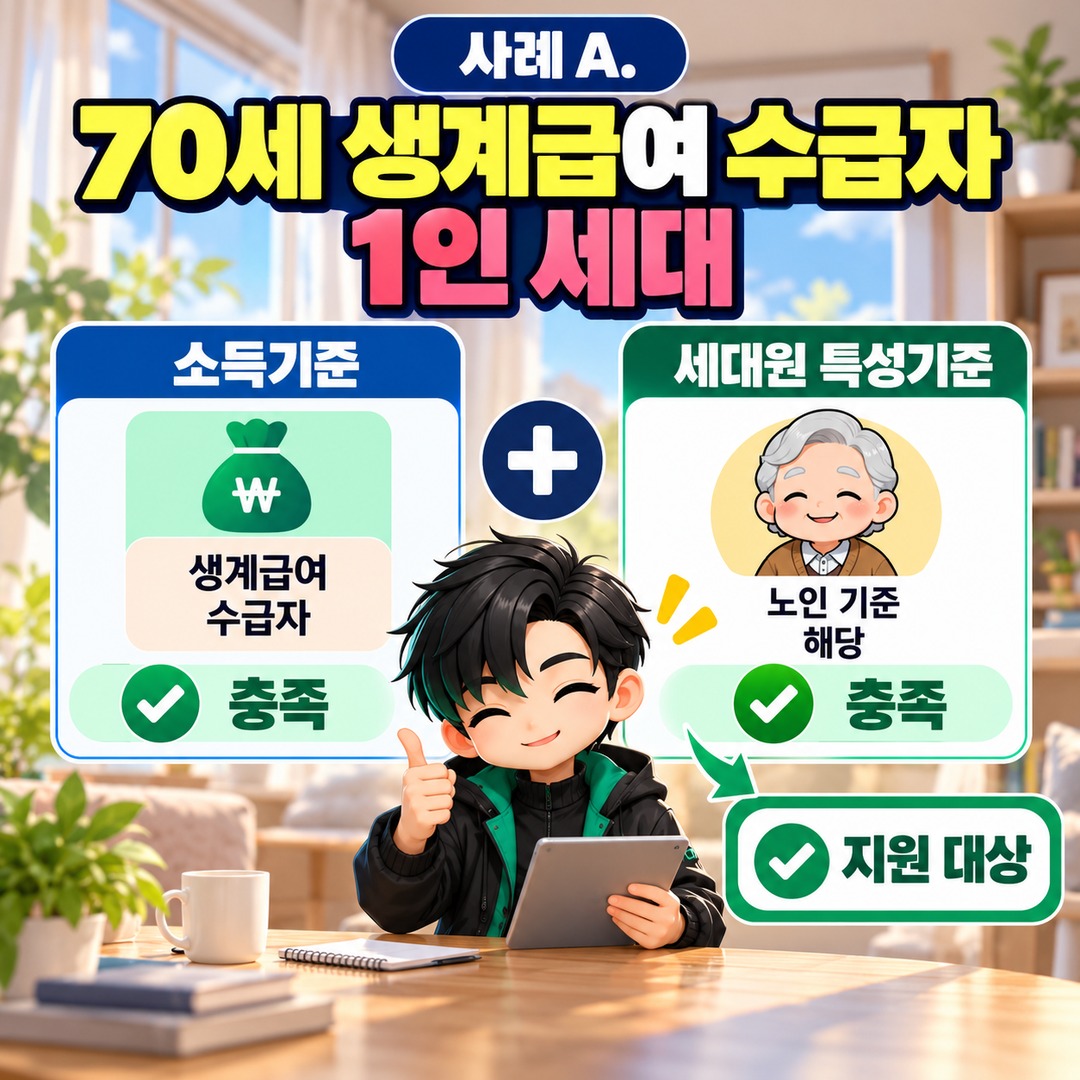
Hypothetical Case A: A 1-Person Household Receiving Livelihood Benefits, Age 70
This person receives livelihood benefits and also meets the age requirement for older adults. Assuming no other exclusion criteria apply, this example satisfies both the income requirement and the household member eligibility criteria.
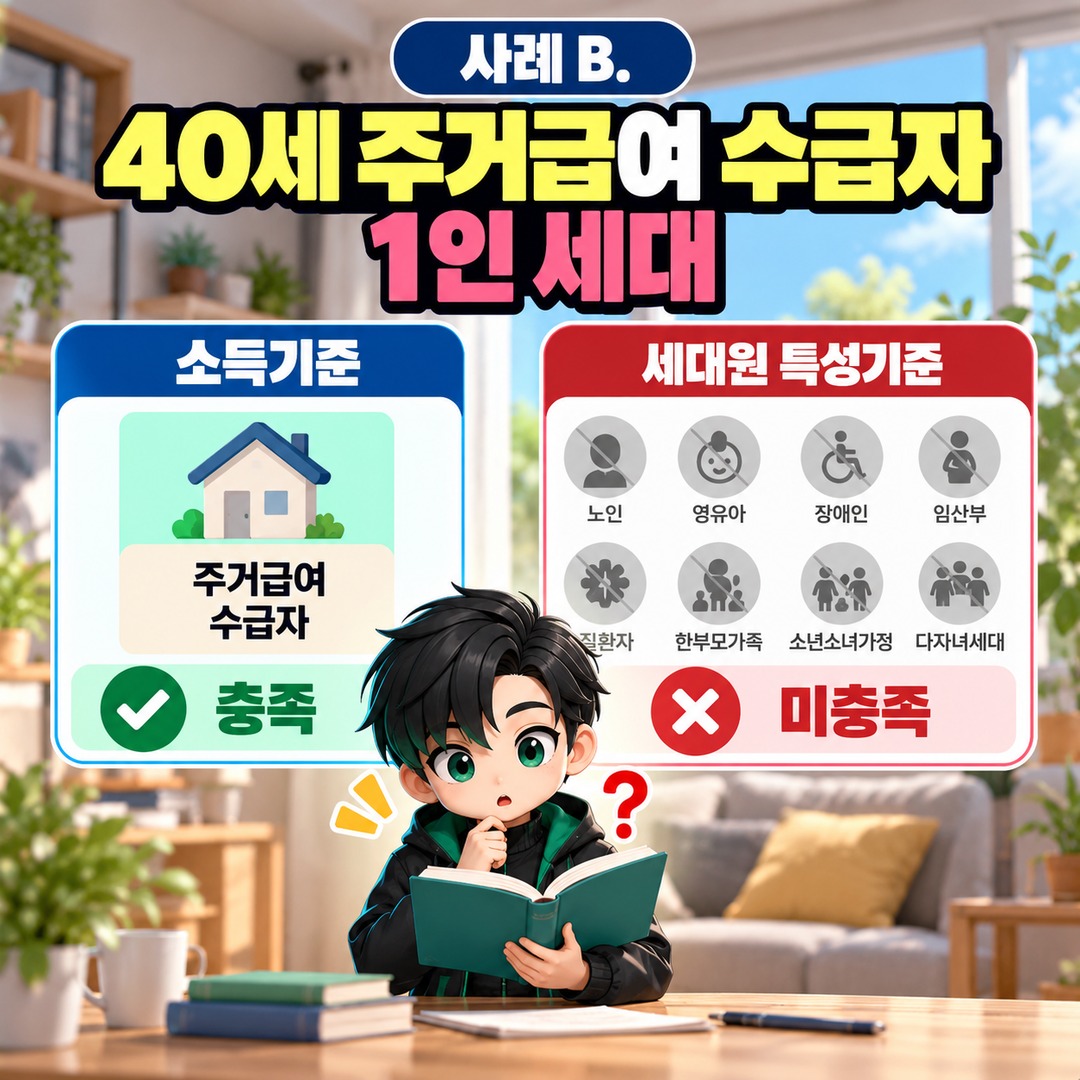
Hypothetical Case B: A 1-Person Household Receiving Housing Benefits, Age 40
Because this person receives housing benefits, the income requirement is satisfied. However, assuming the person does not meet any separate eligibility criteria, such as having a qualifying disability or medical condition, the household does not satisfy the household member eligibility requirement.
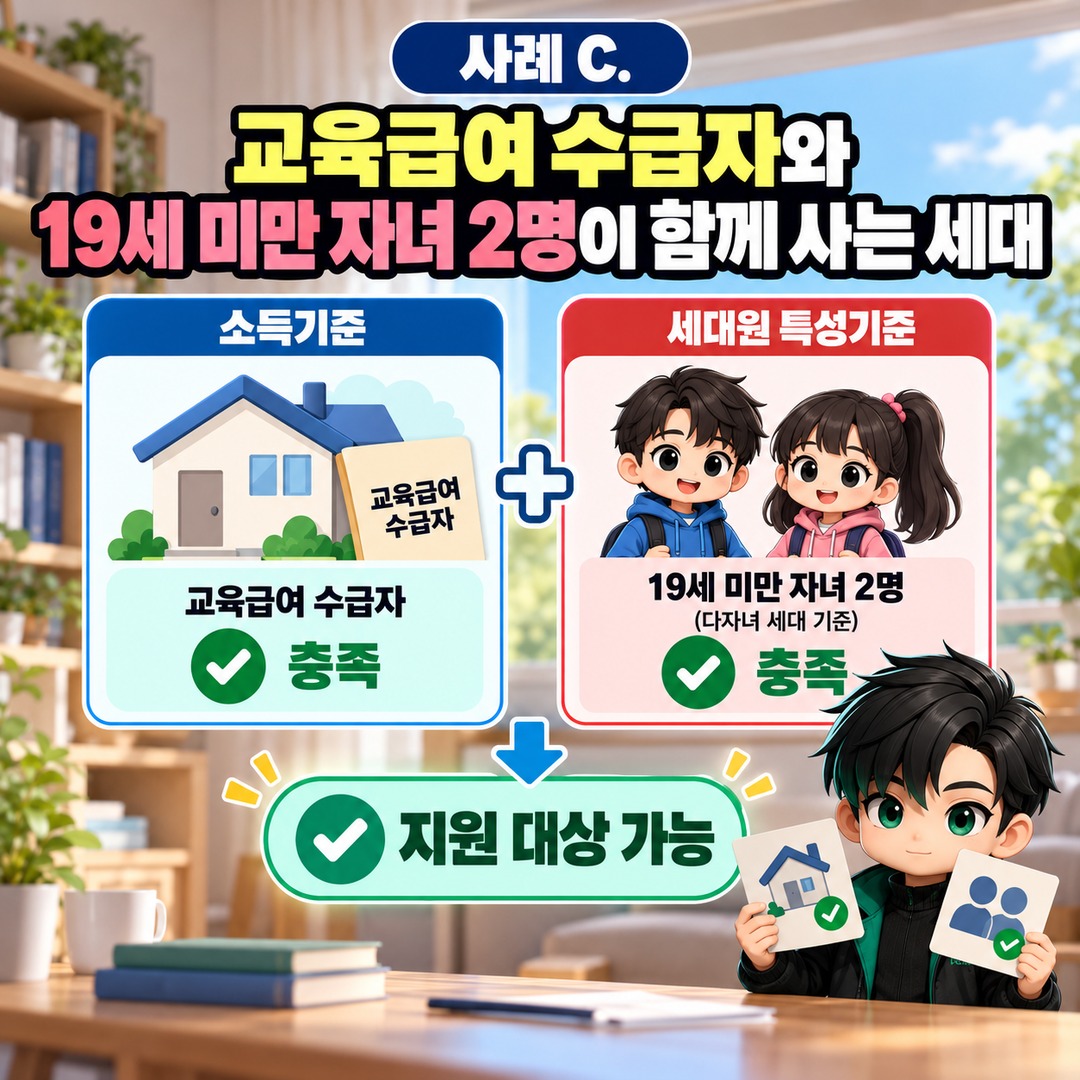
Hypothetical Case C: A Household Receiving Education Benefits with 2 Children Under 19
If the parent-child composition recorded in the resident registration system meets the official criteria for households with multiple children, the household may satisfy the household member eligibility requirement.
All three cases are hypothetical examples. Actual eligibility is determined by reviewing the household's benefit recipient status, household composition, and any applicable exclusion criteria at the time of application.
The key distinction is that being a Basic Livelihood Security recipient is not the same as being eligible for an energy voucher.
How Does the 2026 Energy Voucher Amount Vary by Household Size?
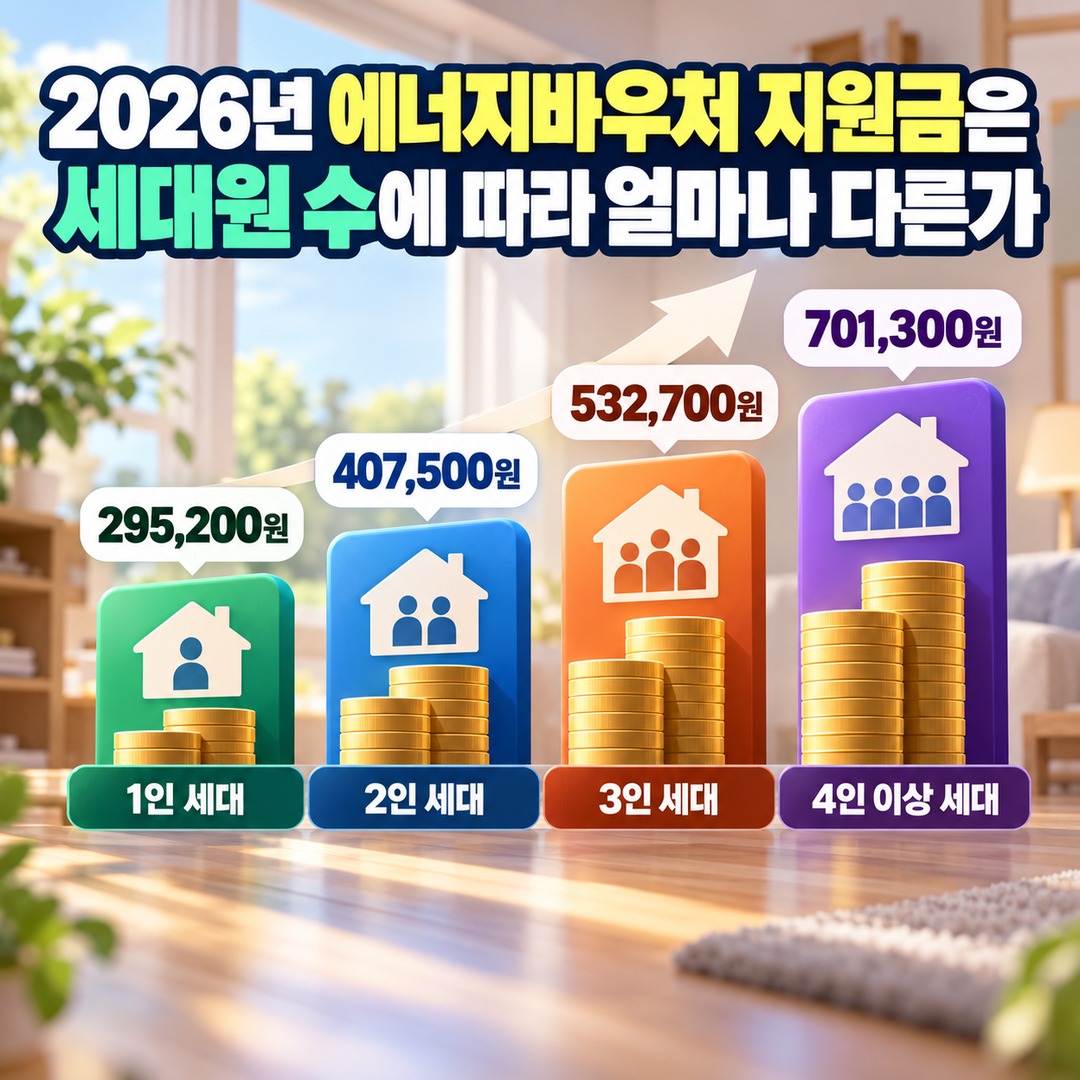
In 2026, the total energy voucher allocation per household is KRW 295,200 for a 1-person household, KRW 407,500 for a 2-person household, KRW 532,700 for a 3-person household, and KRW 701,300 for a household with 4 or more members.
| Household Size | Total Energy Voucher Support in 2026 |
|---|---|
| 1 person | KRW 295,200 |
| 2 people | KRW 407,500 |
| 3 people | KRW 532,700 |
| 4 or more people | KRW 701,300 |
These amounts are not monthly payments. They represent the total support limit for each household over the entire 2026 program usage period.
The number of household members used to calculate the support amount is also based on the resident registration record.
Therefore, even if only one household member meets the special eligibility criteria, the amount of support may vary according to the total number of household members officially registered at the same address.
However, separate rules apply when a household chooses winter coal briquette coupons, coal-to-energy conversion vouchers, or emergency welfare fuel cost assistance. In these cases, only the amount corresponding to summer usage is provided, rather than the standard total benefit amount.
When Support May Be Restricted Even If You Are Eligible to Apply
In 2026, energy vouchers are subject to exclusions and restrictions on receiving overlapping benefits, in addition to the household member eligibility criteria.
First, households in which every member receives benefits at a residential welfare facility under the National Basic Living Security Act are excluded from support.
During winter, energy vouchers cannot be combined with the following benefits:
Emergency welfare winter fuel cost assistance provided from October 2026 through March 2027
2026 coal briquette coupons
2026 coal-to-energy conversion vouchers
Households that used regular energy vouchers during summer must also complete a change procedure if they wish to use another energy assistance program during winter.
Therefore, if you are already receiving other heating cost assistance, it is advisable to check with your local administrative welfare center before applying to determine whether the benefits can be combined.
Apply by December 31: Online and In-Person Applications Available
The application period for 2026 energy vouchers runs from June 15 through December 31.
The Ministry of Health and Welfare's 2026 energy voucher application guidance on Bokjiro, the government welfare portal, also confirms the same application period and eligibility requirements.
There are three ways to apply.
1. Apply in Person at an Administrative Welfare Center
Applicants or their authorized representatives can apply at the administrative welfare center serving the eup, myeon, or dong of their registered residential address.
2. Apply Online Through Bokjiro
Eligible individuals can apply on their own behalf through the Bokjiro website. However, applications submitted by representatives are not accepted online and must be made in person.
3. Application Initiated by a Responsible Public Official
If an eligible person has difficulty moving around, the responsible public official may submit an application with that person's consent.
An application for an energy voucher generally requires an Energy Voucher Issuance Application Form. Additional documents may be required depending on the applicant's circumstances.
| Application Situation | Additional Supporting Documents |
|---|---|
| Application through a representative | Letter of authorization and the representative's identification |
| Utility bill deduction application | Electricity, gas, or district heating bill |
| Pregnant individuals or people with qualifying medical conditions | Medical certificate or confirmation issued by a healthcare institution |
| Certain households with multiple children | Family relationship certificate |
| Children born in 2019 whose school enrollment has been deferred or exempted | Confirmation document bearing the school principal's official seal |
Apartment residents applying for utility bill deductions may prepare their apartment management fee statement.
Because the documents required to verify household member eligibility can vary by individual, it is advisable to contact the responsible administrative welfare center before visiting.
Do Last Year's Recipients Need to Apply Again?
If you received energy vouchers last year, your information has not changed, and you still meet this year's eligibility requirements, your application may be processed automatically.
However, if you have moved or the number of people in your household has changed, you must submit a new application or reapply.
In particular, different deadlines apply to changes involving an increase or decrease in household size. The official 2026 guidance specifies that changes involving an increase in household members are permitted until 2027-05-31, while changes involving a decrease are permitted until 2026-06-26.
Therefore, receiving benefits last year does not necessarily mean that this year's application and payment have been processed correctly.
The Application Deadline and the Final Date for Using Benefits Are Different
Applications for 2026 energy vouchers close on December 31, but approved vouchers can be used until 2027-05-31.
| Category | Usage Period |
|---|---|
| Summer utility bill deductions | 2026.7.1.~9.30. |
| Winter utility bill deductions | 2026.10.1.~2027.5.31. |
| Winter National Happiness Card | 2026.10.3.~2027.5.31. |
Under the utility bill deduction method, benefits are applied to bills issued during the relevant usage period.
During winter, recipients can choose the method that best suits their circumstances, such as deductions from electricity, city gas, or district heating bills, or payment through the National Happiness Card.
It is important not to confuse the application period with the actual usage period. You must complete your application by 2026-12-31. Once approved, you can use the benefits according to the designated usage schedule.
The First Thing to Check Is Your Officially Registered Household Composition
To determine whether you qualify for 2026 energy vouchers, simply confirming that you are a basic livelihood security recipient is not enough.
You should first identify which benefits you receive—livelihood, medical, housing, or education assistance. Then check whether anyone listed on your resident registration certificate meets one of the household member criteria: older adults, infants or young children, people with disabilities, pregnant individuals, people with qualifying medical conditions, single-parent families, child-headed households, or households with multiple children.
Even if both requirements are satisfied, eligibility may still depend on whether household members receive benefits at a residential welfare facility and whether the household participates in another winter energy assistance program.
If you are unsure whether your household qualifies, you can contact the administrative welfare center responsible for your registered address or the Energy Voucher Integrated Consultation Center at 1600-3190 to confirm your household's eligibility.