
2026 Small Business Business Stabilization Voucher: Eligibility Depends on the Business Opening Date Even if 2025 Revenue Was Below KRW 104,000,000
The 2026 Small Business Business Stabilization Voucher is available to operating small businesses whose 2025 annual revenue or annualized revenue was above KRW 0 and below KRW 104,000,000, and that opened by 2025-12-31. However, businesses opened in 2025 must annualize their revenue rather than compare their actual revenue as is. As of 2026-11-23, the eligibility requirements
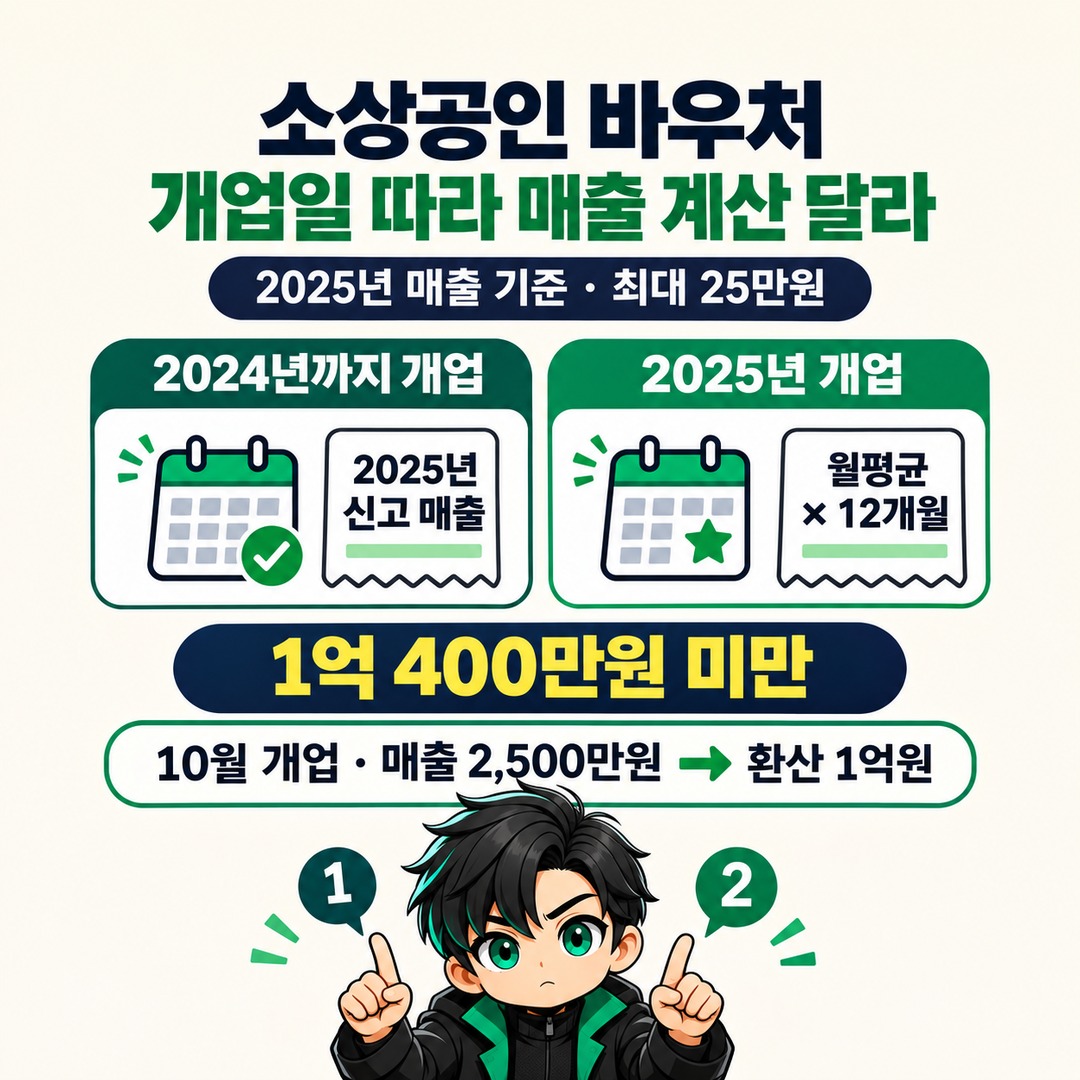
The 2026 Small Business Business Stabilization Voucher is open to operating small businesses whose 2025 annual revenue or annualized revenue was above KRW 0 and below KRW 104,000,000, and that opened by 2025-12-31. However, businesses opened in 2025 must annualize their revenue rather than compare their actual revenue as is.
As of 2026-11-23, eligible businesses can receive up to KRW 250,000 per business. Applications are accepted until the budget is exhausted, so check both whether you meet the eligibility requirements and whether applications are still being accepted.
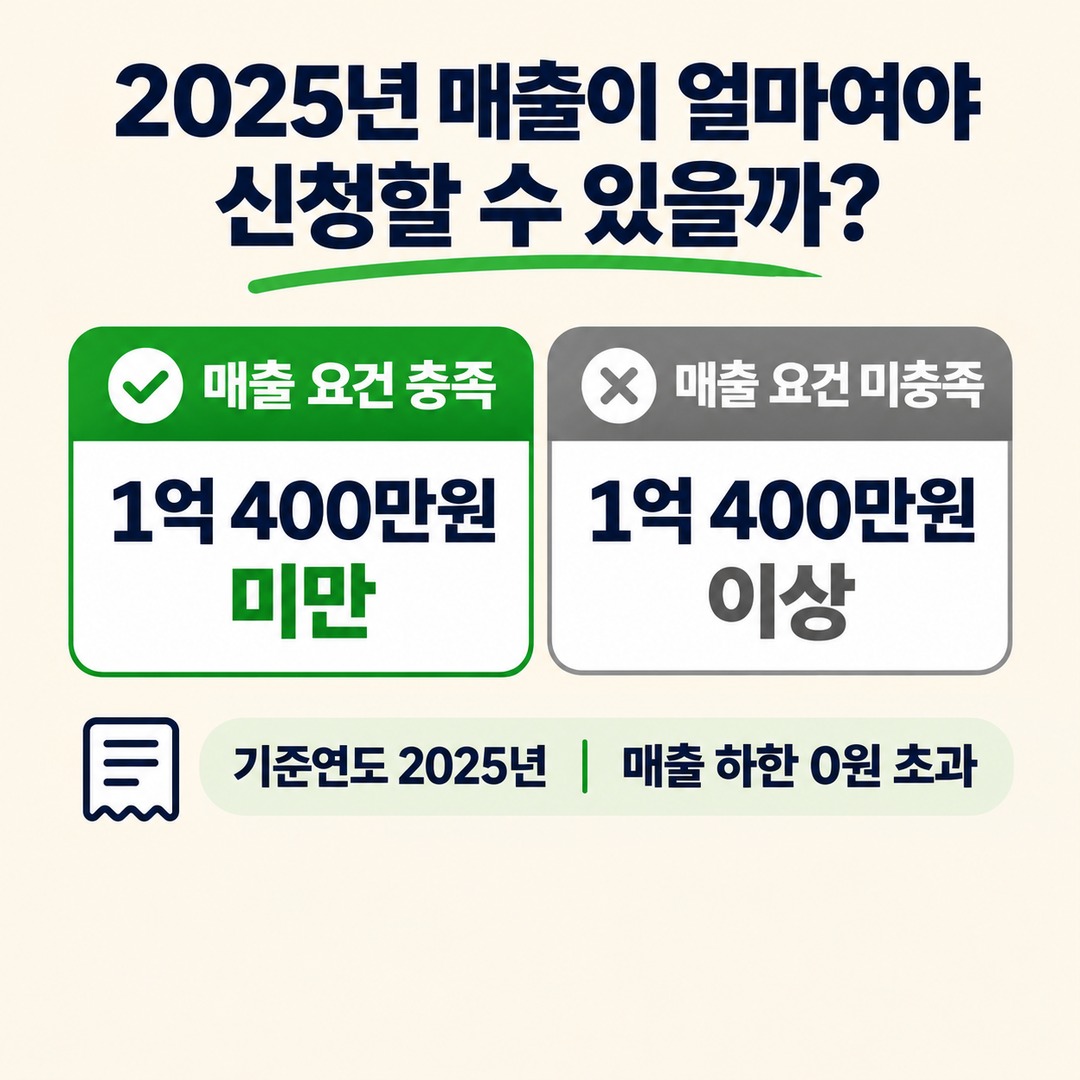
How much revenue did you need in 2025 to apply?
The revenue threshold is below KRW 104,000,000 in annual or annualized revenue for 2025. Revenue exactly equal to KRW 104,000,000 or above does not meet the revenue requirement.
According to the implementation notice for the Small Business Business Stabilization Voucher announced by the Ministry of SMEs and Startups on 2026-01-28, the Korea SMEs and Startups Agency checks eligibility using reported sales data from the National Tax Service and other sources.
| Checkpoint | 2026 eligibility criteria |
|---|---|
| Revenue reference year | 2025 |
| Revenue lower bound | Above KRW 0 |
| Revenue upper bound | Below KRW 104,000,000 |
| Business opening date | On or before 2025-12-31 |
| Operating status | Must not be temporarily closed or shut down on the application date |
| Grant amount | Up to KRW 250,000 per business |
The business opening year is the point that requires the most attention.
The method for assessing revenue differs between businesses opened before 2024-12-31 and those newly opened in 2025.
If your business opened in 2025, check annualized revenue rather than actual revenue
For small businesses opened in 2025, annual revenue is calculated by multiplying average monthly revenue since opening by 12 months.
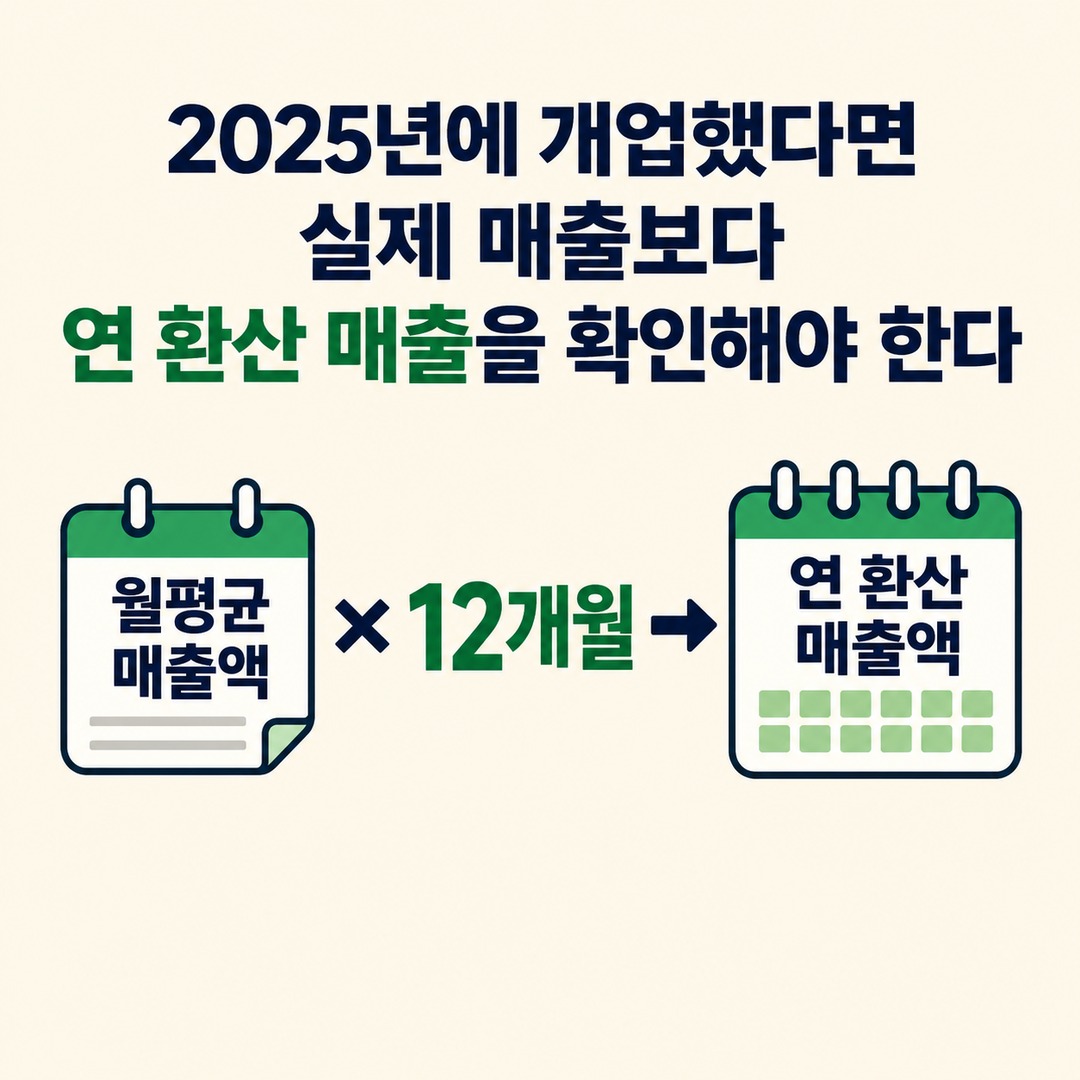
The calculation is as follows.
Annualized revenue = 2025 reported revenue ÷ number of months since opening × 12 months
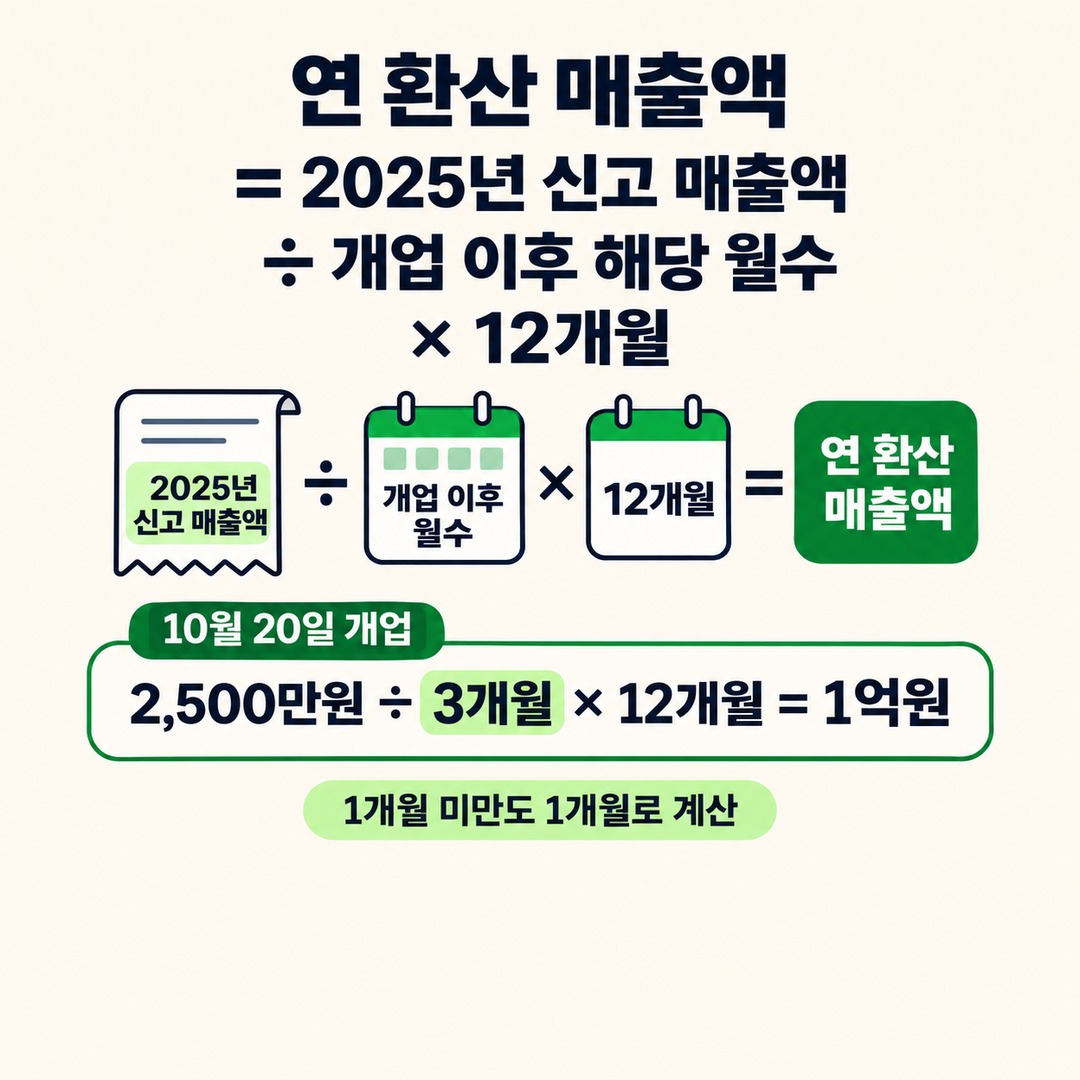
A period shorter than 1 months is also counted as 1 months. Therefore, the result may differ from annualizing based on 365 days, calculated using the number of days from the opening date through December 31.
What if you opened in October 20 and earned KRW 25,000,000?
Applying the calculation example provided in the Ministry of SMEs and Startups’ official notice gives the following:
Opening date: 2025-10-20
2025 revenue: KRW 25,000,000
Period included in the calculation: October~December, 3 months
Average monthly revenue: approximately KRW 8,333,333
Annualized revenue: KRW 100,000,000
The calculation is KRW 25,000,000 ÷ 3 months × 12 months = KRW 100,000,000.
Annualized revenue of KRW 100,000,000 is KRW 4,000,000 below the eligibility threshold of KRW 104,000,000. Therefore, this example meets the revenue requirement.
By contrast, annualizing based on 365 days and the 72 actual operating days gives approximately KRW 126,740,000. However, this is not the calculation method used in the official notice.
Businesses that started up in the second half of 2025 should not determine their eligibility based only on the amount earned by the end of the year.
Can you apply if your business opened on 2025-12-31?
A business that opened on 2025-12-31 also meets the opening-date requirement. However, meeting this requirement does not automatically make the business eligible for support.
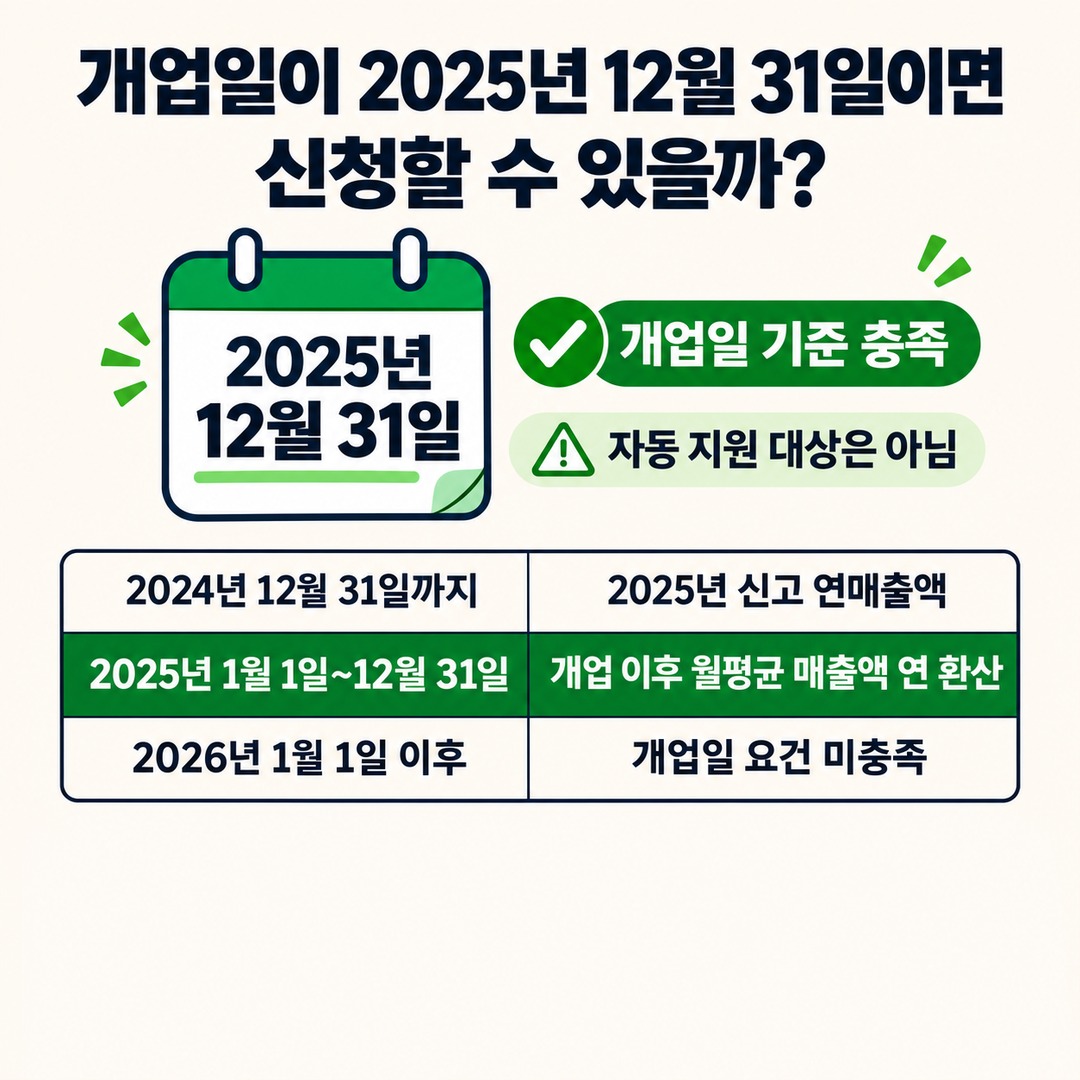
Eligibility is determined based on the opening date listed on the business registration certificate. A business opened after 2026-01-01 does not meet the opening-date requirement for the 2026 program.
Here is a summary of how the opening date affects eligibility.
| Opening period | How revenue is assessed |
|---|---|
| Through 2024-12-31 | Reported annual revenue for 2025 |
| 2025-01-01~December 31 | Annualized average monthly revenue since opening |
| After 2026-01-01 | Does not meet the opening-date requirement |
In particular, businesses opened in December 2025 must annualize their revenue, even if the period in which they earned revenue was short.
Revenue calculation example for a business opened in December
The following is a hypothetical example using the official calculation method.
Assume the business opened in 2025-12-15 and reported revenue of KRW 8,000,000 through December 31.
Actual revenue: KRW 8,000,000
Calculation period: 1 months
Annualized revenue: KRW 8,000,000 × 12 months = KRW 96,000,000
Annualized revenue of KRW 96,000,000 is below the threshold of KRW 104,000,000, so it meets the revenue requirement.
By contrast, if reported revenue for the same period were KRW 9,000,000, annualized revenue would be KRW 108,000,000. In that case, it would exceed the revenue threshold.
These two cases are hypothetical examples intended to explain the calculation method; they are not actual application outcomes. The final determination also takes into account National Tax Service reported data and the other eligibility requirements.
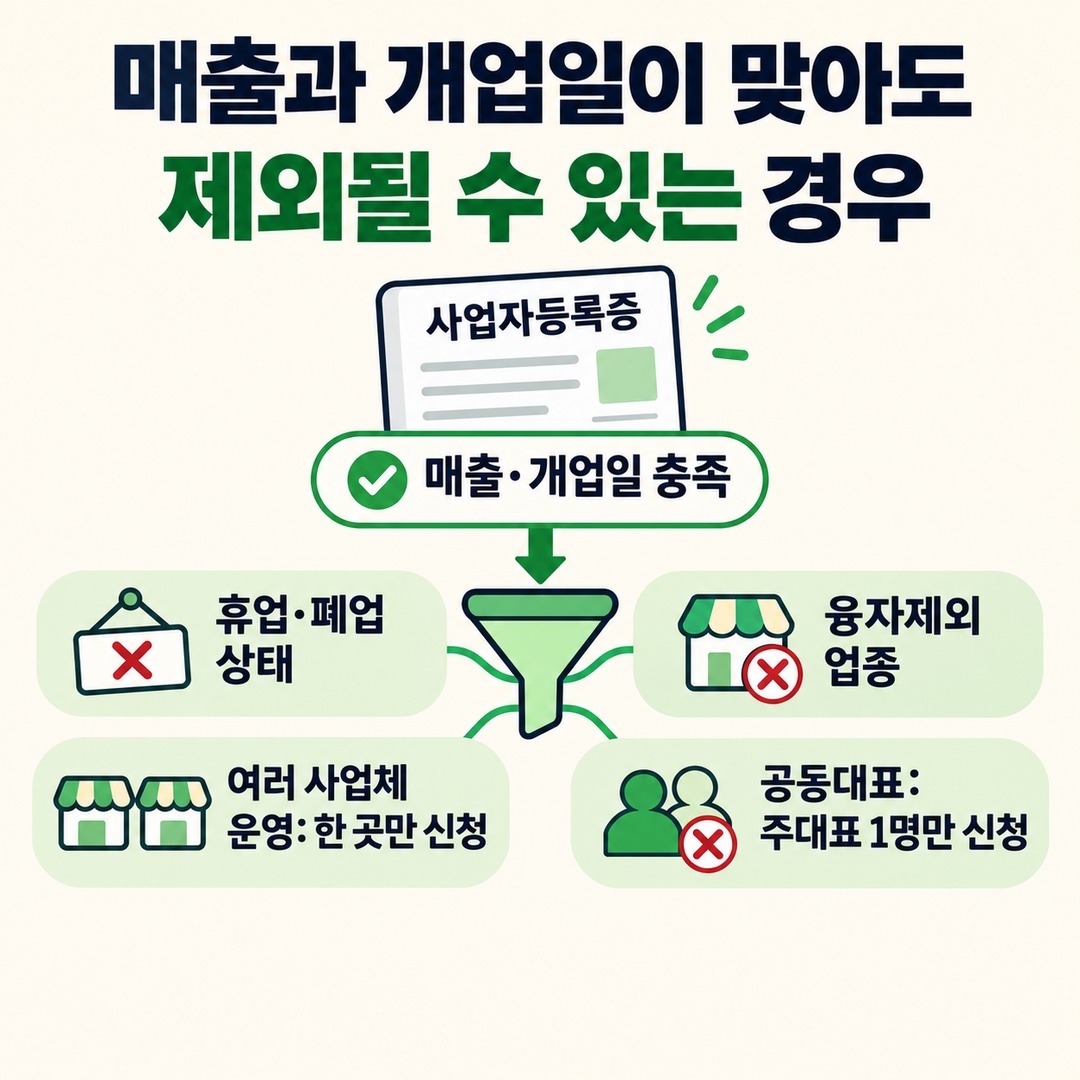
When you may be ineligible despite meeting the revenue and opening-date requirements
Even if you meet both the revenue and opening-date requirements, you are not eligible if your business is temporarily closed or shut down on the application date.
You should also check for industry restrictions and limits on duplicate support when operating multiple businesses.
According to the Ministry of SMEs and Startups’ announcement on 2026-01-27, industries excluded from small business policy fund loans are not eligible for this support.
Examples include adult entertainment, tobacco brokerage, gambling machines and other speculative businesses, and virtual asset trading or brokerage.
Even if one person operates multiple businesses, they can apply for only one business that meets the requirements. For a business with joint representatives, only one lead representative may apply.
Before applying, check the business registration status and industry as well as revenue.
Can you apply now, as of November 2026?
Applications for the 2026 Business Stabilization Voucher opened at February 9 on 9. The provisional application deadline stated in the official notice is 2026-12-18 at 6, but applications may close early if the budget is exhausted first.
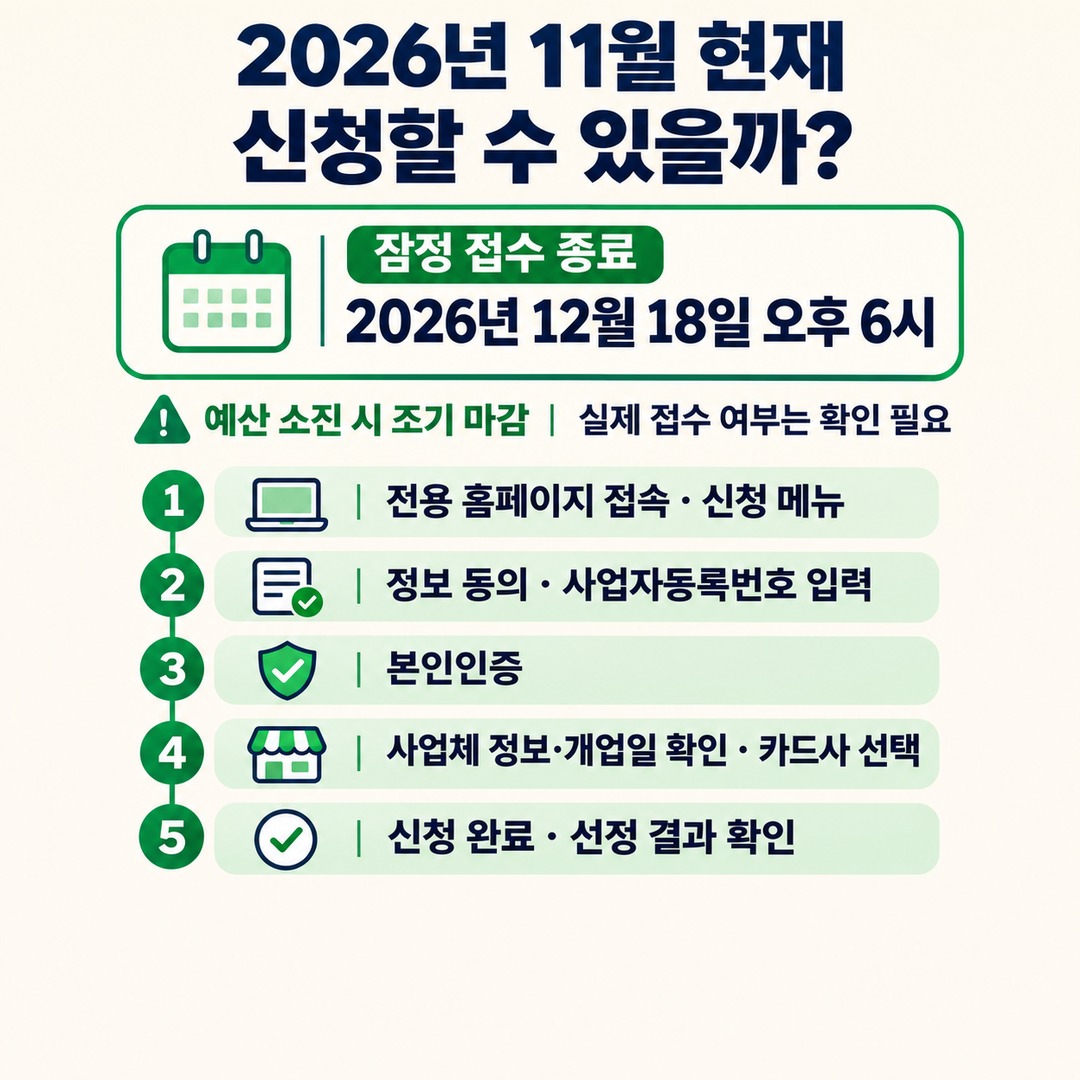
Therefore, small businesses preparing to apply as of November 23 should check whether applications are actually being accepted.
Applications are submitted through the dedicated Small Business Business Stabilization Voucher website.
The application process is as follows.
1. Visit the dedicated website and select the application menu.
2. Agree to the provision of personal information and enter your business registration number.
3. Verify your identity using a mobile phone or certificate.
4. Check your business information and opening date, then select a card issuer.
5. After completing the application, check the selection result through a Kakao notification or on the website.
Generally, the program uses National Tax Service tax data, so no separate paper documents are required. However, some tax-exempt businesses may need to submit supporting documents if their revenue must be verified again.

Once selected, the voucher is registered with the card issuer you chose. You cannot change the card issuer or card type after registration, so choose carefully when applying.
Where can you use the KRW 250,000 you receive?
The Business Stabilization Voucher is not a grant that can be freely withdrawn as cash. When you pay for designated fixed-cost items by card, the support amount is deducted first.
Eligible expenses include electricity, gas, and water bills; National Pension, health insurance, employment insurance, and workers’ compensation premiums; fuel for business vehicles; and traditional market fire insurance premiums.
In 2026, traditional market fire insurance premiums were added as an eligible expense, while telecommunications charges were excluded.
The voucher must be used by 2026-12-31. Any remaining balance is generally reclaimed after the deadline.
For example, if the voucher balance is KRW 250,000 and you pay KRW 100,000 in eligible utility bills, KRW 100,000 is deducted from the voucher, leaving KRW 150,000. The voucher does not apply to purchases at regular restaurants, which are not designated eligible businesses.
What should you check one last time before applying?
Eligibility for the 2026 Small Business Business Stabilization Voucher is not determined solely by whether 2025 revenue was below KRW 104,000,000.
If your business opened in 2025, calculate its annualized revenue and check the business registration certificate to confirm it opened by 2025-12-31. It must also be operating on the application date and meet the industry requirements.
In particular, for businesses opened in October 2025 or December, actual revenue over a short operating period may differ substantially from the official annualized revenue.
The most reliable approach is to check your business opening date and reported 2025 revenue, then use the dedicated website to check whether you qualify and can apply.