

2026 Energy Voucher: Families With 2 Children Qualify as Multi-Child Households, Eligibility and Benefits for Basic Livelihood Security Recipients
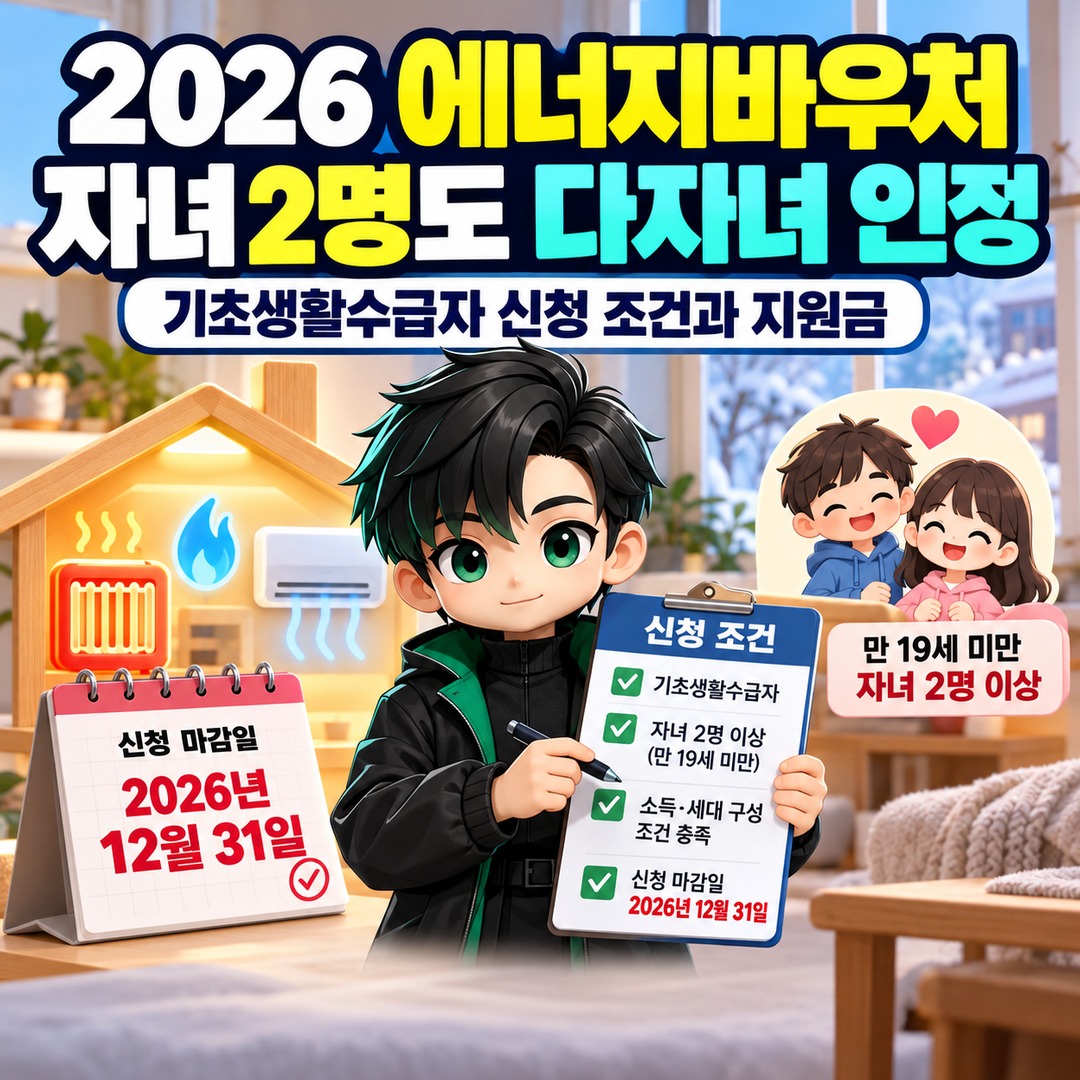
Under the 2026 Energy Voucher program, households receiving Basic Livelihood Security benefits may apply if they have 2 children under the age of 19. This year's multi-child criterion is 2 or more children, rather than 3, and households must meet both the income and household composition requirements. The application deadline is 2026-12-31.
As of 2026-10-20, the key details to check are the children's ages, the household composition recorded in the resident registration system, and whether the household receives benefits under the National Basic Livelihood Security system.
Families with 2 children, in particular, should first determine whether they meet the multi-child criterion.
Do 2 Children Qualify as a Multi-Child Household Under the 2026 Energy Voucher Program?
The multi-child criterion for the 2026 Energy Voucher program is 2 or more children under the age of 19.
A household may satisfy the multi-child household-member criterion if at least one parent and 2 or more of that parent's children are registered as members of the same household.
Therefore, having at least 3 children is not a requirement.
However, meeting the multi-child criterion alone does not mean that Energy Voucher benefits will be paid automatically.
This is because the Energy Voucher program applies both an income criterion and a household-member characteristic criterion.
For example, if parents and their children aged 10 and 15 are registered in the same household, and that household receives livelihood benefits, it would be an example of a household meeting both criteria.
Conversely, even if a family has 2 children, if one child is aged 19 or older, those children alone do not satisfy the multi-child household characteristic criterion.
However, the household may still qualify separately if another household member meets a different qualifying characteristic.
Which Basic Livelihood Security Benefits Make a Household Eligible to Apply?
The 2026 Energy Voucher program applies its income criterion to households receiving at least one of the following benefits under Korea's National Basic Livelihood Security system: livelihood, medical, housing, or education benefits.
Eligibility is not limited to households receiving livelihood or medical benefits.
Recipients of housing or education benefits may also qualify if they meet the household-member characteristic criterion.
In addition to multi-child households, qualifying household characteristics include older adults, infants and young children, people with disabilities, pregnant women, people with severe, rare, or severe intractable diseases, single-parent families, and child-headed households.
Therefore, even if 2 children in a Basic Livelihood Security recipient household do not meet the multi-child criterion, the household should check whether another qualifying characteristic applies.
By contrast, an ordinary multi-child household that does not receive Basic Livelihood Security benefits does not become eligible for Energy Voucher support solely because it has 2 children.
How Much Support Can 3-Person and 4-Person Households With 2 Children Receive?
The 2026 Energy Voucher benefit amount depends on the total number of household members recorded in resident registration, not the number of children.
For a 3-person household consisting of 1 parents and 2 children, the annual benefit amount is KRW 532,700.
For a 4-person household consisting of 2 parent and 2 children, the annual benefit amount is KRW 701,300.
The 2026 benefit amounts by household size are as follows.
| Number of Registered Household Members | 2026 Benefit Amount |
|---|---|
| 1-person household | KRW 295,200 |
| 2-person household | KRW 407,500 |
| 3-person household | KRW 532,700 |
| Household with 4 or more people | KRW 701,300 |
The difference in support between a 3-person household and a household with 4 or more members is KRW 168,600.
An important point is that these amounts represent the total benefit for 2026, not a monthly payment.
In addition, households with 4 or more members fall into the same benefit bracket regardless of whether they have 4 or 5 members.
However, if a household chooses other forms of assistance, such as emergency welfare winter fuel assistance, coal briquette coupons, or the coal-to-alternative-energy transition voucher, restrictions on overlapping benefits and separate benefit amounts may apply.
If You Apply by December 31, How Long Can You Use the Voucher?
Although the application deadline for the 2026 Energy Voucher program is December 31, the voucher can be used until 2027-05-31.
The application deadline and the final date for using Energy Voucher benefits are different.
The 2026 application period runs from June 15 through December 31, while the usage periods are divided as follows.
| Category | Usage Period |
|---|---|
| Summer | 2026-07-01~September 30 |
| Winter utility bill deductions | 2026-10-01~2027-05-31 |
| Winter National Happiness Card | 2026-10-03~2027-05-31 |
As of 2026-10-20, the winter usage period is in effect.
During winter, households can choose between having electricity, city gas, or district heating charges deducted from their bills and paying energy expenses with the National Happiness Card.
The most suitable method depends on the energy source used, such as kerosene, LPG, or coal briquettes.
In addition, official guidance for 2026 indicates that application and reapplication services may be temporarily suspended for 2~3 days toward the end of December.
It is therefore advisable to check eligibility in advance rather than waiting until the application deadline.
Where Can You Apply for an Energy Voucher?
Applications for the 2026 Energy Voucher program can be submitted through the local eup, myeon, or dong administrative welfare center responsible for the applicant's registered residence, or through Bokjiro, Korea's online welfare services portal.
Application methods include in-person applications, online applications, and applications initiated by an authorized public official.
For an in-person application, applicants complete the required forms at their local administrative welfare center.
Online applications are submitted through Bokjiro and reviewed and processed by the responsible public official.
People with mobility difficulties or those unable to apply independently may also use a representative or have an authorized public official submit an application with their consent.
Applicants should prepare the following information and documents.
Household composition recorded in resident registration and the children's dates of birth
Whether the household receives livelihood, medical, housing, or education benefits
The applicant's identification and required application documents
A recent energy bill when applying for utility bill deductions
A letter of authorization and the representative's identification when applying through a representative
Apartment residents applying for utility bill deductions may need to provide a building maintenance fee statement.
After an application is submitted, the relevant city, county, or district government checks benefit eligibility, household-member characteristics, and household size before determining eligibility and the amount of support.
Can You Apply If You Already Receive Other Heating Assistance?
The 2026 winter Energy Voucher cannot be received simultaneously with certain other heating assistance programs.
Examples include emergency welfare winter fuel assistance from October 2026 through March 2027, coal briquette coupons for 2026, and coal-to-alternative-energy transition vouchers for 2026.
Households already receiving other assistance should check restrictions on overlapping benefits before applying.
Households are also excluded from Energy Voucher support if every household member receives benefits while residing in a residential welfare facility covered under Korea's National Basic Livelihood Security Act.
Therefore, even if a household receives Basic Livelihood Security benefits and has 2 children, its actual eligibility is determined only after its household composition and participation in other assistance programs have been reviewed.
What Basic Livelihood Security Recipient Households With 2 Children Should Check First
Under the 2026 Energy Voucher program, 2 children may be sufficient to meet the multi-child household characteristic criterion.
In particular, a 3-person household consisting of 1 parents and 2 children receives a different benefit amount from a 4-person household consisting of 2 parent and 2 children. It is therefore important to verify the exact number of household members recorded in resident registration.
The application deadline is 2026-12-31, and winter Energy Voucher benefits can be used until 2027-05-31.
Households that have not yet applied should verify their children's ages as recorded in resident registration and their Basic Livelihood Security eligibility before applying through their local administrative welfare center or Bokjiro.
If a household's individual eligibility or restrictions on overlapping benefits remain unclear, it can contact the Energy Voucher Integrated Counseling Center at 1600-3190.