

2026 National Pension: Why Less Than KRW 142,500 Is Deducted From a KRW 3,000,000 Salary — The Difference Made by KRW 200,000 in Tax-Exempt Meal Allowances

Even if your gross monthly salary is KRW 3,000,000 in 2026, your National Pension contribution is not necessarily KRW 142,500. If your salary includes a tax-exempt meal allowance of KRW 200,000 and your standard monthly income for National Pension purposes is KRW 2,800,000, your monthly employee contribution is KRW 133,000. Even with the same gross salary of KRW 3,000,000, differences in salary composition can result in a monthly contribution difference of KRW 9,500.

However, the actual deduction depends on the standard monthly income reported to the National Pension Service and when that amount takes effect.
*Information verified as of 2026-10-11 / National Pension workplace-based insured persons*
1. Why Is My National Pension Contribution KRW 133,000 When My Salary Is KRW 3,000,000?
The key point is that the gross salary shown on your payslip is not always the same as the standard monthly income used to calculate National Pension contributions.

In 2026, the National Pension contribution rate is 9.5%, with workplace-based insured employees and their employers each paying 4.75%.
The National Pension Service explains that contributions are calculated using income excluding tax-exempt amounts.
For example, suppose a monthly salary of KRW 3,000,000 consists of the following components:
Base salary and taxable allowances: KRW 2,800,000
Tax-exempt meal allowance: KRW 200,000
Total gross salary: KRW 3,000,000
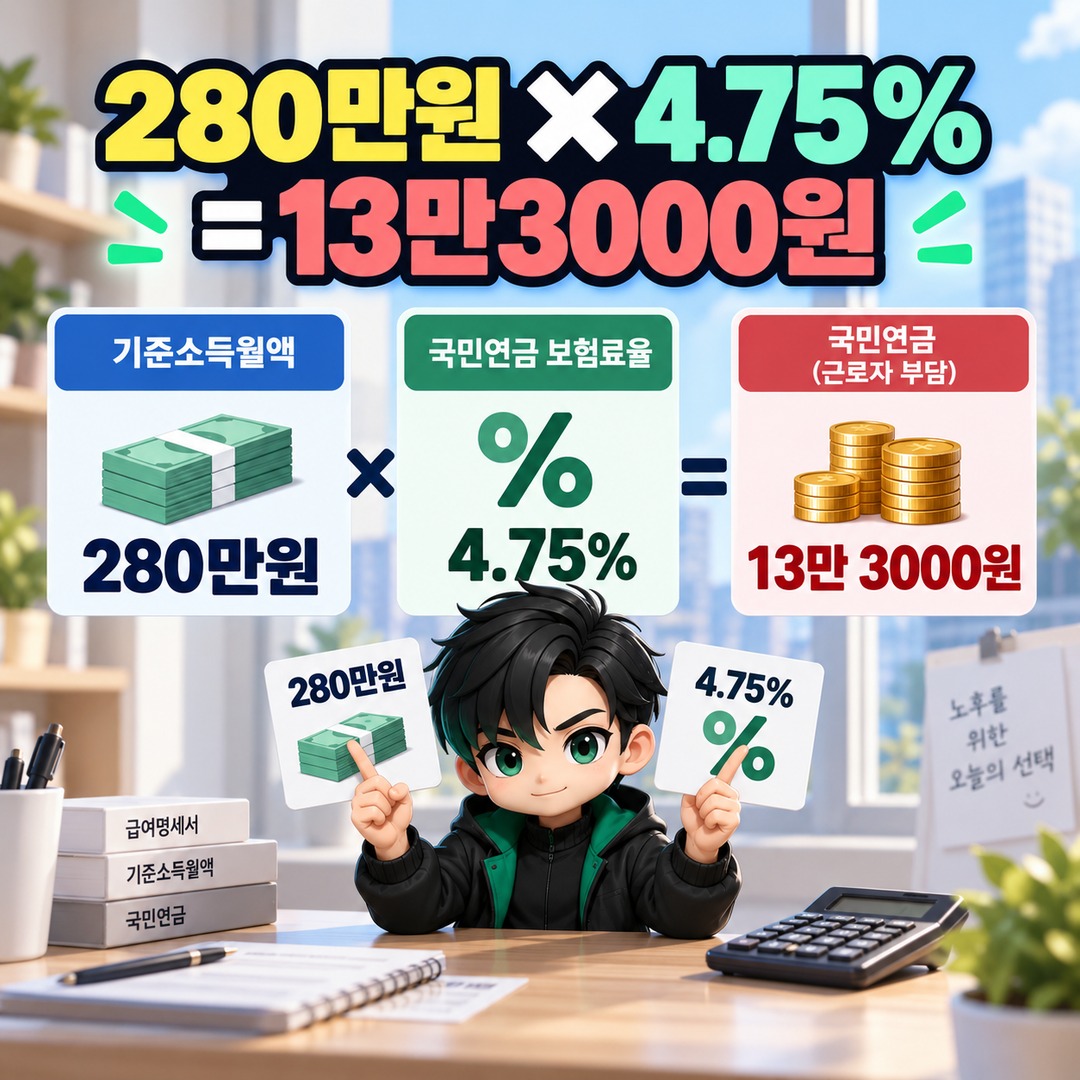
If the tax-exempt meal allowance of KRW 200,000 is excluded from the National Pension contribution calculation and the reported standard monthly income is KRW 2,800,000, the calculation is as follows.
KRW 2,800,000 × 4.75% = KRW 133,000
Conversely, if the entire KRW 3,000,000 is subject to contributions and the standard monthly income is also KRW 3,000,000, the calculation is as follows.
KRW 3,000,000 × 4.75% = KRW 142,500
Both employees receive a gross salary of KRW 3,000,000, but their actual National Pension deductions may differ.
2. How Much Difference Does a Tax-Exempt Meal Allowance of KRW 200,000 Make?
Even employees earning the same gross monthly salary of KRW 3,000,000 may have different National Pension deductions depending on the amount of tax-exempt income included in their pay.
The following calculations assume that all other conditions are identical and that each employee's reported standard monthly income equals the corresponding taxable income amount.
| Monthly Tax-Exempt Amount | Standard Monthly Income | Employee Contribution |
|---|---|---|
| KRW 0 | KRW 3,000,000 | KRW 142,500 |
| KRW 100,000 | KRW 2,900,000 | KRW 137,750 |
| KRW 200,000 | KRW 2,800,000 | KRW 133,000 |
*Calculated by the author using the 2026 employee contribution rate of 4.75%.*
Under these assumptions, each increase of KRW 100,000 in tax-exempt income reduces the employee's monthly National Pension contribution by KRW 4,750.
Comparing a situation with no tax-exempt income against one with KRW 200,000 in tax-exempt income gives the following results:
Difference in monthly deductions: KRW 9,500
Simple total over 12 months: KRW 114,000
Difference in employer contributions: KRW 9,500 per month
There is an important point to consider here.
Paying Less Into the National Pension Is Not Necessarily an Advantage.
Standard monthly income is used not only to calculate contributions but also to determine future pension benefits. If all other conditions are equal, a lower reported income may also affect the amount of pension received in the future.

However, the actual amount of an old-age pension depends on factors such as the total contribution period, income history during the insured period, and the pension benefit formula. Therefore, a difference in monthly contributions alone cannot establish the exact difference in future pension benefits.
3. Other Reasons Your Gross Salary and Standard Monthly Income May Differ
Tax-exempt meal allowances are not the only possible explanation.
National Pension contributions are not calculated solely by reflecting an employee's current monthly salary every month.
For workplace-based insured persons, standard monthly income is generally determined through a regular assessment based on income earned at the relevant workplace during the previous year. The assessed amount applies from July of that year through June of the following year.
Therefore, even if your salary has increased this year, your National Pension deduction may not change immediately.
Consider the following example.
An employee currently earns KRW 3,000,000 per month in 2026, but the standard monthly income registered with the National Pension Service is KRW 2,800,000.
In this case, the employee contribution is calculated as follows.
KRW 2,800,000 × 4.75% = KRW 133,000
A discrepancy arises if you look only at the current salary on your payslip and assume that KRW 142,500 should be deducted.
This is because the contribution may still be based on an amount determined using previous income.
Conversely, an employee's salary may decrease while their National Pension contribution remains unchanged.
However, separate procedures may apply, including requests to change standard monthly income following changes in earnings. Therefore, not every employee must wait until the next regular assessment.
4. The Standard Monthly Income Ceiling Also Changed From July 2026
The applicable standard monthly income range for National Pension contributions from July 2026 through June 2027 is as follows.
| Category | Standard Monthly Income |
|---|---|
| Minimum | KRW 410,000 |
| Maximum | KRW 6,590,000 |
| Applicable Period | July 2026~June 2027 |
Employees earning approximately KRW 3,000,000 per month generally do not reach the income ceiling. Their contributions can therefore be calculated by applying the employee contribution rate of 4.75% to their actual reported standard monthly income.
By contrast, the ceiling applies to individuals whose standard monthly income exceeds the maximum.
For example, if an employee's reported monthly income at one workplace is KRW 7,000,000, contributions are calculated using the ceiling of KRW 6,590,000 rather than the entire KRW 7,000,000.
KRW 6,590,000 × 4.75% = KRW 313,025
This is the employee contribution calculated using the maximum standard monthly income.
Therefore, when checking your National Pension deductions, it is more accurate to confirm the standard monthly income applicable to you before simply multiplying your salary by 4.75%.
5. How to Check Whether Your National Pension Deduction Is Correct
If your payslip shows a National Pension deduction that is lower or higher than expected, follow these steps to check it.
First, Check the Tax-Exempt Items on Your Payslip.
Look for amounts treated as tax-exempt income, such as meal allowances.
The fact that a meal allowance appears on your payslip does not automatically mean the entire amount is tax-exempt. You must check whether it meets the tax-exemption requirements under Korean tax law.
Second, Check the Standard Monthly Income Reported by Your Employer.
You can ask your payroll administrator about the standard monthly income currently reported to the National Pension Service.
You can also check information related to your National Pension enrollment and contributions through the National Pension Service's electronic civil service portal.
Third, Check When the Reported Amount Took Effect.
If your current salary differs from your standard monthly income, check the regular assessment date, the amount reported when you joined the company, and whether any subsequent changes were reported.
Fourth, Calculate the Contribution Yourself.
For a typical workplace-based insured employee in 2026, use the following formula.
National Pension employee contribution = Standard monthly income × 0.0475
For example, if your standard monthly income is KRW 2,800,000, your contribution is KRW 133,000.
If the calculated amount differs from the deduction shown on your payslip, check whether there are additional reasons, such as contribution subsidies, adjustments, changes in reported income, or the timing of payroll deductions.
The National Pension Service customer support number is 1355, with no area code required.
6. Can My National Pension Deduction Still Be KRW 142,500 Even With a Tax-Exempt Meal Allowance of KRW 200,000?
Yes, it can.
Having a tax-exempt meal allowance of KRW 200,000 on your payslip does not necessarily mean every employee's National Pension contribution will be KRW 133,000.
Some common situations include the following.
First, your current salary composition may differ from the standard monthly income reported to the National Pension Service.
Second, the amount determined through a regular assessment based on previous income may still apply.
Third, you may need to confirm whether the meal allowance shown on your payslip actually qualifies as tax-exempt income excluded from the National Pension contribution calculation.
Fourth, your payslip may include adjustments for contributions from previous periods.
Therefore, you should not conclude that your employer has incorrectly deducted National Pension contributions simply because you receive a tax-exempt meal allowance.
You need to compare the actual reported standard monthly income with the details of your payroll deductions.
7. Frequently Asked Questions
Q. If My Monthly Salary Is KRW 3,000,000, Is My National Pension Contribution Always KRW 142,500 in 2026?
No. KRW 142,500 is the employee contribution for a workplace-based insured person whose standard monthly income is KRW 3,000,000. The actual deduction may differ because of tax-exempt income or differences in the reported standard monthly income.
Q. Does Receiving a Tax-Exempt Meal Allowance of KRW 200,000 Automatically Reduce My National Pension Contribution by KRW 9,500?
No. KRW 9,500 is the calculated difference when the standard monthly income actually changes from KRW 3,000,000 to KRW 2,800,000. The result depends on the currently reported amount and whether the change has taken effect.
Q. If Less National Pension Is Deducted Now, Will I Receive a Smaller Pension Later?
Standard monthly income is one of the factors used to calculate future pension benefits, so it may affect the amount you receive. However, the total contribution period and past income history are also considered. You cannot determine your future pension benefits from your current monthly contribution alone.
Conclusion: Check Your Standard Monthly Income Before Looking at Your Salary
When checking National Pension contributions in 2026, the most important figure is not the gross salary shown on your payslip but the standard monthly income reported to the National Pension Service.
Even if your gross monthly salary is KRW 3,000,000, your employee contribution is KRW 142,500 if your standard monthly income is KRW 3,000,000, and KRW 133,000 if it is KRW 2,800,000.
The difference between these amounts is KRW 9,500 per month.
However, having a tax-exempt meal allowance does not automatically change your standard monthly income.
To determine whether your National Pension deduction is correct, you need to check the tax-exempt items on your payslip, the income amount reported by your employer, and when the standard monthly income became applicable.