

2026-08-05 KOSPI Outlook: Check AMD Earnings and Foreign Investor Flows Rather Than Just a Higher Open
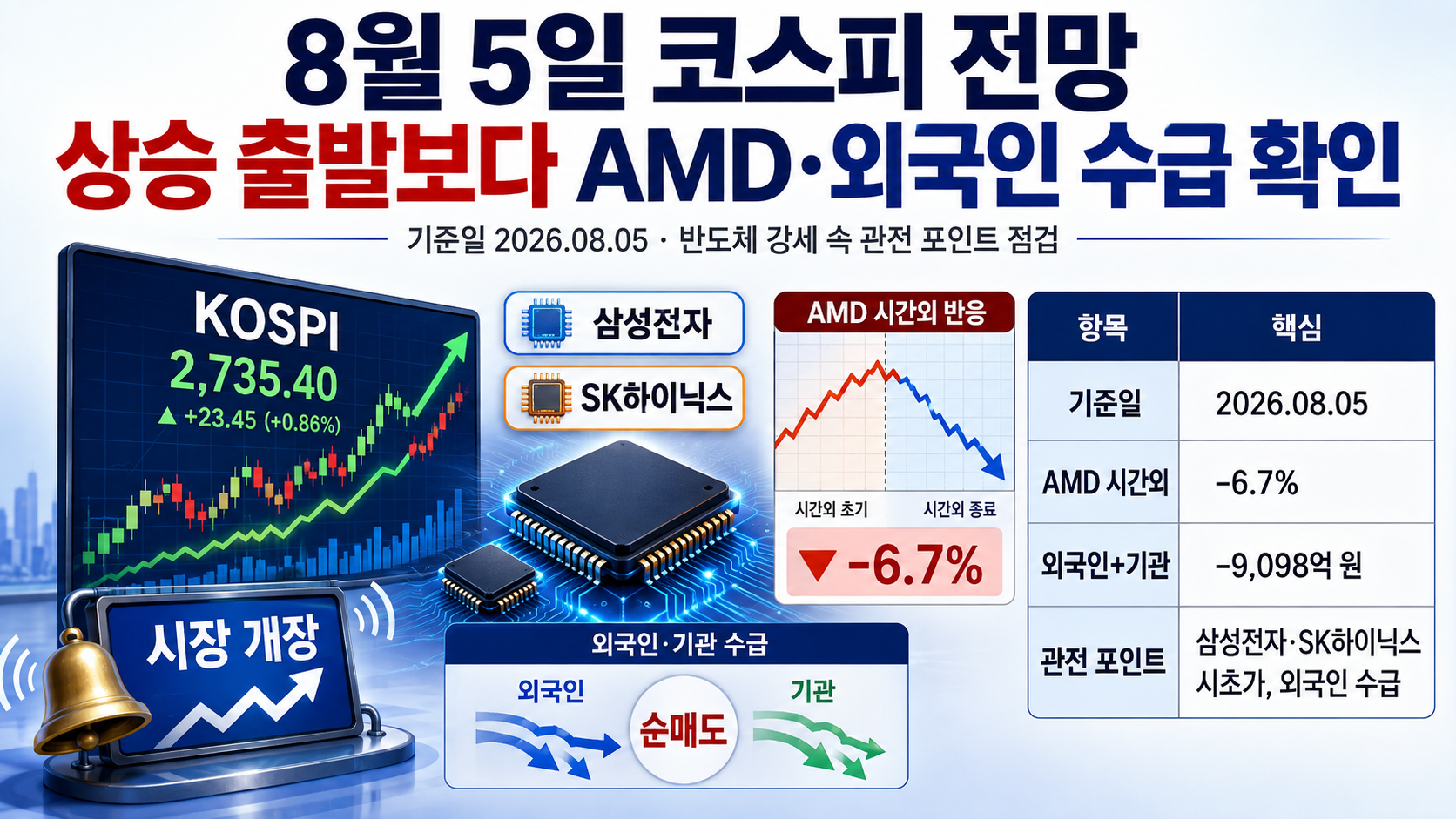
The 2026-08-05 KOSPI has favorable conditions for the opening thanks to sharp gains in U.S. stocks and the semiconductor index. However, AMD fell approximately 6.7% in after-hours trading despite reporting better-than-expected earnings, while foreign and institutional investors recorded combined net selling of KRW 909,800,000,000 on the KOSPI the previous day.
Therefore, what matters more today than the opening index level is whether Samsung Electronics and SK Hynix can hold their opening prices and whether foreign investors are buying both cash equities, meaning actual shares, and KOSPI 200 futures.
What Is the Difference Between a Higher Open and a Sustained Uptrend?
A higher open reflects the previous U.S. market session and premarket expectations in opening prices. A sustained uptrend, however, requires continued foreign capital inflows after the opening and sufficient buying demand to absorb selling pressure in major semiconductor stocks.
Overnight, the Nasdaq index rose 2.59%, while the Philadelphia Semiconductor Index gained 6.6%. These are positive developments for the Korean stock market, but investors must also consider that AMD released its earnings after the U.S. regular trading session had ended.
| Comparison | Higher Open | Sustained Advance |
|---|---|---|
| Main driver | Sharp U.S. market gains and premarket expectations | Foreign buying of cash equities and futures |
| When to check | Opening price at 9 a.m. | 9:20 a.m.–10:30 a.m. |
| Semiconductor indicator | Gap-up openings in Samsung Electronics and SK Hynix | Holding opening prices and breaking above previous highs again |
| Warning signs | Selling pressure after a high opening | Increasing foreign net selling |
| Assessment | Confirms only the initial direction | More important for assessing the day's trend |
It is difficult to conclude that Korean semiconductor stocks will sustain their gains simply because the U.S. semiconductor index rose. AMD gave back most of its regular-session gains in after-hours trading.
Why Did AMD Shares Fall After Hours Despite Strong Earnings?
AMD's revenue and adjusted earnings per share for the 2 quarter of 2026 exceeded market expectations. Its revenue guidance for the 3 quarter also indicated continued growth. However, because the stock had already risen more than 7% during regular trading, selling pressure may have emerged as investors questioned whether the results were strong enough to exceed already elevated expectations.
Key AMD Figures for the 2 Quarter of 2026
| Metric | Reported Figure | Comparison |
|---|---|---|
| Revenue | USD 11,536,000,000 | Up 50% year over year |
| Non-GAAP earnings per share | USD 1.66 | Up 246% year over year |
| Data center revenue | USD 6,700,000,000 | Up 107% year over year |
| Non-GAAP gross margin | 56% | Up 13% percentage points year over year |
| Revenue guidance for the 3 quarter | USD 13,000,000,000±USD 300,000,000 | Approximately 41% year-over-year growth at the midpoint |
| Gross margin guidance for the 3 quarter | Approximately 56% | Non-GAAP basis |
The earnings trend remains positive. Data center revenue more than doubled, and AMD expects data center revenue growth to accelerate further in the second half of the year.
However, stock prices move in response to results relative to expectations already priced in, rather than absolute earnings levels alone. On August 4, AMD rose 7.22% to USD 518.58 during regular trading. However, during the 7 a.m. hour on August 5 Korea time, its after-hours price was approximately USD 483.83, or 6.7% below the regular-session closing price.
Author's Calculations
After-hours percentage change: USD 483.83 ÷ USD 518.58 - 1 = approximately -6.70%
Estimated previous trading day's closing price: USD 518.58 - USD 34.99 = USD 483.59
After-hours price compared with the previous closing price: USD 483.83 ÷ USD 483.59 - 1 = approximately +0.05%
In effect, the sharp regular-session gain had almost entirely disappeared in after-hours trading. This appears less like a sign of weak earnings and more like an indication that elevated expectations had already been substantially priced in.
After-hours trading was still underway at 7:48 a.m. Korea time, so the final price and percentage change could differ.
The Previous Day's KOSPI Rebound Was Not Driven by Foreign Investors
On August 4, the KOSPI closed at 6,358.95, up 1.62%, but individual investors drove the advance. Foreign and institutional investors were both net sellers, while program trading also showed a net selling bias.
| KOSPI Investor Flows on August 4 | Net Buying or Selling |
|---|---|
| Individual investors | KRW 818,400,000,000 net buying |
| Foreign investors | KRW 370,600,000,000 net selling |
| Institutional investors | KRW 539,200,000,000 net selling |
| Program trading | KRW 406,600,000,000 net selling |
Author's Calculation: Combined net selling by foreign investors of KRW 370,600,000,000 and institutional investors of KRW 539,200,000,000 amounted to KRW 909,800,000,000.
Although the index rose, foreign and institutional investors did not confirm the rebound through their buying activity. Even if the KOSPI opens higher today, gains could narrow quickly if foreign investors resume net selling or concentrate their selling in semiconductor stocks.
Intraday volatility was also substantial the previous day. The KOSPI fell as low as 6,080.25 before climbing to 6,389.40, creating an intraday high-to-low range of 309.15 points.
Author's Calculation: 309.15 points ÷ previous trading day's closing level of 6,257.45 × 100 = approximately 4.94%
This is why a single day's rebound is not enough to conclude that volatility has stabilized.
What Should Investors Check on August 5, and in What Order?
Today, the sequence of checks throughout the trading session matters more than any single index reading. A practical approach is to assess opening strength at 9 a.m., foreign investor flows around 9:30 a.m., and whether semiconductor stocks hold their opening prices after 10 a.m.
9:00 a.m.–9:10 a.m.
First, check how much higher Samsung Electronics and SK Hynix open.
Even if both stocks open sharply higher, an immediate drop below their opening prices may indicate that the overnight rise in U.S. semiconductor stocks has already been priced in. Conversely, if they open slightly higher or near unchanged levels and then move to higher prices on increasing trading volume, this may indicate strengthening buying demand.
During the first 5–10 minutes after the opening, concentrated orders can cause exaggerated price movements. It is therefore better not to draw conclusions about the market's direction from opening prices alone.
9:20 a.m.–9:40 a.m.
Second, examine foreign investor activity in both cash equities and KOSPI 200 futures.
Cash equities are actual shares, such as Samsung Electronics and SK Hynix, while KOSPI 200 futures are derivatives used to trade expectations about the future direction of an index centered on large-cap stocks. When foreign investors are net buyers of both cash equities and futures, confidence in the market's upward movement is relatively stronger.
The following situations warrant caution:
The index rises while foreign investors are net sellers of both cash equities and futures.
Foreign investors buy the index, but Samsung Electronics and SK Hynix fall below their opening prices.
Institutional and program selling increases further from the previous day.
The number of advancing stocks declines, with only a few major companies by market capitalization supporting the index.
Preliminary investor flow figures change continuously during the session, so investors should not reach conclusions based on a single snapshot of net buying or selling.
10:00 a.m.–10:30 a.m.
Third, check whether semiconductor stocks are holding their opening prices and morning lows.
If foreign buying emerges and Samsung Electronics and SK Hynix trade above their opening prices, the likelihood of a sustained advance increases. Conversely, if foreign net selling grows and both stocks break below their morning lows again, the index's initial gains could weaken.
Scenario-Based Trading Decision Table
Rather than trying to predict a fixed index target, it is better to assess the market by combining foreign investor flows with semiconductor stock price movements.
| Intraday Scenario | Interpretation | General Response Guideline |
|---|---|---|
| Higher open + foreign net buying of cash equities and futures + semiconductor stocks hold opening prices | Investor flows confirm the advance | Consider entering in stages during pullbacks rather than chasing prices |
| Higher open + foreign net selling + semiconductor stocks fall below opening prices | Gains may reflect only the rise in U.S. markets | Avoid chasing stocks at elevated prices |
| Flat or lower open + foreign investors turn net buyers + relative strength in semiconductor stocks | Buying demand absorbs the initial market shock | Consider selective entries after confirming morning lows |
| Lower open + simultaneous foreign and institutional selling + semiconductor stocks break below their lows | Volatility may expand again | Prioritize cash allocation and loss management |
| Index rises + gains spread to non-semiconductor sectors | Market breadth is improving | Assess earnings and investor flows by sector |
| Index rises + only Samsung Electronics and SK Hynix show strength | The advance depends heavily on a few index constituents | Check the number of advancing stocks and program trading activity |
This table is not an instruction to buy or sell any particular stock. Investors may reach different decisions under the same market conditions depending on their purchase prices and investment horizons.
Existing Shareholders and New Entrants Need Different Criteria
Investors who already hold semiconductor stocks should consider whether those stocks maintain their opening prices and whether foreign investors are buying, rather than reacting immediately simply because opening prices are high. If stocks fail to hold their opening prices after a higher open and foreign net selling increases, short-term volatility management becomes necessary.
New investors holding cash may be better served by observing the first 20–30 minutes after the market opens. With AMD declining in after-hours trading, it is important to confirm whether foreign capital is actually entering the market rather than simply chasing elevated opening prices.
Short-term traders should monitor KOSPI 200 futures and program trading alongside foreign cash equity flows. Long-term investors may place greater importance on AMD's data center growth, earnings prospects for Korean semiconductor companies, and the sustainability of AI investment than on a single day's investor flows.
| Investor Situation | Priority Indicators |
|---|---|
| Existing semiconductor shareholders | Holding opening prices, morning lows, foreign cash equity trading |
| Investors waiting to enter | Direction of investor flows 20–30 minutes after the opening |
| Short-term traders | Foreign futures trading, program trading, trading volume |
| Long-term investors | Data center demand, corporate earnings, valuations |
Variables That Could Change Today's Outlook
The KOSPI does not move solely in response to AMD's earnings. Changes in U.S. stock index futures before the Korean market opens, the won-dollar exchange rate, international oil prices, and developments in the Middle East could alter the opening direction.
AMD's after-hours share price may continue to fluctuate until U.S. after-hours trading ends. Because the Korean stock market opens before the next U.S. regular trading session, Korean investors must first react to after-hours prices that have not yet been finalized.
In addition, recent KOSPI volatility has been higher than usual due to the effects of single-stock leveraged ETFs and position liquidations. Even if foreign net buying is confirmed, investors should allow for the possibility of another wide intraday range between the high and low, as seen in the previous session.
Today's Time-Based Checklist
Around 8:50 a.m.: Check U.S. futures, AMD's final after-hours trend, and the won-dollar exchange rate.
9:10 a.m.: Check whether Samsung Electronics and SK Hynix are holding their opening prices.
9:30 a.m.: Check the direction of foreign cash equity and KOSPI 200 futures trading.
10:30 a.m.: Check program trading and the number of advancing stocks.
After 2 p.m.: Check whether foreign net buying is sustained and the direction of closing prices.
Frequently Asked Questions
If AMD Reports Better-Than-Expected Earnings, Will Samsung Electronics and SK Hynix Also Rise?
Not necessarily. AMD's data center growth is positive for AI semiconductor demand, but Korean stocks are also influenced by memory prices, their own earnings outlooks, foreign investor flows, and how much optimism is already reflected in their share prices.
How Much Must Foreign Investors Buy for It to Be Considered a Bullish Signal?
There is no fixed threshold. Trading value and market volatility vary from day to day. Rather than focusing on a single net buying figure, it is better to check whether foreign investors are buying both cash equities and futures and whether Samsung Electronics and SK Hynix are rising alongside those purchases.
Should Investors Immediately Buy if the KOSPI Opens Sharply Higher?
Volatility can increase immediately after the opening as overnight developments are reflected in prices all at once. From a risk management perspective, it is better to make a decision after checking whether stocks hold their opening prices, foreign net buying emerges, and program selling decreases.
Today's Outlook in One Sentence
The 2026-08-05 KOSPI has favorable opening conditions following sharp U.S. market gains, but considering AMD's after-hours reversal and the previous day's combined foreign and institutional net selling of KRW 909,800,000,000, foreign cash equity and futures flows after 9:30 a.m. will matter more than the higher open itself.
This article is general market reference material based on publicly available information through 7:48 a.m. on 2026-08-05. Stock prices and investor flows change in real time, and investing involves the risk of losing principal.
---
※ This article is provided for reference purposes to help readers understand market trends and does not constitute an investment recommendation regarding any particular stock or asset. Final investment decisions and responsibility rest with each individual investor.