

Missed the September Application for the 2026 Earned Income Tax Credit? Comparing Reapplication in March 2027 and Payment in December

Even if you missed the September 15 deadline for the first-half application for the 2026 Earned Income Tax Credit, you can still apply for the second half from 2027-03-01 through 15. However, you will not be eligible for the December 2026 payment and will instead go through the reconciliation and payment process in June 2027. If you have income other than employment income, you should check the regular application period in May.
As of 2026-10-28, a review of the application schedule and payment procedures announced by the National Tax Service (NTS) shows that the most important distinction is not whether you have lost your chance to apply, but when you can apply and when you will receive payment.
Even If You Missed September 15, You Can Still Apply in March 2027
In its first-half Earned Income Tax Credit application guidance announced on 2026-09-01, the NTS explained that people who missed the September application period could still use the second-half application period in March of the following year or the regular application period in May.

Missing the application deadline does not necessarily mean losing every opportunity to receive the Earned Income Tax Credit for income earned in 2026.
However, the semiannual application system in March applies to employment income earners. You must first determine whether you and your spouse have only employment income.
| Application Type | Application Period | Payment Timing |
|---|---|---|
| First-half application | 2026.9.1–9.15 | December 2026 |
| Second-half application | 2027.3.1–3.15 | June 2027 |
| Regular application | 2027.5.1–5.31 | By September 2027 |
| Late regular application | Through 2027.11.30 | Within 4 months of the application date |
The schedule above applies to income attributable to 2026.
Importantly, applying in March 2027 does not mean you are applying for the Earned Income Tax Credit on income earned in 2027. This application covers employment income earned in 2026.
What Is the Difference Between Payment in December 2026 and Payment in June 2027?
The December payment provides part of the estimated annual credit in advance, while the payment in June of the following year involves reconciling the credit based on annual income and other relevant factors.

In its announcement on September 2026, the NTS stated that it planned to review first-half applications and issue payments in 2026-12-17. The general program guidance published by the NTS lists December 30 as the payment deadline for first-half applications.
Applying does not mean everyone will receive the same amount in December.
The NTS explains the applicable rules as follows.
Applicants for the first half of 2026 receive 35% of their estimated annual credit in advance in December.
If the calculated payment is less than KRW 150,000, payment in December is deferred and the application is reviewed in June of the following year.
Payment in December may also be withheld if the reconciliation process is expected to result in a repayment obligation.
In June 2027, the final credit is reconciled based on annual income for 2026, household circumstances, property requirements, and other eligibility conditions.
Therefore, not receiving a payment in December does not, by itself, mean that your application was incorrect or that you have been excluded from receiving the final credit.
Conversely, if you did not apply at all in September, you should check the application periods in March 2027 or May rather than expect an advance payment in December.
If You Apply in March, Will You Receive Less Than You Would Have in December?
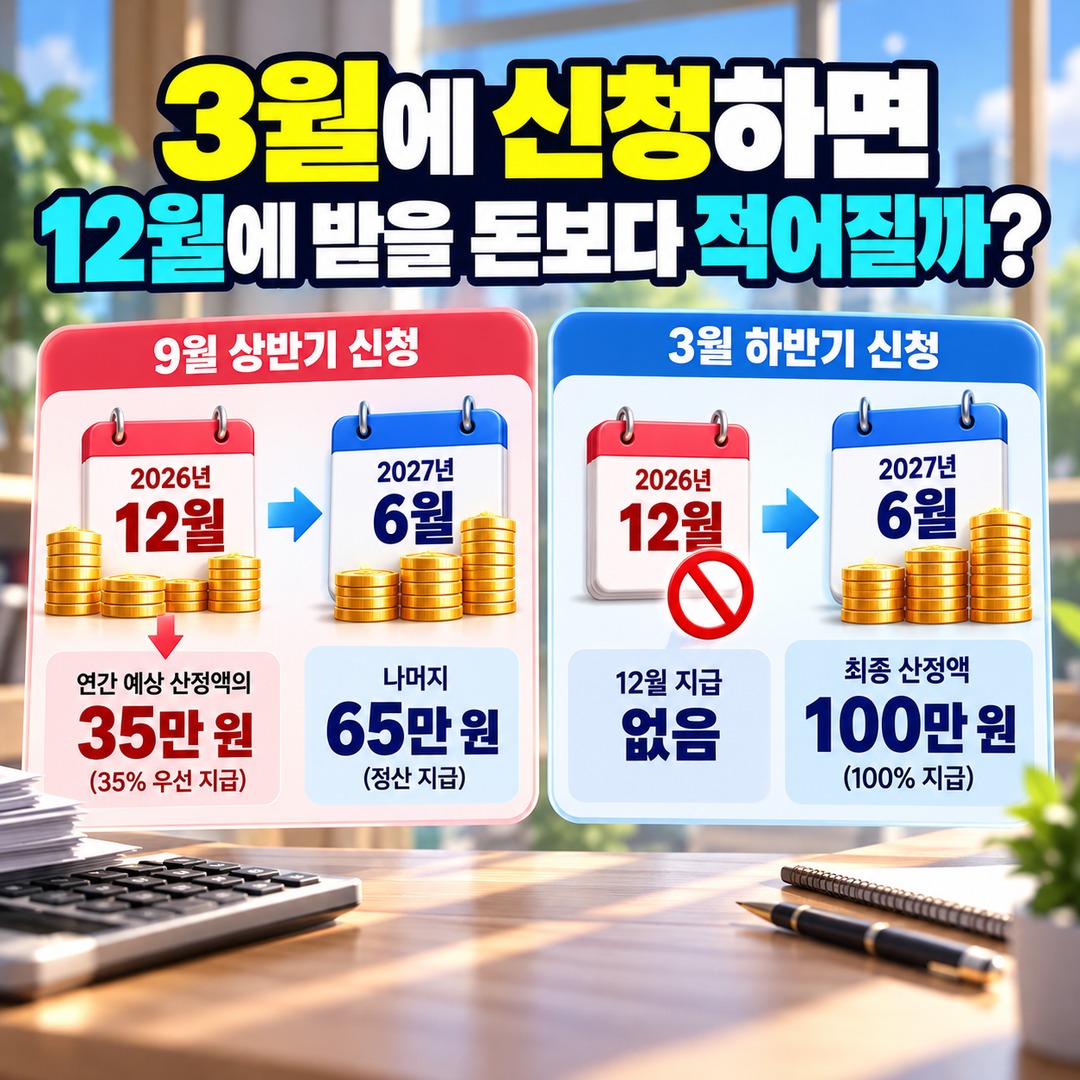
Missing the first-half application in September does not automatically reduce your final credit by 35%.
The NTS explained that people who missed the first-half application but apply during the second-half period in March 2027 or the regular application period in May can receive 100% of the calculated credit if they meet the payment eligibility requirements.
Here, 35% is not a reduction rate applied to the credit. It is the proportion paid in advance to first-half applicants.
Let's compare the two approaches using a hypothetical example.
Hypothetical Calculation Example · Assuming a Final Calculated Credit of KRW 1,000,000
First-half application in September
December 2026
KRW 350,000
Reconciliation in June 2027
KRW 650,000
Application in March 2027
December 2026
KRW 0
Review and payment in June 2027
KRW 1,000,000
Author's calculation: KRW 1,000,000 × 35% = KRW 350,000, KRW 1,000,000 − KRW 350,000 = KRW 650,000. This is a simplified hypothetical example that does not account for reductions, offsets against unpaid taxes, or repayments. Actual payment amounts depend on income, assets, household eligibility requirements, and the results of the review.

The main difference between the two approaches is the timing of payment and whether an advance payment is made, rather than the final calculated credit itself.
However, the 35% paid in December is based on the estimated credit, while the amount is recalculated in June using actual annual income and other relevant factors. Therefore, not every applicant will receive payments in the same way as shown in the example above.

Application Timing Differs for People With Only Employment Income and Those With Business Income
The March 2027 semiannual application is available to applicants whose income, including their spouse's income, consists exclusively of employment income. If you have employment income alongside business income or religious worker income, you should check whether you need to apply through the May 2027 regular application process.
For example, an employee who received only wages from a company in 2026 can choose between the semiannual and regular application processes.
By contrast, if you earned business income in addition to your salary, you should not assume that you qualify for the March semiannual application simply because you are an employee.
Eligibility also depends on household composition, combined income for married couples, and property requirements, not just the type of income earned.
According to the National Tax Service's guidance on Earned Income Tax Credit reviews and payments, the initial eligibility assessment for the semiannual application covering income earned in 2026 uses income, property, and other criteria from 2025. During the June 2027 reconciliation, the amount is recalculated using the criteria for 2026.
Reduction rules also apply. For example, if total household property is at least 1 hundred million 7 ten million won but less than 2 hundred million 4 ten million won, only 50% of the credit is paid.
Therefore, being able to submit an application during the application period is not the same as actually qualifying to receive the credit.
If You Also Miss the March 2027 Application, Check the May Regular Application Period
Even if you fail to submit a second-half application by 2027-03-15, the May regular application period is still available.

According to the National Tax Service, the regular application period for the Earned Income Tax Credit covering income earned in 2026 runs from 2027-05-01 through 31.
If you also miss the regular application period, you can submit a late application until 2027-11-30. However, according to National Tax Service guidance, late applications are subject to a payment rate of 95% of the calculated credit amount.
In a hypothetical example where the calculated credit is KRW 1,000,000, the amount payable after a late application would be KRW 950,000, assuming no other reductions apply.

In other words, missing the September semiannual application and missing the May regular application are treated differently, including in terms of the amount paid.
What to Check on HomeTax Before Applying in March 2027
If you missed the September 2026 application, it is a good idea to check your income category and whether you have already submitted an application before the next application period begins.
According to the National Tax Service's guidance on Earned Income Tax Credit application periods and procedures, semiannual applications can be submitted through HomeTax.
The steps are straightforward.
1. Visit the National Tax Service HomeTax website.
2. Under the Tax Credits, Year-End Tax Settlement, and Donations menu, find the relevant Earned Income Tax Credit application options.
3. Check whether an application for income earned in 2026 has already been submitted.
4. Check whether both your income and your spouse's income in 2026 consisted exclusively of employment income.
5. If you qualify for the March 2027 application, submit it during the designated period and confirm that it has been received.
The National Tax Service explains that even if you did not receive an application notice, you can apply directly through HomeTax if you believe you meet the eligibility requirements.
If you need assistance with the application process, you can contact the National Tax Service's Tax Credit Consultation Center at 1566-3636.
For those who missed the first-half application in 2026, the two key remaining dates are March 1–15, 2027 and May 1–31.
Not receiving the December advance payment does not, by itself, reduce your final Earned Income Tax Credit. What matters is applying within the correct period for your income category.