

2026 National Pension Back Payments: How Much Would 24 Months Cost at the 9.5% Contribution Rate?
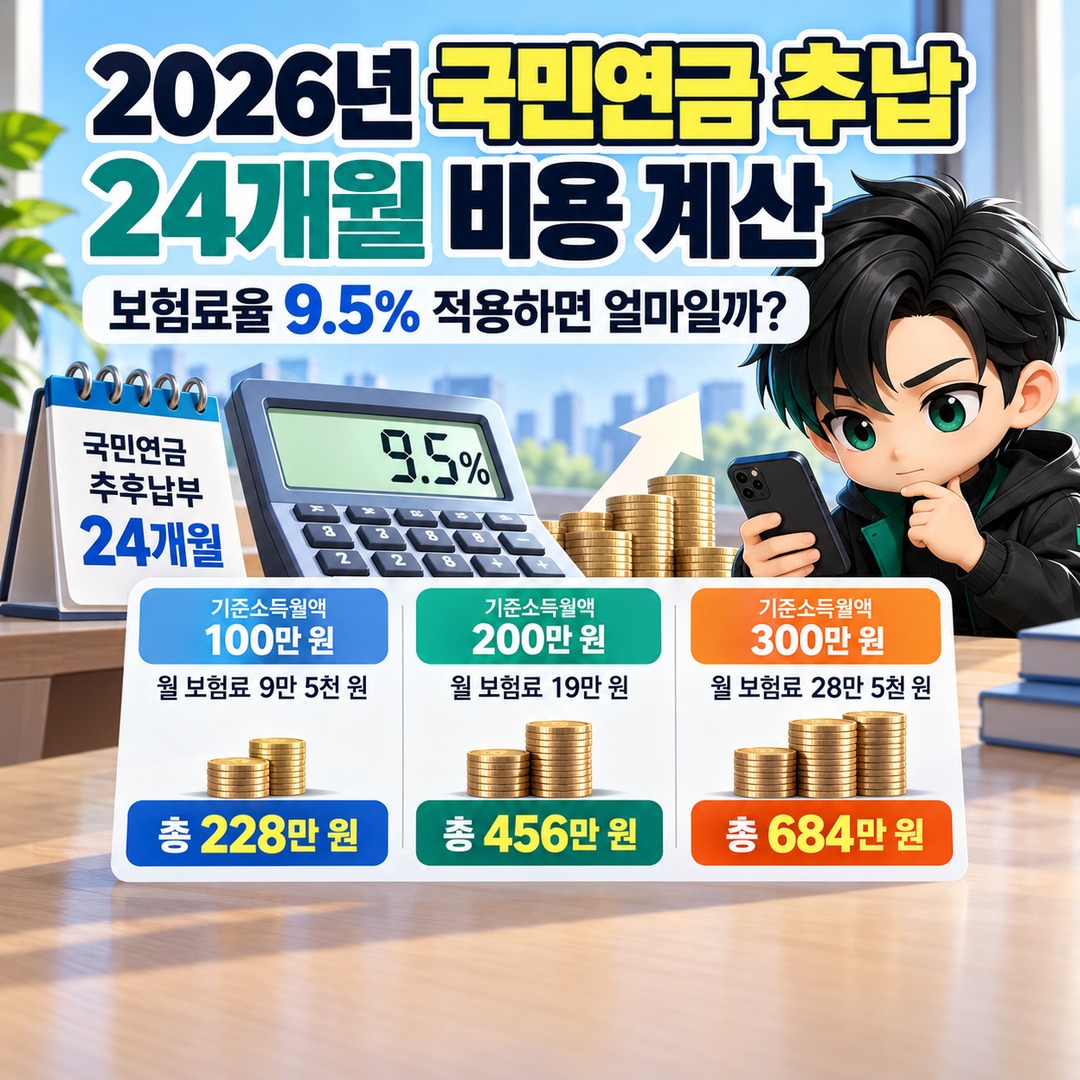
For 2026, making 24 months of retroactive National Pension contributions would cost KRW 2,280,000 at a standard monthly income of KRW 1,000,000, KRW 4,560,000 at KRW 2,000,000, and KRW 6,840,000 at KRW 3,000,000. These are lump-sum calculations using the 9.5% contribution rate. Actual payments vary depending on each individual's standard monthly income and payment deadline.

As of 2026-10-18, anyone considering retroactive National Pension contributions should check not only the payment amount but also the eligible contribution period, interest on installment payments, and the expected increase in their old-age pension.
How Much Would 24 Months of National Pension Back Payments Cost at Different Income Levels in 2026?
Retroactive National Pension contributions are calculated by multiplying the standard monthly income for the month of application by the contribution rate applicable in the month containing the payment deadline, then multiplying the result by the number of months being paid retroactively.

The National Pension contribution rate for 2026 is 9.5%. Therefore, if the payment deadline falls in 2026 and the retroactive contribution period is 24 months, the following formula can be used.
Retroactive Contribution = Standard Monthly Income × 9.5% × 24 Months
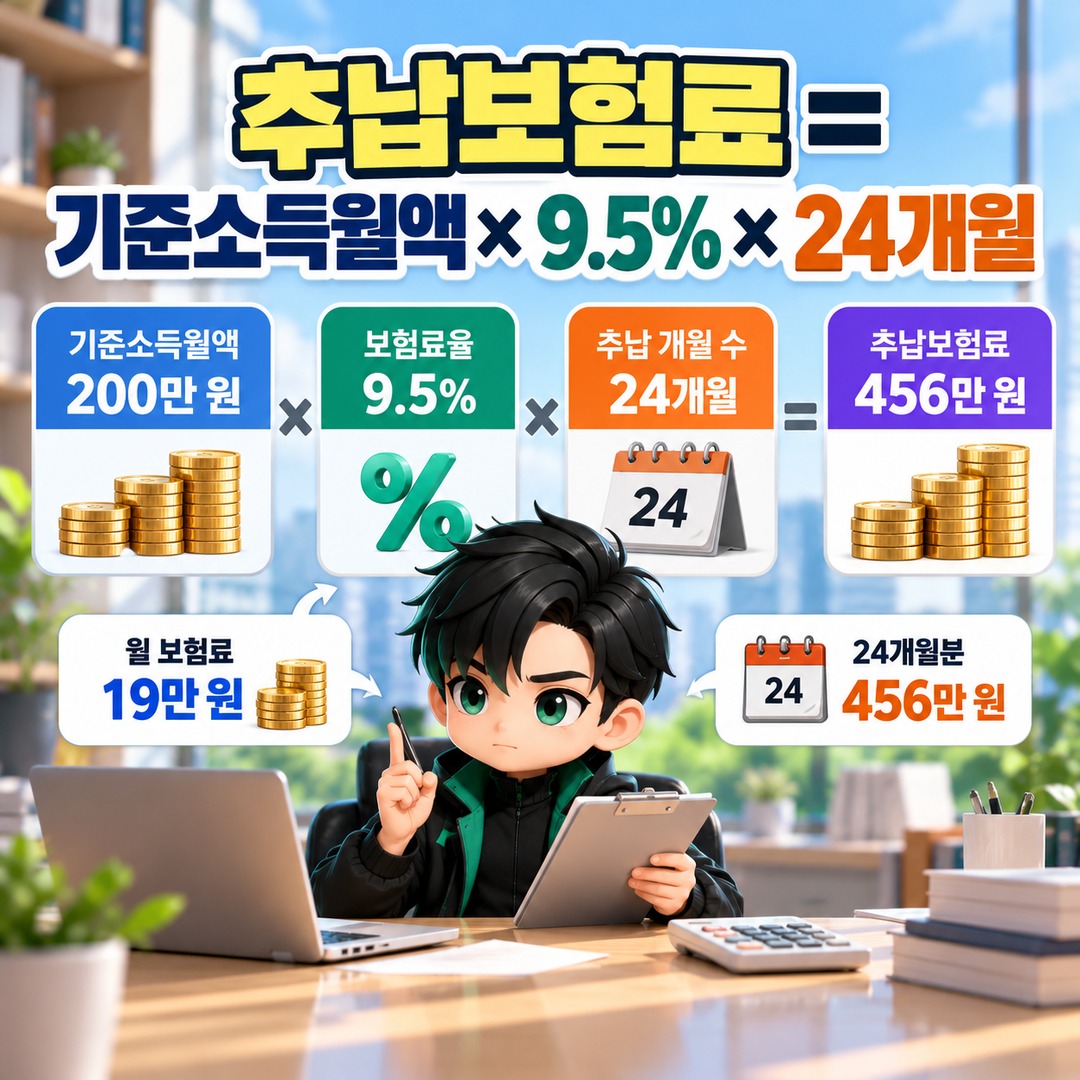
For example, if the standard monthly income is KRW 2,000,000, the monthly contribution is KRW 190,000, and the total for 24 months is KRW 4,560,000.
The following amounts are calculations made by the author and exclude interest on installment payments.
| Standard Monthly Income | Monthly Contribution | Back Payment for 24 Months |
|---|---|---|
| KRW 1,000,000 | KRW 95,000 | KRW 2,280,000 |
| KRW 1,500,000 | KRW 142,500 | KRW 3,420,000 |
| KRW 2,000,000 | KRW 190,000 | KRW 4,560,000 |
| KRW 2,500,000 | KRW 237,500 | KRW 5,700,000 |
| KRW 3,000,000 | KRW 285,000 | KRW 6,840,000 |
Even when both individuals make retroactive contributions for the same 24 months, the payment amount differs by KRW 4,560,000 between someone with a standard monthly income of KRW 1,000,000 and someone with KRW 3,000,000.
Standard monthly income does not simply mean take-home pay. It is the income figure used to calculate National Pension contributions and should be checked in the individual's pension contribution records.
Also, while an employee's usual share of National Pension contributions deducted from wages is 4.75% in 2026, retroactive contributions are calculated using the full contribution rate of 9.5%. The calculation must not assume that the employer pays half of the retroactive contributions.
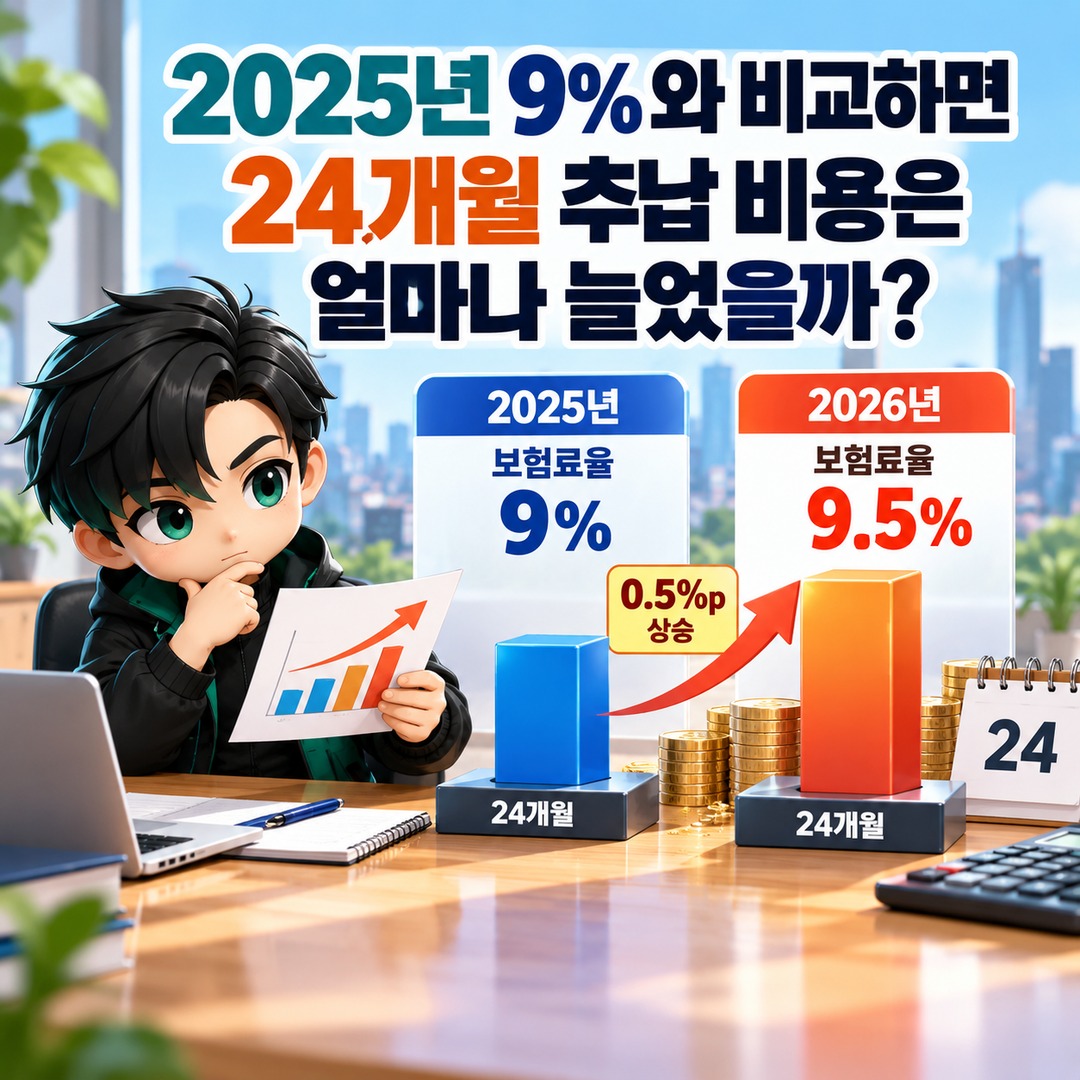
How Much Have 24-Month Back-Payment Costs Increased Compared with 9% in 2025?
The National Pension contribution rate increased by 0.5% percentage points, from 9% in 2025 to 9.5% in 2026.
Assuming the same standard monthly income and the same 24-month contribution period, the difference caused by the contribution rate change can be calculated.
| Standard Monthly Income | At 9% | At 9.5% |
|---|---|---|
| KRW 1,000,000 | KRW 2,160,000 | KRW 2,280,000 |
| KRW 2,000,000 | KRW 4,320,000 | KRW 4,560,000 |
| KRW 3,000,000 | KRW 6,480,000 | KRW 6,840,000 |
The difference is KRW 240,000 at a standard monthly income of KRW 2,000,000 and KRW 360,000 at KRW 3,000,000.
However, this table compares contribution rates while keeping the income basis unchanged. It does not represent the actual difference between an individual's retroactive contribution bills in 2025 and 2026.
Importantly, retroactive National Pension contributions are not calculated by simply applying the contribution rate that was in effect during the past unpaid period.
Under the system introduced in 2026, the key factors are the standard monthly income in the application month and the contribution rate applicable in the month containing the payment deadline.
Therefore, even if an application is submitted in December 2026, the amount should not automatically be calculated using the 2026 contribution rate of 9.5% if the payment deadline falls in January 2027. This is because the contribution rate for 2027 is scheduled to be 10%.
Rather than determining the amount based solely on the application date, applicants should check the actual payment deadline and applicable contribution rate on their payment notice.
Does Applying for 24 Months of Back Payments Increase Everyone's Contribution Period?
The National Pension retroactive contribution system allows eligible individuals to pay contributions later for certain past periods when they did not contribute, so those periods can be recognized as part of their pension contribution history.
To apply for 24 months, an individual must have at least 24 months that qualify for retroactive contributions.
Typical eligible periods include periods when contribution payment exemptions applied because of unemployment or business suspension, certain periods of exclusion from National Pension coverage, and qualifying periods of military service.
Having paid National Pension contributions in the past does not mean an individual can freely select any gap in their contribution history.
Applicants must also meet eligibility requirements, such as currently reporting income under the National Pension system or participating through voluntary or voluntary continued coverage.
The maximum eligible retroactive contribution period, including military service, is 119 months. Although 24 months falls within this limit, the actual eligible period depends on the individual's contribution history.
It is advisable to confirm the number of eligible months with the National Pension Service before applying.
Must KRW 4,560,000 Be Paid All at Once, or Are Installments Available?
Retroactive National Pension contributions can be paid either in a lump sum or in monthly installments, up to a maximum of 60 payments.
For someone with a standard monthly income of KRW 2,000,000 making retroactive contributions for 24 months, the principal amount is KRW 4,560,000.
Simply dividing this amount into 24 installments gives KRW 190,000 per installment, while dividing it into 60 installments gives KRW 76,000 per installment.
However, these figures are only arithmetic examples of dividing the principal, not actual installment billing amounts.
The National Pension Service adds interest to installment payments, so the total amount paid and the amount due for each installment may differ.
When choosing installment payments, applicants should compare not only the monthly financial burden but also the total amount payable, including interest.
Also, a retroactive contribution period of 24 months and 24 installment payments are different concepts. The former refers to the additional period an individual wants recognized toward pension eligibility, while the latter refers to the number of payments used to settle the contributions.
How Much Would Monthly National Pension Benefits Increase After Paying for 24 Months?
The increase in pension benefits resulting from 24 months of retroactive National Pension contributions is not the same for every participant.
Although 24 months are added to the recognized contribution period, the actual increase in old-age pension benefits depends on factors such as the individual's existing contribution period, income history, and when pension payments begin.
Therefore, it is not possible to calculate a uniform monthly pension increase for everyone who pays KRW 2,280,000 or KRW 4,560,000 in retroactive contributions.
The 2026 pension reform raised the contribution rate to 9.5% and adjusted the income replacement rate to 43%. However, the 43% income replacement rate does not represent a rate of return directly applicable to an individual's retroactive contributions.
For example, paying KRW 4,560,000 in retroactive contributions does not mean receiving 43% of that amount as pension benefits.
For an accurate comparison, individuals should check their estimated old-age pension before retroactive contributions and their estimated pension after adding 24 months, using the same assumptions.
The following items should be compared:
Estimated monthly old-age pension before retroactive contributions
Estimated monthly old-age pension after including 24 months of retroactive contributions
Monthly difference between the two amounts
Actual total cost of a lump-sum payment or installment payments
For example, suppose an individualized estimate from the National Pension Service shows that monthly pension benefits would increase by KRW 30,000. The annual increase would then be KRW 360,000.
In this case, dividing the retroactive contribution principal of KRW 4,560,000 by the annual increase of KRW 360,000 produces a simple comparison period of approximately 12.7 years.
However, the monthly increase of KRW 30,000 is a hypothetical figure used to explain the calculation, not an actual pension estimate. This simple arithmetic comparison does not account for when pension payments begin, inflation-related pension adjustments, taxes, the duration of benefit payments, or the time value of money.
It should not be treated as a definitive payback period for determining whether retroactive contributions are financially worthwhile.
How Can You Apply for Retroactive National Pension Contributions and Check Estimated Benefits?
Individuals can check their contribution history and services related to retroactive contributions through the National Pension Service website or its mobile app, 'National Pension by My Side' (내 곁에 국민연금).
A good first step is to verify your identity, review your contribution history, and determine how many months are eligible for retroactive contributions.
Next, during the application process, confirm your standard monthly income and the number of eligible months.
To assess the actual increase in pension benefits, do not rely solely on your current estimated old-age pension. You should separately obtain an estimate that reflects the additional 24 months of retroactive contributions.
If it is difficult to check the difference before and after retroactive contributions through the online service, you can request an individualized comparison through the National Pension Service customer center at 1355 or by consulting a local branch.
Required documents include a marriage relationship certificate and other relevant paperwork. Additional supporting documents may be required depending on the retroactive contribution period.
Even when applying online, applicants must attach the required documents as files, so preparing them in advance is recommended.
What to Check Before the Cost of 24 Months of Retroactive Contributions
Paying more in retroactive contributions does not produce the same benefit for everyone.
In particular, individuals with relatively short National Pension contribution histories should check how retroactive contributions would change their total recognized contribution period.
As a general rule, an individual must meet the minimum contribution period of 10 years to receive an old-age pension. Therefore, someone with an existing contribution period of 8 years who makes retroactive contributions for an eligible 24 months faces a different situation from someone who has already contributed for 20 years.
For the former, whether the additional period satisfies the minimum contribution requirement is an important consideration. For the latter, the main point of comparison may be the expected increase in monthly pension benefits.
Retroactive contributions are also voluntary. Even if eligible, individuals can decide whether to apply based on their immediate living expenses and the financial burden of installment payments.
For 2026, the cost of 24 months of retroactive National Pension contributions is KRW 4,560,000 when using a standard monthly income of KRW 2,000,000 as an example. In an actual application, however, the individual's eligible contribution period, payment deadline, and expected pension increase are more important than this illustrative amount.
By obtaining an individualized estimate of retroactive contributions and comparing expected old-age pension benefits before and after those contributions through the National Pension Service, individuals can make a decision suited to their circumstances.