

BOK August Rate Decision: 5 of 7 Securities Firms Expect a Hike…2.75% or 3.00% Is the Key Question
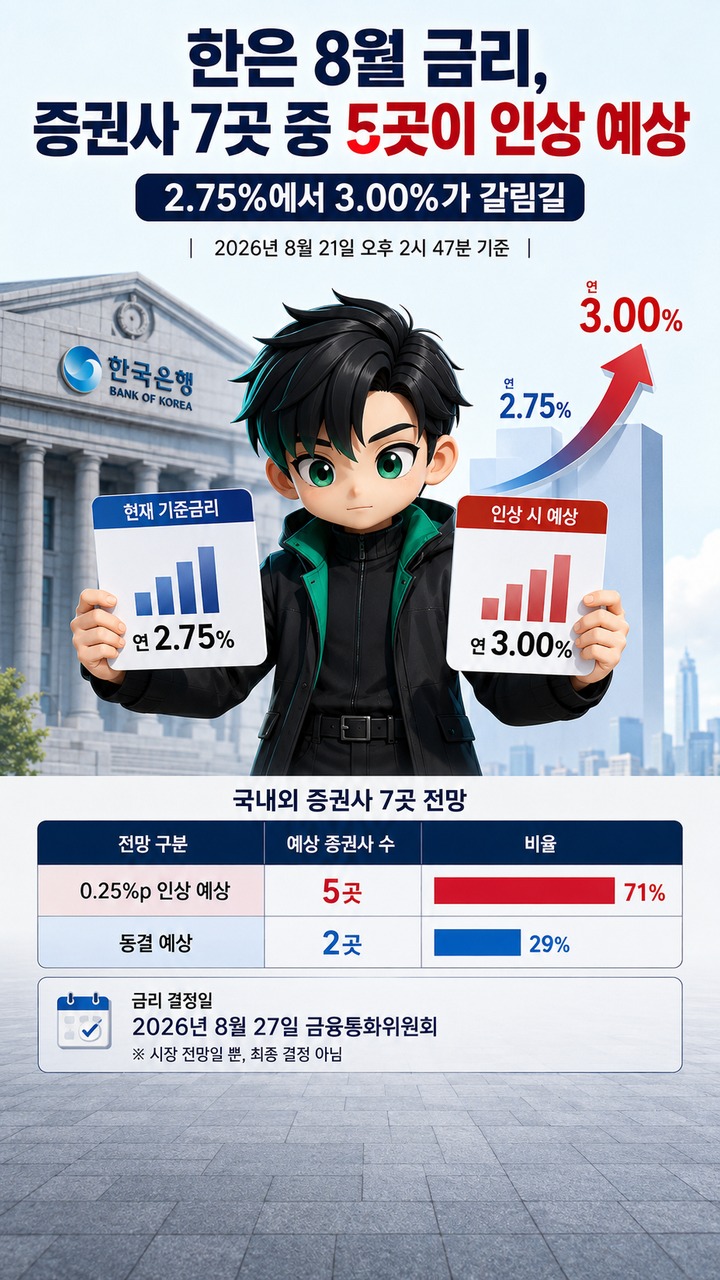
As of 2026-08-21 at 2:47 PM, 5 of 7 domestic and international securities firms in a recent survey expect the Bank of Korea to raise its benchmark interest rate by 0.25% percentage points in August. The current benchmark rate is 2.75% per year, and an additional increase of 0.25% percentage points would bring it to 3.00% per year. However, this remains a market forecast, and the rate decision will be made by the Monetary Policy Board on August 27.
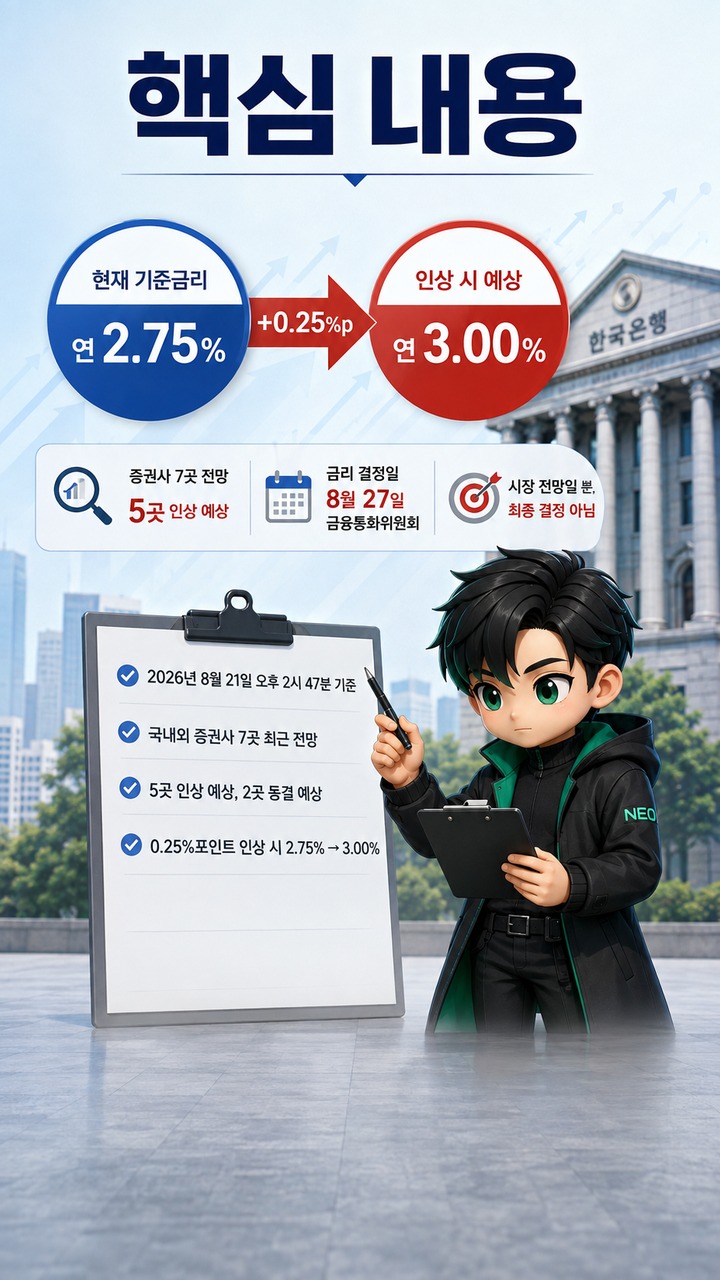
What deserves attention is not simply the number of firms predicting an increase, but how the direction of their forecasts has changed over the past month. The Bank of Korea raised its benchmark interest rate from 2.50% to 2.75% on July 16. At the time, opinions were divided over whether it would follow that move with another increase at the very next meeting.
Since then, more securities firms have revised their forecasts toward a August rate hike after taking into account newly released 2-quarter growth figures and inflation trends. However, some analysts still expect the rate to remain unchanged in August, arguing that financial conditions have already become tighter.
5 of 7 Securities Firms Expect a 0.25%-Percentage-Point Increase
Among 7 domestic and international securities firms that had published monetary policy outlook reports by August 21, 5 expected the Monetary Policy Board to raise the benchmark rate by 0.25% percentage points in August. The remaining 2 firms maintained their forecasts for the rate to remain unchanged at 2.75% per year.
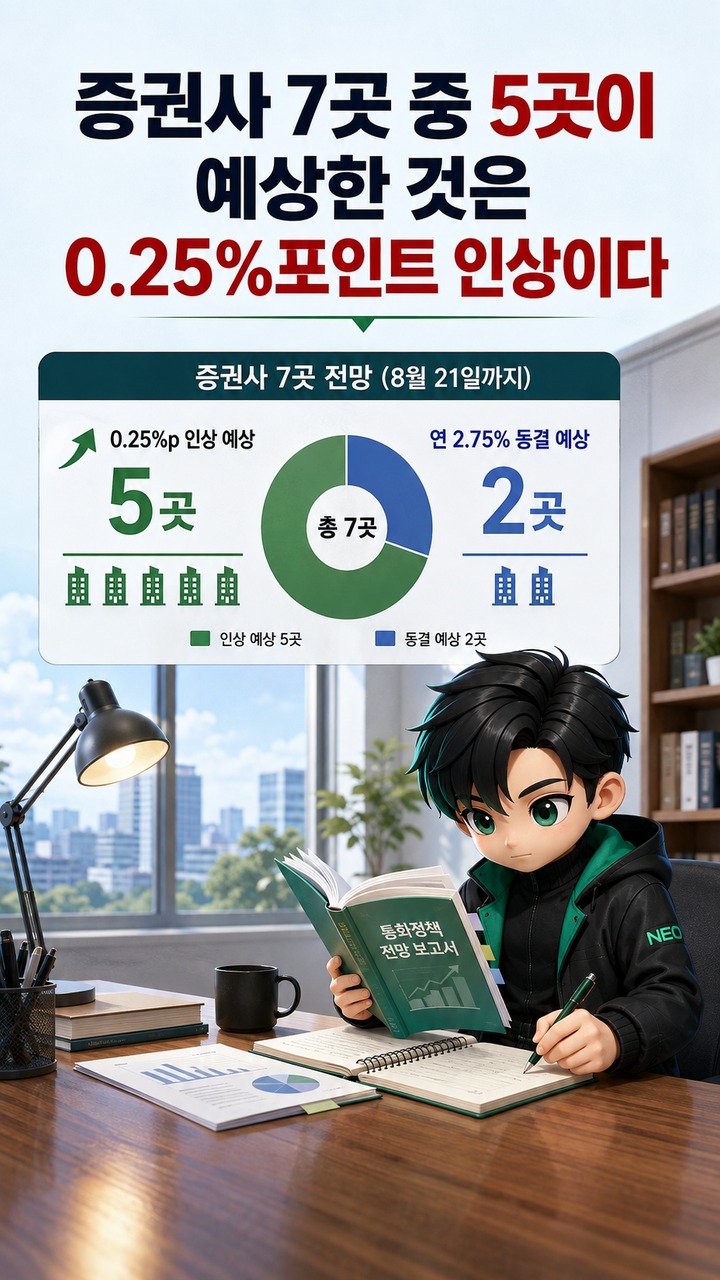
The securities firms identified as forecasting an increase include Daishin Securities, Shinhan Securities, Hana Securities, iM Securities, and Meritz Securities. Meanwhile, Barclays and Eugene Investment & Securities favor keeping rates unchanged in August.
A simple calculation based solely on these 7 firms puts the share forecasting an increase at approximately 71.4%.
Author's calculation
5 ÷ 7 × 100 = approximately 71.4%
However, this figure should not be interpreted as meaning that the entire market assigns a 71.4% probability to a rate increase. It represents a count of forecasts from 7 securities firms that issued outlook reports during the period, which is different from a probability estimate covering all financial institutions or market participants.
The Bank of Korea's current benchmark interest rate is 2.75% per year. If the Monetary Policy Board raises it by another 0.25% percentage points on August 27, the rate will reach 3.00% per year.
2.75% + 0.25%p = 3.00%
Conversely, if the board decides to hold rates steady, the annual rate will remain at 2.75%.
Stronger Growth Figures Are Behind the Shift Toward Rate-Hike Forecasts
One of the major developments strengthening expectations for a August rate increase is the 2-quarter growth data. According to preliminary figures released by the Bank of Korea on July 23, real gross domestic product in the 2 quarter of 2026 increased 0.6% from the previous quarter and 3.7% from the same period a year earlier.
Real gross domestic income also increased 3.6% quarter on quarter and 15.6% year on year.
When deciding the benchmark interest rate, stronger-than-expected economic growth can reduce the need to delay a rate increase to prevent an economic slowdown. Indeed, recent forecasts from securities firms cite the possibility of an upward revision to the growth outlook as one reason for expecting a August rate hike.
Daishin Securities expects the Bank of Korea to substantially raise its growth forecast for this year from the previous 2.6% in its August economic outlook. It is important to distinguish this securities firm's projection from an officially revised growth forecast already announced by the Bank of Korea.
The officially confirmed preliminary GDP figures for the 2 quarter currently show growth of 0.6% quarter on quarter and 3.7% year on year.
In other words, interpreting the situation as meaning that the Bank of Korea has already raised its annual growth forecast to the 3% range would confuse the timing of the announcements. The actual extent of any revision to the Bank of Korea's forecast in its August economic outlook must be checked separately on the day of the Monetary Policy Board meeting.
Rates Were Already Raised in July. Could Another Increase Follow?
The possibility remains open, but no decision has been made. On July 16, the Bank of Korea raised its benchmark interest rate by 0.25% percentage points, from 2.50% to 2.75%. At the time, the central bank explained that growth was strengthening, particularly in exports and investment, inflation was expected to remain above its target for a considerable period, and financial stability risks persisted.
If the Bank of Korea raises rates by another 0.25% percentage points in August, it would mark consecutive increases at two monetary policy decision meetings.
The change becomes clearer when expressed numerically.
Before the July increase: 2.50%
After July 16: 2.75%
If an additional 0.25%p increase occurs in August: 3.00%
Assuming rates rise by 0.25% percentage points at each of the two consecutive meetings, the benchmark rate would increase by a total of 0.50% percentage points, from 2.50% to 3.00%.
For this reason, a more important consideration at the upcoming meeting may be whether the Bank of Korea views growth, inflation, and financial stability risks as serious enough to justify consecutive rate increases, rather than simply the 0.25%-percentage-point change itself.
Why a August Rate Hike Is Still Not Certain
Although securities firms' forecasts have shifted toward an increase, some analysts continue to expect rates to remain unchanged. Among the 7 securities firms whose forecasts were confirmed as of August 21, Barclays and Eugene Investment & Securities maintained their expectations for a hold.
The key argument supporting a hold is that recent financial market developments may already be producing a tightening effect, even without another increase in the benchmark interest rate.
If developments such as a stock market correction or appreciation of the Korean won have tightened financial conditions, the Bank of Korea could wait to assess the impact of the July rate increase before deciding when to raise rates again. Another factor to consider is how widely semiconductor-led growth has spread across the domestic economy, including consumption and employment.
Barclays expects a rate increase in October rather than August. Eugene Investment & Securities has also expressed the view that consecutive increases are not necessarily required.
Ultimately, the current market outlook shows that expectations have shifted more strongly toward a rate increase rather than a hold. It does not mean that the rate decision itself has been finalized.
In particular, the Monetary Policy Board does not set interest rates according to securities firms' forecasts. It determines the benchmark rate by comprehensively assessing economic growth, inflation, financial stability, foreign exchange markets, and domestic and international financial conditions.
On August 27, the Rate Decision Alone Will Not Tell the Whole Story
The Bank of Korea's August monetary policy decision meeting is scheduled for August 27. At this meeting, it will be important to examine not only the benchmark rate decision but also the economic outlook and signals about the future path of interest rates.
The first point is the benchmark interest rate itself. If an increase of 0.25% percentage points is approved, the benchmark rate will rise from 2.75% to 3.00%. If rates are held steady, 2.75% will remain in effect.
The second point is the size of any revision to this year's growth forecast. Because stronger-than-expected economic growth is one of the main reasons market expectations have shifted toward a August rate increase, how the Bank of Korea revises its economic outlook will be important.
The third point is the possibility of further rate increases. Raising rates in August would not automatically determine the subsequent interest rate path. Conversely, keeping rates unchanged in August would not necessarily eliminate the possibility of further increases.
Since 2026, the Bank of Korea has improved the way it presents Monetary Policy Board members' conditional interest rate forecasts in conjunction with the release of its economic outlook. As a result, market participants will examine not only the upcoming decision but also board members' views on future interest rate levels.
What Should Borrowers, Depositors, and Stock Investors Watch?
A benchmark interest rate decision does not cause an individual's loan or deposit rate to move by exactly 0.25% percentage points on the same day. The actual timing and extent of changes depend on banks' funding costs, market interest rates, and the rate-setting methods used for individual financial products.
If you have a variable-rate loan, the first step is to check which reference rate your loan uses. When the benchmark used to determine a loan's interest rate differs, such as the Cost of Funds Index (COFIX) or financial bond yields, the timing of how changes in the Bank of Korea's benchmark rate affect the actual loan rate may also differ.
Likewise, an increase in the benchmark rate does not mean that interest rates on all deposit products will rise by the same amount. Product rates may vary depending on each bank's funding situation and strategy for attracting deposits.
It is also difficult to assume that a rate increase will always cause stocks to fall or that a rate hold will always cause stocks to rise. Market movements depend on how much of the expected rate decision has already been priced in, as well as changes in growth forecasts, the future interest rate path, the value of the Korean won, and bond yields.
The easiest way to understand the upcoming Monetary Policy Board meeting is to review the announcements in this order: August 27 benchmark rate decision → revised economic outlook → explanation of the future interest rate path.
To summarize the figures confirmed so far, the benchmark interest rate stands at 2.75%. Of the 7 securities firms covered by the recent survey, 5 expect an increase and 2 expect rates to remain unchanged. If the Monetary Policy Board approves a 0.25%-percentage-point increase in August, the benchmark rate will reach 3.00%. However, as of August 21 at 2:47 PM, this remains a market forecast rather than a confirmed decision.
※ This article is provided for informational purposes to help readers understand market developments and does not constitute a recommendation to invest in any particular security or asset. Final investment decisions and responsibility rest with the individual investor.