

Bank of Korea Holds Key Rate at 2.75%: Exchange Rate in the KRW 1,410 Range and Three Factors for the August Policy Meeting
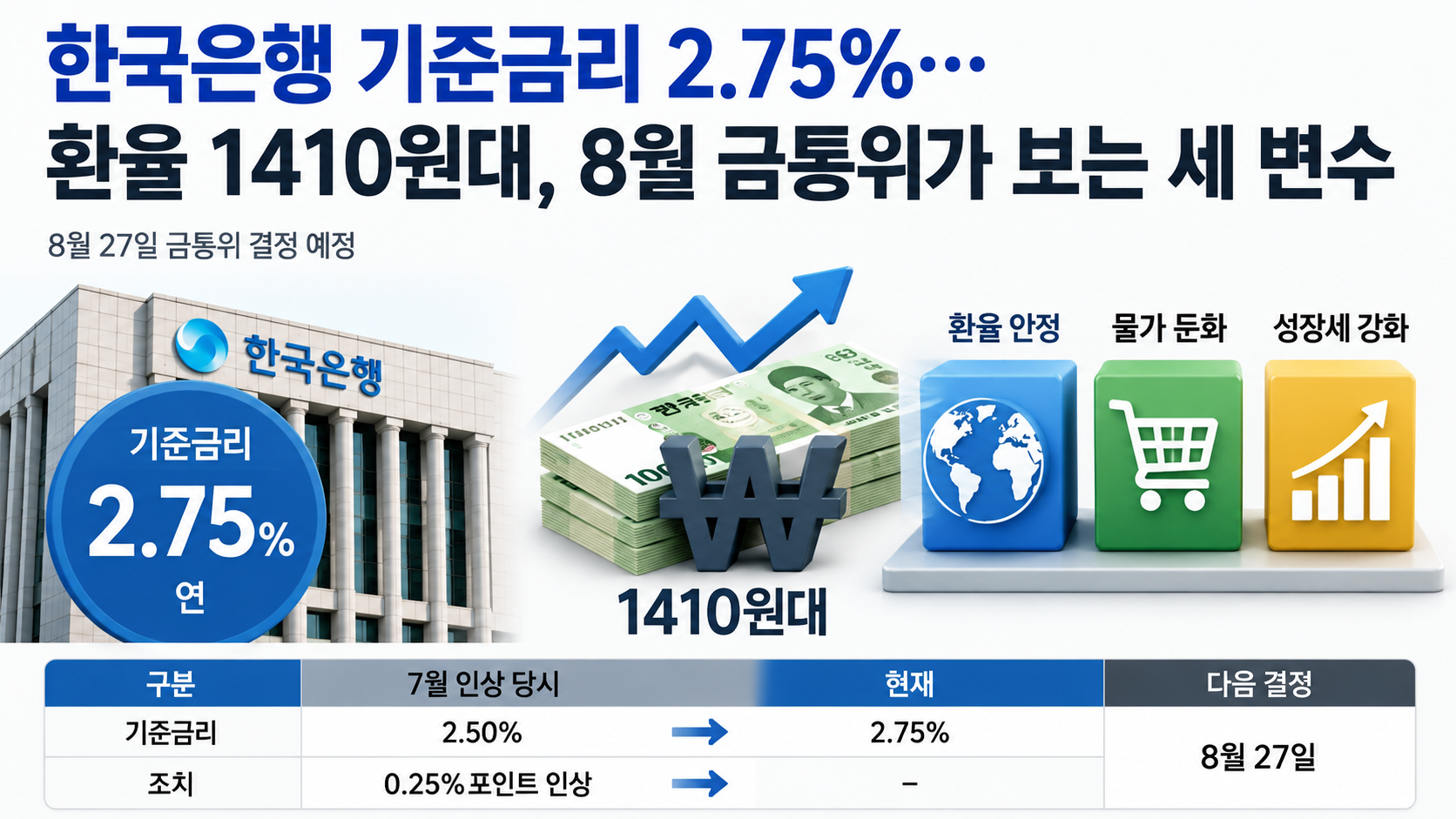
The Bank of Korea's current base interest rate is 2.75% per year. After raising it by 0.25% percentage points at the July 16 2.50% meeting, the next decision is scheduled for August 27. Based on the indicators released so far, the August meeting will focus on three questions: whether exchange-rate stability continues, whether inflation slows sufficiently, and whether stronger economic growth warrants another rate increase.
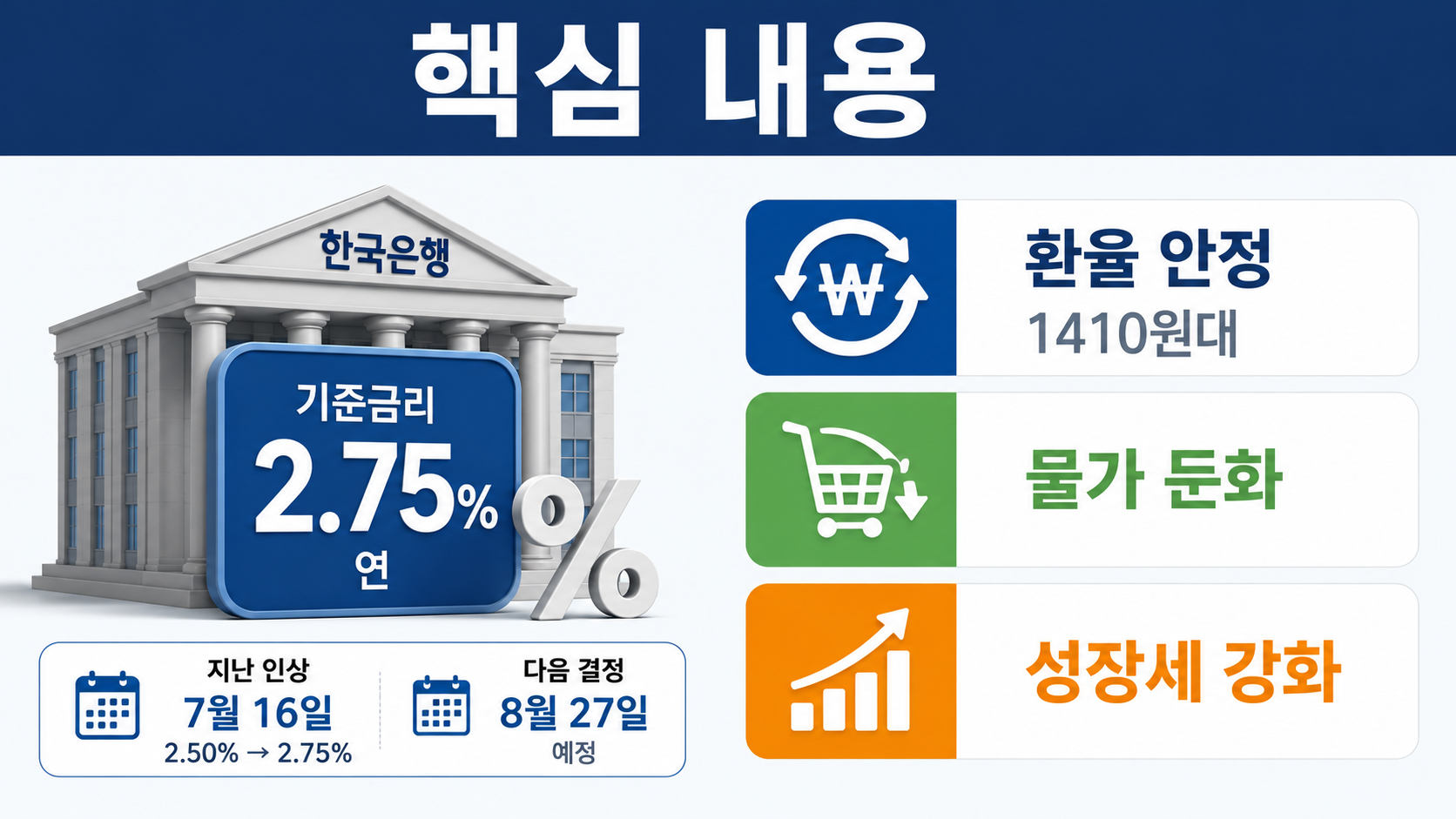
Conditions have changed considerably since the July rate hike. The Korean won–US dollar exchange rate has fallen to the lower-to-middle part of the KRW 1,400 range, while consumer price inflation in July slowed to 2.8%. Meanwhile, economic growth in the 2 quarter was stronger than expected.
That is why interpreting the August monetary policy meeting simply as 'the exchange rate has fallen, so rates will be held' or 'the economy is strong, so rates will rise' would overlook important considerations.
1. Exchange Rate in the KRW 1,410 Range: Pressure Has Clearly Eased Since the July Rate Hike
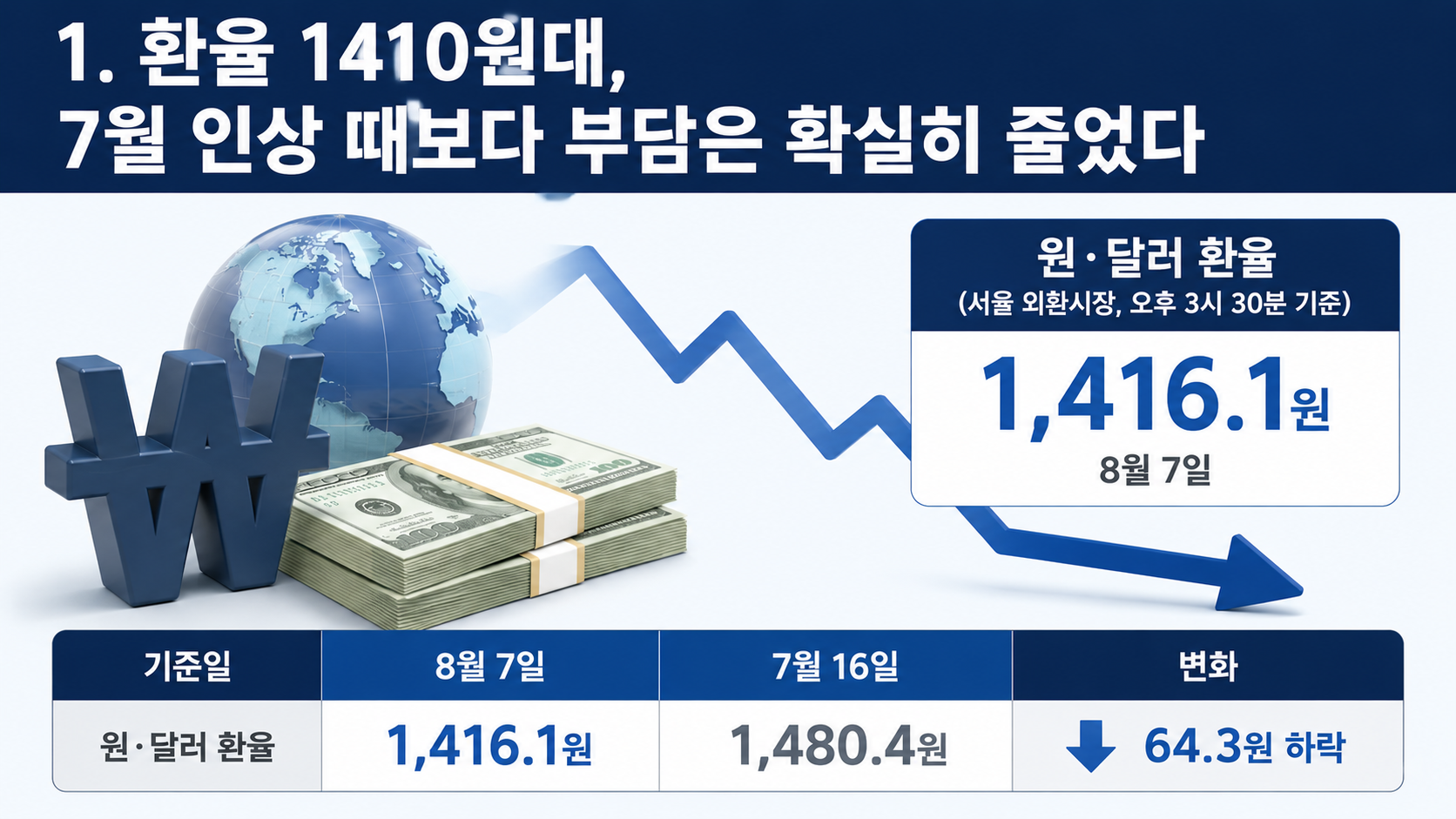
The won–dollar exchange rate stood at KRW 1,416.1 in the Seoul foreign exchange market as of 3:30 p.m. on August 7. On July 16, when the Bank of Korea raised its base rate, the exchange rate at the corresponding reference time was KRW 1,480.4.
Author's calculation
July 16: KRW 1,480.4
August 7: KRW 1,416.1
Change: 1,416.1 - 1,480.4 = -KRW 64.3
Percentage decline: approximately -4.34%
In other words, the exchange rate has fallen by more than KRW 64 per dollar in approximately 3 weeks.
A lower exchange rate eases two pressures on the Bank of Korea.
The first is import prices. When the Korean won strengthens, the cost in won of importing crude oil or raw materials priced at the same dollar amount may decrease, reducing inflationary pressure.
The second is financial market instability. When the Bank of Korea raised interest rates in July, it identified high exchange-rate volatility as one of the risks to financial stability. With the exchange rate now down to the KRW 1,410 range, the immediate need to defend the currency through another rate increase has diminished, at least compared with mid-July.
However, it would be premature to conclude that the exchange-rate problem is over simply because the rate has reached the KRW 1,410 range.
The won–dollar exchange rate has been highly volatile this year, at one point approaching KRW 1,560 before falling sharply over a short period. More important than whether it falls below KRW 1,400 is whether the downward trend continues and whether another sudden surge can be avoided.
2. The United States and Japan Held Rates Steady, but Their Interest Rate Levels Remain Very Different
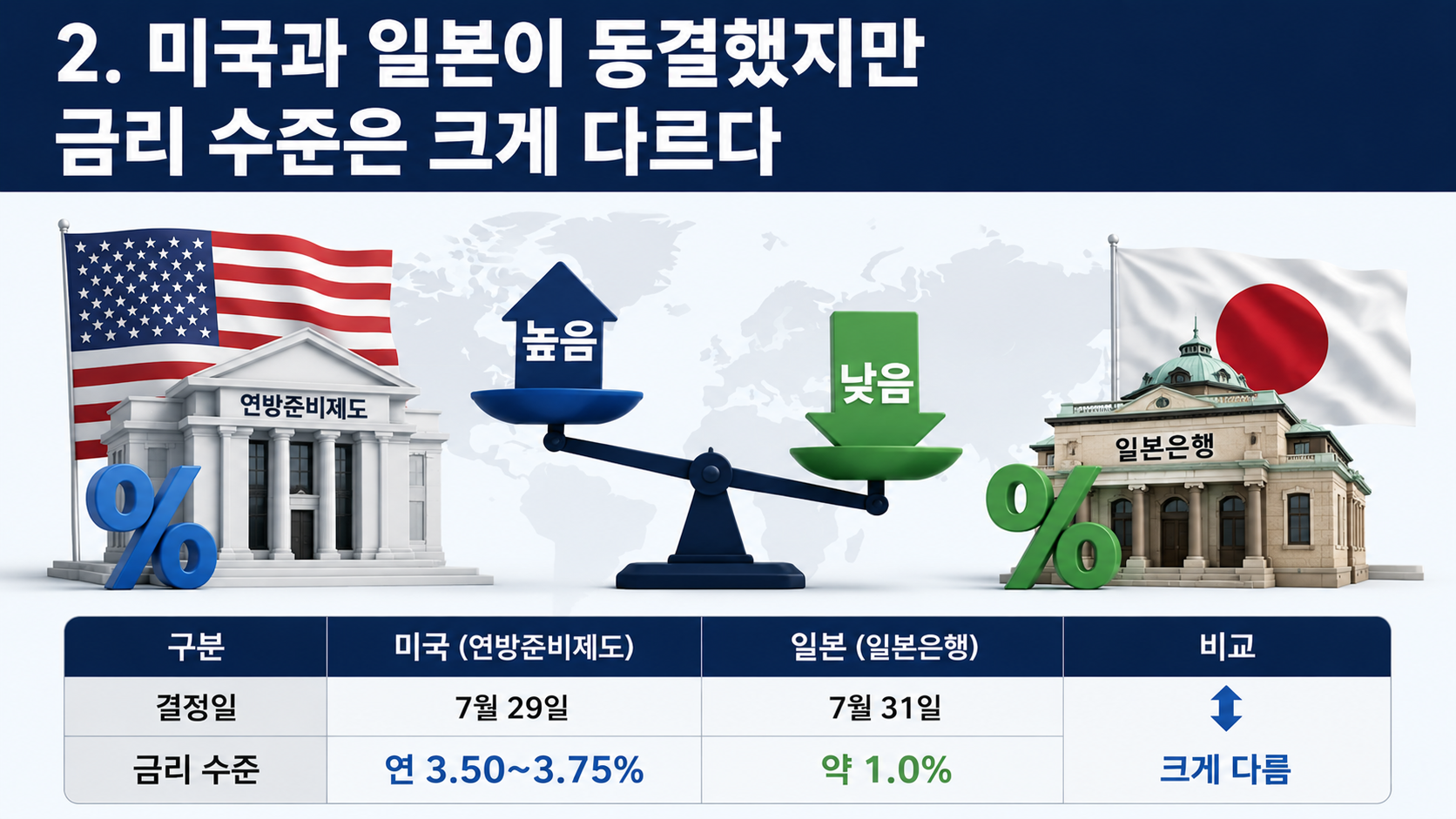
The US Federal Reserve held its federal funds rate target range at 3.50~3.75% per year on July 29. The Bank of Japan also maintained its short-term policy rate at approximately 1.0% on July 31.
The differences are clear when compared with South Korea's 2.75% rate.
The US policy rate is 0.75~1.00% percentage points higher than South Korea's, while South Korea's base rate is 1.75% percentage points higher than Japan's.
Although US interest rates remain higher than South Korea's when considering only the US–Korea policy rate differential, the won–dollar exchange rate has actually fallen significantly since mid-July.
This distinction matters.
Exchange rates do not move solely according to how many percentage points US interest rates exceed South Korean rates. Several factors influence currency movements simultaneously, including dollar strength or weakness, expectations for future US interest rates, foreign capital flows, dollar sales by exporting companies, international oil prices, and movements in the Japanese yen.
Therefore, a Federal Reserve decision to hold rates does not automatically mean the Bank of Korea will do the same. Nor does the existence of a US–Korea interest rate differential necessarily mean South Korea must raise rates.
At the August monetary policy meeting, policymakers are likely to examine whether the won's actual value and capital flows are stabilizing.
3. Inflation at 2.8% in July: Lower, but Still Above the 2% Target
Consumer price inflation in July 2026 was 2.8% compared with the same month a year earlier. It declined by 0.4% percentage points from 3.2% in June, returning to the 2% range for the first time in three months.
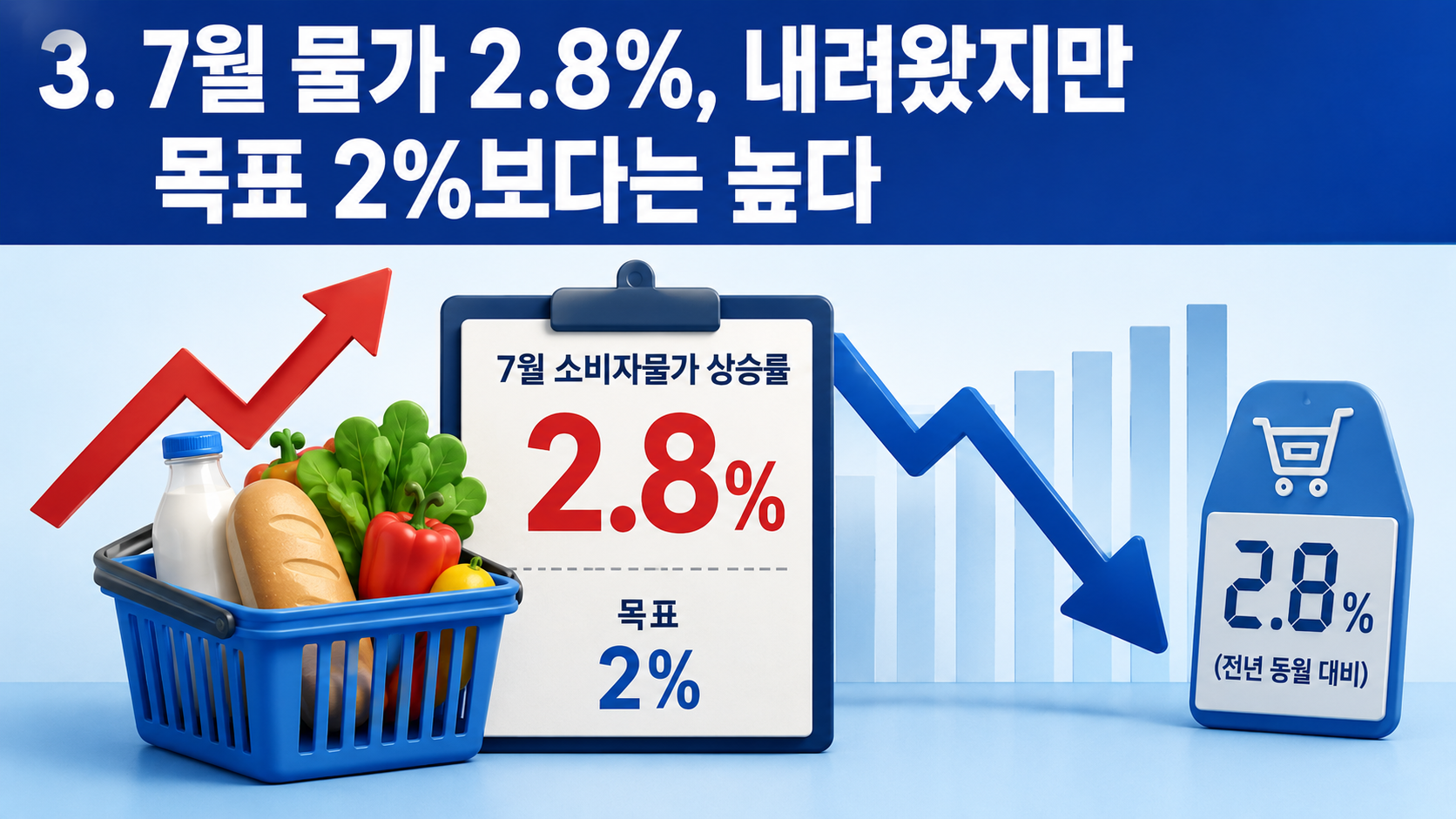
Looking only at the direction of inflation, the case for rushing into consecutive rate increases at the August meeting has weakened.
However, 2.8% is still 0.8% percentage points above the Bank of Korea's inflation target of 2%. When raising rates in July, the Bank of Korea also cited the possibility that inflation would remain above its target for a considerable period as a reason for the increase.
There is a particular reason why headline consumer inflation alone is insufficient for making this assessment.
Prices of highly volatile items, such as international crude oil and agricultural products, can cause overall monthly inflation to fall rapidly. In fact, although headline inflation slowed to 2.8% in July, assessments suggest that underlying inflationary pressure has remained relatively more persistent.
What the August monetary policy meeting ultimately needs to establish is not simply whether one month's inflation figure has declined, but whether the risk of inflation returning to the 3% range has diminished.
4. Economic Growth Is the Indicator That Actually Strengthens the Case for Another Rate Increase
While exchange-rate and inflation pressures have eased compared with July, economic growth indicators have moved in the opposite direction.
Real gross domestic product in the 2 quarter of 2026 increased by 0.6% from the previous quarter. Real gross domestic income also rose by 0.8% quarter on quarter, exceeding the GDP growth rate.
When economic activity is stronger than expected, the Bank of Korea has greater room to maintain interest rates at elevated levels or raise them further.
One of the biggest concerns when raising interest rates is a slowdown in economic activity. If growth is stronger than anticipated, that concern becomes relatively less significant.
Current indicators therefore send signals in different directions.
The decline in the exchange rate and slowing inflation support the argument that policymakers can afford to wait and observe developments. Stronger-than-expected economic growth, by contrast, suggests there may be room for additional monetary tightening.
This is what makes the August decision difficult.
Seoul Metropolitan Area Housing Prices and Household Debt Are Additional Constraints Beyond the Three Main Factors
Even when focusing on the three main factors of exchange rates, inflation, and growth, the Seoul metropolitan area's housing market and household debt cannot be ignored.
When raising its base rate in July, the Bank of Korea also cited financial stability risks, including rising housing prices in the Seoul metropolitan area and expanding household debt.
If housing prices and borrowing begin increasing rapidly again, it may be difficult to end monetary tightening simply because inflation has eased slightly.
Conversely, if the housing market and household lending growth also stabilize, policymakers would have stronger grounds to observe the effects of the July rate increase for another policy cycle before taking further action.
Therefore, immediately before the August monetary policy meeting, it will be important to examine household lending and Seoul metropolitan area housing price trends alongside the exchange rate.
Will the Bank of Korea Hold Its Base Rate at the August Meeting or Raise It Again?
Based solely on information available as of August 9, the urgency of consecutive rate increases has diminished compared with July, but the possibility of another increase has not disappeared.
The exchange rate has fallen from the KRW 1,480 range to the KRW 1,410 range, while consumer price inflation has declined from the 3% range to 2.8%. These two indicators provide grounds for observing the effects of the July rate increase and changes in external conditions for a little longer.
On the other hand, growth has been stronger than expected, inflation remains above the 2% target, and risks from financial imbalances persist. It is therefore too early to declare that monetary tightening has ended. Market analysts also hold differing views: some expect the Bank of Korea to hold rates at the August meeting before raising them later, while others see the possibility of another consecutive increase at August.
Accordingly, at the August 27 monetary policy meeting, it will be more important to assess three factors together than to focus solely on the base rate decision itself.
Whether the won–dollar exchange rate stabilizes near the lower end of the KRW 1,400 range, whether the slowdown in inflation extends to core inflation, and how strong economic growth and household debt remain after the 2 quarter.
When these three trends point in the same direction, the Bank of Korea's future interest rate path is likely to become much clearer.
Interest rate forecasts may change depending on economic indicators and financial market conditions. They should not be treated as definitive predictions for decisions about buying or selling specific financial products or taking out loans.
※ This article is provided for informational purposes to help readers understand market trends and does not constitute investment advice concerning any particular security or asset. Readers are responsible for their own final decisions and investment outcomes.