

Why Did Freechal Fail? User Exodus Proved More Devastating Than the KRW 3,000 Monthly Fee
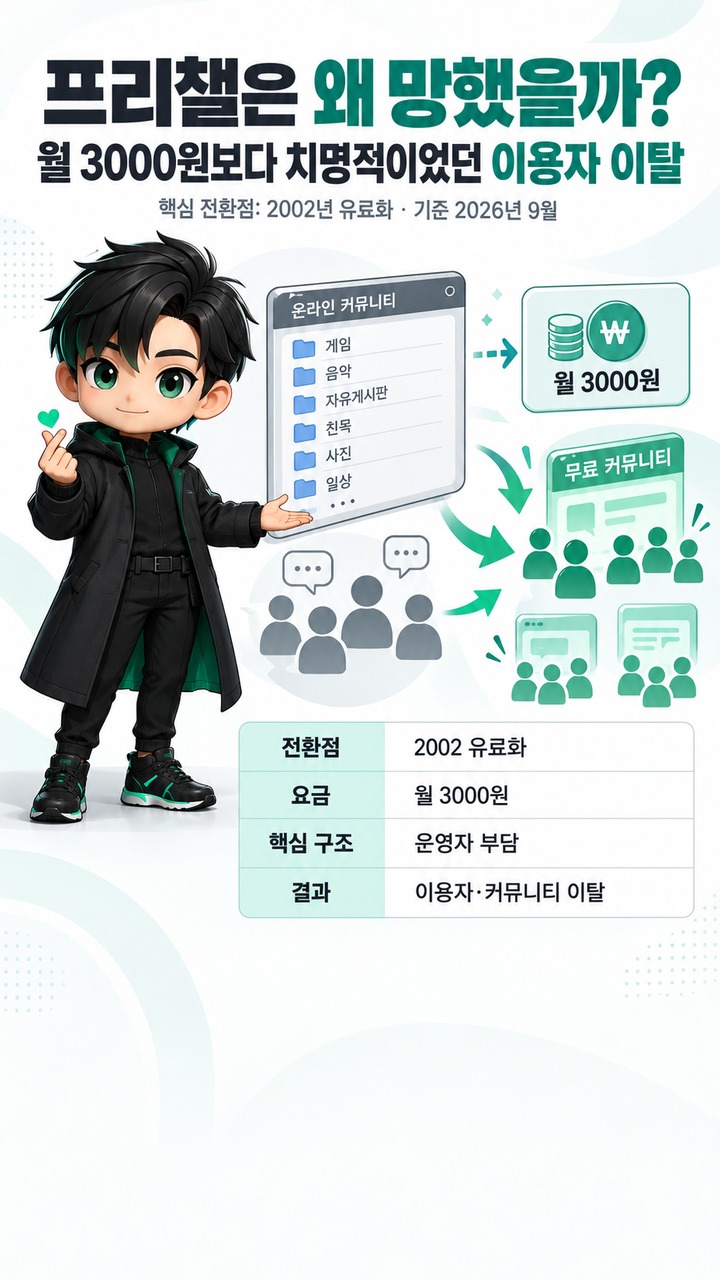
The biggest turning point in Freechal's decline was its decision to charge for community services in 2002. But saying it failed simply because “KRW 3,000 a month was too expensive” misses the bigger picture. More importantly, the new payment structure made it difficult to maintain communities unless their administrators paid, while free alternatives were readily available. Together, these factors prompted users and entire communities to leave at once.

Recent attention surrounding September 2026 Freechal founder Jeon Je-wan has also renewed interest in the platform's rise and fall. Rather than focusing on his current personal circumstances, this article examines historical reports to understand why Freechal, once a platform with 1000 million members, lost its competitive edge.
What Exactly Did Freechal Start Charging For?
Freechal began charging for its community services on 2002-11-14.

The key point of the policy announced at the time was that it did not impose a membership fee on every ordinary user. Instead, community administrators were charged KRW 3,000 per month. Elementary and middle school students who operated communities were exempt, while certain services, including joining communities as ordinary members, remained free.
Paying administrators also received benefits such as ad removal and expanded email storage capacity.
The problem arose when administrators refused to switch to the paid plan. Remaining on the free plan meant facing operational restrictions or difficulties maintaining existing communities in their original form. As a result, ordinary members could also see the spaces where they interacted affected. Communities opposing the paid policy emerged, along with movements encouraging users to migrate to other services.
In other words, although administrators were responsible for payment, the consequences of monetization were felt by entire communities.
Did Users Really Leave Because of KRW 3,000 a Month?

Looking at the price alone, the monthly figure of KRW 3,000 does not fully explain what happened.
A bigger issue at the time was the availability of free alternatives offering functions similar to Freechal's. Shortly after the paid-service announcement, reports emerged that users were moving to other free community platforms, including DreamWiz, Intizen, and Cyworld.
Community services are particularly influenced by network effects.
With software used individually, each person can decide whether to pay. A community, however, derives its value from the presence of friends, club members, administrators, and other participants.
Consequently, when a single administrator moves a community to another free service, dozens or even hundreds of members may follow.
For Freechal, the risk of losing the interconnected network of users that made up its communities was far greater than the benefit of collecting KRW 3,000 per month.
How Much Did the 110 Million Communities Shrink After Monetization?
Comparing contemporary reports reveals the scale of the changes.
| Period | Reported Findings |
|---|---|
| Before monetization in 2002 | Approximately 110 million to 112 million communities |
| 2002-11-14 | Approximately 13 million communities secured on the first day of paid service |
| Subsequent reports concerning the return to free services | Decline from approximately 110 million to around 40 million communities |
On the first day of monetization, Freechal announced that it had secured approximately 13 million of its roughly 110 million existing communities. However, because one person could operate 5 communities at the time, reports estimated that the actual number of paying members was approximately 10 million.
Freechal eventually revised its policy and returned to a system offering both free and paid communities. Contemporary reports stated that the number of communities had fallen from approximately 110 million to around 40 million.
There is an important distinction to keep in mind.
The change from 110 million to 13 million should not be interpreted as meaning that approximately 90% of members canceled their memberships. Those figures represent the number of communities, which is a different metric from the number of individual members.
What can be established is that the number of communities maintained through the monetization process declined substantially.
Did Freechal Really Fail Because of Monetization Alone?
It would also be inaccurate to attribute Freechal's long-term decline entirely to its decision to charge for community services.
Even before monetization, dot-com companies faced the challenge of converting large registered user bases into actual revenue. Freechal also needed a revenue model to address server operating costs and financial difficulties. Its decision to introduce paid services emerged from those circumstances.
The critical issue was what the company chose to monetize.
Rather than charging for optional features, Freechal imposed fees on its core community services, where users' relationships and interactions were concentrated. At the same time, competing platforms offered free alternatives.
The resulting sequence can be understood as follows.
Need for revenue → Monetization of core communities → User backlash → Migration to free competing services → Decline in communities → Weakened platform competitiveness
The lesson from Freechal is therefore not simply that free services should never charge users.
A more important lesson is that when a platform begins charging for a core feature users have come to regard as free, it must offer sufficiently clear value and compelling reasons to stay that outweigh the additional cost.
How Did Cyworld Attract Former Freechal Users?
The availability of competing services was a decisive factor in enabling Freechal users to leave.
Other companies offering free communities at the time even provided so-called “migration services” to help Freechal users transfer existing message-board content. Later reports also explained that many departing Freechal users moved to services such as Daum Cafe, while some migrated to Cyworld.
For Freechal, this meant the competition was about more than pricing.
When users decided to leave, competing companies had also reduced the cost and effort of switching platforms.
On online platforms, the departure of a single community administrator can have a far greater impact than an individual user clicking the account deletion button. When administrators move their message boards and members elsewhere, the relationships between people, which are among a platform's most valuable assets, move to competing services as well.
The Lasting Lessons of Freechal's Failed Monetization Strategy
Freechal was once a major platform with 1000 million members and more than 110 million communities. Yet its size alone was not enough to retain users.
To understand Freechal's experience, it is more accurate to consider three factors together rather than focusing solely on the monthly price of KRW 3,000.
It began charging for a core feature that had previously been free, free alternatives were available, and users could migrate together as entire communities.
Ultimately, what made Freechal's monetization strategy so damaging was not KRW 3,000 itself, but the fact that users who chose not to pay had readily accessible alternatives where they could continue their activities.
Related Articles
Jeon Je-wan's Recent Life as a Pension Cleaner: What Happened to the Freechal Founder?