

Court Upholds Trump's USD 800 De Minimis Exemption Suspension: Why Tariffs Were Blocked but Duty-Free Treatment Could End

A U.S. court has upheld the Trump administration's authority to suspend the de minimis exemption for imports valued at USD 800 or less. However, it is inaccurate to say that the U.S. Supreme Court ruled the elimination of the de minimis exemption lawful. The Supreme Court blocked the imposition of new tariffs under the International Emergency Economic Powers Act (IEEPA) in February 2026, while the U.S. Court of International Trade (CIT) ruled in a separate case in August 13 that suspending the de minimis exemption involves a different type of authority.
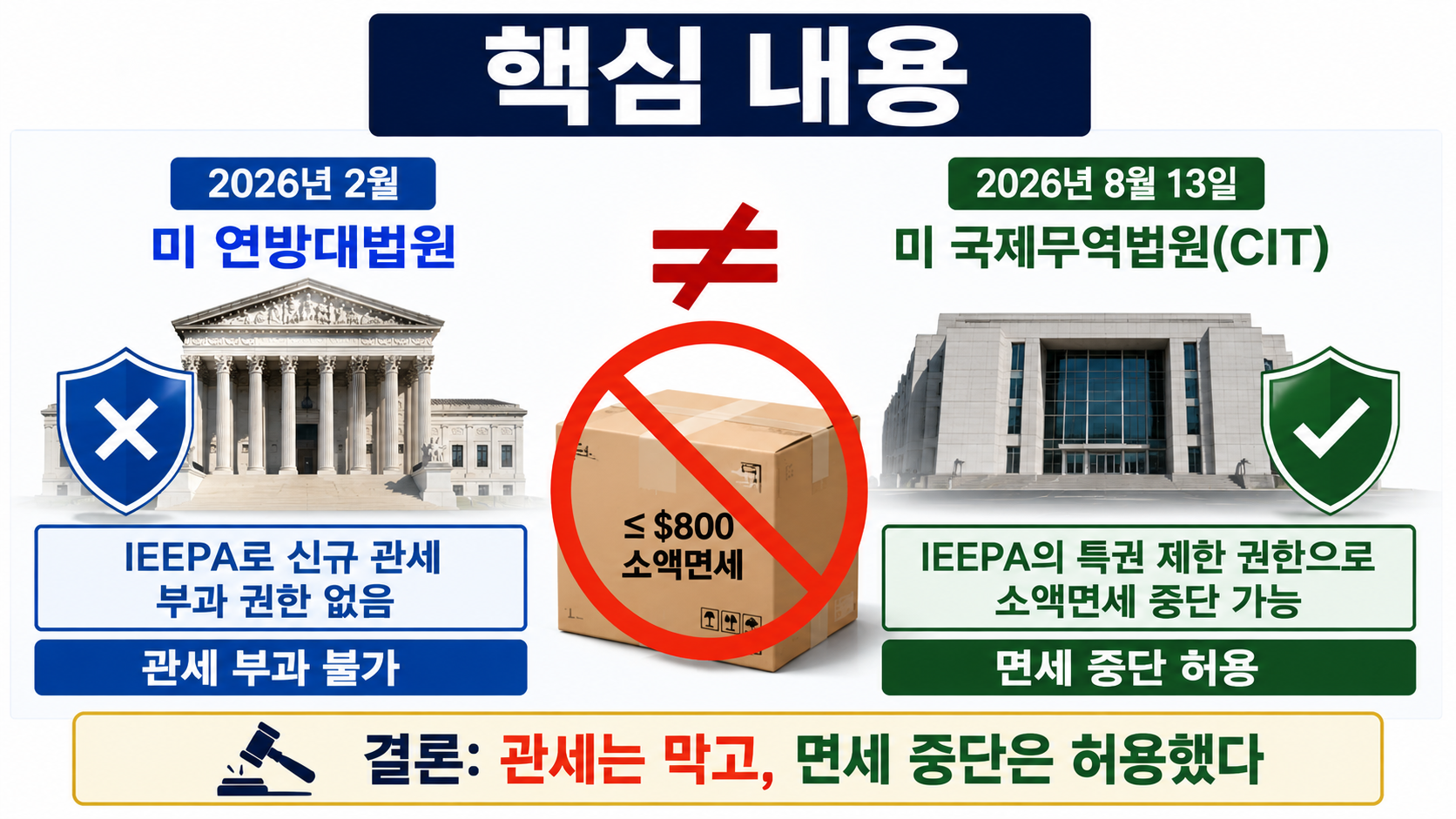
Although both cases involve the same International Emergency Economic Powers Act (IEEPA), the key reason for their different outcomes is that the courts treated the creation and imposition of new tariffs differently from the suspension of an existing duty-free privilege.
First, a Key Correction: The Supreme Court Did Not Uphold the Elimination of the De Minimis Exemption
The central question before the U.S. Supreme Court in 2026-02-20 was whether IEEPA authorized the president to impose tariffs.

The Supreme Court's answer was no. The central reasoning was that the U.S. Constitution assigns the power to impose taxes, including tariffs, to Congress, and IEEPA contains no explicit provision authorizing the president to impose new tariffs or taxes. As a result, the sweeping tariffs imposed by the Trump administration under IEEPA were found to lack a valid legal basis.
However, the question before the Supreme Court at that time did not include whether the so-called de minimis exemption for goods valued at USD 800 or less could be suspended.
That issue became the subject of separate litigation.
Detroit Axle, a Michigan-based automotive parts company, argued that if the Trump administration's suspension of the de minimis exemption caused goods previously imported duty-free to become subject to tariffs, the practical effect was no different from imposing new tariffs.
However, a panel of the U.S. Court of International Trade consisting of 3 judges rejected that argument in 2026-08-13. The court held that although IEEPA does not authorize the president to create new tariffs, it does permit the restriction or elimination of existing trade-related privileges in response to a national emergency.
That is why the two outcomes may appear contradictory at first glance.
Supreme Court ruling: The president cannot create new tariffs solely under IEEPA.
Court of International Trade ruling: IEEPA can be used to suspend the existing trade privilege known as the de minimis exemption.
The courts involved and the legal questions presented were different from the outset.
What Was the Original USD 800 De Minimis Exemption?
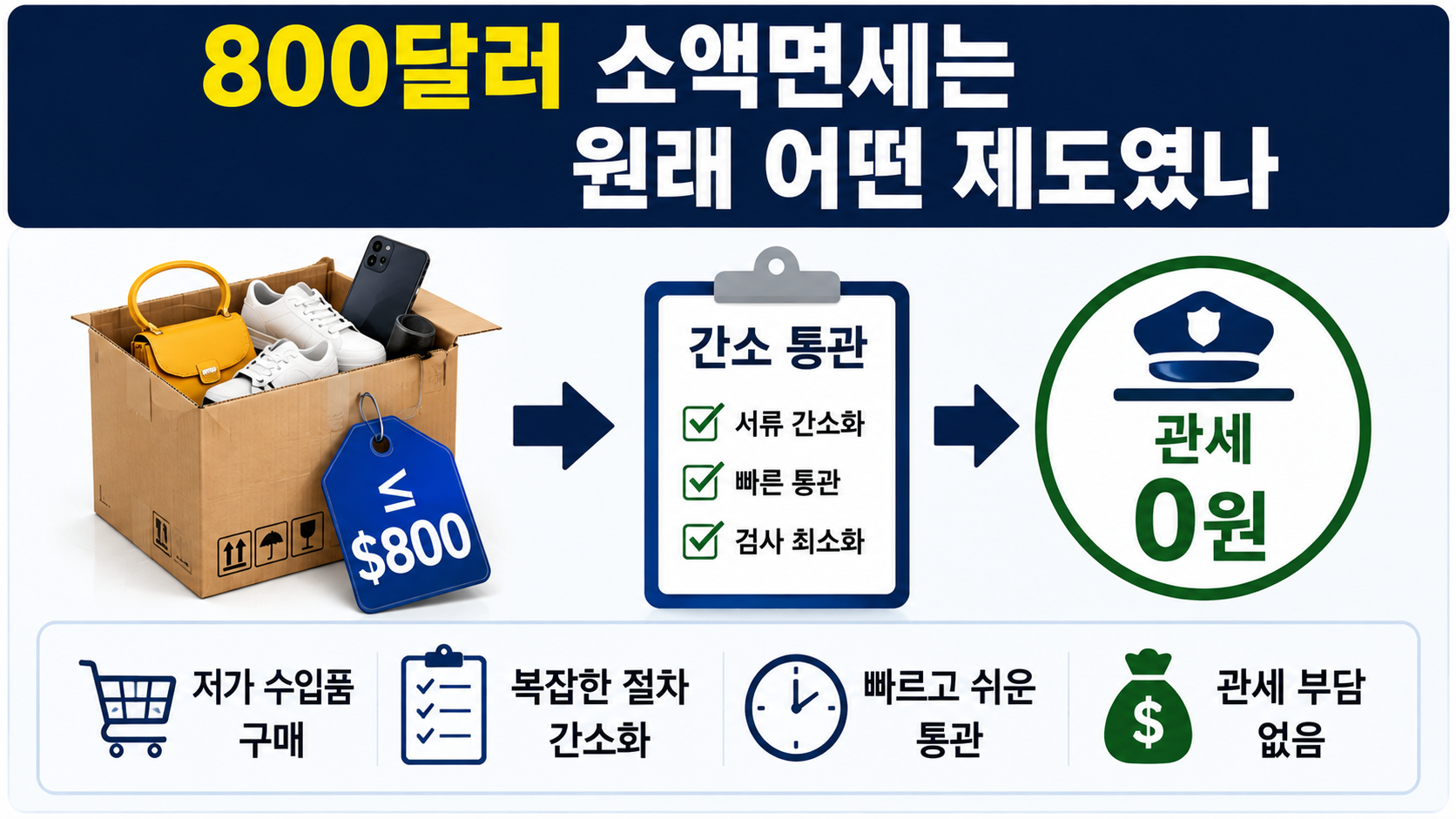
The U.S. de minimis system allowed low-value imported goods below a specified threshold to enter the country without complicated customs procedures or tariff burdens.
The de minimis provision of U.S. customs law, 19 U.S.C. §1321, generally set the threshold at USD 800 for goods imported by one person in a single day. The statutory language itself describes this treatment as a 'privilege.'
That wording became important in the latest ruling.
IEEPA contains language allowing the government, in connection with a national emergency, to regulate, nullify, or prohibit the exercise of rights, powers, and privileges relating to property in which a foreign country or foreign national has an interest.
The Court of International Trade connected this provision directly to the de minimis issue.
In other words, the court reasoned that deriving a new power to impose tariffs from IEEPA, where no such authority is expressly provided, is not the same legal act as using emergency economic powers to restrict duty-free treatment that existing legislation already defines as a privilege.
Without recognizing this distinction, it is easy to conclude that the rulings conflict because the Supreme Court found an action unlawful under IEEPA while the Court of International Trade found another action lawful under the same statute.
In reality, the two courts answered different questions.
Both Tariffs and Ending an Exemption Increase Costs. Why Did the Courts Treat Them Differently?
From an importer's perspective, the results may look similar. If goods that previously entered without tariffs suddenly become subject to duties, the financial impact may feel little different from the introduction of a new tariff.
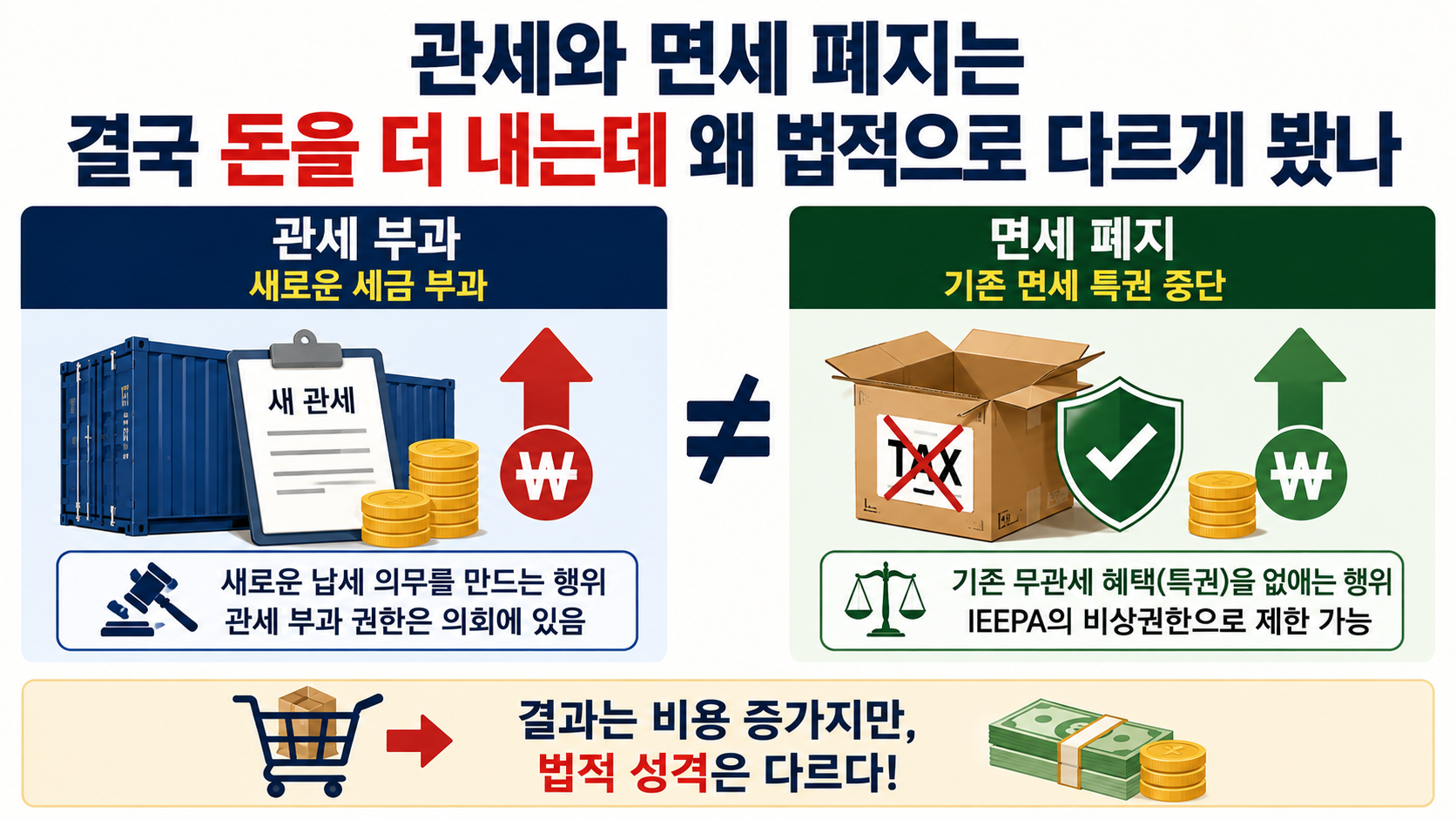
That was precisely the issue Detroit Axle raised.
However, the court did not treat the two actions as legally identical merely because their economic consequences were similar.
Imposing a new tariff requires creating a tax obligation that did not previously exist. The Supreme Court concluded that the general language in IEEPA authorizing the regulation of imports could not be interpreted as granting such taxing authority. The fact that tariff-setting authority is a core congressional power was also important.
By contrast, suspending the de minimis exemption involves an existing general tariff system and the removal of an exceptional duty-free treatment previously granted to certain low-value goods.
The Court of International Trade emphasized that IEEPA expressly addresses actions involving 'privileges' and that the U.S. statute governing the de minimis exemption also describes the duty-free treatment as a 'privilege.' The court therefore distinguished between creating a new tax and removing an existing exemption so that the ordinarily applicable tariff system would apply again.
The distinction can be summarized as follows.
The question in the tariff case was: 'Can the president create new tariffs under IEEPA?' The question in the de minimis case was: 'Can the president suspend an existing duty-free privilege under IEEPA?'
The Supreme Court answered 'no' to the first question, while the Court of International Trade answered 'yes' to the second.
Does This Mean U.S. Direct-to-Consumer Imports Valued at USD 800 or Less Are Duty-Free Again?
Goods valued at USD 800 or less entering the United States have not automatically returned to their previous de minimis duty-free status because of the Supreme Court ruling.
The Trump administration expanded the suspension of the de minimis exemption worldwide through Executive Order 2025-07-30. Beginning 2025-08-29, imported goods valued at USD 800 or less generally could no longer receive the previous de minimis duty-free treatment. U.S. customs authorities have also administered clearance procedures under this standard.
Even after the Supreme Court invalidated IEEPA tariffs in February 2026, the suspension of the de minimis exemption remained in place separately. President Trump issued a new executive order, February 20, directing the continued suspension of the exemption, with the related changes taking effect from February 24.
Therefore, it would be incorrect to assume that because the Supreme Court blocked Trump's tariffs, overseas purchases valued at USD 800 or less automatically became duty-free again.
However, the specific legal issue decided in the August 13 ruling should not be treated as entirely identical to the scope of the Trump administration's worldwide suspension of the de minimis exemption.
The Court of International Trade ruling directly addressed Trump's authority to suspend the de minimis exemption for low-value imports from China, Mexico, and Canada through Executive Order February 2025. The current worldwide suspension must also be assessed in light of subsequent executive orders and customs measures.
For sellers shipping products from South Korea to consumers in the United States, checking only whether a shipment is below USD 800 is insufficient. To determine the actual cost, they must also consider the goods' country of origin, product-specific tariff rates, shipping method, customs clearance procedure, and any separately applicable tariffs and fees.
Why Did Congress Set 2027-07-01 Separately?
There is another potentially confusing date. The U.S. Congress has already legislated the elimination of the USD 800 de minimis exemption, but the effective date is 2027-07-01.
This gave Detroit Axle another significant legal argument.
The company argued that if Congress had directly amended the law and set 2027-07-01 as the date for eliminating the de minimis exemption, the president's use of IEEPA to suspend the benefit earlier would conflict with the timetable established by Congress.
However, the Court of International Trade did not interpret the date in 2027 as preventing the president from exercising separate emergency economic powers that already existed before then. In effect, the court treated Congress's permanent statutory amendment and the president's earlier suspension under emergency authority as distinct legal pathways.
Separating the dates makes the situation much clearer.
2025-08-29 was the date the Trump administration implemented the suspension of de minimis treatment for low-value imports worldwide.
On 2026-02-20, the Supreme Court ruled that IEEPA did not authorize the president to impose tariffs.
On the same day, the Trump administration introduced a separate measure to maintain the suspension of the de minimis exemption.
On 2026-08-13, the Court of International Trade upheld the authority to suspend the de minimis exemption under IEEPA in the Detroit Axle case.
On 2027-07-01, the provision eliminating the de minimis exemption, enacted by Congress through legislation passed in 2025, is scheduled to take effect.
In other words, July 2027 is not 'the date Trump's executive action first takes effect.' The distinction is that it marks the point at which Congress's statutory amendment eliminates the existing USD 800 provision itself.
Can This Ruling Be Considered Final and Settled?
As of 2026-08-15, the most accurate description is that the U.S. Court of International Trade has upheld Trump's authority to suspend the de minimis exemption.
Saying that 'the U.S. Supreme Court definitively ruled the elimination of the USD 800 exemption lawful' would misidentify both the court responsible and the substance of the decision. The Supreme Court's ruling in February held that IEEPA does not grant authority to impose tariffs. It did not directly decide the de minimis issue.
The significance of the latest ruling lies precisely in that distinction.
After the Supreme Court's decision, an important question remained: If tariffs imposed under IEEPA were unlawful, should the suspension of the de minimis exemption, which also relied on IEEPA, automatically be invalidated?
The Court of International Trade drew a clear distinction on this issue for the first time.
Although the authority to create new tariffs is not recognized, separate emergency powers to restrict trade-related privileges may still exist.
Therefore, the latest ruling did not overturn the Supreme Court's decision. Rather, it reflects a different interpretation of the particular type of authority the president exercised under the same statute.
This interpretation could be reconsidered if appellate proceedings or additional rulings follow. Businesses selling goods to the United States or importing products into the country should check the U.S. customs rules and applicable tariff rates in effect at the time of clearance rather than determining duty-free eligibility based solely on a news headline.