

Why Limit Orders Go Unfilled and How Bid-Ask Spreads Create Round-Trip Trading Costs
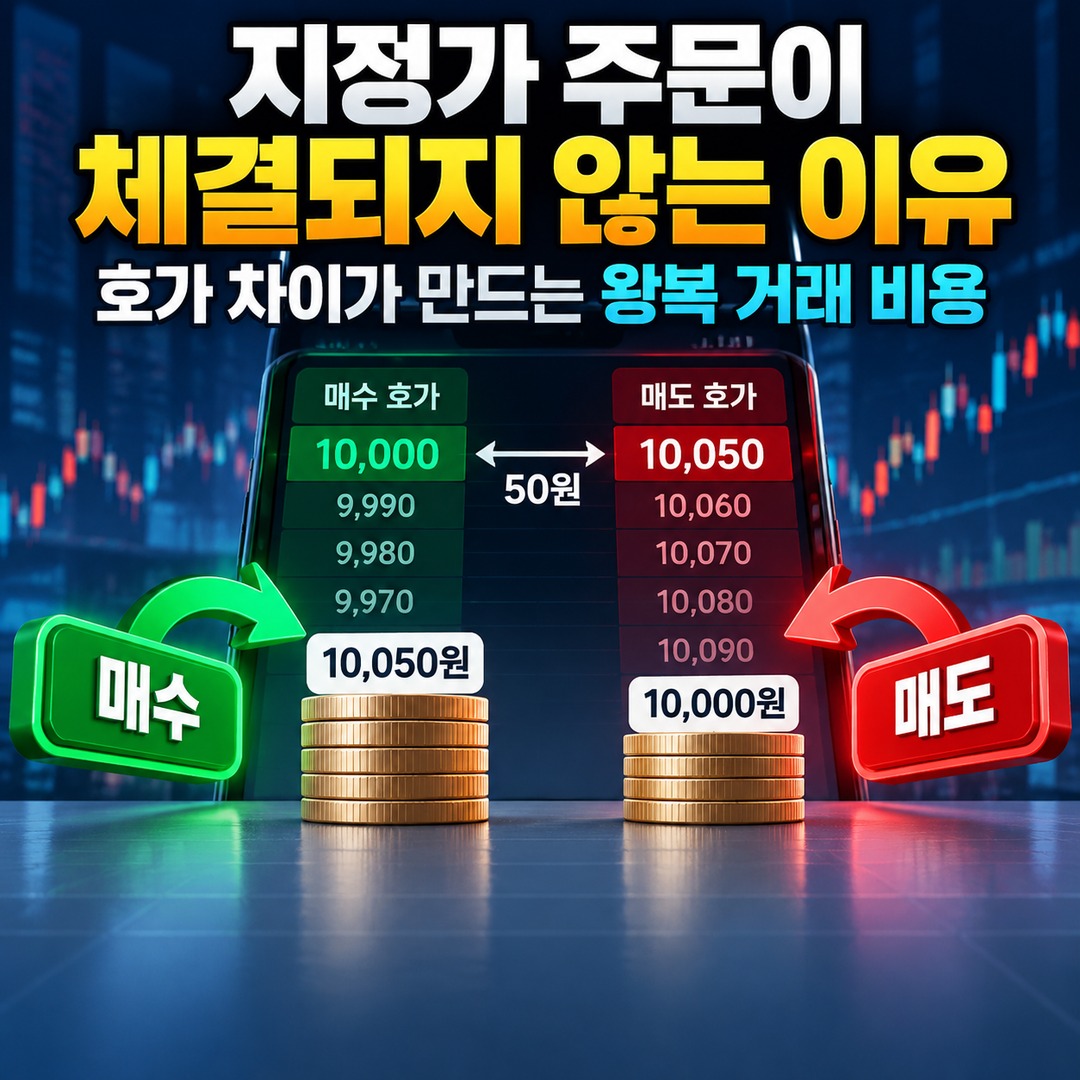
A limit order restricts a purchase to a specified price or lower, or a sale to a specified price or higher, so submitting an order does not guarantee execution. A wide bid-ask spread can create costs simply from buying and then selling once. The following calculations use hypothetical quotes of KRW 10,000 and KRW 10,050 per share to illustrate execution conditions and round-trip trading costs.
Why Doesn't a Trade Execute Even After I Enter a Limit Price?
The key point about limit orders is that complying with a price condition and actually getting an order executed are two different things. The U.S. Securities and Exchange Commission (SEC), in its investor guidance document *Understanding Order Types*, explains that a buy limit order may execute at the specified price or lower, while a sell limit order may execute at the specified price or higher. Execution itself is not guaranteed.
Consider a buy order. If the lowest price currently offered by a seller is KRW 10,050 and you enter a buy limit price of KRW 10,000, the trade may not execute unless a matching sell order becomes available at KRW 10,000. A matching sell order must be willing to sell at that price.
Conversely, if you enter a sell limit price of KRW 10,050, the order can execute only if a buyer is willing to pay that price or more.
Check the following:
Buy limit price: Is the price high enough compared with the current ask price?
Sell limit price: Is the price low enough compared with the current bid price?
Available order-book quantity: Are there enough opposing orders to fill the quantity you want to trade?
Order status: Is the order unfilled, partially filled, or canceled?
Order duration: Is it a day order, or does it have a separately specified validity period?
Even if the displayed current price appears to match your limit price, execution is not guaranteed. The displayed current price may be the price of the most recent trade, which can differ from the current bid and ask prices.
How Should You Read the Difference Between Bid and Ask Prices?
The bid is the price at which a buyer wants to buy, while the ask is the price at which a seller wants to sell. The gap between these two prices is called the spread. Investor.gov's explanation of quote terminology likewise distinguishes the bid as the highest price buyers are offering and the ask as the lowest price sellers are offering.
The following are hypothetical quotes, not actual market prices.
Bid 1 quote
KRW 10,000
The highest price offered by a buyer
Ask 1 quote
KRW 10,050
The lowest price offered by a seller
Bid-ask spread
KRW 50
Spread relative to the average bid and ask price
Approximately 0.50%
Author's calculation: The spread is KRW 10,050 − KRW 10,000 = KRW 50. Using KRW 10,025, the average of the two quotes, as the reference price, the spread is approximately 0.499% as a percentage.
When the bid and ask prices are this far apart, a buyer may want to purchase at a lower price, but the seller on the other side may not be willing to sell at that price. Conversely, a buyer who wants an immediate trade and matches the ask price may have to pay more.
What Does a Round-Trip Trade Cost at KRW 10,000 and KRW 10,050 per Share?
A round-trip trade consists of completing both a purchase and a sale. In the hypothetical example below, assume that 100 shares are traded at the respective bid and ask prices. Actual commissions and taxes are excluded.
Hypothetical example · Trade of 100 shares
① Buy
KRW 1,005,000
KRW 10,050 × 100 shares
② Sell
KRW 1,000,000
KRW 10,000 × 100 shares
Author's calculation · Assumes the buy and sell prices remain unchanged
Difference between the amounts before and after the trade
−KRW 5,000
Loss as a percentage of the purchase amount
Approximately −0.50%
The calculations are as follows:
Purchase amount: KRW 10,050 × 100 shares = KRW 1,005,000
Sale proceeds: KRW 10,000 × 100 shares = KRW 1,000,000
Difference before and after the trade: KRW 1,000,000 − KRW 1,005,000 = −KRW 5,000
Loss rate: −KRW 5,000 ÷ KRW 1,005,000 × 100 ≈ −0.4975%
This calculation is a hypothetical example that isolates the price difference. It does not mean that an actual trade will necessarily incur a loss of KRW 5,000. Quotes may change, and execution prices may differ. Commissions, taxes, partial fills, and other factors must be accounted for separately.
What Changes When the Bid-Ask Spread Narrows to KRW 10?
The result changes if we use the same quantity of 100 shares and assume a bid of KRW 10,000 and an ask of KRW 10,010.
| Item | Spread KRW 50 | Spread KRW 10 |
|---|---|---|
| Purchase amount | KRW 1,005,000 | KRW 1,001,000 |
| Sale proceeds | KRW 1,000,000 | KRW 1,000,000 |
| Difference in amount | −KRW 5,000 | −KRW 1,000 |
| Loss as a percentage of the purchase amount | Approximately −0.50% | Approximately −0.10% |
Author's calculations · Each example assumes that the bid and ask prices remain unchanged and that all 100 shares are executed at the specified prices. Fees and taxes are excluded.
The difference between the two examples is KRW 4,000. Under these hypothetical conditions, this illustrates how much the price disadvantage of a round-trip trade can decrease when the bid-ask spread narrows. However, a narrow spread does not mean that trading volume is sufficient or that an order will necessarily be executed at the desired price.
Should You Keep Your Limit Price or Change It?
Before changing an order price, distinguish execution priority from your trading objective. A limit order is useful for controlling the price, but it does not guarantee execution speed. Raising a buy limit or lowering a sell limit can change the likelihood of execution, but you must also consider the risk of trading at a less favorable price.
You can check the following items in order.
1. Check current quotes: Check the 1 bid and 1 ask, rather than relying on the last traded price.
2. Check available quantities: Compare the number of shares you want to trade with the quantity available at the opposing quote.
3. Check the order status: Determine whether the order remains unfilled or only part of the quantity has been executed.
4. Assess the implications of changing the price: If you raise a buy limit or lower a sell limit, consider whether you are willing to accept a higher purchase cost or lower sale proceeds.
5. Check the order's validity period: Consult your broker's guidance to determine whether the order expires at the end of the day or remains active if unfilled.
Especially for illiquid securities or those experiencing rapid price movements, the quotes displayed on the screen may differ from those available when the order actually arrives. The U.S. Securities and Exchange Commission's guidance, Executing an Order, also explains that order transmission takes time and prices may change during that interval.
Three Things to Remember Before Trading
A limit order sets a price restriction; it does not guarantee execution.
When calculating round-trip trading costs, check not only the bid-ask spread but also the actual execution prices, fees, and taxes.
Before changing a price to increase the likelihood of execution, calculate the amount you would have to give up as a result.
Before submitting an order, checking the 1 bid, the 1 ask, available quantities at each quote, and the order status can help you identify why an order remains unfilled and estimate the expected trading costs.
The following item is for website publishing settings only and should not be included in the publicly visible article.
※ This article provides reference information for understanding market behavior and is not an investment recommendation for any specific security or asset. You are responsible for your own final decisions and investments.