

How to Calculate Share Quantity Using Your Stop-Loss Price and Account Risk Limit
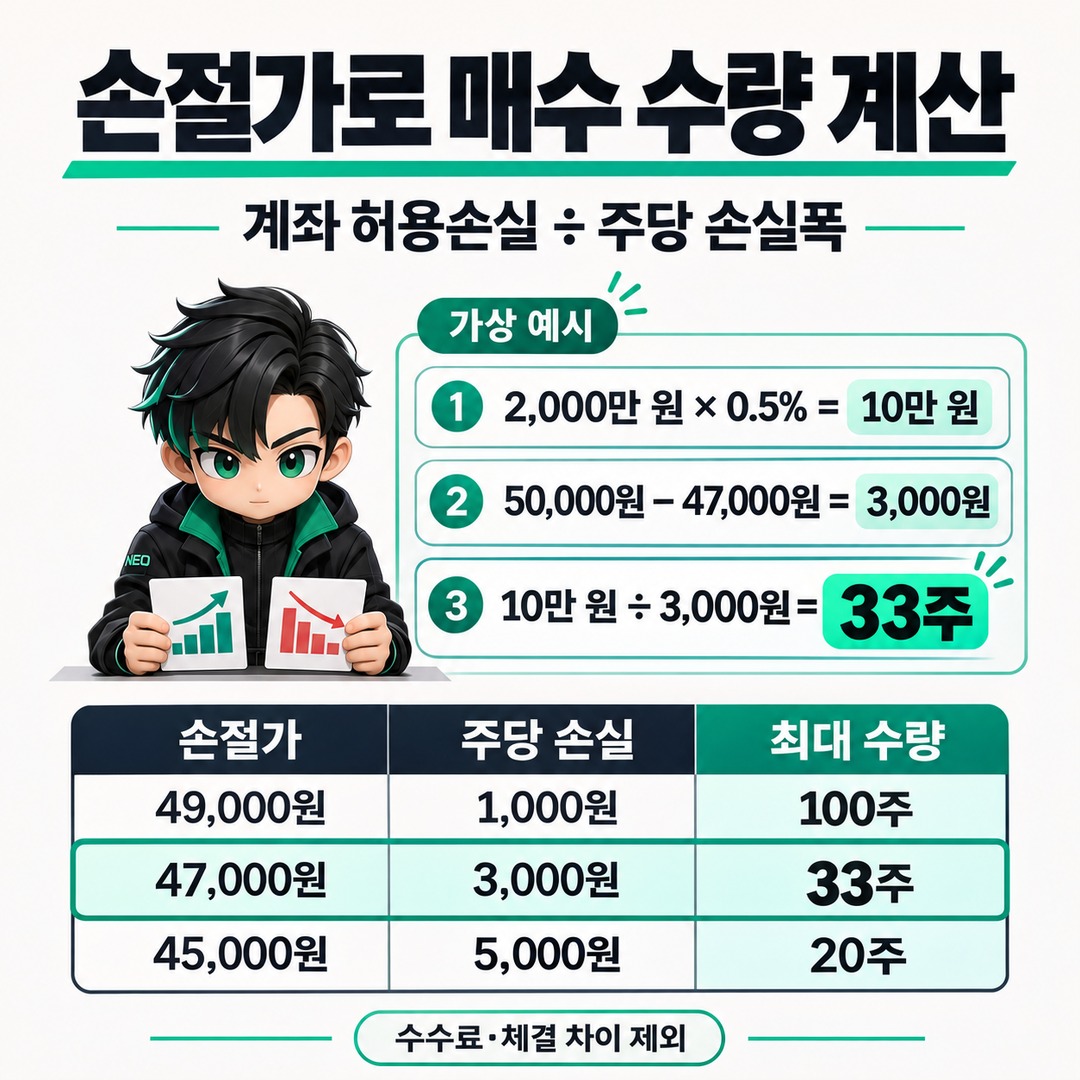
Instead of deciding on an investment amount first, you can calculate how many shares to buy based on the loss you can accept on a single trade and the difference between the purchase price and stop-loss price. For example, if the account value is KRW 20,000,000 and the allowable loss per trade is set at 0.5%, the loss limit is KRW 100,000. Once the purchase and stop-loss prices are set, the number of shares you can buy is determined using this KRW 100,000.
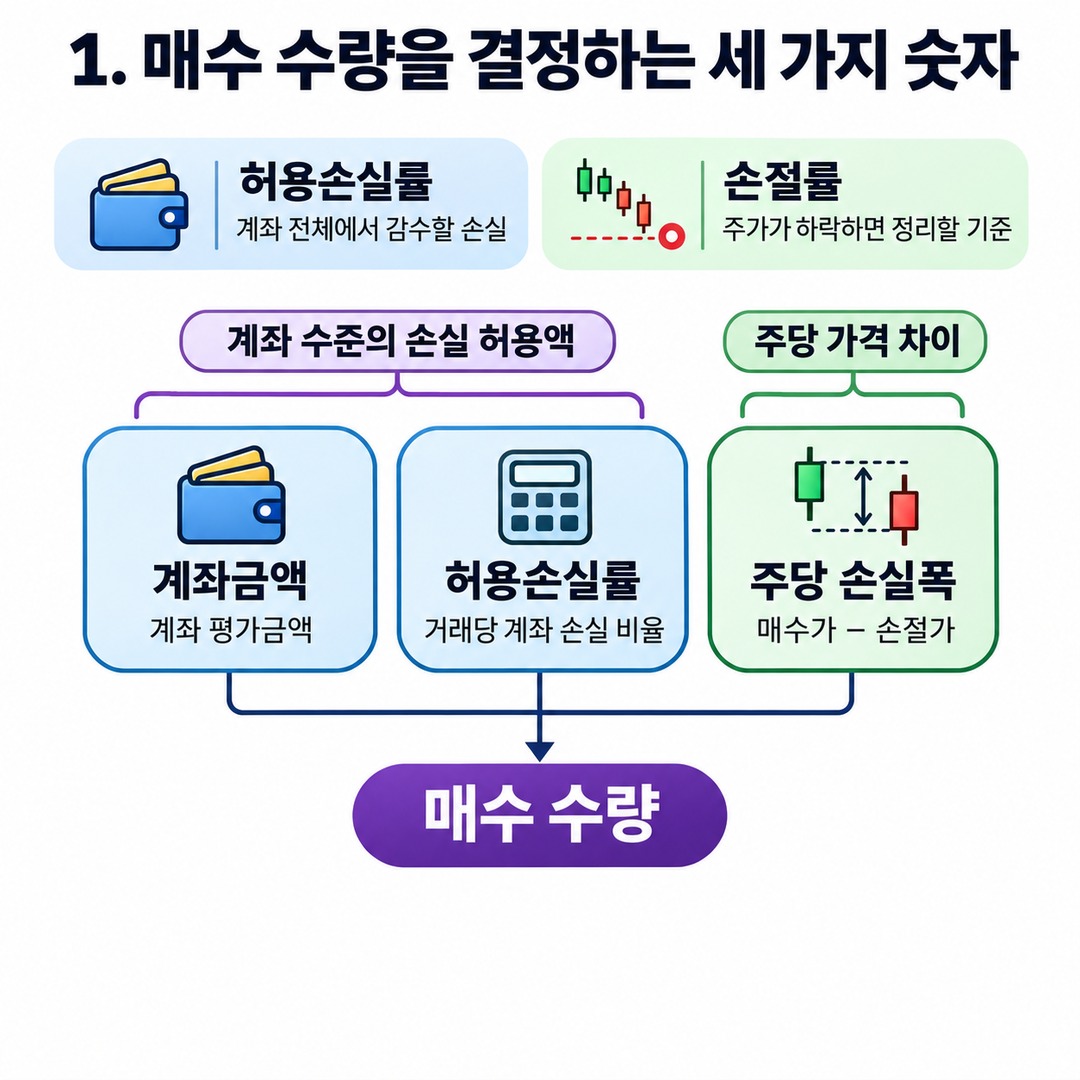
The key formula is as follows.
Number of shares to buy = account balance × allowable loss rate ÷ (purchase price − stop-loss price). Round the result down to a whole number of shares. However, the actual loss may exceed the amount calculated in advance depending on the actual execution price when selling, transaction costs, and price gaps.
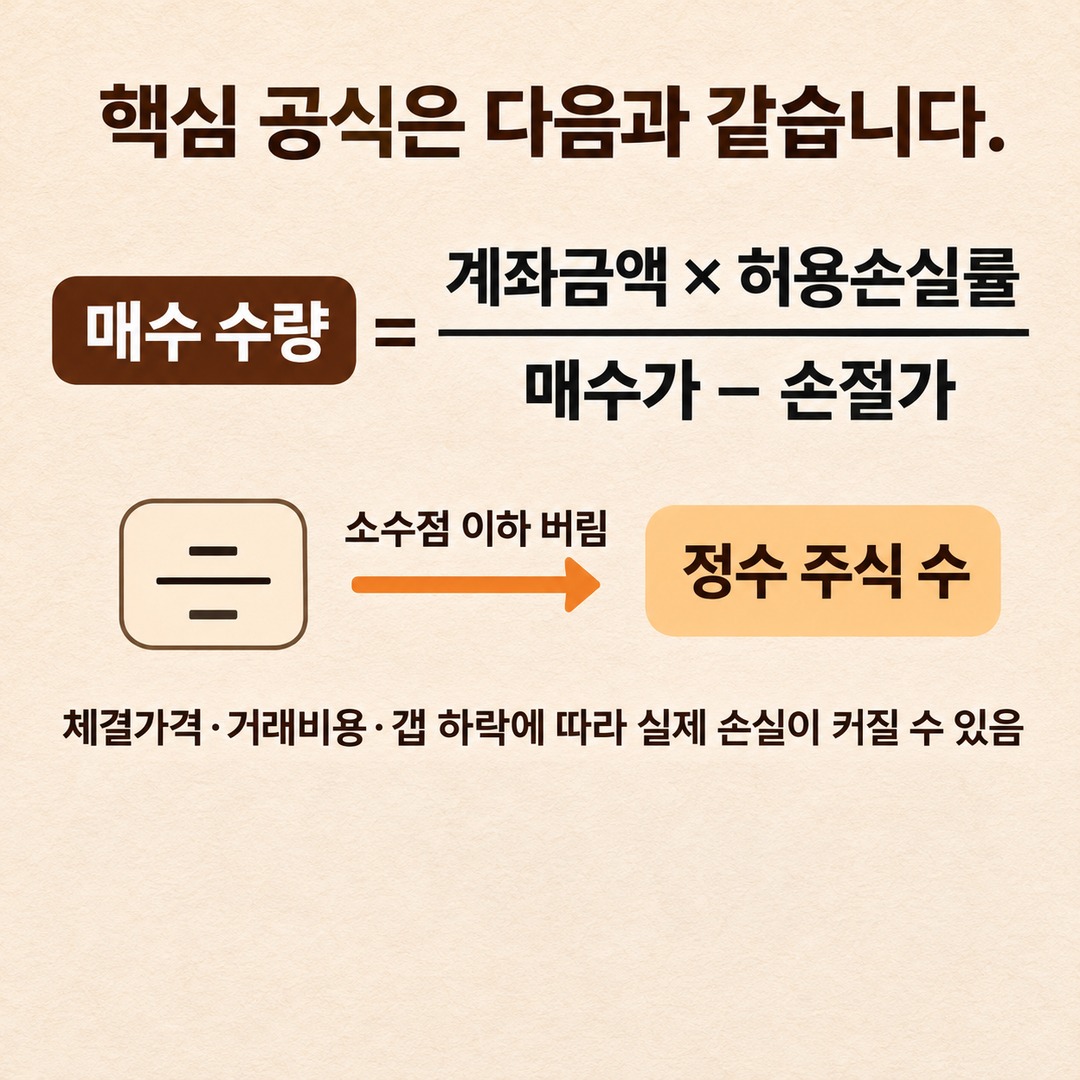
1. Three figures that determine how many shares to buy
To calculate how many shares to buy, you need the account balance, the allowable loss rate per trade, and the loss per share.
| Calculation item | Meaning |
|---|---|
| Account balance | The account value used as the basis for the trade |
| Allowable loss rate | The share of the account balance you are willing to risk losing on a single trade |
| Loss per share | The purchase price minus the stop-loss price |
The key point here is that the allowable loss rate and the stop-loss rate are different concepts.
Allowable loss rate: How much of the account balance are you willing to lose?
Stop-loss rate: What percentage drop in the purchased stock would trigger an exit?
For example, deciding to risk only 0.5% of your account does not mean you should set a stop-loss when the stock price falls by 0.5%.
First set the stock's stop-loss price, then adjust the number of shares to match the size of that potential loss.
2. What is the loss limit for an account of KRW 20,000,000?
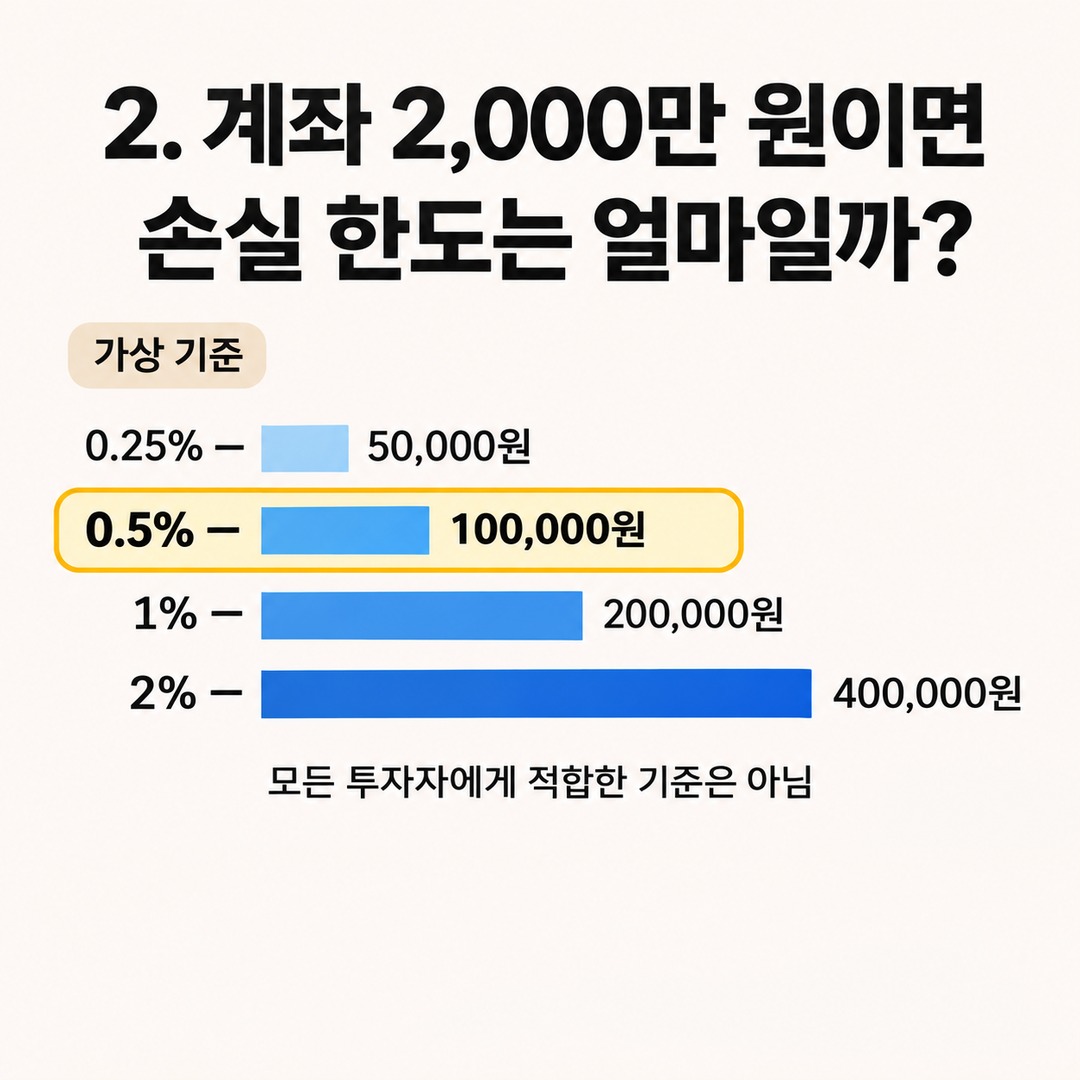
Assuming an account value of KRW 20,000,000, the allowable loss per trade at different allowable loss rates is as follows.
| Allowable loss rate | Allowable loss per trade |
|---|---|
| 0.25% | KRW 50,000 |
| 0.5% | KRW 100,000 |
| 1% | KRW 200,000 |
| 2% | KRW 400,000 |
The figures above are hypothetical values intended to explain the calculation; they do not represent a loss rate suitable for every investor.
If you choose 0.5% as the allowable loss rate, the planned loss limit for a single trade is KRW 100,000.
You can now calculate the actual number of shares to buy using the purchase and stop-loss prices.
3. How many shares if the purchase price is KRW 50,000 and the stop-loss price is KRW 47,000?
Let’s set the following hypothetical trading conditions.
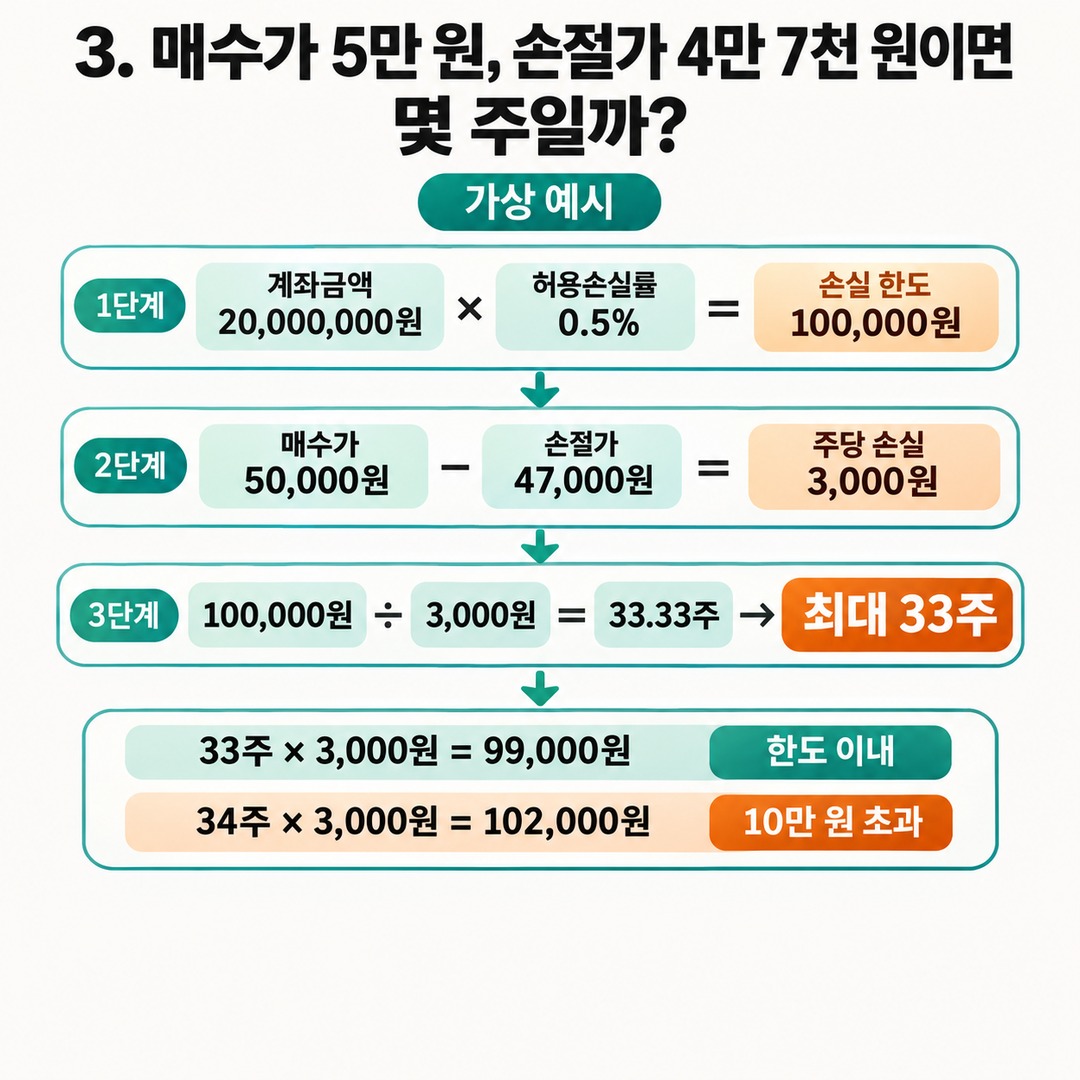
Account balance: KRW 20,000,000
Allowable loss rate per trade: 0.5%
Purchase price: KRW 50,000
Stop-loss price: KRW 47,000
First, calculate the amount you are willing to risk losing from the account.
20,000,000 × 0.005 = 100,000 Next, calculate the loss per share.
50,000 − 47,000 = 3,000 Finally, divide the allowable loss amount by the loss per share.
100,000 ÷ 3,000 = 33.33 Therefore, the maximum number of shares you can buy is 33.
Author’s calculation · Hypothetical example · Excludes commissions, taxes, and execution-price differences
If you actually buy 33 shares, the results are as follows.
| Item | Calculation result |
|---|---|
| Purchase amount | KRW 1,650,000 |
| Loss per share at the stop-loss price | KRW 3,000 |
| Expected loss amount | KRW 99,000 |
| Loss as a percentage of the account | 0.495% |
Buying 34 shares would result in an expected loss of KRW 102,000.
Therefore, 34 shares exceed the allowable loss of KRW 100,000, while 33 shares remain within the limit.
This shows that the number of shares to buy should be based not simply on how much cash is available to invest, but on how much the account would lose if the stop-loss were triggered.
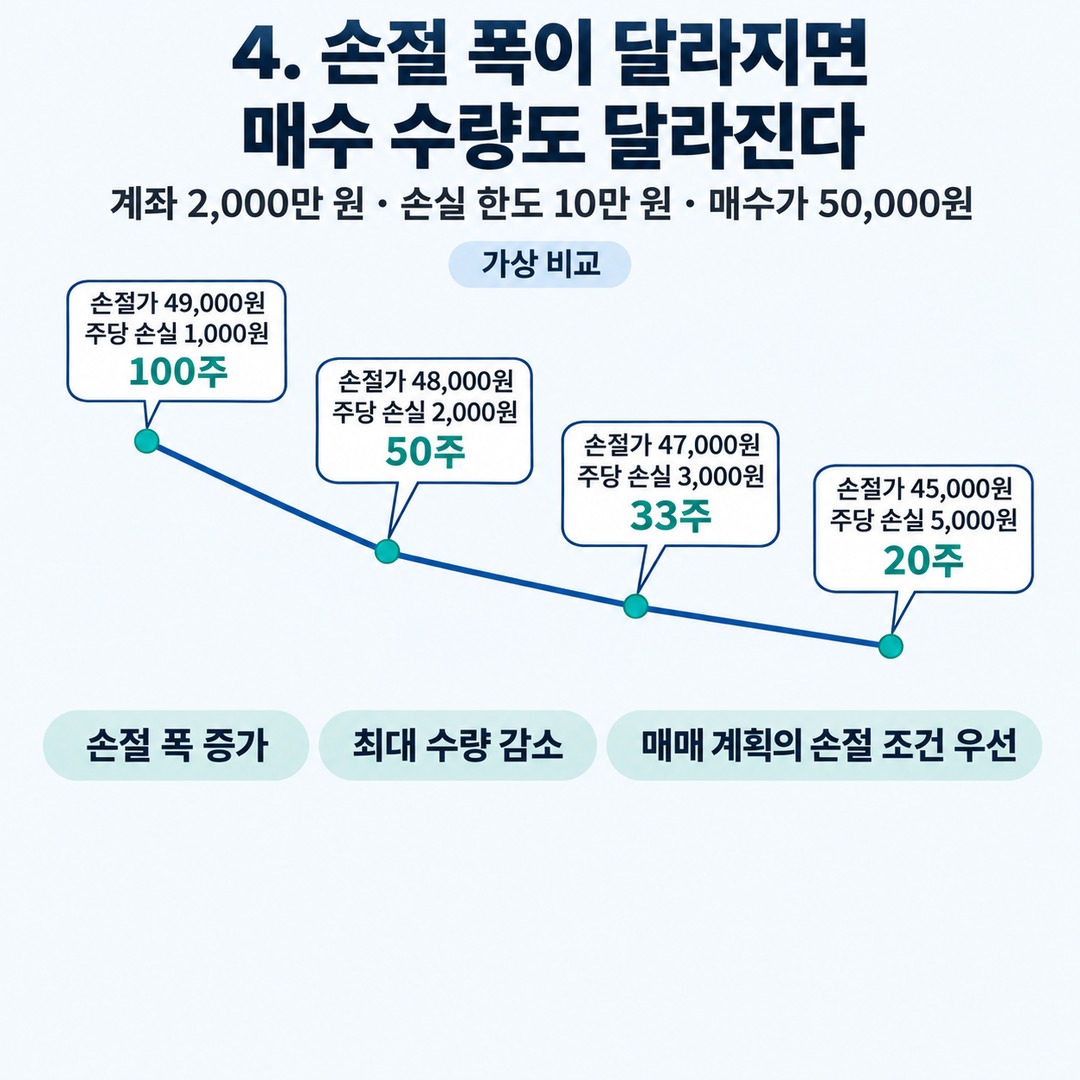
4. A wider stop-loss range means a different share quantity
Even when the account balance and allowable loss amount stay the same, the number of shares to buy changes when the stop-loss price changes.
Let’s compare scenarios while holding the account balance at KRW 20,000,000, the allowable loss at KRW 100,000, and the purchase price at KRW 50,000.
| Stop-loss price | Loss per share | Maximum shares to buy |
|---|---|---|
| KRW 49,000 | KRW 1,000 | 100 shares |
| KRW 48,000 | KRW 2,000 | 50 shares |
| KRW 47,000 | KRW 3,000 | 33 shares |
| KRW 45,000 | KRW 5,000 | 20 shares |
Even with the same loss limit of KRW 100,000, the number of shares to buy falls as the stop-loss range widens.
Conversely, the number of shares to buy rises as the stop-loss range narrows.
Understanding this difference can help you avoid setting a stop-loss arbitrarily close to the purchase price or buying so many shares that you exceed your allowable loss.
However, narrowing the stop-loss range is not always better. First, keep the stop-loss conditions set out in your actual trading plan.
5. How do you calculate the quantity if you don't have enough funds?
The quantity calculated from the loss limit alone may exceed the number of shares you can actually afford to buy in the account.
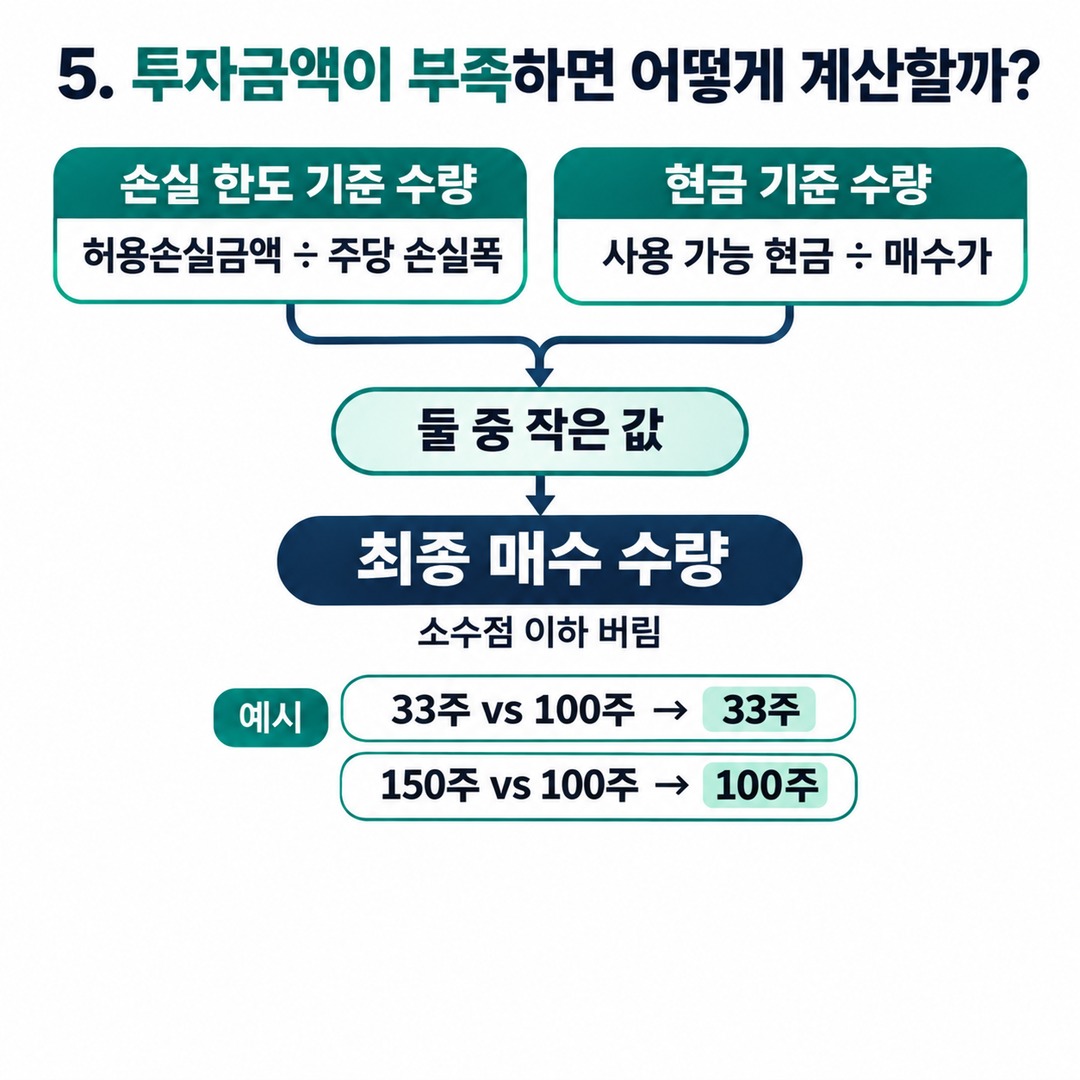
In that case, apply both of these limits.
1. The quantity calculated from the allowable loss amount
2. The quantity calculated from the cash actually available to buy
The final quantity is the smaller of the two.
Final quantity = min (allowable loss amount ÷ loss per share, available cash ÷ purchase price). Round down each result to a whole number of shares when placing the actual order.
For example, if the account has KRW 5,000,000 and the purchase price is KRW 50,000, the maximum number of shares you can buy is 100, excluding fees and other costs.
But if the quantity calculated from the loss limit is 33 shares, the actual quantity to buy is 33 shares.
Conversely, even if the quantity calculated from the loss limit is 150 shares, if your cash only lets you buy 100 shares, then 100 shares is the cap.
6. The calculation changes when you account for fees and price gaps
The preceding formula assumes that the purchase and stop-loss prices are executed exactly as specified.
However, in the actual stock market, the stop-loss price is not necessarily the price at which the shares are sold.
In its updated explanation of stop orders, the U.S. Securities and Exchange Commission (SEC) investor materials, dated 2026-08-18, explain that when the stop price is reached, a standard stop order becomes a market order, and the actual execution price may differ substantially from the stop price.
So it is a good idea to account for expected trading costs and price slippage in your calculations.
If you estimate costs as an amount per share, you can calculate the quantity as follows.
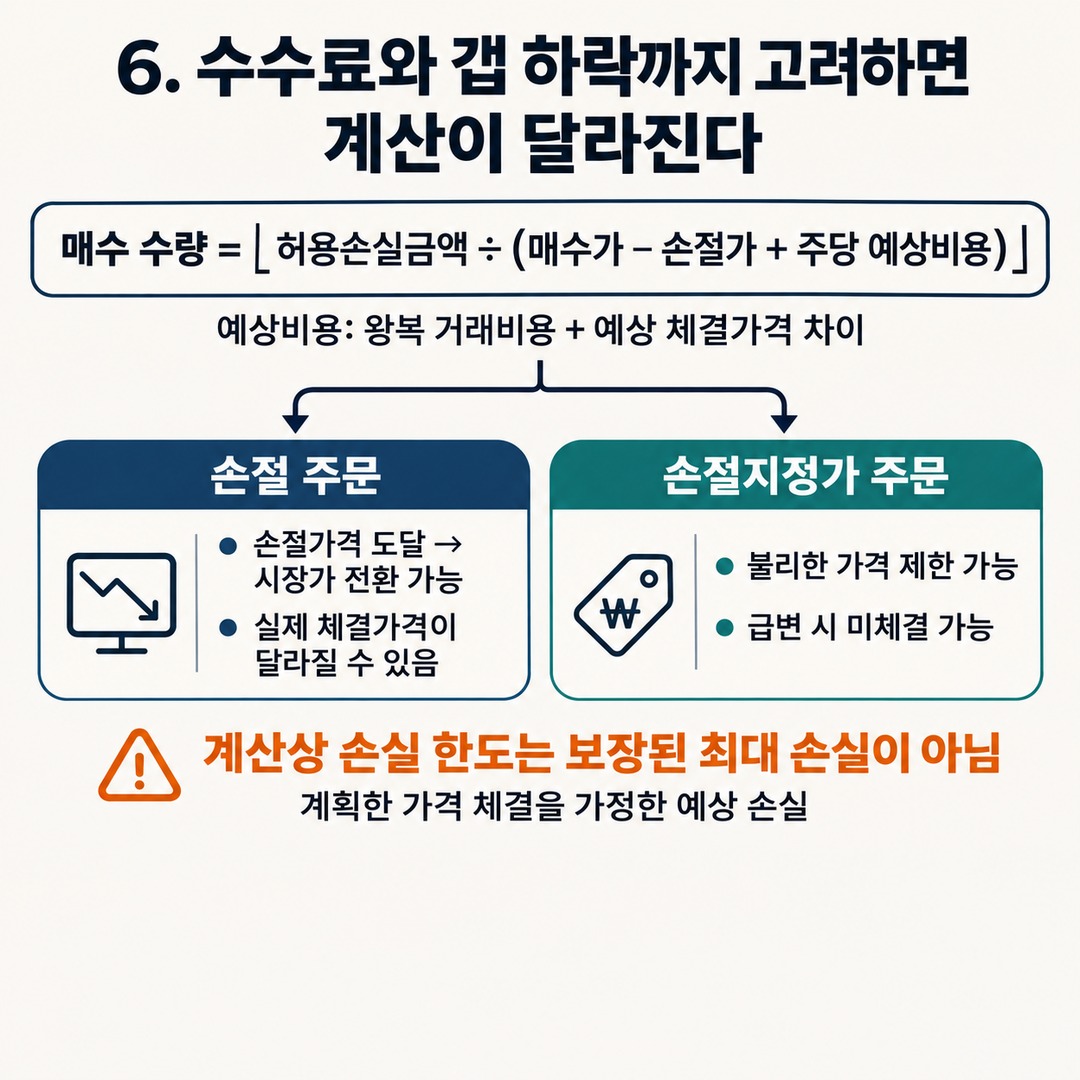
Number of shares to buy = ⌊allowable loss amount ÷ (purchase price − stop-loss price + estimated cost per share)⌋. Here, estimated costs are assumed values that account for round-trip trading costs and the expected difference in execution price.
Actual commissions and taxes vary depending on the market, brokerage, and trading conditions, so check the actual cost basis for your account.
In particular, distinguish between these two types of orders.
Stop order: When the stop price is reached, the order may become a market order, so the actual loss may exceed the calculated amount.
Stop-limit order: It can limit execution at a price worse than the specified price, but during sharp price movements the sale may not execute at all.
Therefore, the calculated loss limit is not a guaranteed maximum loss; it is an estimated loss calculated on the assumption that the order executes at the planned price.
7. Calculation steps to check before placing an actual buy order
Check the following steps before placing a buy order.
1. Check the current account value.
2. Set the allowable loss rate you are willing to accept on a single trade.
3. Set the stop-loss price based on your chart and trading criteria.
4. Subtract the stop-loss price from the purchase price to calculate the loss per share.
5. Divide the allowable loss amount by the loss per share.
6. Round down to a whole number.
7. Check the cash actually available for the purchase and the estimated trading costs.
8. Compare the two quantity limits and decide on the final order size.
In *Plan Your Escape*, 2019-year-old investment education material from U.S. investment firm Fidelity Investments, Fidelity also presents a method for calculating position size by dividing the amount at risk per trade by the loss per share.
The key point to remember is that the 1% rule is not a universal answer for every investor. 1% in Fidelity’s material is an educational example explaining the calculation; you should set your allowable loss per trade based on your own financial circumstances and risk tolerance.
8. Common mistakes when calculating share quantityFirst, confusing the account’s allowable loss with the investment amount.
Even if your account is KRW 20,000,000, you do not need to invest the entire KRW 20,000,000 in a single trade. The number of shares to buy should take both the allowable loss and the stop-loss range into account.
Second, deciding how many shares to buy before setting a stop-loss price.
Changing the stop-loss level also changes the loss per share. Without a stop-loss criterion, it is difficult to calculate the precise quantity that fits within the allowable loss.
Third, assuming the stop-loss price will be the actual selling price.
Sudden market moves or price changes before the market opens can cause the actual execution price to differ from the stop-loss price.
Fourth, calculating each position’s risk separately and overlooking the overall risk.
Even if you calculate the allowable loss per trade for each stock, losses across several positions at the same time can increase the total loss in the account. Consider the risk of your entire portfolio as well as that of each individual trade.
Frequently Asked Questions
Q. Should I set the number of shares to buy based on 1% of my account?
1% is one assumption you can use in the calculation. It is not an official rule you must follow. You can compare your risk tolerance and financial circumstances using different assumptions, such as 0.5% or 1%.
Q. What happens to the number of shares to buy if the stop-loss price is farther away?
If the allowable loss amount stays the same, the number of shares to buy decreases because the loss per share is larger.
Q. If I lower the stop-loss price, can I buy more shares?
Mathematically, yes. But the stop-loss price is not a number to adjust arbitrarily just to increase the number of shares you can buy. First set the price at which you would acknowledge that your trading decision was wrong, then calculate the quantity accordingly.
Q. If the stop-loss price is reached, will the shares always sell at that price?
No. For a standard stop order, the stop price is the trigger, and the actual execution price may differ. A stop-limit order restricts the price but carries the risk that it may not execute.
The final factor in deciding how many shares to buy
The number of shares to buy is not determined by account size alone.
The basic approach is to first set the amount you are willing to lose from the account, then divide it by the difference between the purchase price and stop-loss price.
For example, if the account is KRW 20,000,000, the allowable loss rate is 0.5%, the purchase price is KRW 50,000, and the stop-loss price is KRW 47,000, the maximum quantity to buy according to the calculation is 33 shares.
In actual trading, however, you also need to consider trading costs, differences in execution price, price gaps, and the risk of other holdings.
Set the stop-loss level and allowable loss first, then calculate how many shares to buy. This is the basic principle for managing account risk with numbers.
※ This article is for reference to help readers understand market movements and is not an investment recommendation for any particular stock or asset. You are responsible for your final decisions and investments.