

Joint Spousal Income for Mortgage DSR: Does Adding Your Spouse's Income Increase Your Loan Limit? Their Debts Count Too
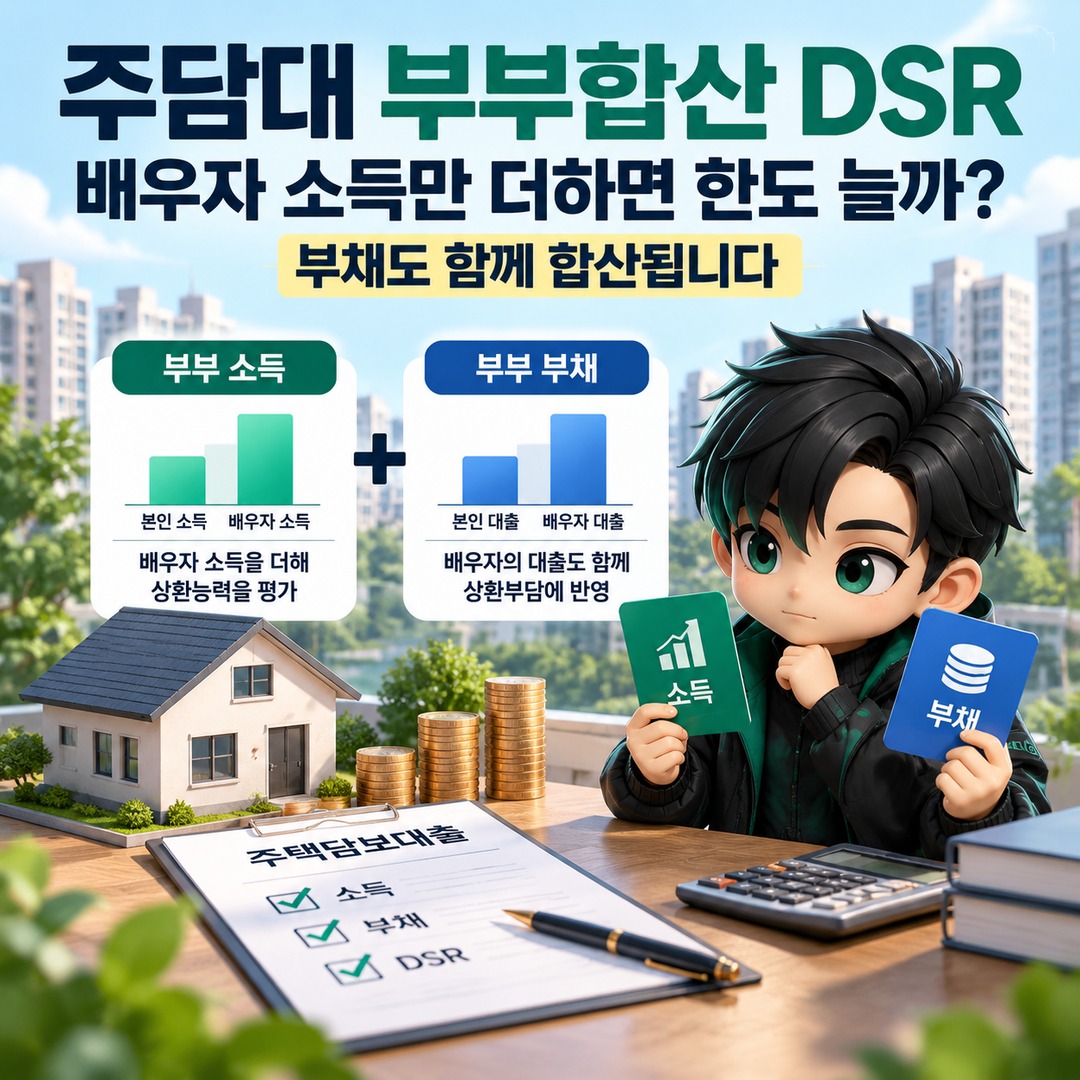
When a mortgage's debt service ratio (DSR) is assessed using a couple's combined income, the spouse's income can be included in evaluating repayment capacity. However, the calculation includes not only the spouse's income but also the repayment obligations associated with their existing loans. Therefore, having two incomes does not necessarily increase the mortgage limit in direct proportion to the additional income.

As of 2026-09-29, the key consideration is not simply the couple's combined annual salary, but how much DSR borrowing capacity remains after accounting for both spouses' recognized income and existing debts.
Combining Spousal Income for DSR Does Not Mean Adding Income Alone
DSR is the percentage of annual income used to repay the principal and interest on all financial debts due over 1 year.

The basic formula is as follows.
DSR = Annual Principal and Interest Repayments ÷ Annual Income × 100

The borrower-level DSR regulatory limit for banks is generally 40%. South Korea's Financial Services Commission has implemented regulatory improvements allowing a spouse's income and debts to be combined even when that spouse already has a mortgage. In other words, when a spouse's income is included, their repayment obligations are also considered.
For example, suppose the husband's annual income is KRW 50,000,000 and the wife's annual income is KRW 40,000,000. The difference is substantial when considering income alone.
| Assessment Basis | Recognized Income | Annual Repayment Capacity Under DSR 40% |
|---|---|---|
| Husband alone | KRW 50,000,000 | KRW 20,000,000 |
| Combined spousal income | KRW 90,000,000 | KRW 36,000,000 |
According to the author's calculations, combining the couple's income increases annual principal and interest repayment capacity by KRW 16,000,000.
However, if the wife has an unsecured personal loan, an existing mortgage, or other debts, the DSR repayment burden associated with those loans must also be considered. Therefore, it would be incorrect to assume that the entire KRW 36,000,000 shown in the table is available for a new mortgage.

How Much Does the Mortgage Limit Change With Annual Salaries of KRW 50,000,000 + KRW 40,000,000?
Under the simplified assumption that neither spouse has any other debt, the effect of combining their incomes can be illustrated numerically.
For example, assume the couple takes out a variable-rate mortgage in the Seoul metropolitan area, with an actual annual loan interest rate of 4.0%, a maturity of 30 years, a bank DSR limit of 40%, and an annual interest rate of 7.0% for DSR assessment purposes.
As of 2026, a minimum stress interest rate of 3.0% applies to mortgages in the Seoul metropolitan area and regulated regions. The stress interest rate does not mean borrowers actually pay an additional 3% percentage points on their loan interest rate. Instead, it is an assessment rate used to reflect the possibility of rising interest rates when calculating the DSR borrowing limit.
Using these assumptions and a simplified calculation based on equal monthly payments of principal and interest produces the following results.
| Scenario | Estimated Mortgage Amount Under DSR |
|---|---|
| Individual annual income of KRW 50,000,000 | Approximately KRW 250,510,000 |
| Combined annual income of KRW 90,000,000 | Approximately KRW 450,920,000 |
| Difference | Approximately KRW 200,410,000 |
Author's calculation: This simplified calculation assumes an actual interest rate of 4.0% + a stress interest rate of 3.0% = an assessment interest rate of 7.0%, equal principal and interest payments over 30 years, and no existing debt.
There is an important distinction here.
Approximately KRW 450,920,000 is not a confirmed amount that a bank will actually lend. It is an amount calculated solely under the DSR assumptions used in this example.
The actual mortgage limit may be lower because other factors also apply, including the loan-to-value ratio (LTV), property-price-based lending limits, the number of homes owned, the purpose of the loan, and the financial institution's underwriting criteria.
Existing Loans Held by a Spouse Reduce the Benefits of Combining Income
This is one of the most commonly overlooked aspects of combining spousal income.
Even if the husband's KRW 50,000,000 and the wife's KRW 40,000,000 are combined to produce recognized annual income of KRW 90,000,000, any existing loans held by the wife must be deducted from the available repayment capacity when calculating how much room remains for a new mortgage.
The Financial Services Commission's decision to require the inclusion of a spouse's existing loans when allowing spousal income to be combined was also intended to assess the couple's actual repayment capacity more accurately.
Consequently, the following two households may have different mortgage limits despite having the same combined annual income.
Household A
Husband's annual income: KRW 50,000,000
Wife's annual income: KRW 40,000,000
Neither spouse has existing loans
Household B
Husband's annual income: KRW 50,000,000
Wife's annual income: KRW 40,000,000
Wife has an unsecured personal loan, auto financing, or other debts
Both households have combined annual income of KRW 90,000,000, but in Household B, principal and interest repayments on existing debts consume part of the available DSR capacity first.
Therefore, calculating the mortgage limit on the assumption that 'my spouse earns KRW 40,000,000 annually, so our borrowing limit will increase substantially' may produce results that differ from the bank's actual assessment.
Must a Home Be Jointly Owned to Combine Spousal Income?
Joint Ownership of a Home and the Inclusion of Spousal Income in DSR Calculations Should Not Be Treated as the Same Issue.
DSR does not assess only ownership shares in a property. It evaluates the income and debts of the people responsible for repaying a loan. Under the Financial Services Commission's framework, spouses' income and debts may be combined when evaluating repayment capacity.
However, during the actual lending process, the method used to recognize a spouse's income, how the spouse must participate in the loan arrangement, and the required documentation may differ depending on the financial institution and loan product.
Therefore, before deciding how to register ownership of the property, it is more accurate to ask the prospective lender the following question.
“I would like my mortgage DSR assessed using our combined spousal income. How will my spouse's existing debts be reflected, and in what capacity must my spouse participate in the loan?”
Asking this specific question makes it easier to estimate the actual borrowing limit than simply asking, “Can we combine our incomes?”
In 2026, Stress DSR Must Also Be Calculated After Combining Income
The calculation does not end once the spouse's income has been included.
As of 2026-09-29, stress DSR affects actual borrowing limits depending on factors such as the loan's location and interest rate structure.
In particular, the minimum stress interest rate for mortgages in the Seoul metropolitan area and regulated regions has been strengthened to 3.0%. For mortgages in other regions, the relaxed application method remains in effect until 2026-12-31, with a stress interest rate of 0.75% currently applied to mortgages in those areas.
Therefore, when comparing mortgage limits based on combined spousal income, it is useful to follow this sequence.
1. Confirm the eligible annual income recognized for both spouses.
2. Identify all existing loans held by both spouses.
3. Calculate DSR repayment capacity based on combined spousal income.
4. Apply the stress interest rate appropriate to the mortgage's interest rate structure.
5. Check separate regulations, including LTV and property-price-based lending limits.
6. Finally, confirm the actual recognized income and estimated borrowing limit with the financial institution.
Especially when purchasing a home in the Seoul metropolitan area or a regulated region, buyers should not determine their affordable purchase price solely from a DSR calculation. Mortgage limits based on property prices and LTV restrictions may impose a lower ceiling before DSR becomes the deciding factor.
Dual-Income Couples Should Also Consider Which Spouse Should Be the Borrower
For dual-income couples, choosing the spouse with the higher annual salary as the borrower is not necessarily the end of the decision-making process.
Even if one spouse earns more, their available DSR capacity may be smaller than expected if they hold substantial existing debts, such as unsecured personal loans or revolving credit lines. Conversely, if the repayment burden from a spouse's existing debts is large relative to the additional income recognized, combining incomes may not increase the borrowing limit as much as anticipated.
Ultimately, the comparison should focus on three factors rather than a single gross annual salary figure.
Recognized Income + DSR Burden From Existing Debts + Stress Interest Rate Applied to the New Mortgage
Combining spousal income for DSR purposes has the advantage of allowing dual-income households to receive greater recognition for their combined earnings. However, the essential point is that the spouse's debts are also included in the assessment.
Rather than signing a property purchase agreement first, it is safer to obtain estimated borrowing limits from financial institutions under both individual and combined-spousal-income assessments and compare the results. The actual approved amount may vary depending on the financial institution, loan product, income documentation, and each borrower's debt profile.
※ This article is provided for reference to help readers understand market conditions and does not constitute an investment recommendation regarding any particular security or asset. Final decisions and investment responsibilities rest with the individual.